Woman charged after allegedly breaking into residence, pepper-spraying victim

Ryan Shiner

COLUMBIA, Mo. (KMIZ)

A woman was charged with multiple felonies after she and other suspects allegedly broke into a residence on Whitegate Drive on Wednesday and pepper-sprayed a victim.

La’Jaya Robinson, 20, was charged with first-degree burglary, second-degree robbery, second-degree assault and third-degree assault. She is being held at the Boone County Jail without bond. A court date has not been scheduled.

The probable cause statement says police were called on Wednesday to Columbia Crossing Apartments and found a woman who was hit with pepper spray. The victim identified Robinson and claimed that she and three other people were in her apartment, hit her with pepper spray, assaulted her and took her iPhone. The other suspects were not named in the probable cause statement.

Police recognized Robinson’s name and went to her residence on Claudell Lane and a standoff ensued. Robinson’s mother allegedly tried to ask police to leave during the encounter, the statement says.

Robinson eventually walked out of the residence and admitted to entering the victim’s residence through a back door that was unlocked, court documents say. She also admitted that the victim was pepper-sprayed and assaulted, the statement says. She allegedly went to the victim’s residence “about a past altercation,” court documents say.

Click here to follow the original article.

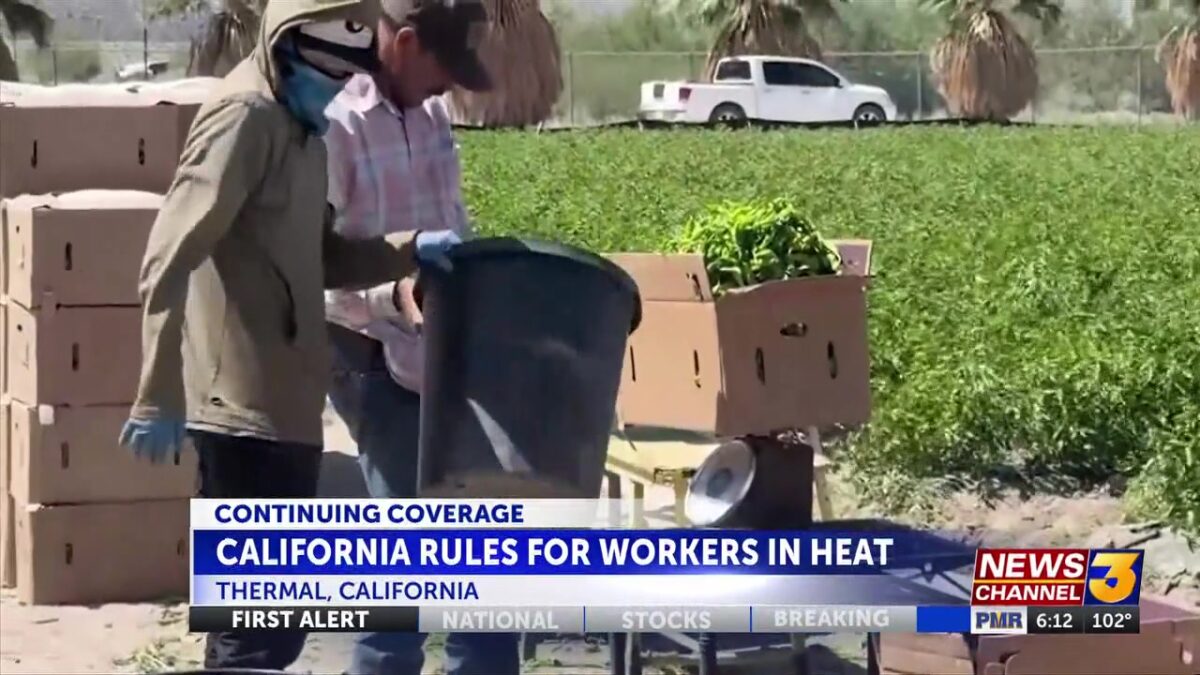
California rules for workers in heat

Kiera McKinney

PALM DESERT, Calif. (KESQ)- Employers in the valley must provide fresh water, shade, and rest breaks during extreme heat. The law in California requires employers to put shade in place when temperatures pass 80°F. Workers can request rest breaks in the shade at any time to cool down.

Employers must check workers for signs of sickness. They must also ensure regular and mandatory rest breaks.

Heat Requirement Rules: When temperatures reach extreme heat

Breaks: Workers have a right to a minute cool down break in the shade anytime they feel they need it

Water: Employers must provide enough fresh, cool water so each worker can drink at least one quart per hour

Shade: Shaded areas must be put up when temperatures exceed and be large enough to comfortably fit all resting workers

Stay tuned for my full story at 5 to see what what employers are doing to protect their workers during the extreme heat.

Click here to follow the original article.

Palm Springs Police Chief Andy Mills announces retirement after 48-year law enforcement career

Tommy Gallegos

PALM SPRINGS, Calif. — Palm Springs Police Chief Andy Mills has announced he will retire on September 5, bringing to a close a 48-year career in law enforcement, including nearly five years leading the Palm Springs Police Department.

“I notified the city manager and the city council earlier this week that the time had come after, 48 years of policing, 13 as a chief, to hang up my gun belt and move on to something else like maybe playing pickleball every day,” Mills told News Channel 3.

Mills shared the news Thursday in a social media message addressed to the Palm Springs community, friends and family.

“Palm Springs is the crown jewel of an amazing career,” Mills wrote.

Chief Mills became Palm Springs Police Chief in October 2021, succeeding former Chief Bryan Reyes. During his tenure, he emphasized community policing, public safety, officer wellness and strengthening relationships between the department and the community.

In his retirement announcement, Mills expressed deep appreciation for the city and the officers he has led throughout his career. “I cannot adequately express what an honor it has been to lead the men and women of policing and serve this amazing community,” he wrote.

Mills also recognized his wife, Cathy, for her support throughout his career. “Cathy has been my partner through each struggle, crisis and victory,” he said. “She retires too.”

The couple plans to relocate to the Sacramento area to be closer to Mills’ mother and provide support for her.

Mills also expressed confidence in the future of the Palm Springs Police Department, saying the agency is well-positioned for the transition.

“The department is ready to move forward with the mission,” he said. “They are committed to supporting and serving a wonderful community that cares about people, supports one another and wants great public safety. The team is 100% ready.”

Mills served notably as chief during the bombing of the American Reproductive Center in Palm Springs, leading first responders in the community. Mills also pushed for reforms within the department following a motorcycle accident at the Palm Springs Christmas parade back in December of 2024.

Mills had announced he was taking steps to walk-away from his role as Chief back in March. Today, he confirms his final day as Palm Springs Police Chief is scheduled for September 5.

“Serving you has been an honor and a privilege,” Mills concluded.

Click here to follow the original article.

Cyclosporiasis cases nearly double in Missouri; Boone County up to 13 cases

Marie Moyer

COLUMBIA, Mo. (KMIZ)

In about a week, the Missouri Department of Health and Senior Services has reported that cases of cyclosporiasis in Missouri has nearly doubled from 43 to 80.

“There are more cases across the country than we usually see in an entire year,” DHSS said in a Facebook Post Thursday.

The Columbia/Boone County Department of Public Health also stated on Thursday that cases in the county have risen from 9 cases on Wednesday to 13 on Thursday.

“The current indication is that these cases were acquired locally; however, further analysis will be required,” PHHS spokesman Austin Krohn said in a statement on Thursday.

John Macon, the owner of Smash and Dash Grill, reported that sales were down by around 50% Thursday. He adds the food truck is also temporarily removing lettuce from its burgers.

 “Everybody that’s come up has said ‘no lettuce on our sandwich.'” Macon said. “In fact, we added a sign that said we don’t have lettuce simply because everybody was coming up and saying, ‘no, lettuce on our sandwich.'”

According to DHSS, the Cyclospora parasite is spread through human waste.

“In the United States, we have very robust water treatment facilities; it would be unusual for raw sewage to make its way into say like a farm or an irrigation system,” DHSS epidemiologist Nathan Koffarnus said. “In some less developed countries, that is unfortunately much more common.”

Macon adds that while his products are at low risk, it’s better to be safe than sorry.

“While we wash all of our produce, we prep all of our produce, we get it local, much lower risk, we care about the customers enough, and that’s our that’s why we’re here, is because of the customers,” Macon said.

Cyclosporiasis is believed to be contracted through eating produce or water contaminated by the Cyclospora parasite. Health officials say symptoms usually begin about a week after exposure and can include frequent diarrhea, dehydration from diarrhea, weight loss, bloating, nausea and fatigue. Less common symptoms include vomiting and a low-grade fever.

DHSS reports cyclosporiasis cases typically rise during the summer, but Missouri usually sees only about 15 around this time of year. The department also suspects that the attention to the parasite has increased the number of reports made.

Boone Health reported Wednesday that five people have been hospitalized due to the illness.

The Cole County Health Department wrote in a Thursday statement that it was not releasing its numbers just yet because “When case numbers are very small, releasing additional information may increase the risk of identifying an individual. Protecting patient confidentiality remains our priority, and we do not release information that could compromise an individual’s privacy.”

While some people have been seen online using vinegar to clean produce, health experts say the best way to kill the parasite is to cook produce at 158 degrees. It is also recommended to thoroughly wash all fruits and vegetables, both local and imported, before eating

Krohn added that buying local could help reduce the risk, but still encourages produce to be washed.

Click here to follow the original article.

Dog who survived abuse now a therapy animal at El Paso DA’s office

Lauren Bly

EL PASO, Texas (KVIA) — A dog named Buddy has an important job at the El Paso District Attorney’s Office.

The small therapy dog works as a victim assistance companion alongside his handler, Lorena Garcia, helping crime victims through some of the hardest moments of their lives.

“A lot of times victims come for trials here in our office with the attorneys,” Garcia said. “And I take Buddy in the room, and immediately you can see a smile.”

Garcia said Buddy’s presence helps ease tension for victims meeting with prosecutors.

“Even though they’re going through such a hard time coming here and talking to the prosecutors, as soon as they see Buddy walking in, you can see a smile,” she said. “They start playing with him and interacting with him.”

Buddy has his own work station at the office and regularly visits attorneys, paralegals and staff throughout the building.

“He’s so loved,” Garcia said. “We tour the whole second floor. I think Buddy’s providing more emotional support to all of you.”

Buddy also served during emotional victim impact statements connected to the Aug. 3 mass shooting in El Paso.

“That was hard,” Garcia said. “He was in that courtroom many, many hours. By himself, he was getting close to the people that he felt needed him.”

Garcia said Buddy is uniquely suited for the role because he was once the victim of abuse himself.

“Him being a victim of abuse and then becoming a comfort dog, a therapy dog for victims of crime — I think that’s really awesome,” she said.

Garcia first saw Buddy on television in 2020.

“We saw a picture of him hanging from an iron with a very short leash on top of a box,” she said.

El Paso Animal Services rescued Buddy and partnered with local nonprofit Laws N Paws to help rehabilitate him.

“When Buddy was taken in, he was hospitalized for an extensive amount of time,” Laws N Paws volunteer Jasmine Gallardo said. “He was able to receive procedures and any type of treatment needed for him to heal.”

Gallardo said Buddy’s case began as neglect and escalated into abuse.

“At some point he was out there for such an extensive amount of time that the owner should have realized what was happening,” she said. “The owner was choosing to ignore it, which is where they were charged with animal abuse.”

Court records show Buddy’s former owner, Lupe Amalia Rodriguez, was charged with cruelty to non-livestock animals. She was ordered to pay fines and served several days in jail.

Garcia later delivered Buddy’s victim impact statement in court.

“I stood and I spoke on his behalf,” she said. “From being abused by her at her house, now Buddy is a therapy dog at the district attorney’s office.”

After completing rehabilitation through Laws N Paws, Buddy was recommended for therapy dog training after the DA’s office reached out looking for a therapy animal.

“It was because of his demeanor and also his size,” Gallardo said. “He is a smaller guy.”

Buddy passed his therapy dog exams and was officially sworn in at the DA’s office, with Garcia volunteering to become his handler.

“I feel very honored and very happy to be here,” Garcia said. “I guess it was meant to be.”

Garcia said Buddy still struggles with some trauma.

“He hears loud noises, he gets scared, and I just calm him down,” she said.

But despite that, Buddy has become a success story.

“He’s totally a success story,” Garcia said.

Click here to follow the original article.

Mexico, Texas, New Mexico authorities analyze New World screwworm impact on cattle trade

Heriberto Perez Lara

SANTA TERESA, N.M. (KVIA) — Agriculture officials, international trade representatives and other leaders from Chihuahua, Mexico, Texas and New Mexico met in Santa Teresa Thursday to discuss challenges the cross-border cattle trade is facing with New World screwworm in the region.

It’s been nearly two years since the U.S.-Mexico border has been closed to live cattle and livestock imports into the U.S. due to the spread of the New World Screwworm and this has halted and crippled all cattle business in the area.

Experts say this has also disrupted the supply chain, as local businesses have been facing inventory shortages while Mexico also works to stop the spread of the parasite.

U.S. Agriculture Secretary Brooke Rollins made the order and she has also announced a phased, risk-based reopening of ports for cattle, bison and horses to resume trade soon.

The New Mexico Border Authority (NMBA) hosted the NW Screwworm summit in Santa Teresa today, where local leadership from El Paso, Juárez, New Mexico and even from the cattle and livestock business from both sides of the border agreed to take further steps and find solutions for this problem in the region.

“There are two issues, one is the reopening of the border that obviously has to be dealt with between both federal governments, but also dealing with the flies at the local level and that’s the other part,” said Gerardo Fierro, Executive Director of the New Mexico Department of Agriculture. “For the reopening of the border, it has to be between USDA and Senasica (Servicio Nacional de Sanidad, Inocuidad y Calidad Agroalimentaria) and then how the states, the livestock ports can also help meet those requirements, those protocols, so that cattle from Mexico crosses into the U.S. again.”

Texas Agriculture Commissioner Sid Miller said they want to use the Screwworm Adult Suppression System (SWASS), a USDA-developed toxic bait designed to reduce wild New World screwworm populations quickly. It works by using a synthetic attractant (Swormlure) to draw in adult flies, combined with a feeding bait and insecticide to kill them before they can lay eggs in any animal wounds.

According to the Texas Agriculture Commission, this is how SWASS could fight the outbreak:

Integrated strategy: Texas Agriculture Commissioner Sid Miller and livestock advocates are urgently lobbying the USDA to pair SWASS with the existing Sterile Insect Technique (SIT).

Immediate Knockdown: SWASS can eliminate up to 85% to 95% of adult wild flies in targeted areas within weeks.

There’s also a problem with SIT Alone: while the USDA is dropping millions of sterile flies to stop the parasite from breeding, scaling up production can take months to years. Commissioner Miller argues SWASS is needed to immediately knock down the population while sterile flies complete the eradication process.

“We should be deploying the SWASS system, the fly bait first and then following up with the sterile flies,” said Commissioner Miller. “I think everyone here today learned something. I know I did and about the fly bait, we did discuss it is very cheap compared to producing 500 million flies a week, that takes a billion dollar facility.”

“We are in an education listening mode today, especially the City of El Paso, where we have to make sure that we are in communication with our partners in Juárez and as well as the County of El Paso, to make sure that we are prepared, as County Judge Samaniego said, to have a strategy in place to handle this situation if it does continue to move our direction; hopefully doesn’t conitnue to do that,” said El Paso Mayor Renard Johnson. “The New World Screwworm situation has crippled our cattle industry here in the border region.”

“For us, this relationship is so important that we are the ones convening this meeting, precisely to take proactive measures. In our municipal government activities, we have sought to focus on prevention before any situation arises that might cause alarm,” said Juárez Mayor Héctor Ortíz Orpinel. “The communication we maintain, the ability to create the necessary conditions to have the right tools in the event of a contingency, and the ongoing dialogue among various parties on both sides of the border, I believe, all of this will greatly help us prepare.”

“Naturally, we are also in communication with the Mexican federal government, whose support we always deeply appreciate, seeking not merely a standard Mexican government-to- US government interaction, but rather ensuring they understand the situation as we are experiencing it here in Juárez and, of course, in the other cities,” Mayor Ortíz Orpinel added.

All government and nongovernment participants signed a memorandum of understanding saying they will:

Protect animal health and strengthen agricultural economies.

Improve surveillance, early detection, and rapid information sharing.

Coordinate prevention, containment, and eradication efforts.

Support science-based innovation and proven technologies.

Promote secure and resilient cross-border agricultural commerce.

Encourage continued partnership among governments, producers, veterinarians, researchers and industry.

They also committed to:

Establish ongoing technical cooperation.

Maintain regular communication and coordination.

Convene future binational meetings to review progress and emerging risks.

Develop recommendations that strengthen regional preparedness and response.

Work together to protect agriculture, animal health and the future of the U.S.-Mexico border region.

More meetings are set to be held soon.

Click here to follow the original article.

Missing person: Ramsey McNeal

Skylar Heisey

UPDATE (2:56 PM): The Yuma County Sheriff’s Office says Ramsey McNeal was found dead, and next of kin was notified.

He was 55-years-old.

2026-55-Missing-Person-Mcneal-Ramsay-UpdateDownload

YUMA COUNTY, Ariz. (KYMA) – The Yuma County Sheriff’s Office (YCSO) is asking the public’s help in locating a missing person.

YCSO says 55-year-old Ramsey McNeal of San Diego was last seen Tuesday, at around 7 p.m., near the boat ramp at Mittry Lake.

McNeal, according to YCSO, left the area on foot, leaving his phone, medications and personal belongings behind, and he may be suffering from a mental health condition.

YCSO describes McNeal as an African American, around six-foot, one-inch tall, weighing 250 pounds, and has brown hair and brown eyes.

He was last seen wearing brown camouflaged pants, a long white sleeve shirt and water shoes.

If anyone has information regarding McNeal’s whereabouts, call YCSO at 928-783-4427, 78-CRIME to remain anonymous, or visit YCSO’s website to submit an anonymous tip.

PR-2026-Missing-Person-Mcneal-RamsayDownload

Click here to follow the original article.

This group home made 600+ missing child reports in four years

By Melissa Blasius

Click here for updates on this story

    PHOENIX (KNXV) — Xion Ervin-Jenkins’ bedroom is waiting for a boy who will never come home again.

His mom, Stephanie Combs, keeps the room just as he left it: drawers half-open, running shoes on the floor.

Combs says a juvenile judge ordered Xion, who was 15 years old, to attend a residential treatment program in spring 2025.

“I was under the impression that he was going to be safe,” Combs said.

He arrived at Canyon State Academy in Queen Creek on May 21, 2025, after a wildfire forced evacuations at a different facility. He disappeared a few days later.

After six weeks, on July 4, 2025, Phoenix police arrived on Combs’ doorstep.

“They came to the house to let us know that he had been found deceased,” Combs said.

Combs will never know why her son decided to run away.

“I don’t wish that type of pain on anyone,” Combs said.

Canyon State Academy for boys and Desert Lily Academy for girls are side-by-side campuses in Queen Creek.

Arizona’s foster care system and the juvenile courts keep sending kids here, but the tall walls don’t keep them all safe inside.

ABC15 reviewed call-for-service records from the Queen Creek Police Department between January 2022 and September 2025. In all, the campuses made more than 600 missing person calls to police in less than four years.

“We don’t need any more kids going missing or dying,” said Leila Woodard, founder of the Arizona Missing Child Taskforce.

Through her organization, Woodard makes runaway prevention presentations, assists families of missing children, and raises community awareness. She also keeps tabs on how many kids go missing from group homes, including Canyon State and Desert Lily.

“They’re going missing at rapid amounts, like, more than anywhere, any other home in the state,” Woodard said.

A spokesperson for the academies says they serve about 600 youth a year. Combined, they are the largest group home facility licensed by the Arizona Department of Child Safety.

Most of the kids on campus are teens who were sent by DCS caseworkers or the juvenile court system – after prior placements didn’t work out. They are provided housing, therapy, schooling, job training, sports, and other activities like horseback riding.

“People are like, well, what’s happening there?” said Queen Creek Police Chief Randy Brice. “These kids are at risk already, so when they leave the facility, that’s a high concern for us.”

Representatives from Canyon State and Desert Lily declined on-camera interviews. In a statement, a spokesperson wrote, “We report to the QCPD proactively because speed matters and child safety comes first. That practice can inflate the number of reports, but it reflects our commitment to safety, not a failure to care.”

DCS also replied with requests for comment by providing a statement, which said, “Call-for-service data does not necessarily indicate wrongdoing by the facility or staff. Many reported incidents reflect the significant behavioral and emotional challenges presented by the population the facility serves.”

“I’m very confident that they have a great mission, but I’m going to continue to hold them accountable,” Brice said. “I’m going to make sure that these kids are as safe as I can possibly make that.”

DCS rules prevent group homes from locking youth in or preventing a safe exit.

Brice said there are still ways to improve security, including expanding camera coverage and better tracking kids as they move from place to place.

Brice says he’s also worked to speed up response times to missing child calls.

“As soon as a call comes out there, the drone is en route. We have cameras all around the facility on our street cameras,” Brice said. “We’re seeing about 90% of the runaways — we’re catching within minutes to maybe an hour or two.”

Queen Creek police officials say these efforts are making a difference, and they’ve seen missing child calls from the facilities trending down.

According to the academy’s spokesperson, many of their missing child reports involve repeat episodes, brief absences, children located quickly, reports tied to home passes, appointments, or on-campus outings.

Most youth are located safely, but two remain missing as of Wednesday, July 15, 2026. They are Abrianna Madrid, 15, and Aiden Searcy, 16.

“They’re so vulnerable to things like trafficking or exploitation,” Woodard said. She added that reducing the number of missing children from such a large facility would have a significant impact.

Overall, Woodard said better conditions and more services for kids living in Arizona group homes could dissuade more kids from leaving. She has also lobbied for more resources to locate missing foster kids after high-profile deaths. These include the murders of Emily Pike and Zariah Dodd in 2025 after they ran away from different group homes in the Valley.

Xion turned 16 during the weeks he was missing. He died on a concrete bench in Phoenix, about a mile from his mom’s home. The day before he was found, the temperature hit 115º. The medical examiner determined it was a heat death.

Canyon State Academy’s spokesperson described Xion’s death as tragic, adding in a statement that “we immediately reported his absence to law enforcement and fully cooperated with their investigation.”

But an academy spokesman also wrote that Xion “was never a student of Canyon State” as “he was evacuated from another state-licensed open campus.”

ABC15 learned the evacuated campus is also managed by Rite of Passage, the same company that runs Canyon State and Desert Lily.

The one-year anniversary of Xion’s death just passed, and Combs said she is taking it “one day at a time.”

“Sometimes, I sit out in the backyard at night – and recently we’ve had a couple of full moons – and I see a big X in the sky. That’s my boy showing up,” Combs said.

Additional statement from Canyon State and Desert Lily Academies:

“Many youth in our care have experienced trauma, instability, exploitation, behavioral health challenges, and, in some cases, runaway episodes. For more than 25 years, we have provided a safe, normalized environment where children attend school, receive therapy, play sports, join clubs and vocational or equine programs, build trust with caring adults, and begin to see a different future.

The academies are licensed, regulated, and Qualified Residential Treatment Programs in good standing. By state design, they are not locked facilities. Youth who leave voluntarily are immediately reported.    

We are proud of our community partners, therapists, teachers, nurses, direct-care staff, and other professionals who do difficult work every day with children who deserve dignity, compassion, and a chance to heal.”

Please note: This story was provided to CNN Wire by an affiliate and does not contain original CNN reporting. This content carries a strict local market embargo. If you share the same market as the contributor of this article, you may not use it on any platform.


Bend seeks community members for Police Chief’s Advisory Council

Adrielle Hasara

Bend, ORE. (KTVZ) — The Bend Police Department is seeking applications from community members to serve on its Police Chief’s Advisory Council. Applications for the council must be submitted by 5 p.m. on Wednesday, July 29.

The Police Chief’s Advisory Council, which was rebooted in 2022, aims to build and maintain trust between the Bend community and the Police Department. The council is designed to include as many as 20 community members, reflecting the diverse life experiences within Bend.

The Police Chief’s Advisory Council fulfills three critical missions for the department. It advises the Chief of Police and the Police Department on various issues from the community’s perspective. The council also acts as a communication channel between community networks and law enforcement. Additionally, it works to enhance trust between residents and the law enforcement agencies that serve them.

Members of the council will serve two-year terms. While the Chief of Police has the discretion to reappoint members for additional terms, members generally do not serve more than one single two-year term. The Chief of Police will select members based on their integrity, commitment to the community and demonstrated ability to act as a communication channel to community networks.

Meetings for the council will typically be held one evening per month, primarily on the fourth Wednesday. These meetings are expected to run for 90 minutes to 2 hours and regular attendance is required. In addition to meetings, members are expected to attend the Community Academy and participate in at least one ride-along with a police officer.

Community members interested in serving on the Police Chief’s Advisory Council must submit their applications by 5 p.m. on Wednesday, July 29. More information about the council is available on the Bend Police Department website.

Click here to follow the original article.

Missouri Task Force 1 to deploy to Texas for flood response

Ryan Shiner

COLUMBIA, Mo. (KMIZ)

Missouri Task Force 1 has been activated by FEMA to deploy to San Antonio, Texas, to assist with a flood response, a Thursday press release from the Boone County Fire Protection District says.

The release says 45 members of TF-1 and more than 100,000 pounds of equipment will be sent.

TF-1 was deployed earlier this week to Sikeston for flooding in Missouri.

A date for which TF-1 will be sent to Texas was not listed in the release.

Check back for updates.

Click here to follow the original article.