CPD considering new drone program if proposed public safety sales tax is approved

COLUMBIA, Mo. (KMIZ)
The Columbia Police and Fire departments held their final scheduled Public Safety Sales Tax meeting Friday, making one last push to convince voters to approve a 1% public safety sales tax during the Aug. 4 election.
The meeting at Daniel Boone Regional Library marked the sixth and final public session held across Columbia’s wards between July 9 and 17, as city officials continued efforts to educate voters about the proposed tax.
If approved, the additional 1% sales tax is expected to generate an estimated $38 million annually, with the revenue dedicated exclusively to the Columbia Police and Fire departments. City officials estimate about one-third of that funding would come from sales made in the downtown area.
CPD says it plans to use the extra funding to help hire an additional 50 police officers, build a new headquarters and modernize its public safety tools.
The push to upgrade the department’s technology is designed to help bring new tools to officers in the field. On Friday, CPD officials said they are considering updated body-worn cameras that could reduce reliance on written reports, along with translation technology already used by larger cities to help officers communicate more effectively with residents who speak different languages.
This comes after Columbia Police Chief Jill Schlude told ABC 17 News in May that technology investments the department has already made, including Flock cameras, have helped improve the department’s clearance rate.
“I don’t think the leveraging of the technology can be understated. The expansion we’ve done with everything from the body-worn camera program to in-car cameras to the Flock system has just really increased our I think, our efficiency and our accuracy in our investigations,” Schulde said. “The folks that are boots on the ground doing the work tend to have the best ideas about what they need and what the scope is of what they need. And so we would definitely have that conversation as a department again.”
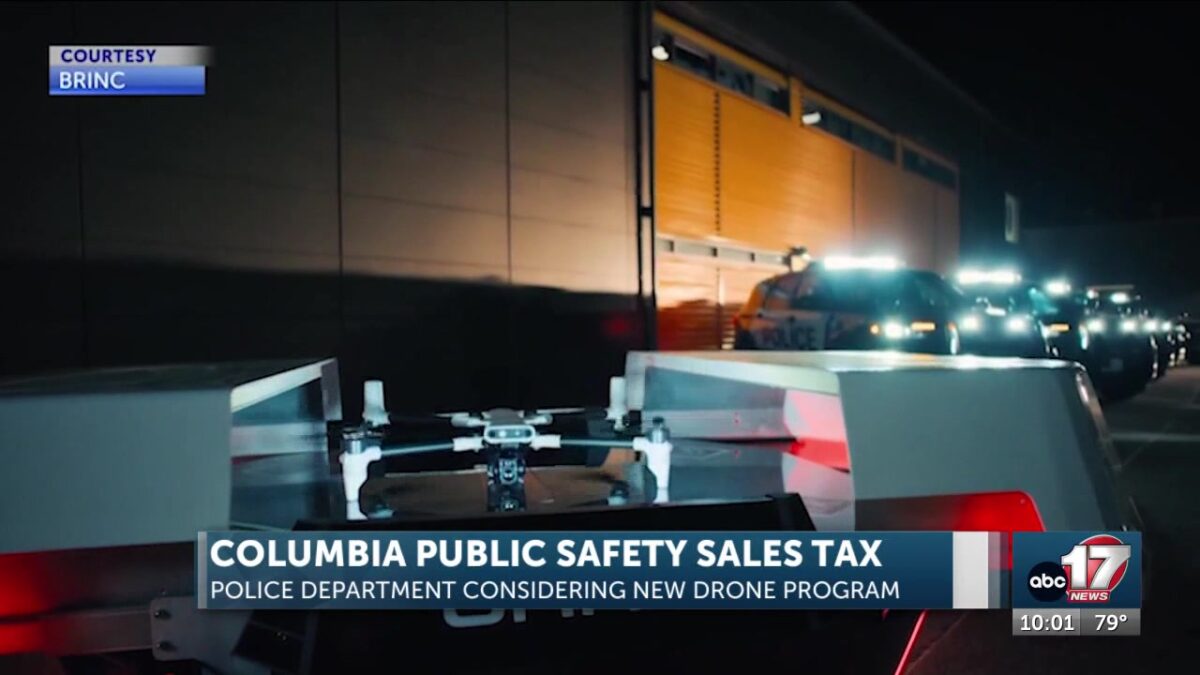
If the sales tax is approved, Schlude said another tool the department is exploring is the use of first responder drones.
“That’s something we’re definitely interested in here. The officer safety aspect of that is very compelling, as well as getting eyes up early to see whether or not someone really has a gun or do they have a stick or a cell phone. I mean, all those things are really helpful to officers responding to a call,” Schlude told ABC 17 News in May.
Police and fire agencies across the United States are rapidly adopting “drone as first responder” programs, with dozens of departments now launching drones to 911 calls before officers arrive.
The small unmanned aircraft are equipped with zoom and thermal cameras, lights and real-time communications that launch from stations or rooftop docks to stream live video to dispatchers within minutes of a call.
Seth Fallik, chair of the University of Missouri-Kansas City’s Department of Criminology, said while drones may not solve every crime, they can provide valuable information during active situations.
“These are traditional drones as we know them, but they have the ability to, in the first responder program, get to the scene earlier. Now, there’s a bit of a background here. We know that most crimes won’t be solved if law enforcement response time was even zero. But that doesn’t mean that we still can’t glean something from responding to traffic or other types of incidents that are ongoing,” Fallik told ABC 17 News.
The concept grew out of public safety drone use that began in the early 2010s, but formal Drone as First Responder programs took off in the late 2010s and early 2020s and have since spread to cities in Missouri, including Blue Springs, St. Charles County and O’Fallon, with St. Louis police also pursuing a citywide program.
Fallik says the Kansas City Police Department has already seen early returns in helping improve officer safety.
“I think they’re big fans of it in terms of the officer safety component. It basically just provides an understanding of the landscape prior to arrival, which offers this sort of big question for law enforcement in their responses. I think we’re still early on in terms of how it could be used for a whole host of things,” Fallik said. “Think about large events. We just hosted the World Cup here. Being able to have drones in the sky can help with crowd control as well.”
While the concept of using the first responder drones is still relatively new, Fallik believes it will continue expanding in larger communities.
“I think it’s an adapt-or-die situation for folks that are in urban spaces. But if you’re policing in rural America, which is the bulk of law enforcement agencies, it’s not necessarily something that you’ve got, one, the resources to support or the crime to sort of respond to it. So I think certainly our larger cities are going to have to move into these spaces,” Fallik said.
Columbia falls into the category of communities where officials believe additional technology could help keep up with growth. Since 2000, the city has added roughly 49,000 residents and more than 15 square miles of land, increasing the area officers are responsible for covering. As the city continues to grow, so has the demand for emergency responses.
However, Fallik said departments need to make sure residents are part of the conversation before implementing technology that increases surveillance. CPD faced some pushback when it first introduced Flock cameras, with some residents arguing that the technology could compromise privacy. Fallik said those concerns highlight why departments need community support before adopting new tools.
“I always sort of caution anytime you’re putting up a camera or you’re sort of providing some sort of surveillance, you get the approval of the community before you do that,” Fallik said. “You want it to be a welcome technology as opposed to one that’s being imposed. I think, for what it’s worth, these are often reactive as opposed to proactive. So people are calling 911 and asking for law enforcement assistance. This is a tool at their disposal.”
Click here to follow the original article.