9 cases of cyclosporiasis reported in Boone County this week; Boone Health reports 5 hospitalizations

Ryan Shiner
COLUMBIA, Mo. (KMIZ)
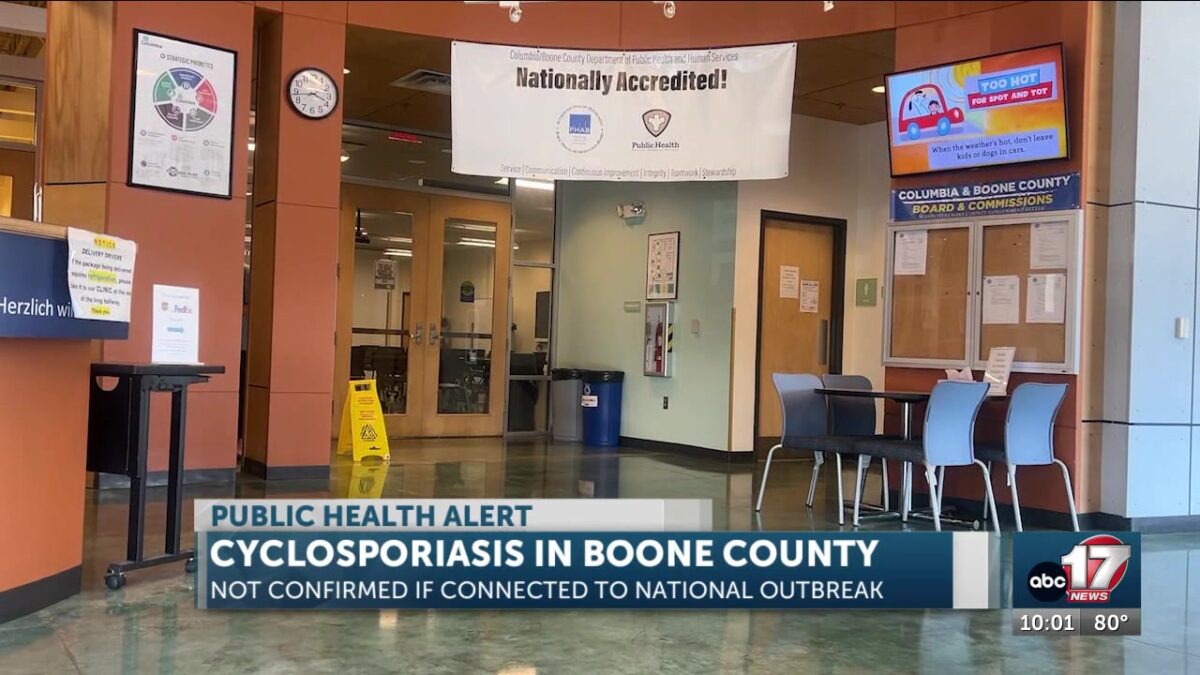
Nine cases of cyclosporiasis have been reported in Boone County this week, according to Columbia/Boone County Public Health and Human Services, with health officials investigating whether the cases are connected to a larger national outbreak.
The PHHS initially reported eight confirmed cases earlier in the day, but an additional case was confirmed Tuesday at 4 p.m. to ABC 17 News.
Boone Health spokesperson Christian Basi told ABC 17 News that five people have been hospitalized because of the parasite. Four of those patients are Boone County residents. A University Hospital spokesperson also confirmed the hospital has treated patients in its emergency department.
State health officials said earlier this week that the diarrhea-causing illness – which is contracted by eating contaminated produce or water – reported in Missouri were believed to be connected with travel.
However, Austin Krohn with the PHHS said the cases in Boone County are suspected to have been contracted locally, though officials have not identified a specific source.
“This is a parasite that is fecal to oral. So it has to be ingested. It cannot be passed person-to-person necessarily,” Krohn said. “We suspect produce of some kind. We don’t know if it’s lettuce, berries, I mean what have you at this point for these cases specifically. I know there’s some talk about Taco Bell and things pulling things from their menu, but as of right now, we don’t want to hone in on a source until we get some more concrete evidence.”
Cyclosporiasis is caused by the Cyclospora parasite and is typically spread by consuming contaminated food or water. Health officials say symptoms usually begin about a week after exposure and can include frequent diarrhea, dehydration from diarrhea, weight loss, bloating, nausea and fatigue. Less common symptoms include vomiting and a low-grade fever.
Krohn said the current cases appear different from earlier cases reported in the state.
“It’s endemic to Mexico and South America, and we’re actually in peak season for it to kind of spread around right now,” Krohn said. “But we are seeing more of a national outbreak in it due to foodborne illnesses and things that are food-based consumption that are not related to travel. That’s the big thing, it’s being acquired at a more local level.”
Earlier this week, PHHS told ABC 17 News there were four cyclosporiasis cases reported in Boone County in 2026. Krohn said those cases were related to travel and were not connected to the current outbreak investigation.
The Boone County Health Department added that “local transmission” does not necessarily mean the source is a Boone County farm or producer.
“When I say ‘local,’ I don’t mean like a local farm or anything like that. It could be food that’s being trucked into a grocery store and being consumed,” Krohn said. “Earlier this year we had a few cases that were travel-related and unrelated to this current national outbreak we’re seeing. But these ones are suspected to be that.”
The PHHS says it is working with the Missouri Department of Health and Senior Services to determine whether the increase in cases is connected to the national outbreak. Krohn said health officials had been monitoring increases in other parts of the country before cases appeared in Missouri.
“We were monitoring the situation. We were seeing the uptick in cases kind of a lot in the either northern Midwest and kind of more toward the East Coast,” Krohn said. “We didn’t have any cases in Missouri yet. As of yesterday, we had eight confirmed cases.”
The most cases reported in Boone County in the past five years was 10 in 2023, according to previous reporting.
Health officials say people can reduce their risk of exposure by following food safety practices.
“We recommend following food safety practices so thoroughly washing your food under running water will help. Washing and sanitizing commonly used surfaces such as kitchen countertops, cutting boards, utensils and washing them,” Krohn said. “If you’re using the same utensil between different food items, washing them between food items to prevent that additional spread, and also cooking your food thoroughly will eliminate the parasite.”
PHHS also recommends washing produce before eating it, even if the product is labeled as pre-washed.