Researchers search for lost Revolutionary War burial ground in New Albany

By Joyce Ogirri
Click here for updates on this story
NEW ALBANY, Ind. (WLKY) — What appears to be an ordinary neighborhood in east New Albany could be hiding an important piece of American history.
“Our goal is to see what’s here, map it. This is a level of verification that finally we get—not just old maps and old deeds,” said project researcher Nathan Allen.
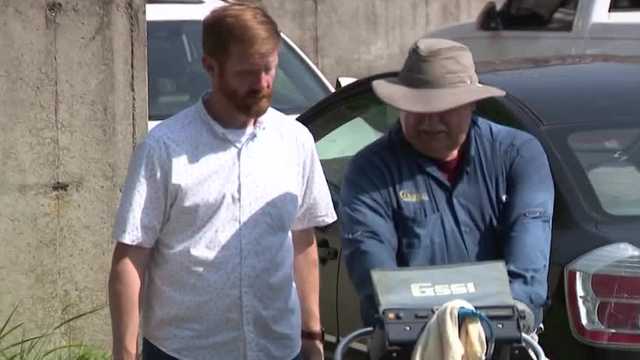
Researchers used ground-penetrating radar Tuesday to search for the Lost Jones Burying Ground, a cemetery believed to have served the early frontier town of Providence, Indiana.
“I’m looking for the burial shafts. I found at least eight back here in the backyard,” said ground-penetrating radar specialist Len Strozier of Omega Mapping Services.
Historians believe the cemetery, hidden for more than a century, lies beneath three residential properties.
The survey was conducted without digging or disturbing the ground, using radar technology to map what may be buried below the surface.
Researchers say they’re looking for evidence of burial shafts that could help confirm the cemetery’s location.
The site is believed to include the grave of Epaphras Jones, a Revolutionary War veteran who spent the last 25 years of his life in Floyd County.
According to researchers, the cemetery eventually fell into disrepair before the land was sold and later divided into residential lots where homes now stand.
“These are people from this community. They’re people that matter. Every life matters,” Allen said.
Homeowner Dennis Jensen, who has lived on the property for 10 years, said human remains have previously been found there. Even so, he believes those buried at the site should continue to be treated with respect.
“Leave it alone. Let them rest in peace. They did their duty,” Jensen said.
Researchers emphasized that the project is strictly non-invasive and that no excavation is planned.
Instead, they hope the radar survey will provide additional evidence to help document and preserve the historic burial ground.
“You know how satisfying that is when you’re putting a puzzle together, when you get that final piece and it clicks. That’s exactly what I’ve done,” Strozier said.
The project has received support from the Indiana250 Commission, the Floyd County Historical Society, and the Indiana Department of Natural Resources.
Please note: This story was provided to CNN Wire by an affiliate and does not contain original CNN reporting. This content carries a strict local market embargo. If you share the same market as the contributor of this article, you may not use it on any platform.