New Lawsuit Criticizes Conservation Plan That Allows Off-Roading at Oceano Dunes

Alissa Orozco

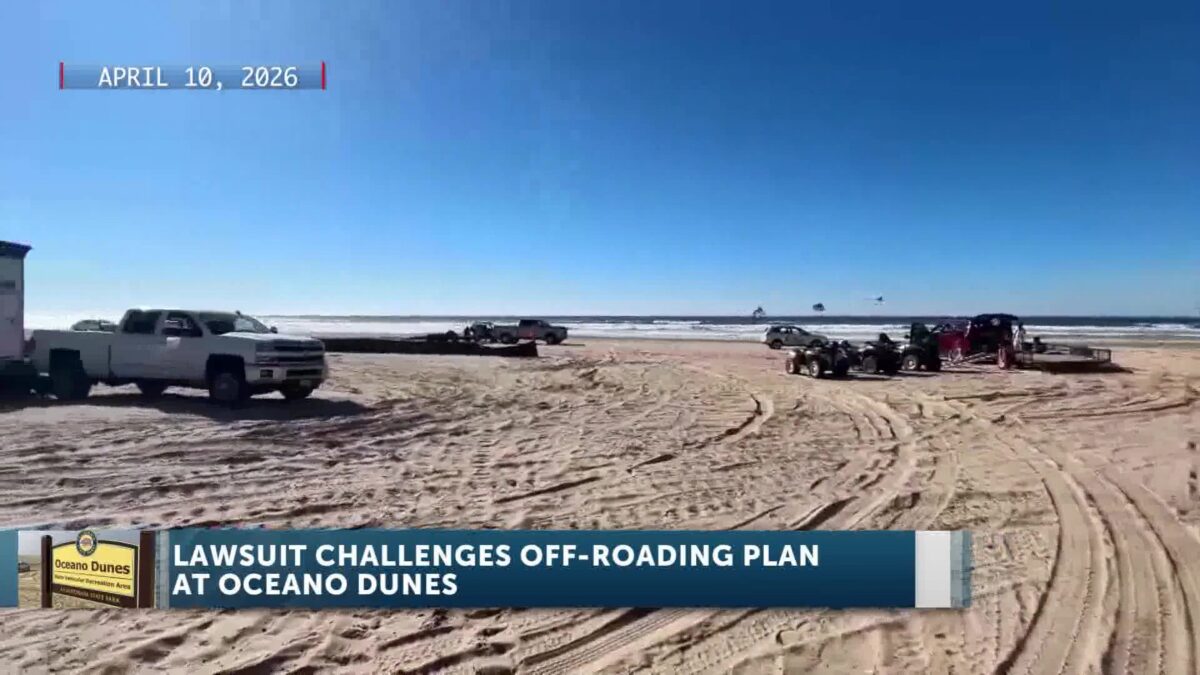
OCEANO, Calif. (KEYT) – On Thursday, California State Parks was hit with a lawsuit over its approval of a habitat conservation plan at Oceano Dunes. The Center for Biological Diversity and Northern Chumash Tribal Council claims State Parks has violated the Endangered Species Act by allowing off-road driving on the beach for decades – putting wildlife like western snowy plovers and California least terns in danger.

In May 2026, California’s Department of Parks and Recreation approved the Oceano Dunes District’s Habitat Conservation Plan to allow visitors to enjoy recreational activities on the beach, while continuing to monitor and minimize any impacts the region’s natural wildlife.

The final plan presented in the April 2026 highlights several species of animals and plants that would be covered under conservation plan, chosen “based on their listing or potential listing status as a federally listed threatened or endangered species.”

Recreation activities popular to the area such as camping, swimming, bicycling, fishing, dog walking, and motorized recreation will all be allowed to continue under the plan.

An April 2026 injunction previously prohibited off-road vehicles on the beach after a federal court ruled those vehicles violated the Endangered Species Act. The beach was temporarily closed to motor vehicles until May 22nd when State Parks received a new permit from the Department of Fish and Wildlife with the approval of the Habitat Conservation Plan.

The lawsuit filed by the Center for Biological Diversity and Northern Chumash Tribal Council claims the plan conserves off-roading, and the park’s popularity with visitors, rather than the region’s natural and protected habitat.

Jeff Miller, a senior conservation advocate at the Center said in a statement, “Oceano Dunes is a place for all Californians and a refuge for some of our most imperiled birds. Letting hobbyists degrade it for another 25 years based on a flawed environmental study is unthinkable.”

The center criticizes State Parks’ decision – claiming the conservation plan lacks proper environmental review and violates Endangered Species Act.

In it’s final draft report, the District and State Parks say this is an attempt to create a balance:

“The mission of CDPR is to provide for the health, inspiration, and education of the people of California by helping to preserve the state’s extraordinary biological diversity, protecting its most valued natural and cultural resources, and creating opportunities for high-quality outdoor recreation. Balancing the need to protect California’s natural resources, while providing recreational access to the parks…”

However, the lawsuit claims the State Park’s authorization for off-roading to continue violates protected nesting and roosting areas, and land scared to the Chumash Tribe for thousands of years.

“State Parks tried to dress up a dune buggy conservation plan as habitat improvement. The plan actually takes away needed protections for nesting plovers and terns,” said Miller. “You’d expect this wanton disregard for imperiled wildlife from Trump, but it’s just sad seeing it coming from California.”

The Latest Breaking News, Weather Alerts, Sports and More Anytime On Our Mobile Apps. Keep Up With the Latest Articles by Signing Up for the News Channel 3-12 Newsletter.

Click here to follow the original article.

Dying to look good? – The toxicity of weight-loss culture

Kaelyn Blessinger

IDAHO FALLS, Idaho (KIFI) — As temperatures rise and summer activities ramp up, many people feel increased pressure to lose weight and achieve a “summer body.” However, health and nutrition experts warn that this seasonal fixation can do much more harm than good.

A summer body often emphasizes the importance of weight loss as well as having a flat stomach, visible muscle definition, and lower body fat. Social media trends have been pushing this ideal lately. From advertisements on products to keep you from eating, extreme fitness challenges, and unrealistic expectations about appearance.

Some people feel as though they need to dramatically change their bodies before stepping onto a beach, attending a barbecue, or simply enjoying the warmer weather. Health and nutrition experts say that mindset can be harmful.

“There’s the emotional component to it,” Dr. Brady Wirrick, Intermountain Wellness Clinic, stated. “We all want to look like the people in magazines or movies. People think they’re doing the right thing by exercising as hard as they can every day and drastically cutting calories. They see the scale move, but then they start feeling terrible.”

While exercise and mindful eating are important components of overall health, experts warn that taking either to extremes can have serious consequences. Excessive exercise and severe calorie restriction can negatively affect organs, bones, metabolism, and mental health.

For some individuals, the pressure to lose weight can contribute to eating disorders.

“I did have an eating disorder growing up,” Chole Goodspell-Hall said. “Because I was the bigger kid, I suffered from bulimia, and it eventually turned into anorexia when I was a teenager. A lot of my family didn’t know.”

Eating disorders are complex mental health conditions characterized by unhealthy obsessions with food, weight, or body shape. They can lead to dangerous behaviors such as restrictive eating, binge eating, or self-induced purging.

Mental health advocates and nutrition experts stress that healthy weight loss should never come at the expense of physical or emotional well-being.

“Anytime there’s an obsession or a feeling that you need to restrict a certain food group or a specific number of calories, that’s unhealthy,” Emily Sucher, Registered Dietician for Live Well Dietitian, said. “Even the guilt that comes from eating a brownie. A healthy mindset is being able to enjoy a brownie and move on. An unhealthy mindset is feeling like you have to work out for an extra hour to make up for it.”

Now, Goodsell-Hall promotes healthy eating habits and body acceptance within her family and community. Her message is simple: health is not defined by unrealistic beauty standards.

“You don’t need to deprive yourself of the little things in life to maintain an unrealistic beauty standard,” Goodsell-Hall said. “Every body is a summer body. If your body exists in the summer, it’s a summer body.”

Experts recommend focusing on sustainable habits such as balanced nutrition, regular physical activity, adequate sleep, and realistic goals rather than quick-fix diets or punishing workout routines.

Ultimately, achieving a healthy weight starts with understanding your body’s unique needs and working with them, not against them.

The pursuit of health should be about feeling stronger, more energized, and more confident, not meeting an impossible standard set by social media or popular culture.

For more information on healthy recipes, click HERE for Goodsell-Hall’s TikTok page.

Click here to follow the original article.

Volunteers unite to build beds for eastern Idaho children

Par Kermani

IDAHO FALLS, Idaho (KIFI) — More than 145 volunteers with The Hall Foundation gathered Thursday in Idaho Falls to build 140 beds for children across Eastern Idaho.

Throughout the morning into early afternoon, volunteers measured, cut, and assembled new bed frames for children in need. The newly constructed beds will be distributed through Sleep in Heavenly Peace (SHP), a nonprofit dedicated to ensuring no child has to sleep on the floor.

“We’re so grateful for this opportunity to help children and to be able to give them a safe, warm, comfortable place to sleep,” shared Sunny Harker, Director of the Hall Foundation.

While the 140 beds will help address the need, the group says more than 500 children in Eastern Idaho are still waiting for a bed of their own.

“Some of the kids that we’ve delivered beds to, they’re sleeping on the floor,” explains Levi Schaefer, SHP Chapter President. “There might be multiple kids on an air mattress or sleeping on a couch. I’ve even delivered beds to where kids had pallets and put blankets on top of them so that they had a place to sleep.”

The group is planning another bed-building volunteer project for Friday, June 26. For more information, or to volunteer, click HERE.

Click here to follow the original article.

Border Patrol pursuit in Palm Springs ends in Cathedral City

Tommy Gallegos

A video circulating on social media has drawn attention to an alleged enforcement stop involving U.S. Customs and Border Protection and a motorist in Palm Springs near Gene Autry Trail and Vista Chino.

According to the Palm Springs Police Department, local officers were not involved in the incident and were not notified in advance of Border Patrol’s presence in the city.

Palm Springs police said the traffic stop was initiated by U.S. Border Patrol in Palm Springs. Authorities reported that the motorist then fled the area, leading the incident into neighboring Cathedral City.

When contacted for additional details, Palm Springs police directed inquiries to the Cathedral City Police Department.

In a statement, Cathedral City police confirmed that Border Patrol agents were involved in a pursuit that entered the city at approximately 8:29 a.m.

Cathedral City police said the pursuit was called off within city limits, and no injuries or crashes were reported. Cathedral City police also emphasized that none of its officers participated in the pursuit.

Questions remain regarding the reason for the initial stop.

Requests for comment have been sent to U.S. Border Patrol. The agency has not responded.

This is a developing story and will be updated as more information becomes available.

Click here to follow the original article.

New court filings detail severe abuse, cover-ups at state-run Wyoming boys’ school

WyoFile

By Maya Shimizu HarrisWyoFile.com

Originally Published: June 12, 2026

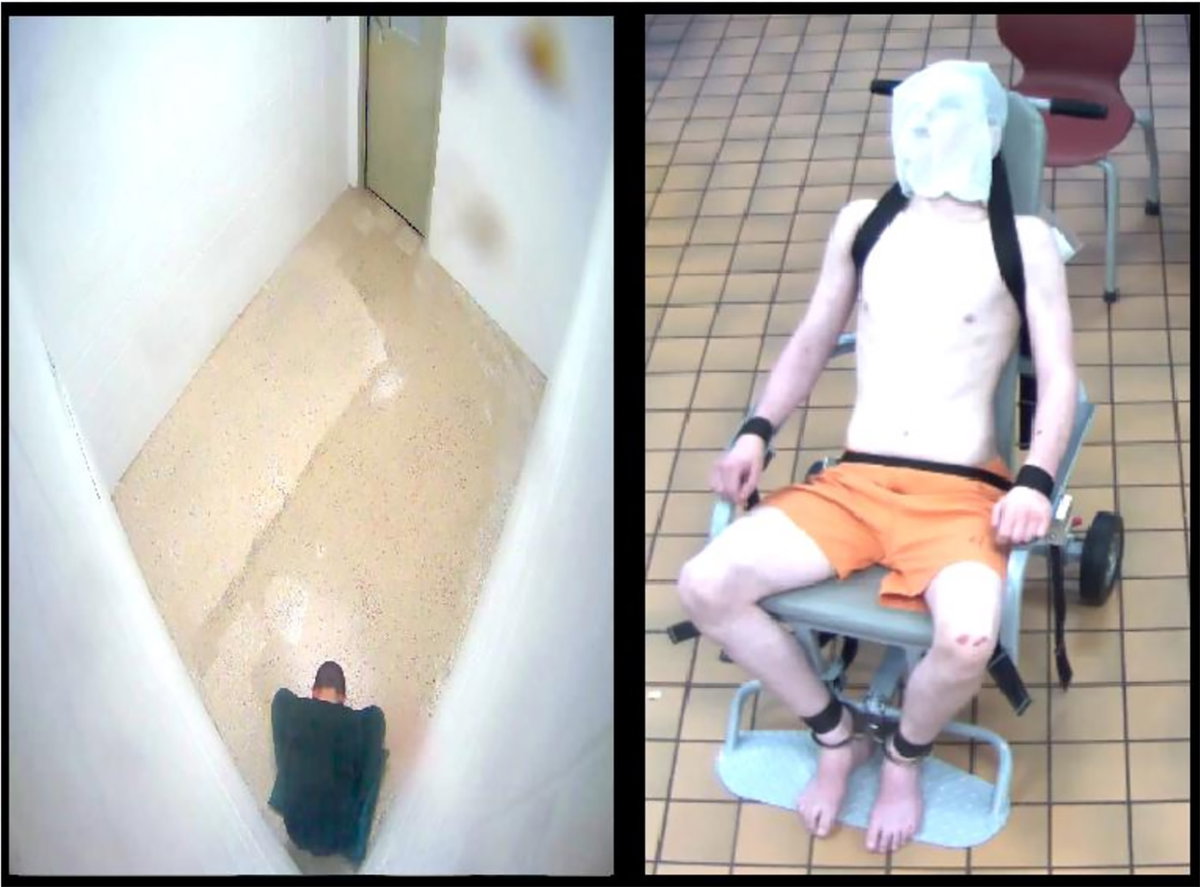
WYO (Wyofile) —The beginning of the plaintiffs’ response in a case alleging abuse at a state facility for delinquent boys features two video footage stills. In one, a boy cowers in the corner of a solitary confinement room. In the other, a boy is strapped to a restraint chair with a white mask over his head. 

Above the photos is a quote attributed to one of the defendants, staff member Thad Shaffer: “[The] best part of the chair is watching the kids cry and scream like a *&%$ing child . . . that’s what makes it worth it.” 

In 2024, six former residents — Blaise Chivers-King, Dylan Tolar, Charles “Rees” Karn, D.H., Haiden Willis and Koby Cranford — joined a lawsuit alleging abuse at the Wyoming Boys’ School, including extended periods of solitary confinement and physical harm. The school, which accommodates delinquent boys ages 12 to 21, is a 38-acre facility near Worland that’s overseen by the Wyoming Department of Family Services. 

Footprints in the snow lead to the Wyoming Boys’ School on Dec. 10, 2021 in Worland. The state-run facility houses delinquent boys ages 12 to 21. (Lauren Miller/Casper Star-Tribune)

Last month, the defendants, which include the Wyoming Department of Family Services, the Wyoming Boys’ School and 10 school employees, responded to these allegations and urged the court to decide the matter in the state’s favor before the case goes to trial.

The plaintiffs’ response, filed on Thursday, brings forward new information from video footage, photos and depositions — testimony given under oath — that paints a picture of how staff members used force and allegedly falsified reports. 

Boys’ school staff said in depositions that leadership frequently ordered them to falsify and downplay the use of force in incident reports. The response also disputes the defendants’ assertion that the boys’ basic needs were met when they were kept in solitary confinement. It states that some of the plaintiffs’ parents complained to the school about their children’s treatment, contrary to the defendants’ description that parents didn’t intervene or follow the school’s grievance policy. The document provides vivid descriptions of how staff members used force against the former residents, often when they weren’t posing a safety threat. 

Wyoming has, for decades, incarcerated juvenile offenders at the highest rates in the nation, according to data collected by the U.S. Department of Justice. While Wyoming’s juvenile incarceration rate declined according to the most recent data collected in 2023, adjudicated delinquents — young people convicted of crimes — were removed from their homes and placed in public and private facilities at over twice the national average. 

Falsified reports 

Boys’ school staff said in depositions that people working at the facility “frequently” falsified records, including incident reports. 

“[A]lmost every incident report” at the school from 2022 to 2024 was falsified, one staff member said in a deposition. School leadership told staff to report that “student behavior” caused the use of force, according to the staffer’s testimony. 

A staffer recalled raising concerns about falsified reports “on multiple occasions, but supervisors ignored his concerns,” a staffer said in his deposition. Once, the staffer told Shaffer he wouldn’t sign a report because it was “untruthful.” Shaffer, according to the deposition, told him to “[s]ign it or find a new job.” 

A Feb. 23, 2023 incident report, the new court document describes, “whitewashed” Shaffer’s use of force against one of the plaintiffs, Chivers-King. The report, according to the document, states that Shaffer placed Chivers-King in the corner and then gave the boy “verbal commands to sit in the corner.” But the response describes video footage that shows Shaffer “violently slamming” Chivers-King into a corner with a riot shield after staff told him to “get back” and Chivers-King “immediately complied.” 

Solitary confinement 

Boys’ School Superintendent Dale Weber testified that the school “concedes that a student who is suffering from severe depression and self-harm should not be kept in solitary confinement,” the plaintiffs’ response states. But “the record shows” that the school “repeatedly punished” the former residents “with additional time in solitary when they engaged in self-harm.”

Dale Weber, superintendent of the Wyoming Boys’ School, sits for a portrait on April 19, 2022 in Worland. He took over in January 2022. Prior to that, he’d been the school’s clinical director for several years. (Victoria Eavis/Casper Star-Tribune)

Solitary confinement at the boys’ school is “significantly harsher” than in a “typical adult prison,” the document states. Adult prisoners in solitary are usually allowed to read books, make phone calls, take part in educational programming, exercise and look out a window. 

By contrast, photos and depositions paint the school’s solitary confinement rooms as small and bare. They are about 8 by 10 feet with concrete floors and cinderblock white walls, the response describes. The typical room has two cameras, a metal toilet-sink combination and a drain in the floor. No windows look outside. Staff “punitively cover” the small interior window on the door “with a large magnet ‘every time a student’ is in the room.” “During the day, a boy in solitary has ‘nothing to sit on,’” the document states. “At night, the boy receives a thin mattress to sleep on the floor.” 

The school bars boys from listening to music, watching T.V. and keeping personal items while they are in solitary, according to a staffer’s deposition, nor does the facility typically allow residents to participate in any activities. It rarely lets boys in solitary have books or educational materials, staffers said. The boys don’t receive educational instruction or therapy while in solitary. 

Video footage shows that no mental health provider or teacher entered the detention room to provide therapy or education to Chivers-King, Karn or Willis. 

Kids in solitary confinement aren’t allowed to interact with peers or to talk with family on the phone, according to staff testimony. 

The Wyoming Boys’ School solitary room in Dorm 3 is shown in this photo. (Court filing)

Boys in solitary would “stand at the door to try to interact with their peers,” including “yell[ing] underneath the door,” staffer and defendant Amanda Turner testified. In response, school staff “put a towel underneath the door,” Chivers-King, one of the former residents, said in his deposition. 

The school rarely lets kids out of solitary confinement for exercise, staffers testified. They said that staff usually check on isolated boys via camera without communication. When staff members do visual checks, they typically remove the magnet, “peek in and look through the window,” then put the magnet back on. Kids in solitary can only communicate with staff by using “hand signals to the camera” or yelling, defendant Darryl Coronado testified. Dorm directors sometimes barred staff from talking with boys in solitary. 

The school, according to a deposition, “places no upper limit on how long a boy can be held in solitary confinement,” the court document states. It also often places kids in solitary confinement for pre-determined amounts of time, which the document described as “punitive.” 

“To be released from solitary, a child must satisfy strict and arbitrary expectations,” the document states. “The child must ‘sit in the co[r]ner of the detention room without falling asleep’ and must ‘raise hand and

wait to be addressed for questions,’” according to the document. Willis, one of the plaintiffs, for example, “would earn a negative day” if he spent “a majority of his day laying down,” staffer Tate Adams, a defendant, said in his deposition. 

“Such expectations are abusive,” the document states. 

One of the former residents, Willis, spent 75% of his time at the school in solitary confinement, the document states. Staff took away his mattress, making him sleep on the floor most nights, often without a pillow, Willis testified. 

The Wyoming Boys’ School solitary room in Dorm 3 is shown in this photo. (Court filing)

While in solitary, some of the former residents attempted suicide. Karn tried to hang himself. Chivers-King tried to kill himself by hitting his head against the wall, after which staffer and defendant Mike Nelson made the boy “clean his blood from the walls,” according to a Wyoming Department of Family Services contact log. 

The document cites case law acknowledging the harm of solitary confinement, particularly for children. “Courts uniformly recognize that solitary confinement is particularly harmful to children and to people with mental health disabilities,” the document states. 

“Even if Plaintiffs were occasionally placed in solitary confinement for arguably legitimate purposes, the duration of their confinement was ‘excessive’ in relation to that purpose,” the response states. 

“Even where there exists an initial, legitimate safety reason for placing a child in confinement, it is unconstitutional to keep the child there ‘for extensive periods’ after the safety threat has ‘dissipated.’” 

The school’s use of solitary confinement was unlawful and violated the former residents’ 14th Amendment rights, the document reiterates. 

Restraint chair 

In 2016, the boys’ school bought a restraint chair with shoulder, lap, wrist and ankle straps, WyoFile reported in a 2022 investigation. These high-back chairs made international news at the Guantanamo Bay detention camp, where they were used to torture and force-feed detainees.

Photos included in the plaintiffs’ Thursday response show that the school’s restraint chair bears a warning label that states: “Warning: Use of the safety restraint chair without first reading and thoroughly understanding the instructions could cause injury or death. . . Do not leave detainees in this chair for more than TWO hours.”

Despite this warning, the school put the former residents in the restraint chair for more than two hours, according to the new court document. 

Two photos from a court filing show, at left, a restraint chair, and right, a close-up of a label on the chair warning not to leave detainees restrained in the chair for more than two hours. (Court filing)

In June 2021, for example, Weber, the school’s superintendent, approved putting Karn in the chair from 11:50 a.m. to 7:30 p.m., according to the response. He stayed in the chair for more than two hours on other occasions. Staffers also restrained Willis, another plaintiff, in the chair for about five hours in 2019, according to an incident report, even though the boy “was ‘relaxed’ after less than an hour in the chair,” the document states. 

Staff members often put Karn in the restraint chair “half-naked, wearing only his shorts,” the document states. The response describes video footage that shows staffers also “shackled [Karn] to the restraint chair with a mask over his head for multiple hours.” 

Shaffer taunted Karn by stating, “You sure love that chair,” and “last time you cried like a baby for like an hour,” according to the document. 

Use of force

The former residents’ new court filing describes several instances when boys’ school staff used force when the boys appeared compliant and non-threatening. Some of those confrontations resulted in serious injuries. 

During an incident in one of the dorms, Shaffer broke Karn’s left wrist and tackled him, the plaintiffs’ response states. According to a staffer’s testimony, Shaffer later bragged about this to other staff, saying that “he heard the kid’s arm break.” On another occasion, staffer John Schwalbe “shoved [Karn’s] face into broken glass” and said: “If you’re going to break shit, then this is pretty much what you’re going to get,” the document describes.  

In 2021, according to video footage and Shaffer’s testimony, Shaffer “charged into” the solitary room where another plaintiff, Chivers-King, was being held. Someone yelled, “get back, get back.” Chivers-King “immediately complied.” But Shaffer “violently slammed” the boy into the wall with a riot shield. “Shaffer and six others then forced [Chivers-King] to the ground and piled on him,” the document states. Shaffer’s justification for entering the room, according to the court filing, was to prevent Chivers-King “from engaging in self-harm.” 

A type of restraint used when transporting boys or when they’re a threat to themselves or others is seen on Dec. 10, 2021 at the Wyoming Boys’ School. (Lauren Miller/Casper Star-Tribune)

Video footage from 2020 shows another altercation between plaintiff Willis and staff members. Willis had “backed away from the door, walked to the far corner of the room, and faced the wall” before Shaffer “opened the door and charged” him. Willis “immediately dropped to the floor and went into the fetal position, covering his face with his hands,” the document states. Shaffer “grabbed Willis and body-slammed him into the floor.” Four staff members then restrained him as Shaffer “slammed” Willis’s head on the ground “several times.”

“Defendants frequently employed significant force to address minor misbehaviors that did not pose any safety threat,” the document states. “And Defendants often unreasonably interpreted benign gestures, such as [Karn] turning his head, as license to employ force.” 

Violence at the boys’ school was documented in police reports obtained for a WyoFile investigation.

‘Deliberate indifference,’ disability discrimination

The plaintiffs’ attorneys asserted that the defendants were “deliberately indifferent” to the former residents’ medical needs and violated their 14th Amendment rights. 

Defendant Kevin McGinty, the response states, “knew that [Karn] faced a substantial risk of suicide because he saw [Karn] hanging from a make-shift noose.” But he didn’t immediately intervene, instead watching Karn “from outside the door for three minutes.” 

“By failing to take any prompt steps to assist [Karn] during the suicide attempt, McGinty violated [Karn’s] clearly established rights,” the response states. 

The attorneys also assert that Olson, Schwalbe and Weber were “deliberately indifferent” to plaintiff Tolar’s “serious medical need when they withheld his leg brace.” Tolar “needs the leg brace to help him walk,” the response states. But his leg brace was “withheld” from him at the school, according to the court filing. School staff still required him to “walk, lift weights, and do jumping jacks” without the brace, the filing states. Tolar testified that he now needs surgery to fix a structural deformity in his knee and ankle. 

Rather than accommodating plaintiffs’ disabilities, the school “extended punishment for disability-related behaviors and exacerbated their mental harm by depriving them of access to mental therapy while in solitary confinement,” the response states. 

The former residents are asking the court to reject the defendants’ request to decide the matter in the state’s favor and allow the case to proceed to trial.

WyoFile is an independent nonprofit news organization focused on Wyoming people, places and policy.

Editor’s Note: This article has been retitled for this platform. All photographs, court documents, and original reporting elements were obtained in accordance with WyoFile’s republishing guidelines and remain the sole property of the original creators and photographers.

Click here to follow the original article.

End of an Era: Idaho families reflect as Melaleuca Freedom Celebration approaches final year

Par Kermani

IDAHO FALLS, Idaho (KIFI) — Many families are reflecting on Fourth of July memories after Melaleuca announced that this year’s Freedom Celebration will be its last.

The annual fireworks show has long been a staple of Independence Day in Idaho Falls, drawing thousands of people to the Snake River Landing area each year.

For some families, the event has become a tradition that stretches across generations.

“It’s a time that we just know that we’re going to be together, that we’re going to go to the activities at the river, we come home, we barbecue, and then we’re going to go do the fireworks at night,” Idaho Falls resident Cindy West said. “There’s so much energy and it’s so positive and it’s so much fun.”

West said the celebration has become more than just a fireworks show.

“It’s like the city coming together all at once, at one time, and we are all celebrating together, our country, our families and just those memories together,” she said.

Others expressed concern about what future Fourth of July celebrations in Idaho Falls could look like if another large fireworks show does not replace the Freedom Celebration.

“It’s kind of a bummer because I don’t know where else in town they’ll be able to do the fireworks,” said Brynae Mahrt. “The person who does them does such a good job of them, and I know everybody in town loves them.”

Mahrt said her family has attended the fireworks every year since moving to Idaho Falls four years ago.

“We did enjoy them so much that we would probably try to find somewhere that’s equivalent to the fireworks that we saw for the last few years,” Mahrt said. “But it’s always been nice because it’s been close to home and it’s easy to travel and see here.”

West said while her family will continue celebrating Independence Day together regardless of what happens next, she hopes organizers understand how much the event has meant to the community.

“Hopefully the Vandersloots know how appreciative my family is, and I’m sure many families in the Idaho Falls area, for the time that they have been doing this fireworks show,” West said. “It’s been a blessing.”

Melaleuca announced earlier this week that the 2026 Freedom Celebration will be the final year for the event, citing ongoing development in the Snake River Landing area.

Click here to follow the original article.
Voter ID proposal goes to the voters in Arizona

Adrik Vargas

YUMA, Ariz. (KYMA) – Voters could have the opportunity to shape the future of Arizona’s elections this November.

Arizona lawmakers have sent a new measure to the November ballot that would require all voters, including those who vote by mail, to provide a government-issued ID.

According to the Citizens Clean Elections Commission, approximately 80% of Arizona voters chose to vote by mail.

The measure would also give voters the option to have their ballots counted at polling places to help speed up results, with the state required to help cover the cost.

“When people go to register to vote, they already do have to show ID in order to register to vote. You do have to have documentation, but this measure would make it so that instead of just going for that signature verification process. All voters would have to show ID in order to cast a mail ballot,” said Sasha Hupka, elections reporter for VoteBeat.

Voters will get to decide this November whether these changes become part of how Arizona runs its elections.

Click here to follow the original article.

Juneteenth celebrations kick off in Palm Springs

Athena Jreij

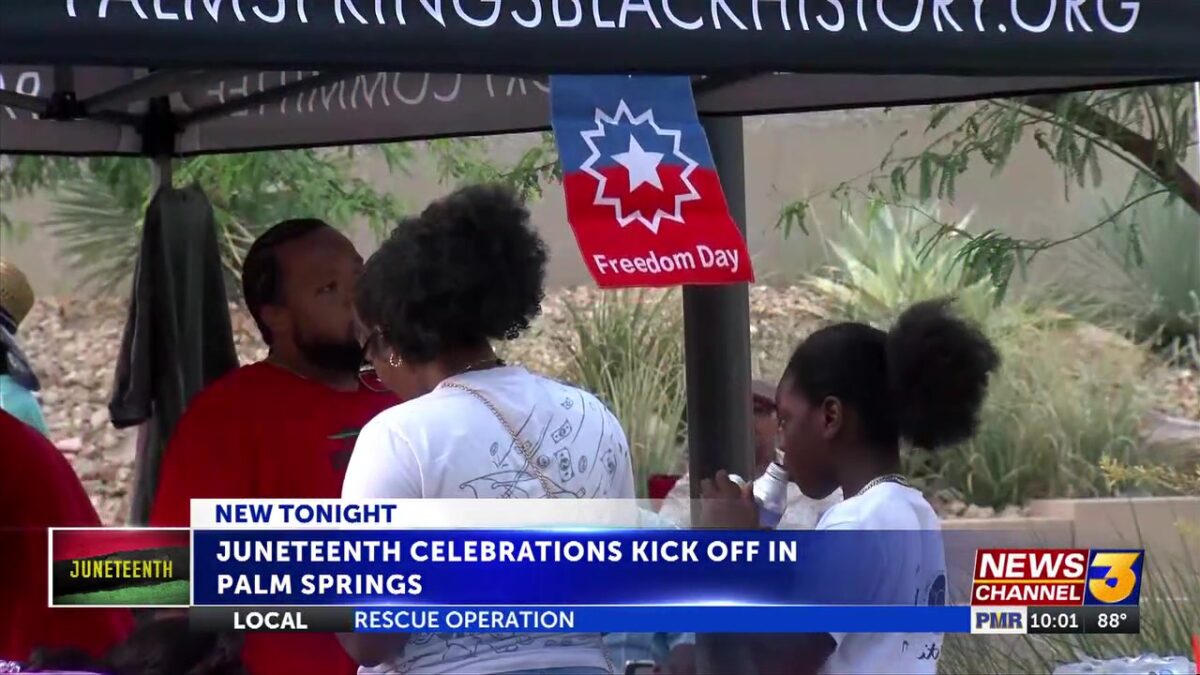
PALM SPRINGS, Calif. (KESQ) – A weekend of Juneteenth celebrations is kicking off in Palm Springs, hosted by the Palm Springs Black History Committee.

The holiday celebrates independence day for African Americans from slavery.

Juneteenth Freedom Weekend began Thursday evening at Villagefest in Downtown Palm Springs and continues through Saturday with a youth pageant at the James O. Jessie Desert Highland Center.

Friday at 5 p.m., the Juneteenth Unity Picnic welcomes residents to Downtown Park for a lineup of educational, cultural, and community engagement experiences. The event will also feature food vendors and live entertainment.

Organizers say it’s been a way to unite the community and educate the public on the true meaning of Juneteenth.

“It’s important to keep educating not only our community, but everybody. Black history, we usually stick everything into one month, but our our mission is to celebrate Black history throughout the whole year,” Brian Jackson, Juneteenth coordinator with the committee said.

For many like Andrea Terry, the history has been passed down generations.

“Well, my mother is from Texas. Being a product of both her father being white, her mother being black, she had so much ties to slavery. She wanted us to know the importance and the significance of this day,” Terry said.

At Sweet Ashley’s, a homemade desert business, owner Ashley Johnson says Juneteenth gives her a chance to showcase her culture.

“It gives us space to be ourselves and give us a space to do recipes that have been passed down from generation to generation. Like the peach cobbler that’s been in our family since I was a kid,” Johnson said.

Terry says the day is a reminder that freedom is still a work in progress for some.

“This day and age, we’re fighting the administration. We’re fighting for people who are running from ICE. We are fighting for all of humanity, not just one race,” Terry said.

For more information on Freedom Weekend, visit: https://palmspringsblackhistory.org/juneteenth-weekend.

Click here to follow the original article.

Father’s Day Contest 2026 winner announced

Dillon Fuhrman

YUMA, Ariz. (KYMA) – After dozens of submissions, we have a winner for the Fox 9 2026 Father’s Day Contest.

Congratulations to Mercedes Pilego! Her family’s Father’s Day will be extra special with a prize pack valued at over $500.

We would like to thank our sponsors: Todd Craig Team at Nova Home Loans, J.T. Pro’s Sandwich Shop, El Centro Motors, Liberty Motorsports, Pro-Tech Automotive and the Barber’s Lounge.

Congrats once again to Mercedes and thank you to everyone else who entered this contest.

You can enter more contests by clicking here.

Click here to follow the original article.

NAACP Yuma County hosts Juneteenth event

Moses Femino

YUMA, Ariz. (KYMA) – Community members gathered at Carver Park Friday evening as the Yuma County NAACP Chapter hosted its annual Juneteenth celebration.

The free event brought together residents from across Yuma County for an evening of live entertainment, local vendors, food, family activities and free bike raffles. Community leaders, elected officials and local organizations also took part in the celebration.

Juneteenth commemorates June 19, 1865, when Union General Gordon Granger arrived in Galveston, Texas, and announced that enslaved people were free. More than two years after President Abraham Lincoln signed the Emancipation Proclamation. The day has been celebrated in African American communities for generations and officially became a federal holiday in 2021.

Yuma County NAACP President Beverly Cade said she was encouraged by the turnout and community support shown during the event.

“This is awesome. We haven’t had a big turnout like this since I don’t know when,” Cade said. “So this is really good. We have the mayor here, he just gave a proclamation. And this is what Yuma community is. All the support.”

Yuma City Councilmember and NAACP Chairperson Karen Watts said Juneteenth serves as an opportunity to celebrate freedom while bringing people together.

“It’s wonderful. It’s a celebration of freedom,” Watts said. “And the community really came out. Getting people out in Yuma during the summer, that’s a hard thing to do. And there’s a lot of people out here.”

Organizers said the event was designed to honor the history and significance of Juneteenth while creating a space for education, reflection and celebration.

The City of Yuma, Freedom Library, National Bank of Arizona and the Yuma County Anti-Drug Coalition were among the event’s sponsors. Organizers hope the annual gathering will continue to grow and help preserve the history of Juneteenth for future generations.

Click here to follow the original article.