10-year-old girl’s quick action may have saved family in early-morning fire

By Carlos E. Castañeda

Click here for updates on this story

    OAKLEY, California (KPIX) — A 10-year-old girl’s quick action likely saved the lives of her family members in Oakley when their house caught on fire early Wednesday morning.

The Contra Costa County Fire Protection District said firefighters responded at 3:29 a.m. after callers reported flames in the garage area of a home on West Cypress Road near Duarte Avenue. When firefighters arrived, they found heavy fire and downed active power lines, Con Fire Battalion Chief Jeff Burris said.

“We arrived on scene to have the front of the house on fire, with the power lines between the pole and the house had dropped onto the ground and were actively arcing, hindering our initial fire attack,” said Burris.

All the occupants had safely evacuated before firefighters arrived, thanks to 10-year-old Elizabeth Morgan, who woke up when the power in the house went out and saw the flames, setting her in action to wake the members of her family.

“The power went out in the house and when it went out, she freaked out, looked out the window to kind of see what was going on, seeing the flames, started yelling at everybody in the house, waking all of us up,” said her mother, Nena Morgan. “She is our hero,”

Elizabeth managed to wake up the four adults and two other children in the house to escape the flames.

“When I woke up, I could just see smoke billowing through the house,” said Nena Morgan. “I was sound asleep in bed with my husband. I don’t know what would have happened if Elizabeth wasn’t awake.”

The family’s two dogs and a roommate’s cat died in the fire, while the family lost virtually all their possessions.

Firefighters believe the fire started on the porch of the house, but the cause of the fire had not yet been determined as of Wednesday afternoon.

The Red Cross was called to assist the displaced residents.

Please note: This story was provided to CNN Wire by an affiliate and does not contain original CNN reporting. This content carries a strict local market embargo. If you share the same market as the contributor of this article, you may not use it on any platform.


Film high school co-founded by George Clooney celebrates first graduating class

By Brittney Ermon

Click here for updates on this story

    LOS ANGELES (KCAL, KCBS) — For many students in Los Angeles, breaking into Hollywood can feel like a dream that’s out of reach. But on Wednesday, the first graduating class of a unique film and television program is proving that talent can come from any ZIP code.

Out of a sea of caps and gowns, 46 students are ready to make waves in the entertainment industry.

“Being able to wear the cap and gown, saying that I made it this far with all the trials and tribulations, it’s a great thing,” student Nathan Zacarias said.

Zacarias said his diploma is more than the traditional milestone; it’s a ticket into the film and television industry that he grew up watching from the outside.

“It really leads us to understand what it is to be in this industry before we even step foot in it,” Zacarias said.

He’s part of the first class to graduate from Roybal Film and Television Magnet, which was co-founded by actor George Clooney. As part of the LA Unified School District, the high school was created four years ago to build a pipeline into the film and television industry that’s inclusive for underrepresented students.

“As we pay it forward, we also came from the community. We know what it’s like to struggle,” principal Blanca Cruz said. “To see my kids also achieve, for what many may seem to be impossible, that’s very powerful.”

From costume design to cinematography, students learn the craft behind the camera. The program also connects teens with mentors and industry professionals to help set the stage for what comes next.

Industry leaders said the school helps fill a labor gap as Hollywood will need tens of thousands of behind-the-scenes crew in the coming years.

“Our community has a lot of talent, and many times we don’t give them an opportunity to show that talent,” Cruz said. “Many times, we don’t tap into it. Many times we don’t invest in it.”

For students like Xavier Calderon, the investment is life-changing.

“I feel very accomplished being able to stand before all these very accomplished individuals,” he said. “Then be able to see me for who I am, and not just, as I want to say, a statistic.”

Calderon is heading to the New York University Tisch School of the Arts, and Zacarias is attending California State University, Northridge.

“I will make it to the big screen,” Zacarias said. “No doubt about that.”

Please note: This story was provided to CNN Wire by an affiliate and does not contain original CNN reporting. This content carries a strict local market embargo. If you share the same market as the contributor of this article, you may not use it on any platform.

Columbia P&Z Commission to potential discuss housing projects

Jazsmin Halliburton

COLUMBIA, Mo. (KMIZ)

The Columbia Planning and Zoning Commission is set to meet Thursday night to discuss a potential housing project near the University of Missouri campus and another on the south side of town.

The first development up for discussion will be “The Retreat at Columbia,” located 350 feet north of Gray Oak Drive. If approved, the 194-unit multi-family development would be built on 32.7 acres, according to the meeting agenda.

This development had been tabled during the commission’s May 7 and June 4 meetings.

A landscape plan, along with a Rock Quarry Road special plan, was conducted for this potential multi-family unit.

Another potential development to be discussed is near the University of Missouri campus. It would be built northwest of the intersection of University and College Avenues. It would include the address 1205 University Ave. The development will be on an approximately 2.91-acre lot and hold 320 dwelling units.

A tree preservation plan, parking analysis, and a shadow study have been completed for the development.

A traffic impact study was also conducted for both potential developments.

Public comment will follow those discussions, according to the meeting agenda.

Click here to follow the original article.

Team Rubicon working to clear hundreds of dead trees from Big Bear wildfire burn scars

By Joy Benedict

Click here for updates on this story

    BIG BEAR, California (KCAL, KCBS) — Team Rubicon volunteers are set to remove dozens of dead trees and vegetation to help mitigate wildfire risk on Big Bear as part of a nearly four-year plan to remove what was left behind by the 2022 Radford Fire and the 2024 Line Fire.

Since the fire broke out in September that year, the area has been closed to the public due to lingering hazards like felled or dead trees and unstable land.

“All the dead trees have a chance of falling at any time; particularly the older it gets, the danger, it increases,” said Robin Brown, a retired firefighter who works with Team Rubicon, which is a veteran-led disaster response organization that has 200,000 volunteers across North America.

He says that volunteers flew in from places like Colorado, Alaska and Canada to help assist with the mitigation process as they work to chop down and remove hundreds of charred trees near Skyline Road. The work is being done in conjunction with Team Rubicon and the U.S. Forest Service.

“Anywhere where we have these fire scars in heavy timber, it is a problem,” said Mike Page, with the U.S. Forest Service in the San Bernardino National Forest. “They have the ability to come in and supplement the work we’re doing and help out in a big way to get it done faster.”

After five days of work, Team Rubicon has successfully dropped more than 350 trees. They expect to remain in the area for at least two weeks. The team has taken over an elementary school in Big Bear as their incident command center, which is being led by Bob Yturralde.

“Normally, you’d see Team Rubicon after the fact to mitigate a crisis, and now, we’re trying to be ahead of the game and mitigate problems that become bigger problems,” Yturralde said.

Please note: This story was provided to CNN Wire by an affiliate and does not contain original CNN reporting. This content carries a strict local market embargo. If you share the same market as the contributor of this article, you may not use it on any platform.

3 rehabilitated sea lions released in Playa del Rey at Dockweiler Beach

By Julie Sharp

Click here for updates on this story

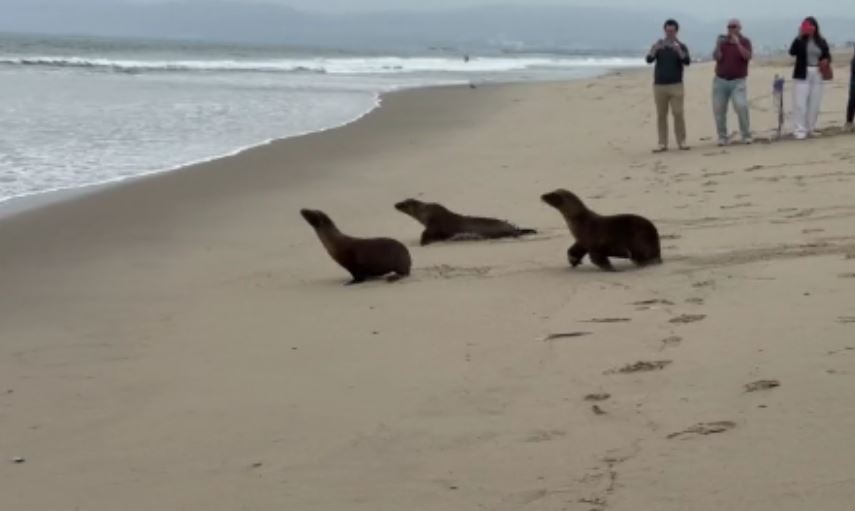
    PLAYA DEL REY, California (KCAL, KCBS) — Three sea lion pups cared for at the Marine Mammal Care Center in San Pedro were released back to their ocean habitat on Monday.

Staff from MMCC transported the pups named Marshmallow, Cascatelli, and Orecchiette in a cage, and when the door opened, they did their best “sprint” to the ocean water.

Three sea lion pups cared for at the Marine Mammal Care Center in San Pedro were released back to their ocean habitat on Monday.

Staff from MMCC transported the pups named Marshmallow, Cascatelli, and Orecchiette in a cage, and when the door opened, they did their best “sprint” to the ocean water.

The public is also a critical part of marine mammal health. Warner said staff from MMCC will respond and bring ailing marine mammals from LA County beaches to its San Pedro facility.

“We ask the public, who are really the eyes on the beaches for us, to call our center, 1-800-39-whale, it’s a marine mammal hotline,” Warner said.

The facility is open to the public for viewing of the animals’ rehabilitation journey. Currently, there are 23 California sea lions, 20 northern elephant seals, and two Pacific harbor seals in care. marinemammalcare.org/visit.

The public is also a critical part of marine mammal health. Warner said staff from MMCC will respond and bring ailing marine mammals from LA County beaches to its San Pedro facility.

“We ask the public, who are really the eyes on the beaches for us, to call our center, 1-800-39-whale, it’s a marine mammal hotline,” Warner said.

The facility is open to the public for viewing of the animals’ rehabilitation journey. Currently, there are 23 California sea lions, 20 northern elephant seals, and two Pacific harbor seals in care. marinemammalcare.org/visit.

Please note: This story was provided to CNN Wire by an affiliate and does not contain original CNN reporting. This content carries a strict local market embargo. If you share the same market as the contributor of this article, you may not use it on any platform.

Congolese refugee turned fashion designer is dressing Kentucky’s governor, NBA stars

By Evelyn Schultz

Click here for updates on this story

    LEXINGTON, Kentucky (WLEX) — A Lexington fashion designer who came to the United States as a Congolese refugee is building a high-fashion brand, dressing some of the most recognizable names in sports, music, and politics along the way.

Albert Lukonga is the founder of Albert Couture, a custom clothing brand based on Third Street in Lexington. Eight years after launching the label, his client list includes jockeys, NBA players like Reed Shepherd, and the CEO of the Grammy Awards.

“That’s the best part, you know, especially when you get to travel to all these places, meet a lot of talented people who are very, very successful, but they trust you over Gucci, Tom Ford, and Balenciaga,” Lukonga told LEX News as we sat down in Kentucky’s first fashion house.

Kentucky Gov. Andy Beshear is among those clients. Lukonga was the tailor on Beshear’s Vogue photoshoot last year. He says he approached the project with one goal in mind.

“I wanted to address him as not for who he was then, but who he’s becoming,” Lukonga said.

As speculation grows about a potential 2028 presidential run for Beshear, Lukonga says his work with the governor will evolve.

“It’s fun because we’re working on something casual, some casual wear,” said Lukonga. “We call it the American dad style. So stay tuned for that.”

Lukonga’s journey to dressing the governor started before he ever arrived in Kentucky two decades ago, through a United Nations resettlement program. Born in the Democratic Republic of Congo, he grew up learning about clothing from his mother, a fashion designer herself. But after graduating from Henry Clay High School in Lexington, he initially considered a different path.

“Every foreign kid out there that knows their parents is like physician, lawyer, whatever, engineering. So I was like, OK, I’ll try this med school, this med stuff, let’s see what happens,” Lukonga said. Fashion ultimately won out, and now he’s responsible for creating one-of-a-kind pieces for discerning clients.

In the future, Lukonga wants to put Lexington on the map alongside fashion capitals like New York City and Paris. He hopes his story motivates other Kentuckians to pursue their own goals.

“Somebody who’s started from nothing and was able to show and remind Americans that it is possible to have a dream still,” Lukonga said.

Lukonga’s next fashion show showcasing his fall collection is scheduled for August 1 in Lexington.

Please note: This story was provided to CNN Wire by an affiliate and does not contain original CNN reporting. This content carries a strict local market embargo. If you share the same market as the contributor of this article, you may not use it on any platform.
Going fishing? Officials confirm carp from Utah Lake are safe to eat after 20 years

By Mya Constantino

Click here for updates on this story

    UTAH COUNTY, Utah (KSTU) — After more than 20 years of health concerns, officials say it is now safe to eat carp caught in Utah Lake.

Utah Lake Authority officials said the change comes after years of watershed restoration projects and removing nearly 30 million pounds of invasive carp and reducing toxic Polychlorinated Biphenyls (PCBs) — man-made industrial chemicals used in industrial and electrical equipment — found in carp.

These efforts have helped improve the lake’s health and made it safer for recreation.

One of the people recreating on Wednesday was Skinny Chantharath, who lives in Provo. Chantharath has fished at the lake for over 30 years.

Over that time, he has caught a wide range of fish, including carp. But he said he hasn’t eaten Carp since the late 1980s.

“The first time I came to the U.S., I ate that Carp, you know?” he said while at a fishing dock.

For years, many anglers avoided exactly that.

According to Utah Lake Authority executive director Luke Peterson, those toxic chemicals likely came from old electronics dumped at the old Geneva Steel mill in Vineyard, which then washed into the lake. Since carp are bottom feeders, the chemicals settled into the mud and ended up inside the fish.

“We went from having dramatically high PCBS in 2005 to where they have dropped so dramatically,” said Luke Peterson, executive director of the Utah Lake Authority.

“It means that the future of Utah Lake is bright. I always say the lake is the healthiest it has been in at least 100 years. We’re excited to say as we’re entering summer, that the lake is healthy, it’s a place to recreate.”

And perhaps a place for Chantharath to catch and eat Carp after all these years.

“You know, some people just come fish for fun,” Chantharath said.

Please note: This story was provided to CNN Wire by an affiliate and does not contain original CNN reporting. This content carries a strict local market embargo. If you share the same market as the contributor of this article, you may not use it on any platform.

Regenerative farming helps this farmer use less water during dry year

By Mythili Gubbi

Click here for updates on this story

    OGDEN VALLEY, Utah (KSTU) — While farms across the state are trying to figure out how to work with limited water from the lack of snowpack, one Ogden Valley farmer is going down to the roots.

Argyle Acres is a regenerative farm in Liberty working to increase the organic matter in soil to make it healthier and hold water better.

For Chris Argyle, farming is his way of making the world a better place.

“This is something that is deep down in your soul that you feel when you’re seeing a farm working in rhythm with Mother Nature, it is awe-inspiring,” he said.

To help build topsoil, he rotates where his cows graze using virtual fencing.

“By the time the cows come back around their full circle, this is regrown and ready to go again and they eat again and it’s just kind of a circle that keep going,” said Argyle.

The cows don’t overgraze in one spot and they move around, helping all parts of the land.

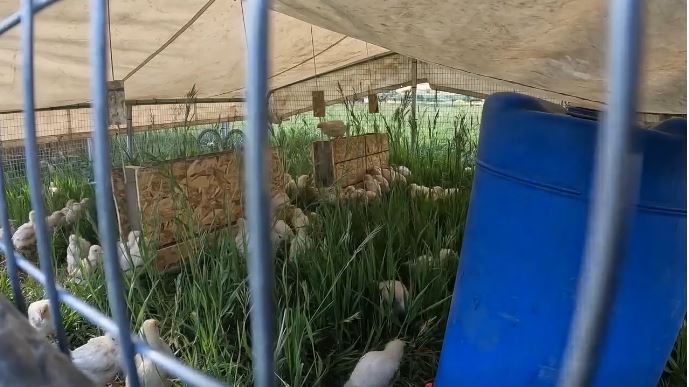
They also have chicken tractors with about 400 meat chickens that go through the pasture.

“They just move through the field,” explained Argyle. “They’re leaving all that beautiful fertilizer. Give it a couple weeks, that’s going to come back thicker, greener, lusher.”

Argyle said he is hoping to increase the organic matter in his soil and use less water — something that’s especially important this year.

“We can go off as, probably as much as an eighth to a quarter of the water that any other farms might use,” Argyle said. “The goal here is deeper roots, not disturbing the soil, keeping it covered, and basically what you’re doing is you’re growing a sponge underground.”

This is a slow process and could take Argyle a couple more years to get to that point. He is two years into regenerative farming on this land, but has used his practices before on a smaller scale and seen successful results.

“This is going to change things and make years like these feel not so terrible,” Argyle added.

To help farmers and growers use less water this year, Professor Burdette Barker with Utah State University Extension advises Utahns to just make sure the water you do get is used the right way.

“Depending on the type of irrigation system they have, this is a good year to make sure that things are well maintained, sprinklers are functioning properly, so we’re getting good uniform applications of water,” he said.

Argyle said his method helps produce healthier meat, fills aquafers, and doesn’t use chemical fertilizers.

“This farm is feeding my community,” Argyle said proudly.

They also do agritourism events and want people to visit to learn more about their farming techniques.

Please note: This story was provided to CNN Wire by an affiliate and does not contain original CNN reporting. This content carries a strict local market embargo. If you share the same market as the contributor of this article, you may not use it on any platform.

Four months after a stroke, teen graduates and looks ahead to nursing career

By Spencer Joseph

Click here for updates on this story

    PAYSON, Utah (KSTU) — Gretl Talbot is 18-years-old, a teenager walking across the state at her Payson High School graduation.

Like many others in the audience, this marks her next steps with pomp and circumstance, but unlike her fellow classmates, this day may very well not have happened.

Just a few months ago, getting ready for an ice skating outing on a normal February day, she looked in the mirror and saw her worst fear staring back at her.

The right side of her face was drooping. Her hand had gone completely numb. In that terrifying moment, most teenagers might have panicked or dismissed the symptoms. But Talbot’s recent training as a certified nursing assistant kicked in with life-saving clarity.

“I checked the mirror and saw that my right side of my face was drooping, and was like, ‘yep, I’m having a stroke,'” Talbot said. “It was the scariest moment of my life, but I knew I had to act fast.”

That split-second recognition — and the courage to trust her training over her disbelief — saved her life.

Four months later, she walked across her high school graduation stage, each step carrying the weight of a battle most of her classmates couldn’t imagine.

“It is a lot more meaningful now,” Talbot said, her voice catching with emotion. “I’m here, and I’m able to graduate high school. In some cases, that’s not the case, but in mine, I was able to do it. I made it.”

When Talbot called her sister on Feb. 21, urgency rippled through her family. Her mother rushed over as an ambulance screamed toward their home, arriving within three minutes of the call.

At Mountain View Hospital in Payson, the medical team felt the jarring reality of seeing someone so young fighting for her life.

“Anytime we hear those young numbers of anything — and especially needing to be admitted to ICU — we all pause,” said Amanda McCoy, the ICU and Cath Lab manager. “Why do we have an 18-year-old having a stroke? I can think of a handful of times that they’re in their 20s or younger that really stand out.”

The cause was a patent foramen ovale, or PFO — a small hole in Talbot’s heart that should have closed after birth but never did. It’s thought that PFOs can create a deadly pathway for a blood clot to travel directly to her brain.

It’s estimated that one in four people has a PFO that never closed, including several members of Talbot’s family.

Racing against a narrow treatment window, the medical team administered TNK, a clot-busting medication, within four hours of her symptoms starting.

“Almost immediately, it starts working and just improved throughout the day,” Talbot recalled.

McCoy emphasized that Talbot’s quick thinking was the difference between recovery and devastating loss.

“Time is tissue. Our brain is tissue,” McCoy said. “The longer we go without oxygen to vital organs and tissue, we lose that, and it’s very hard to recover. Time was very important. And it was on her side, because she recognized all of the things that mattered.”

For McCoy and her team, caring for someone so young brought both heartbreak and determination. They stayed by Talbot’s bedside through the critical hours, watching all of the incredible signs of improvement, and working with their young patient who was defying the odds.

“Being in the ICU, we don’t always get to write the endings,” McCoy said. “It’s not always happy endings that we see, despite all of our best efforts.”

Four months after that life-altering night, Talbot returned to the hospital — not as a patient, but as a survivor ready to thank the people who helped save her life.

The reunion was emotional for everyone involved. Talbot, now healthy and strong, embraced the nurses who had cared for her during her darkest hours.

“I was really sad, honestly, to leave my nurses,” Talbot said, tears in her eyes. “Getting to thank them is really, really special to me, because they’re never going to know enough how much I’m thankful for them. They really saved my life.”

The experience didn’t just save Talbot’s life — it revealed her calling. During the reunion, she shared news that brought her nurses to tears: she plans to pursue nursing at BYU-Idaho this fall.

“How could I not go into nursing when I had such great nurses?” Talbot said. “I really want to be able to do that for someone, too. It really hits me hard that I could be a great nurse for someone else on what could be the worst day of their life.”

McCoy said she has no doubt that Talbot will make an extraordinary nurse.

“Gretl is an amazing girl and an amazing family that went through a really hard situation,” McCoy said. “She’s making lemonade out of lemons. I think she will use this experience, plus all the other goodness in her, to help treat others and change the world.”

Walking across that graduation stage in her cap and gown, Talbot carried more than just academic achievement. She carried the gratitude of someone who almost didn’t make it, the strength of someone who saved her own life, and the determination of someone ready to spend her career saving others.

“I’m really excited because I mean, I’m here. I made it,” she said, her smile radiant with the joy of someone who knows how precious each moment truly is.

For her nurses, watching their former patient choose their profession completes a circle of care and compassion that started on the worst night of a teenager’s life and transformed into inspiration for countless patients she’ll one day serve.

Medical professionals use the acronym BE-FAST to help people recognize stroke symptoms quickly:

B – Balance (sudden loss of coordination)

E – Eyes (sudden vision loss or changes)

F – Face (facial drooping or numbness)

A – Arms (weakness or numbness in arms)

S – Speech (slurred or strange speech)

T – Time (call 911 immediately)

Talbot’s story proves that knowing these warning signs can mean the difference between life and death, especially for young people who might not expect to experience a stroke.

Please note: This story was provided to CNN Wire by an affiliate and does not contain original CNN reporting. This content carries a strict local market embargo. If you share the same market as the contributor of this article, you may not use it on any platform.
After a historically dry 2025 monsoon, local farm hoping for a bounce-back

By Kenny Darr

Click here for updates on this story

    CATALINA FOOTHILLS, Arizona (KGUN) — As Southern Arizona prepares for the start of monsoon season, one local farm is hoping this summer’s storms will bring more than cooler temperatures.

At Felicia’s Farm in the Catalina Foothills, supervisor Scott Robins says rainfall can directly impact how much food the nonprofit farm is able to provide to people experiencing food insecurity across the region.

Last year’s dry monsoon season made that mission more difficult.

“Yeah, it was a lot of… we spent a lot of money on water, you know, on irrigating everything because we had such a dry summer and that’s when you need the most water,” Robins said.

The farm relies on donated produce and eggs to support organizations serving people experiencing homelessness and poverty. Robins said the lack of rain forced the farm to spend more money on irrigation and limited how much it could plant.

“There was some crops that we didn’t even plant last year because there was no way,” Robins said. “The cost gets so high with water.”

Despite those challenges, Robins said the farm rebounded with a strong winter growing season.

“We had a great harvest,” he said. “We’ve had a lot of product, a lot of produce going out.”

According to Robins, Felicia’s Farm donated nearly 15,000 pounds of food and about 30,000 eggs in 2025. So far this year, he estimates the farm has already distributed between 20,000 and 25,000 pounds of food and roughly 40,000 eggs.

Rainfall provides benefits that go beyond simply watering crops.

Robins said groundwater contains minerals that can build up in the soil over time. Monsoon rain helps wash those minerals away, allowing plants to absorb nutrients more effectively.

“Every other day you’ll see a small growth in them,” Robins said. “And then you get one rainstorm and then everything goes crazy.”

The farm is now preparing for monsoon season, which officially begins June 15.

If Southern Arizona sees regular summer storms, Robins says the benefits could ripple far beyond the farm’s fields.

“It would mean a lot more food for a lot more people, and it would mean a lot less expenses for us,” he said. “Which would help because we can put our money into other things that we need to do.”

Robins said the farm’s mission remains the same regardless of weather conditions.

“That’s the main purpose of it all, you know, is to help people out,” he said.

The National Oceanic and Atmospheric Administration’s seasonal outlook suggests Southern Arizona could see a wetter-than-normal monsoon season this year following a drier-than-normal winter.

Felicia’s Farm relies on community support.

Please note: This story was provided to CNN Wire by an affiliate and does not contain original CNN reporting. This content carries a strict local market embargo. If you share the same market as the contributor of this article, you may not use it on any platform.