Military GPS jamming linked to deadly plane crash in Capitan Mountains area: NTSB


Gabrielle Lopez
UPDATE- Retired Air Force pilot Eric Gonzalez, who also flies commercially, said GPS jamming events are not unusual for pilots.
“It’s not uncommon to get a little blurb on your equipment that, hey, there’s GPS signals infected, and then we rely on our backup instrumentation in that case,” Gonzalez said. “Usually it’s something called an inertial navigation system, where the airplane kind of knows where it is based on where it’s been and where it’s going. It’s a backup to the GPS.”
While the NTSB report does not mention a backup GPS system, it provides a timeline of the flight’s final minutes.
According to investigators, the aircraft departed Roswell shortly before midnight and flew to Sierra Blanca Regional Airport in Ruidoso to pick up a patient for transport to Albuquerque.
At 12:08 a.m., the flight crew reported they had the airport in sight. Moments later, the crew said they would cancel instrument flight rules, or IFR, and continue flying visually.
Gonzalez said that decision can increase risks, especially when flying through mountainous terrain at night.
“Hopefully they’ve done a good enough job preparing maps and basically going back to the good old days of the Wright brothers of flying visually to navigate through mountain passes and that kind of thing,” Gonzalez said. “If they didn’t have that skill set, then setting themselves up for failure.”
The report states there were no further radio transmissions from the crew after they reported having visual contact with the airport.
At 12:10 a.m., air traffic control advised the military it could resume GPS jamming operations. Five minutes later, the aircraft climbed from 9,400 feet to 9,823 feet while traveling about 173 mph.
Shortly afterward, the plane struck the ground about 250 feet southwest of its last recorded position, according to the report.
The NTSB investigation remains ongoing.
An Army spokesperson declined to comment on the report, citing the active federal investigation.
LINCOLN COUNTY, N.M. (KVIA) — GPS jamming activities done by the U.S. military happened at the same time a plane crashed and killed all four passengers in the Capitan Mountains area, according to a federal report ABC-7 obtained.
On May 13, an air crew planned to fly from Roswell, New Mexico, to the Sierra Blanca Regional Airport (SRR) in Ruidoso to pick up and transfer a patient to Albuquerque, a preliminary investigation report by the National Transportation Safety Board said.
In the plane were two Generation Jets pilots and two Trans Aero MedEvac flight nurses, according to Trans Aero.
The plane had two types of tracking equipment called Spidertracks and ADS-B, the report said. Both sources had consistent data, but the Spidertracks altitude data was about 600 feet higher than the ADS-B data. The report also said there were “large gaps” in the recorded ADS-B data.
Just before midnight, the flight left Roswell and got clearance to fly to SRR, the report said. At this time, the U.S. military had GPS-jamming scheduled to encompass the area and altitudes the same time as the flight, the report noted. The report also said pilots knew about the jamming.
At midnight May 14, air traffic control told the plane they flew 1,000 feet above their assigned altitude. The pilot said they were fixing their altitude and that the plane lost GPS capability, according to the report.
Air traffic control called an operations supervisor and asked the military to stop the GPS jamming, the report said.
After air traffic control asked for the jamming to stop, the plane started turning. The pilot then asked for more guidance to the runway, the report said.
The plane moved forward for about 20 nautical miles. During this time, the report said air traffic control served other air traffic, including three other aircraft that reported losing their GPS capabilities.
One of the other aircraft said its crew had a hard time finding navigation help and needed additional assistance from air traffic control, the report said.
At 12:04 a.m., air traffic control told the medical flight crew they would get an assigned direction “in a couple minutes,” according to the report.
Air traffic control then asked the military to stop jamming again, the report said.
At 12:08 a.m., the flight crew said they had “a visual on Ruidoso,” but their radio transmission was interrupted by other radio traffic, the report said. The flight crew repeated themselves, and air traffic control cleared the flight to use their cockpit tools instead of outside visual cues.
The crew said they would cancel its Instrument Flight Rules (IFR) “in a couple of minutes,” the report said. IFR helps pilots fly when it’s hard to see.
The report said there were no radio transmissions coming from the flight crew after that.
The plane started turning left toward SSR. At this time, the Capitan Mountains, extending 10,201 feet, were about 14 miles northeast of SRR between the plane and airport, the report said.
At 12:10 a.m., an air traffic control supervisor told the military it could resume GPS jamming, according to the report. The plane started descending toward SRR at the same time.
At 12:15, the report said Spidertrack data showed the plane suddenly climbed from 9,400 feet to 9,823 feet at 150 knots groundspeed (about 173 miles per hour).
The plane hit ground about 250 feet southwest of the last recorded data. A fire started spreading in the forest, the report said.
All four passengers died in the crash. On May 18, Trans Aero MedEvac identified the four victims:
Keelan Clark, Generation Jets Pilot
Ali Kawsara, Generation Jets Pilot
Sarah Clark, Trans Aero MedEvac Flight Nurse
Jamie Novick, Trans Aero MedEvac Flight Nurse
The reported included a map of the plane’s flight path.
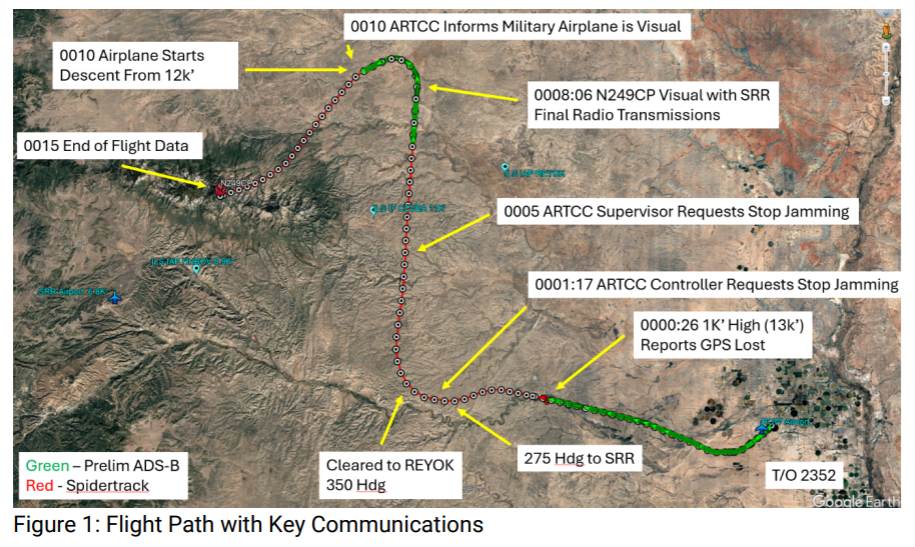 Courtesy: NTSB