Columbia City Council passes ordinance restricting ‘gray’ gaming machines

Olivia Hayes

COLUMBIA, Mo. (KMIZ)

The City of Columbia is continuing the crack down on unregulated gaming machines with a new ordinance.

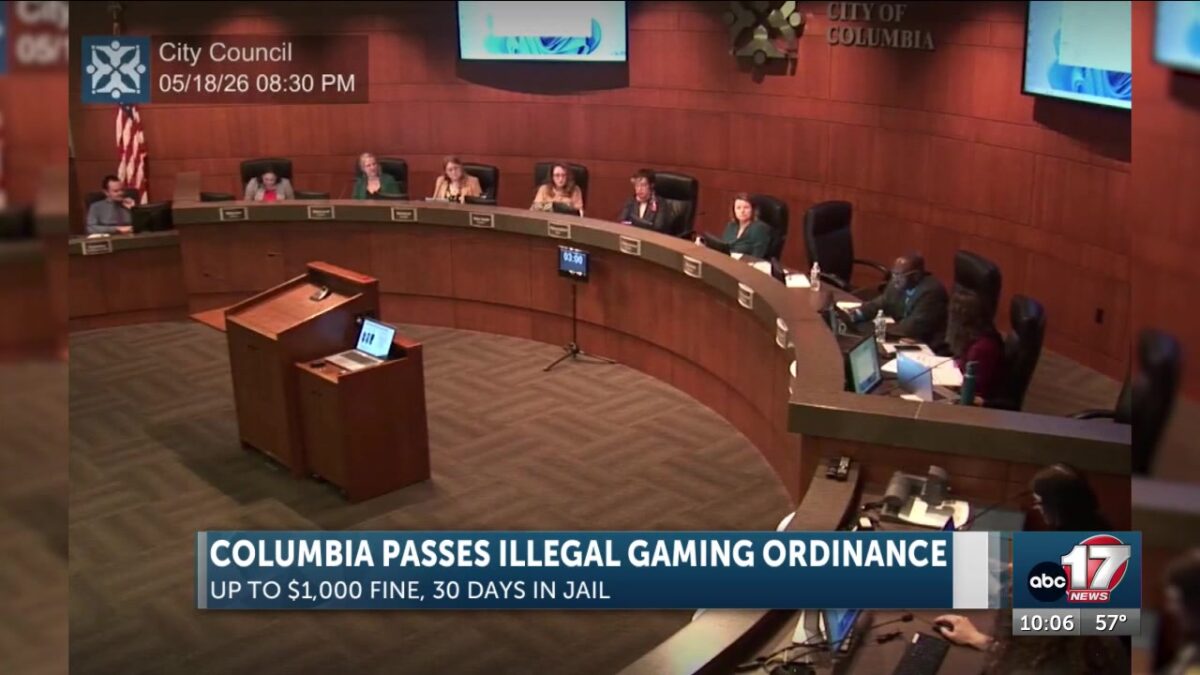
An ordinance was passed at Monday night’s council meeting against the maintenance and offering of illegal gaming or lottery machines.

Previous reporting shows the city has been targeting unregulated machines known as “gray machines” or “no-chance machines.” The machines have been described as being “skill-based,” which has brought up questions of legality.  The Columbia ban includes include a $1,000 fine or 30 days in jail.

Owning the machine is still not illegal, it just has to remain off and unused.

More than a dozen businesses allegedly operated an unregulated machine. The City Council looked to ban the use of those gaming machines as far back as February, but held off as the state appeared to have been moving forward with legislation at the time.

Anthony Gier, the owner of Eagle Stop convenience stores was charged May 12 in Boone and Miller counties after a statewide sting.

He was charged with four counts of first-degree promoting gambling in both counties. An initial court appearance is scheduled in Miller County for 9 a.m. Wednesday, June 10, while a hearing is set in Boone County for 1:30 p.m. Friday, June 26.

Similar felony and misdemeanor charges were filed on four other business owners.

On Feb. 10, Missouri Attorney General Catherine Hanaway also focused on unregulated gaming enforcement by suing five businesses with gaming machines in Dunklin County.

Click here to follow the original article.

Live Updates: Idaho May 2026 primary election results

News Team

Election Note: All results remain unofficial until they are formally certified by the State Board of Canvassers.

IDAHO (KIFI) — Polls are officially closed for the May 2026 Primary Election, and the numbers are now rolling in.

AP: Brad Little, Terri Pickens Win Idaho Gubernatorial Primaries

The Associated Press has called the nominations for Idaho Governor. According to unofficial results, incumbent Governor Brad Little has secured the Republican Primary.

Governor Little will face Democratic candidate Terri Pickens in the general election this November. The Associated Press projected Pickens as the definitive winner of the Democratic primary early Tuesday evening. As of 10:15 p.m. MT, Pickens maintained a comfortable lead over her primary field with 64.89% of the votes counted.

AP: Jim Risch wins Republican nomination for U.S. Senate in Idaho

The Associated Press has called the nominations for U.S. Senate, as of 9:34 p.m. According to unofficial results, incumbent Jim Risch has come out on top, securing the Republican Primary by 65.18% of all votes with 34/44 counties reporting.

AP: Simpson wins Republican nomination for District 2 U.S. House race

As of 10:12 p.m., the Associated Press has called the Republican Primary District 2 U.S. House race. According to unofficial results, incumbent Mike Simpson won his primary election with 62.83% of all votes, 21/26 counties reporting.

District 33A: Barbara Ehardt narrowly secures the Republican nomination

In one of the closest, contested races in Idaho Falls, incumbent Rep. Barbara Ehardt has narrowly secured the Republican nomination for Legislative District 33 Seat A by less than 200 votes, according to unofficial results.

With all 51 precincts fully reporting, Ehardt captured $51.59%$ of the vote to fend off a strong primary challenge from newcomer Connor Cook. Ehardt, who has served in the Idaho House since her initial appointment by former Gov. C.L. “Butch” Otter in late 2017, is now advancing to the November general election, where she will face Democrat Chance Marshall in the race to represent Idaho Falls in Boise. Marshall ran unopposed in the Democratic primary.

Bonneville School District Voters Approve $9.6 Million Supplemental Levy

Bonneville County voters have approved a $9.6 million-per-year supplemental levy aimed at closing a mounting budget gap for Joint School District 93. According to unofficial election results, the measure passed with 58.77% voter support.

While the ballot approved a $9.6 million annual levy for the next two fiscal years (running from July 1, 2026, through June 30, 2028), it functions as a replacement rather than an entirely new tax. The approval effectively cuts short the remaining year of the district’s previous $5.8 million annual levy, which was originally set to expire in 2027.

Rexburg Police Station Bond fails to reach supermajority for the second time

The Rexburg City General Obligation Bond has once again failed to pass, according to unofficial election results.

With all 16 precincts reporting, the bond narrowly fell short of the strict 66.67% supermajority required for approval under Idaho law. While a clear majority of participating voters—63.85%—supported the measure, it was not enough to secure the funding.

The bond was designed to fund the construction of a new city police station. According to the Rexburg Police Department, the current facility is severely outdated and plagued by numerous structural and operational issues.

This election marks the second time Rexburg voters have rejected the proposal. In 2025, a similar measure fell short of the same 66.67% threshold, garnering 62.6% approval. Ahead of this second attempt, city officials made adjustments to the project, reducing the estimated cost by approximately $3.29 million in an effort to win over voters.

City officials have not yet announced whether they will revise the proposal a third time or seek alternative funding methods for the facility.

Fuhriman defeats Young in Republican Primary Repeat

Representative Ben Fuhriman has triumphed in the high stakes remach with Julianne Young in a battle for the Republican nomination for District 30 Seat B, according to unofficial election results.

Voters turned out Tuesday, May 19, to settle the highly anticipated Republican primary, which served as a direct repeat of the 2024 race that came down to a mere four votes. This time around, District 30 voters gave Fuhriman a much wider margin of victory, securing the nomination with 53.65% of all votes with 2/2 counties reporting, as of 11:40 p.m. Tuesday.

Fuhriman now eyes the November 2026 election to secure his second term in the state legislature. He is set to face Democrat Breane Buckingham—who ran unopposed in the Democratic primary—to decide who will ultimately represent Bingham and Butte counties in Boise.

Refresh this page throughout the night for real-time results and breaking news as the ballots are finalized. For live election results, click HERE.

Caribou County Commissioner race ends in a tie

No winner in the Caribou County Commissioner race as it ends in a tie between two of the three candidates.

George Hulse and Tracy Davis earned 469 votes each in Tuesday’s election. Marty McCullough wasn’t far behind with 405 for third place.

According to Idaho Election Laws, the winner will be decided by a coin toss within two days after the canvass.

Click here to follow the original article.

4 Water Rescues in One Month: Sheriff’s Office urges boaters to prioritize safety this summer

Par Kermani

IDAHO FALLS, Idaho (KIFI) — Following four water rescues in just over a month, the Bonneville County Sheriff’s Office is urging residents to make boating safety a top priority this summer. In a statement Tuesday, SGT. Bryan Lovell warned that this year’s mild winter does not mean waterways are any less dangerous.

According to deputies, the recent emergencies involved vessels damaged by debris, mechanical failures, and boaters caught off guard by rapidly changing conditions. Strong runoff flowing through the Snake River and surrounding irrigation systems continues to create treacherous currents and hidden hazards beneath the surface.

“With the extremely cold temperature of the water and tendency for Idaho weather to change in an instant, a relatively calm ride on the water can very quickly turn into an emergency,” warned Lovell.

To prevent further emergencies, the Sheriff’s Office is encouraging boaters to plan ahead before heading onto the water, check local weather conditions before heading out, and ensure that everyone on board is wearing a life jacket.

For a full list and information about boating safety requirements and Idaho boating laws, click HERE.

Click here to follow the original article.

High costs and debt pressures prompt credit union’s spring financial reset

Harley Coldiron

BEND, Ore. (KTVZ) — OnPoint Community Credit Union is encouraging Oregonians to undertake financial “spring cleaning” amid ongoing cost pressures and rising household debt.

New data reveals that 53% of Oregonians are struggling to pay bills, and nearly half cannot cover a $500 emergency expense.

Meredith Bureau, Hillsdale branch manager at OnPoint Community Credit Union, highlighted the difficulty people face in building savings.”Spring is a good reminder to pause, take stock, and get organized to build a stronger financial foundation.”

The 2026 Oregon Financial Wellness Scorecard, published by the Oregon State Treasury, shows the widespread nature of these financial struggles. It found that nearly three of every four Oregonians are feeling cost pressures.

• Taking inventory of accounts, debt and recurring expenses to better understand cash flow

• Strategies such as a Home Equity Line of Credit (HELOC) to tackle high-interest debt, including consolidation or balance transfer options

• Aligning bill due dates with pay cycles and automating payments to avoid fees

• Identifying and trimming “convenience spending” like dining out or subscriptions

• Finding opportunities to lower monthly bills, from insurance to internet plans

• Turning spring decluttering into extra cash by selling unused items

Tidy payment schedules by aligning bills with paydays and setting up automatic payments to create more consistency. Trimming convenience spending can also free up money for savings or debt repayment. Americans spend an average of more than $3,600 on dining out each year, according to the U.S. Bureau of Labor Statistics.

Consumers can also sweep away extra costs from monthly bills by contacting providers for cell phone, internet, insurance and medical services to ask about lower-cost plans or discounts. Additionally, research published in the International Journal of Environmental Research and Public Health suggests clutter can interfere with financial well-being, contributing to indecision. Decluttering physical spaces may uncover items to sell, creating extra cash and reducing unnecessary spending.

OnPoint Community Credit Union offers access to financial experts at its 59 branch locations, providing one-on-one guidance. Bureau emphasized the cumulative effect of small adjustments. “Small changes can have a meaningful impact,” Bureau said. “The goal isn’t perfection. It’s creating a system that helps you feel more confident and prepared, even when costs remain high.”

Click here to follow the original article.

El Paso ISD may declare financial emergency, large-scale layoffs after review puts budget deficit at $52.8 million

El Paso Matters

by Claudia Lorena Silva

A public school consultant is recommending that the El Paso Independent School District declare financial exigency — similar to bankruptcy for educational institutions — and initiate a stabilization plan that could include mass layoffs in the face of an unexpected budget shortfall for the current school year.

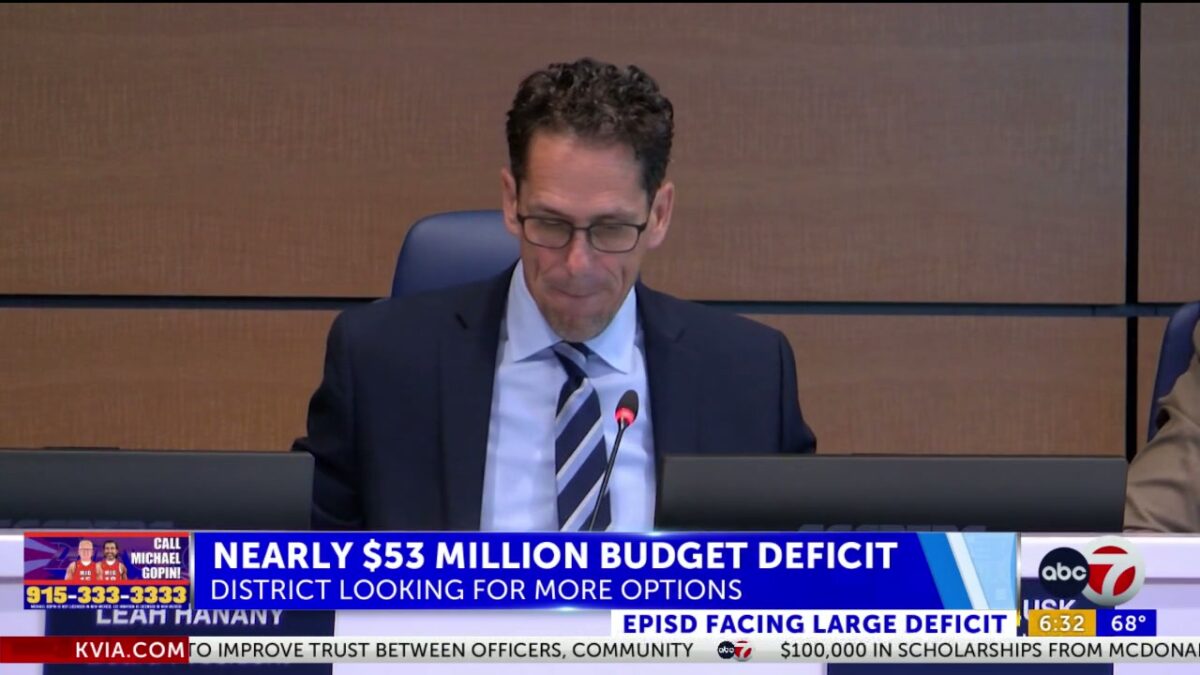
EPISD officials said the district is on track to spend $52.8 million more than it will make in revenue for the 2025-26 school year, after discovering significant systemic issues in how it was tracking its finances, the school board was told Tuesday. 

The $547 million budget adopted by the school board in June 2025 had called for a $6 million deficit, to be covered out of the district’s reserves. The budget was developed by then-Superintendent Diana Sayavedra, who resigned that month when it became clear she didn’t have support from a majority of the school board.

“El Paso Independent School District is currently experiencing significant structural financial pressure resulting from recurring expenditure growth outpacing recurring revenue growth over multiple fiscal years,” according to a presentation to the board by MoakCasey, an Austin-based public school consulting firm the district hired to conduct an audit this month. “Analysis conducted during this engagement indicates that the district’s current financial condition reflects both immediate operational pressures and longer-term sustainability concerns requiring accelerated corrective action.” 

The presentation recommends that the district declare financial exigency, a rare declaration by a school district that its financial resources can’t support its instructional programs or finance the full compensation of staff for the current or next fiscal year. 

EL-PASO-ISD-Board-Brief-1Download

The auditors didn’t specifically mention layoffs, but it is clear that they believe such a step will be necessary. The district’s payroll in 2025-26 exceeded the budgeted amount by nearly $22 million, auditors found. 

They recommend the district “establish clear, quantified budget reduction goals for the 2026-2027 fiscal year – grounded in recurring revenues, not one-time fixes.”

Without significant changes to its spending, the district could nearly deplete its savings by the end of the next school year, according to the presentation.

Superintendent Brian Lusk and Deputy Superintendent David Bates briefed the school board and the public at the meeting on the causes of the overspending and its implications.

In an interview with El Paso Matters ahead of the board meeting, Lusk said EPISD’s former chief financial officer, Martha Aguirre, who resigned earlier this month, deliberately withheld information on the budget from the superintendent and school board.

“We were not given accurate information or data to tell us where we stood. We were not neglectful and were really aiming at understanding. Just weren’t given clear information as to where we were,” Lusk told El Paso Matters.

Aguirre, who officially resigned May 6, did not respond to El Paso Matters’ request for comment. She served as interim superintendent last year before Lusk was hired in December.

READ MORE: Martha Aguirre, former El Paso ISD interim superintendent, resigns as CFO as district finds ‘key financial challenges’

District leaders initially told El Paso Matters they were expecting a $38.7 million deficit, which ballooned to $52.8 million after MoakCasey did more analysis.  

This is expected to wipe out half of the district’s savings, reducing its unassigned fund balance from $101 million to $49 million, leaving it with enough funding to keep running for about 38 days in an emergency.

The district estimates that without significant expense reductions, it would run a $42 million deficit for the 2026-27 school year, which would dwindle its savings down to $6 million, or enough to run for less than 12 days.

Texas school districts need enough reserve funds to run for at least 75 days to get an A in the Financial Integrity Rating System of Texas. Districts that get a failed rating multiple years in a row risk losing their accreditation.

Stabilization plan

The district’s financial issues are the result of “the cumulative impact of delayed intervention, fragmented accountability, unrealized budget assumptions, recurring expenditure growth, and insufficient alignment between operational decisions and long-term financial sustainability,” according to a brief from MoakCasey provided to the board.

One issue identified by the auditors is that employee salaries make up about 87% of EPISD’s operating expenses, giving the district little wiggle room for cutting costs. The district’s payroll expenses exceeded its revised budget by about $21.8 million, according to the presentation.

It also noted that the district’s self-funded health insurance program had become unsustainable and was relying on spending from the general fund to stay afloat.

El-Paso-ISD-Fin-ReviewDownload

To get EPISD’s finances back under control, MoakCasey recommended the district enact an immediate financial stabilization plan in the next 90 days to cut spending and commit to a long-term recovery plan that outlines its goals for the next five years.

As part of the plan, the firm recommended EPISD declare financial exigency, tighten its restrictions on spending, and review its staffing needs to align them with enrollment trends and the district’s ability to pay for them.

MoakCasey also recommended that the district adjust its health insurance program to ensure it is self-sufficient and does not need money from the fund balance to stay afloat, which could lead to increases in employees’ contributions and premiums.

‘Things that didn’t add up’

EPISD officials told El Paso Matters they were unaware of the skyrocketing deficit until Bates took over as interim chief financial officer May 8, two days after Aguirre resigned. Like Lusk, Bates came to EPISD from Dallas ISD.

Bates said the deficit increased because fewer students enrolled than were projected in the budget, and because the initial budget was adopted with incorrect assumptions about savings from vacant positions. He did not give specific details in an interview with El Paso Matters.

“We discovered that we were adopting a budget at the beginning of the year with some carryover money, with lapsed salaries, and with some amendments to staffing. The (actual) revenues and the expenditures just didn’t align. Also, the amount of kids we budgeted for, we didn’t quite get,” Bates said.

Lusk said there were also instances when employees were hired, and changes were made to the budget without first going to the board for approval.

The outside auditors found the district spent $11.2 million that was not accounted for in the budget. This includes almost $3 million in health savings account distributions, $2.4 million for changes in special education staffing guidelines, $681,000 to give employees an incentive to give an early notice of their plans to retire or resign, and $477,000 for leadership changes, among others.

They also found that the district budgeted $10.3 million in savings that were never realized.

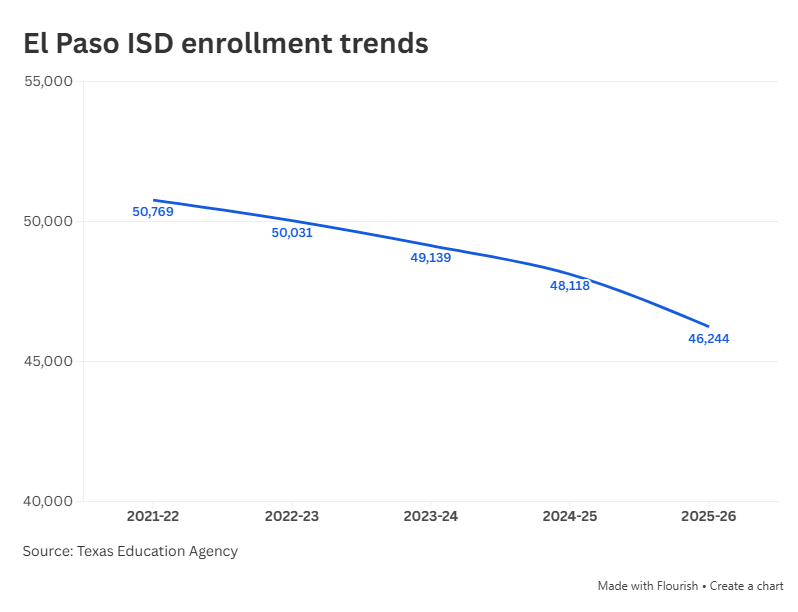
The 2025-26 budget approved by the school board included a projected enrollment of 47,121, a decline of about 1,000 students from the prior year. That was in line with enrollment declines in recent years, according to enrollment data reviewed by El Paso Matters.

But the district’s actual enrollment this school year was 46,244, a decline of almost 1,900 students, according to state data released in March.
(Courtesy: El Paso Matters, Flourish)

Because state aid is tied to student enrollment, the decline of almost 900 fewer students than budgeted reduced state aid by $6.1 million from what the district budgeted, according to El Paso Matters’ calculations.

The actual trends on key budget drivers like enrollment and expected payroll savings from vacant positions were known by the fall of 2025. Usually, school districts make mid-year budget changes to adapt to actual figures, but that didn’t happen in EPISD, Bates said.

“So there’s a lot of things that didn’t add up throughout the course of the first semester, prior to us arriving, that would be typical for any district that they could kind of right the ship along the way. Well, the ship kind of went off course,” he said. 

Bates said the new district leadership had focused this spring on developing a budget for the 2026-27 school year and didn’t see a need to examine the current year’s performance “based on the numbers that we were receiving in senior staff meetings.”

After Aguirre resigned May 6, Bates said he looked at the numbers for the current school year and discovered the huge emerging deficit. 

District officials said the 2026-27 budget likely won’t include pay raises. 

EPISD Board President Leah Hanany said multiple factors played a role in the exploding deficit.  

“I don’t think that you can put this on any one person in the organization. There must have been multiple people who were aware. So, there is definitely a systems failure and control somewhere that we expect to be addressed as a board,” Hanany said.

Hanany said the board chose Aguirre to serve as interim superintendent as the district transitioned leadership because they wanted someone who could focus on balancing the budget.

“The impetus for choosing the CFO at the time was because there could be somebody in the interim role that had the natural capacity to understand the finances,” she said.

Bates said the district hoped to chip away at the deficit by selling some of its land and buses and taking in grants before the end of the fiscal year on June 30.

SEE ALSO: EPISD weighs November bond election to upgrade schools amid school closures, tight budgets

Despite these newly discovered budgetary challenges, EPISD plans to ask voters to approve a nine-figure bond issue in November to improve its aging facilities and upgrade outdated air conditioners.

Voter approval of a bond issue could increase property taxes for homeowners and commercial properties. Lusk said the district will need to be transparent with voters about the district’s financial challenges and its need for improvements.

“We want to be open and upfront about what our financial landscape is. I think if we keep demonstrating that consistently over time, while not everything will be perfect, the community will realize that we will be honest about where we are,” Lusk said.

This is a developing story and will be updated.

Click here to follow the original article.

Full fixed-route bus service restored at Go COMO on May 26

Ryan Shiner

COLUMBIA, Mo. (KMIZ)

Go COMO, the City of Columbia’s public bus service, will restore its full fixed-route service on Tuesday, May 26, according to a press release from the city.

The bus system has been using combined routes since August 2023 because of staffing shortages. The release says the change back to full, fixed routes “is being implemented on a trial basis and is dependent on maintaining adequate staffing levels.”

All six routes – Green, Red, Black, Orange, Blue and Gold – will run throughout the day on weekdays from 6:25 a.m.-6:40 a.m. Three buses will serve all six routes on Saturdays, the release says.

The release says the transition is intentionally aligned with the University of Missouri’s summer break. Drivers who typically serve the MU Tiger Line will be reassigned to support the fixed-route service.

“Go COMO expects to continue hiring and training additional operators throughout the summer,” the release says. “The goal is to sustain full service beyond August; however, the continuation of this service level will depend on maintaining sufficient staffing. If operator availability declines, a return to the combined route system may be necessary.”

Click here to follow the original article.
Columbia safety officials defend proposed public safety sales tax amid business concerns

Mitchell Kaminski

COLUMBIA, Mo. (KMIZ) 

Columbia public safety leaders are making their case to voters after the City Council on Monday approved putting a proposed 1% public safety sales tax on the August ballot, saying the measure is needed to address decades of understaffing, aging facilities and increasing strain on the city’s general fund.

The tax would raise Columbia’s city sales tax rate from 7.975% to 8.975%, pushing it close to 9%. City leaders estimate the tax would generate about $38 million annually and dedicate that revenue solely to police and fire operations, including staffing, equipment and facility improvements.

According to city officials, the measure comes as public safety already accounts for nearly half of Columbia’s general fund spending. Chief Financial Officer Matthew Lue said public safety currently makes up 48% of the general fund, while sales and use taxes make up nearly 25% of the city’s general fund revenue.

If voters approve the measure in August, Lue said public safety would still account for roughly 45% of the general fund, about $60 million, but departments would also receive an additional $38 million through the dedicated sales tax, reducing the city’s need to rely on reserve funds to cover growing costs.

Columbia Police Department Chief Jill Schlude said staffing remains the most urgent issue.

“We’ve got to get some relief for our folks. We’ve got to get to a sufficient number of people, resources to respond to the things we’re being asked to respond to in a city of this size. And as some of the council members alluded to, this isn’t a problem that just started a year or two years ago. It’s compounded over well over 20 years. And so now we’re trying to dig out of that hole and hopefully stay out of it with this type of funding,” Schulde said during Monday’s City Council meeting.

“We got here because we fell behind, horribly behind by not increasing public safety staff staffing in accordance with the growth of the city. So we need to have that wiggle room so we can go, okay, how much did we grow this year? How much more capacity do we need? We’ve never had that approach in this city, and that is vital to staying caught up with us.”

Columbia Fire Department Chief Brian Schaeffer added the city’s growth has outpaced investments in emergency services.

“Now, the real work starts. We have an educational campaign where we have to go out and engage with the public and help them understand the real tangible benefits of their hard-earned money into making Columbia a safer community,” Schaeffer told ABC 17 News on Monday.

The city’s proposed spending plan includes adding 50 police officers and 40 firefighters during a four-year period, building a new police facility, constructing two new fire stations, renovating three existing stations, replacing equipment and vehicles, and developing a police and fire technology plan.

Schaeffer said the city has laid out specific goals tied to each request.

“There’s a plan and we’ve been completely transparent with the plan and every piece of equipment that we’re asking for or person has a purpose and has a measurable outcomes, whether it’s reducing violent crime or whether it’s improving your cardiac arrest save rate or stroke save rate, whatever, we run across as risk is a measurable thing,” he said.

Schlude said the tax would also help the city keep pace with rising technology costs, pointing to programs like license plate readers and drone response systems.

“Look at things like the Flock program, other safety programs I’ve been very open about. I think we need to look at drones as first responders. It’s another huge safety and workforce multiplier,” Schlude said on Monday. “All those things cost money and up to now, every time something new comes out that we feel could help not only the officers or the firefighters but the community, we have to come with our hand out to the council and they have to make these really hard decisions about where that money’s going to come from.

“Frankly, sometimes it’s coming while the time has come from reserves. So having a dedicated funding source to help keep up with those technology asks is so important because technology’s not going to stop in our profession.”

She also acknowledged public skepticism about how past city projects have been handled.

“I know there’s a lot of skepticism about past projects with the city, but also a lot of the projects that they’re talking about were not moved forward by the council,” Schlude said. “Obviously, any money we get through this fund still has to be allocated by council, but it’s a heck of a lot easier for them to allocate funds that’s already dedicated to us.”

Schulde also pointed to unfinished projects like the second floor of the city’s North Police Station as an example of the consequences of delaying infrastructure investments.

“I hear people say, ‘well, the second floor of the North Station still isn’t finished.’ Well, that’s because when that project was an ask in capital improvement, and we said, ‘Hey, we needed North Station.’ We waited so long to build it that construction costs escalated to the point where we couldn’t build the facility that we needed to build,” she said. “And so I think we’ve realized the error in our ways as a city about kicking that can, because we’ve done it with other projects, not just in public safety.”

ABC 17 News spoke with more than half a dozen business owners and organizations downtown on Tuesday. Most declined to comment publicly or asked to remain anonymous, citing either a lack of information about the proposal or concern that taking a position on a ballot issue could affect their business.

Among those who spoke generally, a common concern was the city’s sales tax approaching 9%, or exceeding that in some downtown districts where an additional 0.5% Community Improvement District tax is already in place. Some business owners said they worry higher taxes could discourage spending at a time when inflation and economic pressures are already affecting customers.

Mid-Missouri Peaceworks Director Mark Haim said the proposal raises concerns about the burden on lower-income residents.

“Peaceworks doesn’t take positions on elections, but what I will say is that the idea of having regressive taxation is pretty questionable,” Haim said. “We’re in situation where we are seeing an ever increasing chasm between the well-to-do and the people of very modest means, many of whom are out on the streets or living in very substandard housing. We need to really be looking at how to make our society more just and more economically viable for all participants.”

He added that even small tax increases can add up for families already struggling.

“Low-income people are hurting. They’re hurting badly. And to face more taxes is going to be really difficult. And it’s going to affect lots of people in what seem like small ways. But they add up and, you know, 1% here and 2% there, and pretty soon you’re approaching 10%. That’s a lot of taxation.”

According to city estimates, households earning around $15,000 annually would pay about $81 more per year if the tax passes, while households earning around $58,000 annually would pay an estimated $267 more.

That concern was echoed by resident Brenda Campbell during Monday’s City Council meeting.

“A one-percent additional sales tax can really make a difference in your that you receive. I’m retired, my husband is retired, so our income does not increase,” Campbell said. “I just know my expenses are these amount each month and one percent, especially for low income people can make a real difference.”

Columbia’s current 7.975% sales tax ranks seventh among Missouri’s 10-most-populous cities. For reference, St. Louis is at 9.6%, Kansas City 8.9%, and Springfield 8.1%. If approved, Missouri would be tied for fourth place at 8.9%.

Click here to follow the original article.

LCPD completes pledge to improve trust between officers, community

Mia Okubo

LAS CRUCES, N.M. (KVIA) — The Las Cruces Police Department pledged to improve trust between police and the community with the “Trust Building Campaign.” Part of the campaign includes hearing from residents through surveys, meetings and other events.

LCPD said it prioritized officer’s well-being and implemented trauma-informed response trainings to ensure officer safety.

LCPD Police Chief Jeremey Story said the campaign reinforced the department’s commitment and transparency in keeping the community safe.

“By focusing on transparency, accountability and meaningful engagement, we have strengthened the trust placed in us and reinforced our commitment to providing professional and respectful service to all,” Story said.

The initiative first was instated by the International Association of Chiefs of Police, which LCPD said is the largest influential police leader association.

The association gave LCPD a certificate of completion May 4, LCPD said.

Click here to follow the original article.

Columbia man pleads down to manslaughter in 2023 overdose death

Ryan Shiner

COLUMBIA, Mo. (KMIZ)

A Columbia man pleaded guilty to felonies in a case surrounding a 2023 overdose death.

Chase Rieves pleaded guilty on Monday to first-degree involuntary manslaughter, delivery of a controlled substance and two counts of drug possession. He was sentenced to 10 years in prison. He was previously charged with second-degree murder.

He was one of two people accused in the May 2, 2023, death caused by a fentanyl overdose.

Derek Miltimore pleaded guilty to second-degree drug trafficking, two counts of drug possession and one count of unlawful use of a weapon and was ordered to shock jail time and to complete a drug program.

Police found messages about a drug deal involving Percocet painkillers on the victim’s cellphone and traced them back to Miltimore and Rieves, according to court documents in previous reporting. Detectives searched a business on July 10, 2023, in connection with the investigation.

Click here to follow the original article.

$100,000 in scholarships from McDonald’s El Paso going to graduating seniors

Yvonne Suarez

EL PASO, Texas (KVIA) — Richard Castro, the owner and operator of El Paso area McDonald’s will continue his mission Tuesday to help Borderland students go to college.

McDonald’s El Paso, the University of Texas at El Paso and El Paso Community College will host the 2026 McDonald’s El Paso Scholarships Reception.

McDonald’s El Paso will award 18 high school seniors going to either UTEP or EPCC. In total, $100,000 will go to supporting the students’ journey to starting at either campus in the fall.

“The initiative’s sole purpose is to provide financial support to local, dedicated students who don’t have the financial means to realize their academic goals and seek an opportunity to better their lives through education,” said Castro, who founded the scholarship program. “By partnering with UTEP and EPCC, we take this initiative to a whole new level, enabling the cause to cover the tuition of a student’s entire first academic year.”

2026 McDonald’s El Paso Scholarship recipients:

   Natasha Aguilar  – Andress High School

   Frida Camacho – El Paso Leadership Academy East

   Yazline Chavez – Fabens High School

   Victoria Garcia – Socorro High School

   Aaron Garcia – Pebble Hills High School

   Valeria Hernandez – El Paso High School

   Zuley Lovato – Bowie High School

   Emily Martinez – Eastwood High School

   Itzel Ortiz – Canutillo High School

   Elijah Portillo – Americas High School

   Amir Torres – Riverside High School

   Hillary Bermudez – Socorro High School

   Maxine Ferrer – Montwood High School

   Kevin Lopez – Bowie High School

   Michael Martinez – Parkland High School

   Marley Medina – Bowie High School

   Chloe Melero – El Dorado High School

   Emiliano Rodriguez – Horizon High School

Click here to follow the original article.