Florida residents facing mounting frustration over health insurance companies denying prescription coverage

By Joan Murray

Click here for updates on this story

    MIAMI, Florida (WFOR) — Thousands of Floridians who pay for health insurance are encountering significant obstacles when attempting to fill prescriptions, as health insurance companies increasingly deny coverage for medications recommended by their doctors.

For some, the struggle has become a way of life. Marilyn Bach-Nunez, a 71-year-old retired advocate in Sunrise, cares for her daughter, Joy, who has a rare genetic condition causing chronic pain. Bach-Nunez, who has COPD and rheumatoid arthritis, said she has had to fight her health insurance provider to cover necessary prescriptions not on the official list.

“It makes me angry inside, especially because I worked my whole life,” Bach-Nunez said. She asserted, “The insurance companies are becoming our doctors, and they are not doctors”.

The Pharmaceutical Research and Manufacturers of America, or PhRMA, which lobbies for the industry and patient access, recently claimed a staggering number of prescription denials. “70 percent of patients face rejection on their initial attempt,” PhRMA said.

Health insurance companies dispute this. America’s Health Insurance Plans (AHIP), the industry’s trade group, countered in a statement that the research is misleading. AHIP alleged that “Brand drug makers bankrolled this misleading research to distract from the unaffordable prices they alone set and raise”.

In Fort Lauderdale, cardiologist Dr. Tiffany DiPietro reports that a prescription she writes for a patient is rejected almost daily. “All insurance companies have a formulary, so they want you to try what’s cheaper,” she explained. “But the best medicines are newer, one company makes it, and they set the price”.

The high cost means some patients in South Florida simply go without. Shirley Hanson, an 82-year-old home health aide, never picked up prescriptions to treat blisters on her arm. “I’m 82, and I’m still working. I can’t afford my prescriptions,” she said.

“In my humble opinion, they hope you give up,” Dr. DiPietro said of the denial process, noting she can spend “one to two hours on the phone hoping to get through”.

However, AHIP maintains that “Health plans approve the vast majority of claims and connect patients with care that’s effective, safe and as affordable as possible”.

Marilyn Bach-Nunez refused to give up. After two appeals and two and a half months, she is now paying $12.65 for her COPD medication, which has a shelf price of $765. She said that “within three or four days with this medicine, I wasn’t getting out of breath”.

What to do if your insurer denies coverage: Appeal the decision and work with your doctor on the appeal process before submitting it to the insurance company. Look for discounts online directly from the drug manufacturer and prescription cards. Apply for a grant from a nonprofit organization such as The PAN Foundation, which may offer a cheaper price on your prescription.

Please note: This story was provided to CNN Wire by an affiliate and does not contain original CNN reporting. This content carries a strict local market embargo. If you share the same market as the contributor of this article, you may not use it on any platform.

Ex-wife of Cuban spy involved in Brothers to the Rescue shootdown reacts to Raúl Castro indictment: “Betrayal at another level”

By Abby Dodge

Click here for updates on this story

    MIAMI, Florida (WFOR) — The ex-wife of a Cuban operative said her life transformed into a thriller from the silver screen after she learned her husband had been living a double life. Her comments came as she reacted to the recent indictment of former Cuban leader Raúl Castro in connection with the 1996 downing of a civilian aircraft.

Ana Margarita Martinez, the ex-wife of Juan Pablo Roque, described a mix of relief and lingering disbelief tied to one of the most painful chapters of her life.

“You can’t serve an evil regime like the Cuban regime and not be a sociopath,” Martinez said, referring to Roque.

Martinez met Roque in 1992 after he allegedly defected from Cuba. The two married in 1995. Martinez said he embraced a public life within Miami’s Cuban exile community, acting as a stepfather to her children and participating in humanitarian efforts.

“He was a partner, as far as I could see,” Martinez said. “Of course, I didn’t know that he was living a double life.”

Roque became involved with Brothers to the Rescue, a group that conducted flights to search for and assist Cuban rafters. Martinez said he helped pack supplies for those at sea and flew missions alongside volunteers.

The incident occurred on Feb. 24, 1996, when Cuban fighter jets shot down two unarmed Brothers to the Rescue planes in international airspace, killing three American citizens and one U.S. resident.

Martinez recalled that Roque told her he was leaving for a business trip the day before the planes were shot down. He later resurfaced in Cuba alongside Fidel Castro. “It was just surreal,” she said. ” It was unfathomable. There’s no justification for that.”

Authorities have alleged that Roque was part of a broader intelligence effort that infiltrated exile groups. Martinez noted he had worked closely with some of the men who were later killed in the incident.

Standing inside the historic Freedom Tower as news of the indictments was announced, Martinez said she felt a sense of long-awaited validation.

“I’m just feeling grateful that this has finally happened,” she said. “That the Trump Administration and Secretary of State Marco Rubio have taken this step.”

The indictment of Castro and others marks a significant development decades after the attack, which remains a defining moment for many in the Cuban exile community.

Please note: This story was provided to CNN Wire by an affiliate and does not contain original CNN reporting. This content carries a strict local market embargo. If you share the same market as the contributor of this article, you may not use it on any platform.

Marshall building catches fire

Ryan Shiner

COLUMBIA, Mo. (KMIZ)

A building in a Saline County town caught fire on Thursday.

The Marshall Fire Department told ABC 17 News that an 80-feet-by-100-feet building in the 3000 block of West Arrow Street was “fully involved.”

The department told ABC 17 News at 9 p.m. that crews were on the scene. Multiple photos of the fire had circulated social media and appeared to show daylight when photos were taken.

The cause of the fire was not yet determined. The representative from MFD did not have immediate information on possible injuries.

Check back for updates.

Click here to follow the original article.

Montgomery County man charged with several child sex crimes

Ryan Shiner

COLUMBIA, Mo. (KMIZ)

A Montgomery County man was charged on Thursday with several counts related to child sex crimes.

Dante Lawrence, of Jonesburg, was charged with three counts of statutory sodomy of a victim younger than 12 years old and three counts second-degree child molestation of a youth younger than 12 years old. A warrant was issued and no bond was set.  

Two probable cause statements were filed in the case. The first detailed four separate assaults when the victim was 9-10 years old and Lawrence was 20-21 years old.

A second probable cause statement describes another assault on a victim when they were 9 or 10 years old in 2019.

Click here to follow the original article.

Jefferson City man accused of robbing someone during video call

Ryan Shiner

COLUMBIA, Mo. (KMIZ)

A Jefferson City man was accused of robbing someone Tuesday night while he was on a video call on his cellphone, court documents allege.

Billy J. Reed, 30, was charged with first-degree robbery. He is being held at the Cole County Jail without bond. A court date has not been scheduled.

The probable cause statement says the victim went to the Jefferson City Police Department just after midnight Wednesday, about 30 minutes after the incident took place near Community Park.

The victim allegedly rode a single-wheeled scooter when Reed demanded for the victim to empty their pockets, court documents allege. The victim didn’t see a gun, but claimed Reed’s shirt was pointing and it appeared he was holding one under his clothes, the statement says. Reed was allegedly on a video call with family at the time the robbery allegedly occurred.

The victim gave up their keys and cellphone before getting away, the statement says. Reed allegedly then went into a home on Maple Street, the statement says. Police in the area were able to match a vehicle with Reed’s driver’s license and the victim was able to identify Reed through his driver’s license photo, the statement says.

Police tried contacting Reed and he eventually went outside his home to surrender, the statement says. Reed’s fiancé allegedly told police that the victim was the instigator and that Reed had left the victim’s belongings at a condemned building, which were eventually recovered by police, court documents say.  

Click here to follow the original article.

78-year-old Columbia man dies in Boone County crash

Ryan Shiner

COLUMBIA, Mo. (KMIZ)

A 78-year-old Columbia man died Thursday from injuries he suffered in a crash on Highway 63 just south of the Hinton area of Boone County, according to a crash report from the Missouri State Highway Patrol.

The report says the man drove his 1996 Saturn SL2 onto Highway 63 from a private road and drove into the path of a 2011 Toyota Prius that was driven by a 78-year-old Kirksville woman.

The 78-year-old Columbia man was pronounced dead at University Hospital, the report says. The Kirksville woman had moderate injuries and her husband – a 75-year-old Kirksville – was a passenger who had minor injuries, according to the report.

The Kirksville couple was brought to University Hospital by ambulance and both of them wore seatbelts, the report says. It is not known if the Columbia man wore a seatbelt.

Both vehicles were totaled. MSHP reports do not name those involved in crashes.

Click here to follow the original article.

Record-breaking Meth seizure in Idaho: $1.5 million worth of drugs confiscated

Abi Martin

CHESTER, Idaho — The Fremont County Sheriff’s Office says deputies have made the largest methamphetamine seizure in Idaho history following a traffic stop near Chester.

According to the sheriff’s office, the stop happened Tuesday morning along Highway 20 during routine patrol operations.

During the stop, deputies discovered and seized more than 115 pounds of methamphetamine. Authorities estimate the drugs have a street value of more than $1.5 million.

Two people inside the vehicle were taken into custody and are now facing felony drug trafficking charges.

The Sheriff’s Office says no additional information will be released pending the suspects’ arraignment.

Click here to follow the original article.

Montgomery County Commissioner defends Google data center amid pushback, concerns

Mitchell Kaminski

MONTGOMERY COUNTY, Mo. (KMIZ)

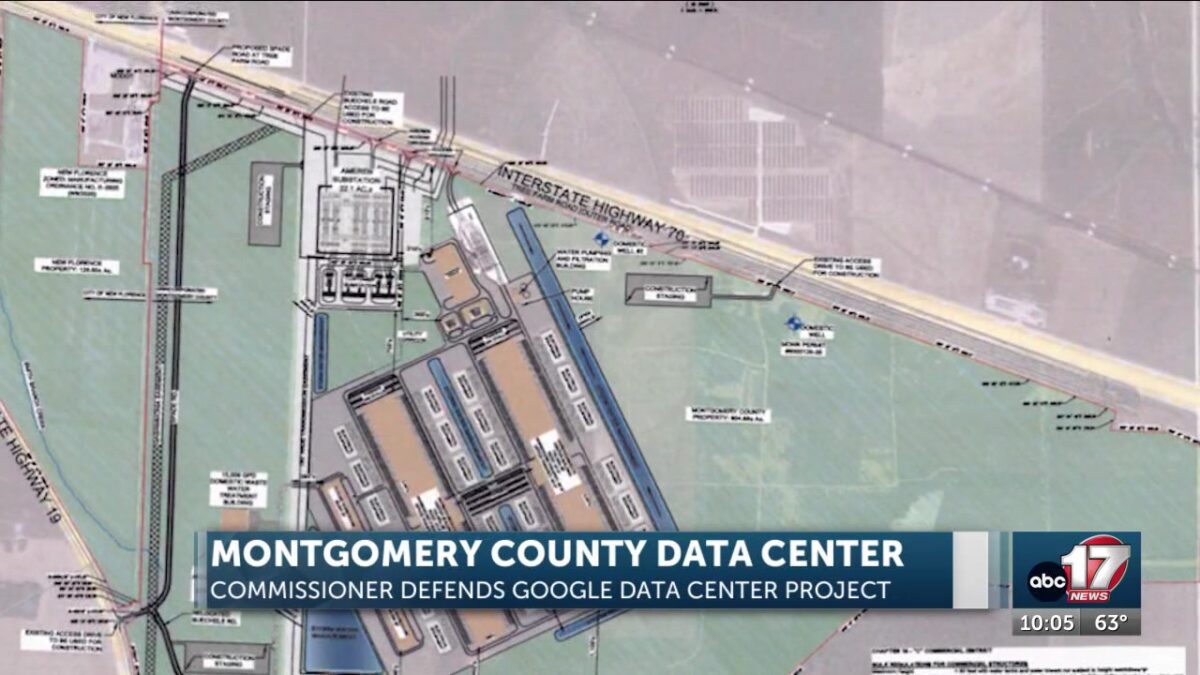
Montgomery County officials have released a cost-benefit analysis for a massive Google data center project that would use up to $100 billion in industrial revenue bonds and provide the company with an estimated $1.62 billion to $2.19 billion in personal property tax savings over 25 years.

The plan, prepared under Missouri’s Chapter 100 law for Kinetic Site Ventures LLC, a Google affiliate, calls for the county to issue taxable industrial revenue bonds not to exceed $100 billion to finance personal property, primarily computer servers, computing equipment and security systems, at a roughly 900-acre site near New Florence off Interstate 70.

Gov. Mike Kehoe joined executives from Google on Wednesday in High Hill to celebrate the company’s plan to build the data center. Google had announced a $15 billion investment into the project.

The county would take title to the equipment, lease it back to Google and receive lease payments covering bond debt service. No taxpayer funds would repay the bonds.

Google estimates investing between $56 billion on the low end and $87.5 billion on the end in personal property from 2026-29, with additional replacement investments of $3.5 billion to $7 billion every six years after. The company also plans about $13.4 billion in real property improvements, which receive no tax abatement.

Under the proposal, Google would make payments in lieu of taxes equal to 30% of what personal property taxes would otherwise be for most taxing districts during a 25-year abatement period from 2028-52, for an effective 70% abatement on personal property. The Montgomery County Ambulance District and New Florence Fire Protection District would receive 100% of their taxes. 

“The tax abatement is on personal property tax. So you do the Chapter 100 to kind of keep it more stable in there. And there’s no abatement on real estate taxes,” Montgomery County Commissioner Ryan Poston said. “One of the most crucial things in there about what we’re going to be able to do for communities with that in their.”

Google would pay full taxes on early equipment in 2027, estimated at about $7.37 million.

The company has committed to $5 million in annual community benefit payments once the data center has been completed. Eighty percent would go to the Greater Montgomery County Port Authority while the City of New Florence, the City of High Hill, the Wellsville-Middletown R-1 School District and the Gasconade County R-1 School District will each receive 5%. 

“The city of High Hill needs a water tower welded in and repainted, The city of High Hill’s budget is about $175,000 a year maybe, and they got about $9,000 in our road and bridge fund to fix roads. They don’t have the $200,000 to fix and paint this water tower, so maybe they can get a grant, maybe they couldn’t,” Poston said. “So you can start helping some of these other communities around the county with other stuff that they don’t have the money for. You’ve got industry in here paying the bills for them, trying to make every community better.”

The cost-benefit analysis must also maintain at least 75 high-wage jobs per building to qualify for the benefits. Poston defended the deal, telling ABC 17 News that the deal makes sense for Montgomery County. 

“You get the most bang for your buck out of something like this. I know there’s a lot of construction and moving parts going on now, and there’s going to be some massive buildings out there,” Poston said. “But it does not overload your public services and your infrastructure. Like if it was a car plant or a beef processing plant or something else where there’s thousands of jobs. You know, four or five thousand jobs compared to what these data centers are. And there’s just there’s so much false information going around,” Poston said.

Poston acknowledge some of the pushback the project received from the community, but alleged much of that was due to misinformation, particularly around the jobs it would create. 

“ I know in the cost benefit analysis it said 75 [jobs], that’s for the tax abatement, 75 jobs per building. Tristin from Google that we’ve been talking to said there will be 300 full time jobs between the two buildings,” Poston said. “Then you’ll have, like Amazon on the other side, probably the security will be a subcontractor, don’t know where the subcontractor’s from, but they still hire local people to work there. And you’ve got the outside maintence of the building so pushing and mowing grass and all that kind of stuff, all of that could be local, that could be a local landscaping company.”

Poston claims modern data centers have improved.

“I think a lot of the misinformation that you see now is on data centers from 15 to 20 or 25 years ago. They’ve learned from the mistakes of the past,” he said. “They don’t want to be bad neighbors. They don’t want you to see them. They don’t want you to hear them. And they want to do great things for the community.”

However, Avery Frank, who is a senior policy analyst at the Show-Me Institute, noted the primary benefits are tax revenue, not jobs.

“When you think of what can a data center bring to the community, the main thing they can bring is property tax revenue and sales tax revenue and personal property tax revenue. These are the main benefits that they have because these are really huge projects, the servers inside these data centers are also liable to be a personal property tax,” Frank said. “They don’t bring a lot of jobs because these are just buildings full of servers using the stored data for artificial intelligence.”

When asked about potential electricity concerns, Poston said Google will cover its own infrastructure upgrades.

“Google is going to pay for all those transformers, all the upgrades to get their power to that site, the power that they need. So you get a large load customer in here. It actually helped stabilize your rates, hardening your grid and make your grid better,” Poston said.

Frank added that Google’s air-cooled design will significantly reduce the impact on water usage. 

“With this Google project specifically, I read that they’re using air-cooled. And so when you use an air-cooled system, you use a lot less water, but you do use a lot more electricity because half of about half of the data centers’ electricity use is for cooling.”

The Google project’s tax incentives are substantially larger than those proposed for a nearby Amazon Web Services data center. Amazon’s plan forecast personal property tax breaks of about $244 million under a minimum build-out and nearly $1 billion at maximum, with a different PILOT structure. Google’s deal provides a flat 30% PILOT across most districts for the full 25 years, while Amazon will make full payment initially, then 5% for a decade, then 25% after that. 

Poston said a cost-benefit analysis hearing for Google’s proposal is scheduled for June 8.

These types of data center projects have begun popping up more frequently across the country. Frank says much of this has been driven by an arms race in artificial intelligence with China.

“This trend is very interesting, one, because it’s not just in Missouri, but it’s across the entire country. There’s a lot of desperation to get data centers online, some for the use of artificial intelligence. A lot of these hyperscale data centers are primarily for artificial intelligence,” Frank said. “As we continue to use those more, we’re going to need more and more data centers. Some is also for national security. President Trump noted that we need a mass build-out of data centers to win an AI arms race with China. So there are a lot of different reasons for this investment. But for a state like Missouri that’s been shrinking a lot, that’s pretty desperate for a lot of investment, this could be a really big deal.”

While Frank said he is not against data center projects, they need to be evaluated on a case-by-case basis. 

“Some might just completely overwhelm your water, some might completely overwhelm your electricity, some might want every single tax incentive you can get. And if they want every single tax incentive they can get, then that is not a good project,” Frank said. “If you’re a local community and you’re considering giving out a bunch of tax incentives, you shouldn’t do it because the tax revenue you get from a data center is the primary benefit you get from a data center.

“You’re not going to get a lot of jobs. You’re not going to get a lot of tourists, you’re not going to get a lot of accompanying development. If you’re not getting the tax revenue, you have a really big building that people are really angry about, and that takes a lot of electricity and it takes a decent amount of water and people and this is not worth the cost that a data center brings.”

Data centers nationwide have been met with pushback from residents. Columbia and Camdenton each passed one-year moratoriums this month on the applications and building of data centers.

Montgomery County residents late last year and earlier this year showed out against Amazon’s attempt to build a data center in the county. Residents and property owners also filed a lawsuit in February to halt its construction.

Click here to follow the original article.

Bunceton school board member pleads guilty to scamming district out of $385k

Ryan Shiner

COLUMBIA, Mo. (KMIZ)

A Bunceton school board member pleaded guilty on Thursday in federal court for her role in an alleged scheme that defrauded the school district out of $385,000.

Ashley Benny, 41, waived her right to a grand jury and pleaded guilty to wire fraud, according to a Thursday press release from the Department of Justice. Benny is currently listed as a school board member on the district’s website, but was described specifically by the DOJ as the treasurer in 2019.

She was asked to research “alternative investment options for the school district’s unallocated savings.” Court documents and the press release say she learned of a “supposedly lucrative overseas ‘standby letter of credit’ investment that carried no risk of loss.” Court documents say they were promised a 10% guaranteed rate of return over the next year.

The district went into a memorandum of understanding with a company called “AgFluent,” which was owned by a friend of Benny’s and that person’s boyfriend, court documents say. The district agreed to invest $385,000.

“The agreement further provided that the district’s $385,000 investment would—in addition to being held safely in an IOLTA account—be secured by [the boyfriend’s] 2019 hay crop,” court document say.

“The investment was a scam, and the school district was defrauded out of $233,000 wired overseas by AgFluent,” the press release says. “Contrary to AgFluent’s agreement with the school board, Benny then helped transfer the remaining school district investment funds to pay various other entities and expenses owed by a co-conspirator, including nearly $60,000 for the purchase of two semi-trucks and a $10,000 escrow payment on a failed land purchase deal.”

Benny was ordered to pay all of the money back and faces up to 20 years in prison. A sentencing hearing has not been scheduled.

Ashley Benny plea agreementDownload

Click here to follow the original article.

Report shows increased housing costs in Columbia, Boone County are among factors contributing to homelessness

Euphenie Andre

COLUMBIA, Mo. (KMIZ)

A 2025 report from the City of Columbia and Boone County Public Health and Human Services said corporate property buying is one of many factors impacting housing stability nationwide locally. The report also notes that keeping people in stable, long-term housing costs less than responding to homelessness after a crisis occurs.

Across the country, rent prices continue to rise. The U.S. Bureau of Labor Statistics reports rent inflation increased 3.3% as of April.

In Boone County, officials said the impact is already visible. For more than a decade, the county’s homelessness rate per 10,000 people has remained above the state average. In 2022, it even surpassed the national rate.

The county’s 2024 housing report also shows affordable rental options were shrinking. From 2023-24, apartments priced between $400-$599 a month dropped by 24%. At the same time, higher-priced units –ranging from $1,500-$1,900 — grew by more than 75%.

The 2025 report also emphasizes the cost difference between housing stability and emergency response systems.

Organizers broke down daily costs, showing that a permanent supportive housing voucher costs $13.76 per day. That compares to $40.55 per night for a local shelter, $49.50 per night for an extended-stay motel, and more than $80 per day to house someone in the Boone County Jail.

Those costs could continue to rise. Boone County Sheriff Dwayne Carey has asked commissioners to consider placing a three-eighths-cent sales tax increase on the August ballot to help address growing jail demand.

“This report shows our coordinated system is working – we utilized every available voucher and housed 152 households in 2025. The cost comparison demonstrates that permanent supportive housing, at $13.76 per day, is our most effective long-term response and our most compassionate approach. These numbers allow us to consider a plan that could be scaled to meet the documented need,” Carter Stephenson, a public health planner, was quoted in Thursday’s press release.

The report also shows the county’s efforts in battling the demand of homelessness.

While Boone County has added shelter beds over time, homelessness is increasing faster than available space. In 2025, 309 people were experiencing homelessness in the county, while there were only 298 available shelter beds.

The report also found that all city and county housing vouchers are currently in use. In addition, the number of people on the housing priority list declined from 338 in December 2024 to 265.

Click here to follow the original article.