Elderly man injured in fall at Black Butte Trail Head

Matthew Draxton

JEFFERSON COUNTY, Ore. (KTVZ) — An elderly man was transported to a hospital on Tuesday, May 5, after reportedly slipping and injuring himself on the Black Butte Trail Head. The incident was reported around 11:30 a.m., prompting a response from multiple local agencies.

Multiple local agencies collaborated in the rescue operation after the initial report of the injury. Jefferson County Search and Rescue led the response, with assistance from Sisters Camp Sherman Fire and Rescue as well as Deschutes County Sheriffs Office.

Click here to follow the original article.

Gem State Shows Up: Idaho Gives passes $4 Million milestone on last day of giving

Seth Ratliff

IDAHO FALLS, Idaho (KIFI) — The clock is ticking for Idahoans to get involved in the state’s largest annual donation drive. Today, Thursday, May 7, marks the final day of Idaho Gives, the statewide campaign dedicated to supporting local nonprofits.

As of Thursday morning, the generosity of Idahoans is already on full display. The campaign has surged past the $4 million mark, with donations continuing to pour in for hundreds of organizations across the Gem State.

Organizers say hundreds of Idaho-based nonprofits are participating this year, representing a wide range of causes, including housing, education, community services, and the arts.

Idaho Gives is designed to raise both funds and awareness for nonprofits serving communities throughout the state. For a full list of participating organizations or to donate, click HERE.

Click here to follow the original article.

Deschutes County prepares for fire season with alert system test May 13th

Matthew Draxton

DESCHUTES COUNTY, Ore. (KTVZ) — Deschutes County residents are preparing for fire season this May as the Deschutes County Sheriff’s Office of Emergency Management rolls out a community-wide awareness campaign. A key part of this effort includes a countywide test of the Deschutes Alerts system, scheduled for May 13 at 1:00 p.m.

The test aims to strengthen residents’ readiness for fire season and ensure the emergency notification system functions properly. It also provides an opportunity for more than 70,000 registered residents to confirm or update their contact information.

The annual test is critical for system reliability. Residents can verify their phone numbers, addresses and any special assistance needed during an evacuation are up to date. These details are vital for receiving timely and urgent information, including evacuation notices, as wildfire season approaches.

Deschutes County Sheriff Ty Rupert emphasized the shared responsibility in wildfire preparedness. “Wildfire preparedness is a responsibility we all share,” Rupert said. “Taking a few minutes this month to check your alerts, understand evacuation levels and talk through a plan with your family can make all the difference when a real emergency hits.”

During May, residents are encouraged to focus on four core actions. These include signing up for Deschutes Alerts, the county’s primary emergency notification system for urgent information and evacuation notices. Residents can customize these alerts for their home, work or school at deschutesalerts.org.

Another key action is understanding the three evacuation levels: Level 1 for “Be Ready,” Level two for “Be Set” and Level 3 for “Go Now!” Authorities advise that leaving early is the safest option when conditions change quickly.

Residents should also build or refresh a 72-hour kit. This essential kit should contain food, water, medications, important documents, pet supplies, chargers and cold-weather clothing. Preparing such a kit helps ensure self-sufficiency during an emergency.

The final recommended action involves preparing homes and neighborhoods. This includes creating defensible space around structures, securing heavy items, safely storing flammable materials and checking in with neighbors who may require extra help in an emergency. The Sheriff’s Office website offers additional wildfire-readiness tools, evacuation guidance, shelter information, animal-evacuation resources and home-safety checklists.

The Wildfire Preparedness Month campaign, with its focus on encouraging residents to sign up for alerts, understand evacuation levels, build 72-hour kits and prepare their homes, will continue throughout May. The countywide test of Deschutes Alerts will proceed as scheduled on May 13 at 1:00 p.m.

Click here to follow the original article.

Summer learning grant awarded to Jefferson County School District 509J

Matthew Draxton

JEFFERSON COUNTY, Ore. (KTVZ) — Jefferson County School District 509J has received a three-year summer learning grant from the Oregon Department of Education. The funding will allow the district to sustain its summer programming for students at no extra cost. This initiative aims to strengthen literacy and support student success across all grade levels.

The district was one of only two in its region to be awarded this competitive grant.

The grant provides approximately $478,860 in annual funding over the next three years. This support benefits more than 500 students in grades K-12.

The program’s goal is to improve student achievement in academic areas.

The summer acceleration program will be offered at Bridges High School, Madras Elementary School and Madras High School. It will run Monday through Thursday, starting on July 20 and concluding on Aug. 6.

Warm Springs K-eight Academy has historically served as a program site. However, its campus will be unavailable this year due to a major construction project. Students who attend Warm Springs K-eight Academy will attend the summer program at Madras Elementary.

The district will offer transportation for students in need and provide meals to all summer program participants. The program provides opportunities for academic enrichment designed to help students meet state standards in subjects including reading and language arts, math and science.

Students will have many opportunities for science, technology, engineering and math-based learning that sparks curiosity. Hands-on activities will make learning engaging. There will also be a strong daily focus on English language arts and math.

Superintendent Jay Mathisen emphasized the importance of the funding for student development. “This competitive funding allows our district to continue to invest in a meaningful and robust summer program that offers additional support to students across all grade levels,” Mathisen said. “We are thankful to receive this funding which allows us to offer these programs that support our students’ growth and ensure they flourish here.”

Jefferson County School District 509J serves approximately 2,650 students across Jefferson County, Ore. The district is committed to uniting to empower culturally enhanced learners to shape the world. Its core values are Students Flourish Here, We Care for Each Other and Better Every Day.

More information on registration and program schedules is available on the district website. Families are encouraged to visit the website to learn more about the programs.

Click here to follow the original article.

Overflowing Idaho prisons are sending women with good behavior to ‘the hole’ 

InvestigateWest

By Whitney Bryen / InvestigateWest

IDAHO (InvestigateWest) — On the nearly four-hour drive from a southeast Idaho prison, Kristine Scott was optimistic. One of 15 women transferred on April 3 to a minimum security prison in Boise, Scott was told she’d work at the community reentry center and live in one of the least restrictive facilities in Idaho’s prison system. 

But when the women arrived at the South Idaho Correctional Institution, Scott said staff told them there weren’t enough beds available in the dorms. Instead, she and five other women were led to a segregated housing unit usually reserved as punishment for inmates who violate the rules or pose a safety risk — a unit known to prisoners as “the hole.” 

For 23 hours a day, the women were confined in pairs to small cells with only a bunk bed, sink and toilet, said Scott, who is serving a four-year sentence for drug possession. Every morning at 7, Scott and her roommate were handcuffed and taken to what women described as a 4-by-5 foot cage outdoors for an hour of recreation. Except for a 10-minute trip to the showers every other day, it was the only time they were allowed out of the cell. They couldn’t see or speak to other inmates. Their communication with family and friends was limited. And they had no idea how long they would be there. 

“They’re treating us like we’re in trouble when we haven’t done anything,” Scott said. “I got moved from a work center to be stuck in the hole. So we’re basically being punished even though we’ve had good behavior.” 

Idaho’s tough-on-crime policies have led to the highest women’s incarceration rate in the nation, according to state and federal data. Only six states have a higher men’s incarceration rate, the federal data shows. Idaho’s rapid rise in incarceration rates has left the state with more prisoners than space to house them, and those already incarcerated say they’re unfairly being punished for it.

Ritchie Eppink, a civil rights attorney at Idaho’s Wrest Collective, said placing inmates in segregation because of overcrowding is a symptom of Idaho’s “addiction to incarceration.” It also violates prisoners’ civil rights, regardless of why they’re being isolated, he said.  

“The research is clear that this kind of segregation, isolation, putting people in solitary confinement conditions causes long-lasting harm, even over very short periods of time,” Eppink said. “It has mental health consequences that can be long lasting. It impacts people’s anger and ability to cope with the conditions of their imprisonment. And it’s counterproductive for the prisoners, for the staff and for society.”

The Department of Correction, which declined interview requests for this story, posted on its website in March that it is “operating at over 100% of capacity requiring the department to implement short-term solutions” such as moving hundreds of men to prisons out of state. That will free up bed space in Idaho men’s facilities for now, but women’s prisons are bursting at the seams, which could mean more reliance on segregation cells for overflow housing. 

Idaho prisons have the capacity for 1,184 women, according to an April 22 email from the department. That day, there were 1,188 women in custody.

The Idaho Department of Correction has moved hundreds of incarcerated men to out-of-state prisons far from their families to in response to Idaho’s rising incarceration rates. (Provided/Idaho Department of Correction)

The decision to subject women to segregated housing restrictions for non-disciplinary reasons defies state policy, along with state and national efforts to limit such practices. The nonprofit Vera Institute, which works with prisons to reduce the use of segregation, found that restrictive housing leads to “unwanted and harmful outcomes for the mental and physical health of those in isolation, the well-being of staff, facility safety, corrections budgets of jurisdictions that rely on the practice, and the public safety of the communities to which most will return.” 

Restrictive housing is meant to protect staff and inmates from “those who are the most violent or present the greatest danger to the safe operations of the facilities,” according to Idaho Department of Correction policies. Those policies also allow inmates to be moved to a restrictive housing unit if a bed is not available in the appropriate housing unit when they arrive at a facility. This places them in “transit status,” which the policy states is “not a form of restrictive housing even if the inmate remains in the restrictive housing unit.” The standards require inmates to be allowed out of their cell for at least three hours a day, have access to their personal property and attend visits. 

But current and former inmates said staff at South Idaho Correctional Institution are violating department policies. 

InvestigateWest interviewed five women who were placed in segregated units at the Boise prison since 2020 due to overcrowding. Scott and her roommate spent five days in segregation, according to Department of Correction records. Others were there for weeks. Some of the women were allowed to have personal items. Others were not. All of them said they were confined to their cell for 23 hours a day. 

“For me it was the most depressing and humiliating time I had in the three years I was incarcerated,” said Tena Bishop, who spent two weeks in segregation waiting for a bed after she was transferred to the Boise prison in 2023. “Segregation is the worst time anyone can do. It makes you suicidal.”

The Department of Correction refused requests for an interview about how it’s addressing overcrowding and its use of segregated housing for overflow. In an email, the department said only that “restrictive housing and segregation units continue to be used according to standard protocols.”

Idaho has the highest women’s incarceration rate in the nation, according to federal data, leading the state to spend $182.5 million on a new women’s prison that will house 512 inmates. The project broke ground in the fall and is expected to be completed at the end of 2027. (Provided/Idaho Department of Correction)

Efforts to reform Idaho’s use of restrictive housing in prisons began 10 years ago following a class action lawsuit and public scrutiny over violence at a privately run Idaho prison.  

In a 2016 interview with Solitary Watch, a nonprofit newsroom that covers prison conditions, then-Department of Correction Director Kevin Kempf said Idaho had reduced the number of segregation cells by more than 25% and that “the only type of inmate that [we] will still have in a temporary segregation cell, is an inmate that has demonstrated a true threat to other inmates or to a staff member.” 

The following year, department leaders and prison staff received training on new policies that limited the amount of time prisoners can spend in segregation and its use as punishment for rule violations. The reforms did not address the use of restricted units for overflow housing. 

The Department of Correction broke ground last fall on a new women’s prison south of Boise that will house an additional 512 inmates. But the facility, which will cost taxpayers $182.5 million, won’t be ready for inmates until at least the end of 2027, leaving the department with few options for managing overcrowding.

It’s unclear what protocols prison staff are using to determine which inmates are sent to segregation once the minimum and medium security beds are full. Eppink, the Wrest Collective attorney and former legal director for the American Civil Liberties Union of Idaho, said a lack of transparency around how and why these kinds of decisions are made suggests that prison staff know they’re doing something they shouldn’t. 

“IDOC is trying to deal with a problem that it’s not prepared to properly address,” Eppink said, referring to the Idaho Department of Correction. “And that is when civil rights and human rights abuses begin.”

Isolation, even with a roommate, can leave prisoners with feelings of hurt, exclusion, rejection or loss that can linger for months or even years, according to a 2020 report from the Prison Policy Initiative, which studies and advocates for the rights of incarcerated people across the U.S. 

“Prisons and jails are already inherently harmful, and placing people in solitary confinement adds an extra burden of stress that has been shown to cause permanent changes to people’s brains and personalities,” according to the report.

Studies on the negative effects of segregation have prompted prisons across the country to reform not only segregation protocols, but other housing units as well. Since 2009, at least 42 states have laws limiting how long prisoners can spend in solitary confinement or banning its use for pregnant, mentally ill or LGBTQ inmates, according to the Brennan Center for Justice, which advocates policies to protect prisoner rights. Idaho is not one of them. 

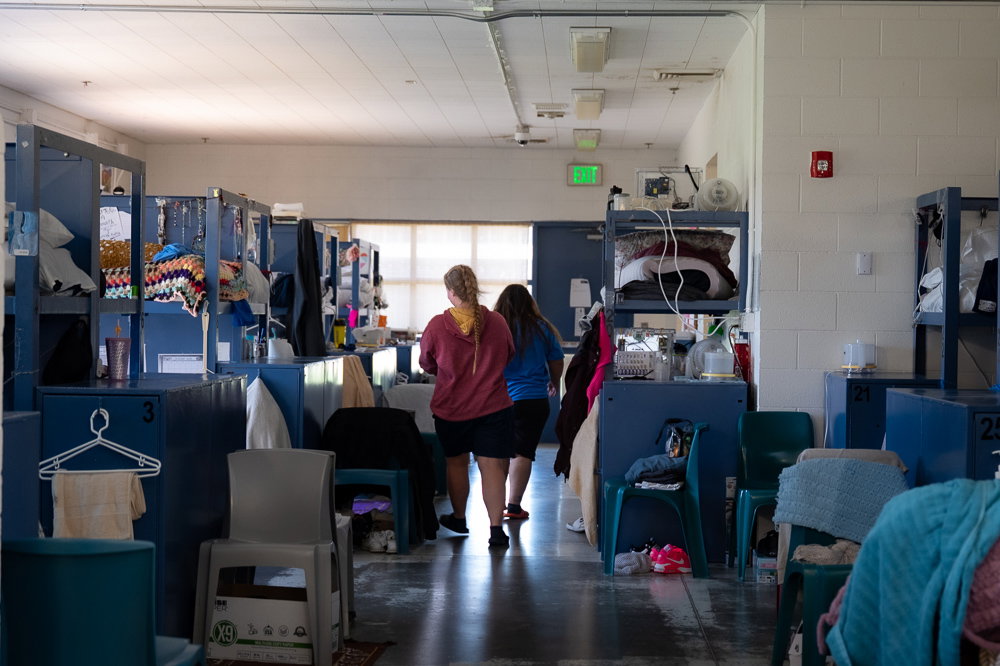
During that time, the Idaho Department of Correction has implemented internal policies and protocols aimed at reducing its use of segregation and improving the treatment of inmates, who are referred to as “residents” by prison staff. Improvements to Idaho’s minimum security facilities make some living spaces look more like dormitories than cells. The unit Scott expected to move into when she arrived in Boise is a large open room with dozens of bunk beds, several windows with natural light and a recreation area with a couch, television, microwave and tables where women play cards and eat together. They have access to a gym and an outdoor track. One wall hosts a row of phones while another holds machines that inmates can use to message family and friends. 

That’s similar to the unit where Bishop lived in Pocatello before she was transferred to Boise on May 4, 2023, to be closer to her family. Other inmates warned her that she might be put in segregation when she arrived. It had happened to them and others they knew, and they wanted her to be prepared. As the bus passed the cage where segregated inmates spent their hour of allotted recreation time, Bishop was certain it wouldn’t happen to her. But then she learned from staff that there were no beds available in the unit where she was slated to go.

Bishop, who was convicted of selling drugs, was forced to give up her personal belongings that included food she purchased from the commissary and letters from her daughters. She couldn’t take her sweatshirt or extra underwear. She would get it all back when a bed opened up in the less restricted units. 

Bishop spent two “degrading” weeks in the hole, she said. It’s where she ate every meal, stared out the tiny window in the door and used the bathroom with her roommate sitting nearby. Bishop opted not to go outside for recreation time, she said, “because I was not going to be out there like a dog in a cage.” 

The only time she left the cell was to take a shower twice a week. 

“It was devastating to me,” Bishop said. “I felt like I was dehumanized. It’s just inhumane treatment.”

InvestigateWest (investigatewest.org) is an independent news nonprofit dedicated to investigative journalism in the Pacific Northwest. Contact reporter Whitney Bryen at whitney@investigatewest.org or 208-918-2458.

Click here to follow the original article.

ABC-7 sits down with UMC’s first female CEO

Rosemary Garcia

EL PASO, Texas (KVIA) — Maria Zampini is off to work as University Medical Center of El Paso’s new chief executive officer. The native El Pasoan has been with UMC for more than 30 years now, marking an exciting step in her career — and the hospital’s history as its first female CEO.

Zampini is a Coronado High School graduate and obtained both a bachelor’s degree and a master’s degree in Business Administration from UTEP.

She began at UMC in 1993 when the hospital was still known as the Thomason General Hospital. Zampini was a Nursing Development Coordinator. She has been the Chief Operating Officer since 2013.

This change at UMC is part of an overall organizational restructure. UMC said Zampini will still report to Jacob Cintron, who is the CEO and President of the El Paso County Hospital District.

Zampini said that over three decades ago she never imagined she would one day become the hospital’s CEO. She feels humbled to enter this new role.

“One of the things that you always want to do is mentor others and make sure that there’s others that are also following along and that say, ‘Hey, I can do this.’ This is something that women can do in nontraditional roles,” she told ABC-7.

During her time as COO, Zampini oversaw multiple bonds, expansion projects, and facility renovations.

In November 2024, El Paso taxpayers approved UMC’s $396 million bond for more than 20 projects to improve the UMC campus, increase healthcare access points and develop a burn center. ABC-7 asked Zampini how these projects are moving along.

“This is the part of any bond where it doesn’t seem like a lot is happening because you’re not seeing the cranes. But so much has happened. We’ve done a lot of outreach to the local community for contractors and other vendors we’ve been working on that. We’ve secured architects, we’ve secured properties. And so it’s going very well, and it’s on pace for where it should be in this, in this point of a construction project.”

Zampini said the bond projects that will be completed first are an observation unit and the rehabilitation facility.

ABC-7 also asked Zampini how she plans to address financial pressures and staffing shortages at UMC.

“I think that that’s something that we talk about on a daily basis, right? Those are the things that we’re always looking at is how can we do things a little better? How can we be more cost-effective? And the things that we’re doing, how do we recruit?”

ABC-7 asked the new CEO how she plans to be transparent with the community and taxpayers.

“I think transparent means that we’re constantly communicating about what we’re doing and how we’re doing it, and that’s something that we strive for and that we’ve been doing with, with everything that we do.”

The new CEO said University Medical Center of El Paso continues to adapt to the growth of the El Paso community and meet the needs of patients.

Zampini said she’s been at UMC for so long because she’s passionate about improving the quality of life of UMC patients.

“You can see that whatever we work on actually changes people’s lives. And so there’s an impact, to, the community. That’s very positive.”

For now, Zampini said she will continue to listen to various stakeholders, help execute current projects and continue UMC’s mission.

Click here to follow the original article.

Prescribed burn on Pine Mountain canceled due to unfavorable conditions

Matthew Draxton

BEND, Ore. (KTVZ) — Prescribed burn ignitions on Pine Mountain, located 14 miles southeast of Bend, were cancelled for Thursday due to unfavorable conditions. The area remains temporarily closed to traffic and recreation.

The Pine Mountain area closures include Forest Service Road 2017 and Pine Mountain Campground. These closures are expected to remain in place for multiple days while firefighters conduct mop-up and patrol operations after the prescribed burn is complete. Prescribed burns can protect homes from tragic wildfires.

The temporary closure to traffic on Pine Mountain affects off-highway vehicles and paragliding. Dispersed recreation opportunities are also unavailable during this period. Firefighters will reopen roads and recreation sites after assessing conditions and determining they are safe for the public.

Fire management officials plan prescribed burns in coordination with Oregon Department of Forestry smoke specialists. These burns are conducted when weather conditions are most likely to move smoke up and away from local communities. While preventive measures are taken, communities may still experience some smoke during or immediately after a prescribed burn.

For additional information on prescribed burning in Central Oregon, the public can visit centraloregonfire.org. Information specific to the Deschutes National Forest is available at fs.usda.gov/deschutes. Updates are also provided on X @CentralORFire, and wildfire and prescribed fire text alerts can be received by texting “COFIRE” to 888-777.

Closures will remain in place for multiple days. Firefighters will reopen roads and recreation sites once conditions have been assessed and are determined safe for the public.

Click here to follow the original article.

The School Buzz: Mesa Ridge HS senior wins prestigious full-ride Boettcher Scholarship

Josh Helmuth

COLORADO SPRINGS, Colo. (KRDO13) — A local high school senior just earned one of the most competitive scholarships in the state — and with it comes a full-ride to any Colorado university.

It’s called The Boettcher Scholarship. And Irene Gbogi-Emmanuel, from Mesa Ridge High School, is the newest recipient.

In fact, Gbogi-Emmanuel called it a life-changing moment.

She plans to attend CU-Boulder with her sights set on medical school, which is appropriate since she comes from a family of nurses.

“I’ve heard a lot about what they don’t like. I feel like to make changes in the world, you have to be one to do change. So, I want to do the change,” said Irene.

She also thanked her teachers, saying they helped her succeed along the way.

Is there someone or something remarkable at your school? Email us! SchoolBuzz@KRDO.com

Click here to follow the original article.

Gov. Kehoe seeks disaster declaration for April storms

Matthew Sanders

JEFFERSON CITY, Mo. (KMIZ)

Gov. Mike Kehoe is asking for federal assistance to help the state recover from storms that hit in late April, including several Mid-Missouri counties.

Kehoe is asking FEMA to take part in damage assessments of public infrastructure for 11 counties, including Chariton, Howard, Monroe, Randolph and Saline, his office said Thursday in a news release. Assessments for assistance for individuals are being requested in Randolph and Saline counties.

Nearly 200 uninsured homes and businesses were damaged by the storms that rolled through the state from April 23 to April 28.

The storm outbreak dropped twisters in Randolph, Chariton, Howard, Saline and Monroe counties.

Kehoe’s office said in a news release that the assessment request is the first step toward a federal disaster declaration.

Click here to follow the original article.

Charges against Mizzou linebacker dropped; will be refiled

Matthew Sanders

COLUMBIA, Mo. (KMIZ)

Boone County’s prosecutor’s office has dropped charges against a freshman Mizzou linebacker, who allegedly tried to evade police who were pulling him over.

Jaden Jacobi “J.J.” Bush, 18, of Theodore, Alabama, was charged earlier this week with aggravated fleeing — a felony — and misdemeanor reckless driving after he was arrested and booked into jail and posted bond.

A probable cause statement says a Columbia police officer saw a white 2024 Ford Mustang speeding near East Broadway and Old Highway 63 on Monday night. Bush turned west onto East Broadway, and the officer turned on his lights for a traffic stop, but Bush kept driving for 24 seconds, the officer wrote in the statement.

Bush had a 19-year-old passenger in his vehicle when he was stopped at East Broadway and Old Highway 63 south, the statement says.

Boone County Prosecuting Attorney Roger Johnson said charges will be refiled.

Click here to follow the original article.