“USMCA trade agreement sustains border’s economy,” business leader say

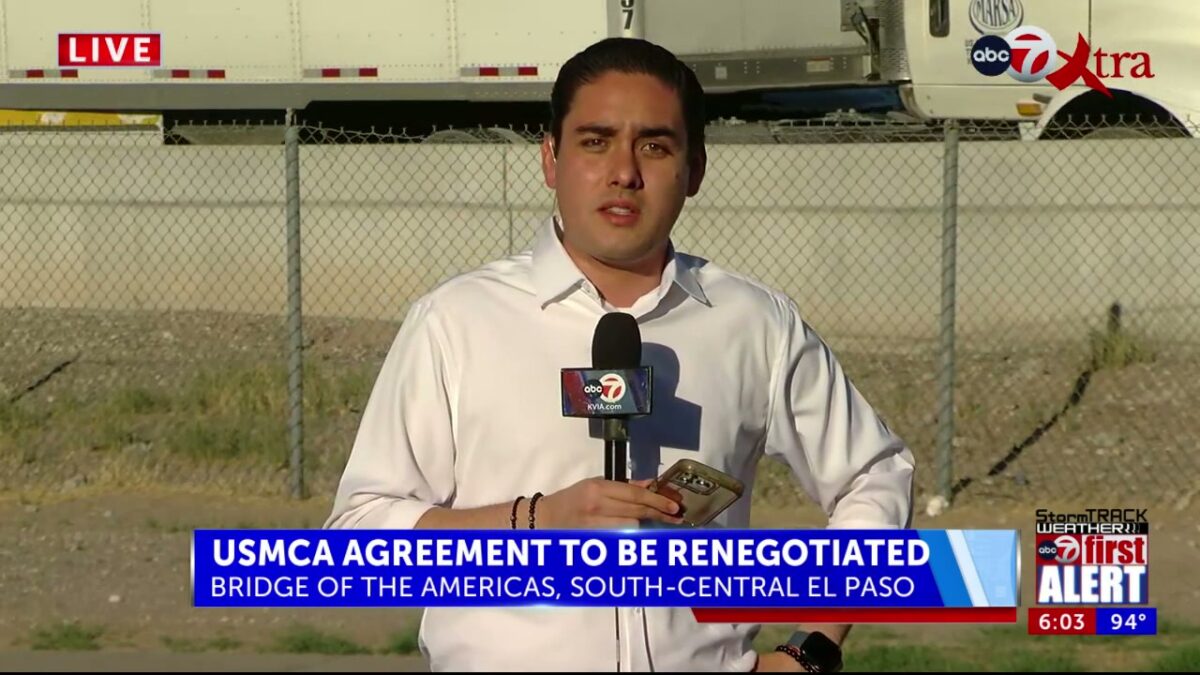
Heriberto Perez Lara
EL PASO, Texas / CIUDAD JUÁREZ, Chihuahua (KVIA) — Last Monday, the renegotiation of the Free Trade Agreement, or USMCA, between Mexico, the United States, and Canada got underway, a development announced by Mexican President Claudia Sheinbaum weeks ago.
According to the Mexican Importers and Exporters Association (ANIERM), the USMCA trade agreement sustains Juárez’s economy and maquiladora industry.
ANIERM regional delegate in Chihuahua, Marcelo Vázquez Tovar, says the renegotiation of the USMCA is not merely a matter of foreign policy; it is a matter of economic survival, evolution and it is critical because the USMCA underpins the economy of Juárez.
“I dare say that we are the border region most dependent on the USMCA, as more than 80% of our economic activity is tied to the maquiladora industry,” said ANIERM delegate Vázquez. “Any change to the rules of the game has a direct impact on the flow of capital and jobs within the region.”
Thousands of Juárez families rely directly on the export and maquiladora industries in the El Paso-Ciudad Juárez border region, and the stability of the treaty guarantees the continued existence of these sources of employment, according to experts. “The legal certainty provided by the treaty is precisely what enables multinational corporations to continue investing here.”
If the agreement is not renewed, particularly in the automotive sector, a shift in regional content percentage requirements could force local manufacturing plants to overhaul their supply chains or face tariffs.
Juárez’s largest employment sector is electronics manufacturing and with USMCA, the stakes are high, as the vast majority of the maquiladoras that produce and manufacture these goods are Asian-owned.
“Regrettably, a statement issued by President Trump two weeks ago was already aimed at the electronics sector,” Vázquez said. “The imposition of tariffs could have a severe impact on companies that manufacture these products almost exclusively for the U.S. market.”
Another concern the workforce in Juárez has is that pressure will mount to raise wages and strengthen union rights within the maquiladoras, measures that could erode the maquiladoras’ competitive edge.
“Juárez’s competitiveness is of vital importance to both Mexico and the U.S. industrial sector,” ANIERM also said. “Furthermore, the stability of our own economy relies heavily on these same factories, given the sheer volume of employment they provide.
According to ANIERM, in December of last year, the maquiladora industry had 258,000 maquiladora jobs and only 220,000 non-maquiladora jobs.
“In other words, more than half of our jobs are in the maquiladora sector, and the maquiladora sector depends 100% on the stability of the USMCA trade agreement,” delegate Vázquez added. “Keeping consumer prices low in the United States depends, in large part, on the factories located in this city (Juárez).”
ANIERM, along with other industries and companies in Juárez, submitted a proposal to Mexico’s Secretariat of Economy, given the importance of the USMCA trade agreement to the maquiladora sector.
“We requested that they negotiate the inclusion of the maquiladora framework within the new free trade agreement because we do not yet know what direction those negotiations will take,” delegate Vázquez added.
Both Mexican President Sheinbaum and the Secretary of Economy, Marcelo Ebrard, have stated they will attempt to have the tariffs on steel, aluminum, and the automotive sector removed from the agreement.
“Starting now, continuing until the negotiations conclude, we can expect to see an increase in uncertainty,” delegate Vázquez said.
“Trump’s stance has been that he would not be averse to withdrawing from the treaty and this initially tough stance is obviously his negotiating style and it is something our negotiators will have to contend with,” ANIERM added.