Skyrocketing diesel costs impact fishing industry on the Central Coast

By Michael Rosales

Click here for updates on this story

    MOSS LANDING, California (KSBW) — Skyrocketing costs of fuel are starting to impact local fishing operations on the Central Coast, with diesel fuel prices now over $7 per gallon.

Hans Haveman, owner of H&H Fresh Fish, said, “These are people that are already hurting.”

Calder Dyerle, a commercial fisherman out of Moss Landing Harbor, noted, “I mean, relatively, the fuel costs right now are doubled what they were last year.”

As of Wednesday, AAA reported that the average cost per gallon for diesel in California is $7.52. Diesel represents 17 percent of total fuel sales in California and is crucial for multiple industries, including trucking, construction, agriculture, and the fishing industry, both commercial and recreational. Some believe the increased costs will soon affect consumers.

Dyerle explained that fuel is one of the many major operational costs. “There’s a lot of uncertainty in fishing already, just with the nature of dealing with Mother Nature and, you know, relying on whatever resources are available out there to catch and the regulations on those resources,” he said.

Hans added, “You take a big boat like these, 80 to 100ft boats, some of them are designed to go offshore. There are 2 to 3,000 gallons of fuel. So just do the math at $8 a gallon. They better catch fish, or they’re in big trouble.”

The cost of fuel is also hitting delivery trucks, raising the cost to import seafood from places like Canada.

Dyerle mentioned that rising costs can sometimes prompt fishermen to make riskier decisions, such as fishing longer hours or going out to sea without help, which can be dangerous.

At the harbor, diesel is slightly cheaper than at normal gas stations due to boaters not having to pay California’s highway fuel tax.

Please note: This story was provided to CNN Wire by an affiliate and does not contain original CNN reporting. This content carries a strict local market embargo. If you share the same market as the contributor of this article, you may not use it on any platform.


Federal judge says Arkansas Capitol Ten Commandments Monument is religious, not secular

By Adam Roberts

Click here for updates on this story

    LITTLE ROCK, Arkansas (KHBS, KHOG) — A federal judge has ruled that the Ten Commandments Monument at the Arkansas State Capitol violates the U.S. Constitution.

The state first installed a monument in June 2017, but a driver destroyed it. He was sent to a mental health hospital.

A new monument was installed in April 2018.

The judge ruled on Tuesday that the monument violated the First and Fourteenth Amendments.

She found that the monument’s purpose and nature is religious, not secular. It cited statements made by Sen. Jason Rapert, who was the primary sponsor of the bill that established the monument.

The state has claimed the monument was erected to honor the Ten Commandments’ historic nature. The judge found that this monument doesn’t do that.

“Nothing in the Display Act requires that the State of Arkansas provide any explanation about the purpose of the Ten Commandments Monument or the manner in which the Ten Commandments provide the basic principles of the American system of government, although the legislative findings in the enacted Display Act include a finding that the Ten Commandments are one of many sources influencing the development of what has become modern law,” the judge wrote in her opinion.

Other groups proposed their own monuments. They included the Satanic Temple, which wanted to install a permanent Baphomet monument. That proposal was rejected.

The judge ordered that the monument be removed from the state capitol. However, put that order on hold to give the state a change to appeal.

Please note: This story was provided to CNN Wire by an affiliate and does not contain original CNN reporting. This content carries a strict local market embargo. If you share the same market as the contributor of this article, you may not use it on any platform.

Woman challenges Trump executive order on birthright citizenship

By Averie Klonowski

Click here for updates on this story

    SALT LAKE CITY (KSTU) — A Utah family is among the plaintiffs in a lawsuit challenging an executive order from President Donald Trump on birthright citizenship as the Supreme Court weighs the case.

One of the plaintiffs, a woman from Taiwan residing in Utah, is identified by the pseudonym “Susan” in the lawsuit documents. She gave birth to a child in Utah last April.

According to the lawsuit, “Susan” is a Taiwanese citizen who has been living in the United States for 12 years on a student visa and is currently applying for permanent residence through a work visa. While Susan’s other three children are U.S. citizens, neither she nor her husband is.

The documents state she is concerned her youngest child could be subject to immigration enforcement if birthright citizenship is not upheld.

The American Civil Liberties Union of Utah released a statement on the case.

“For more than a century, the U.S. Supreme Court has affirmed the 14th Amendment guarantee that children born in the United States are citizens,” said Ellie Menlove, Director of Policy for the ACLU of Utah. “This case was brought, in part, by a Utah plaintiff, to defend the core American promise of birthright citizenship. We await the Supreme Court’s decision while applauding the bravery of the plaintiffs and resolve of attorneys defending this essential right.”

During arguments Wednesday in front of the Supreme Court, several justices, including both liberals and some conservatives, questioned the interpretation of the 14th Amendment offered by Solicitor General D. John Sauer, who claimed undocumented migrants are not automatically entitled to citizenship.

Please note: This story was provided to CNN Wire by an affiliate and does not contain original CNN reporting. This content carries a strict local market embargo. If you share the same market as the contributor of this article, you may not use it on any platform.

Authorities rescue person from tree after vehicle overtaken by floodwaters

By JoBeth Davis

Click here for updates on this story

    MONTROSE, Missouri (KMBC) — Authorities in Henry County, Missouri, were called to rescue a person from a tree after their vehicle was swept away in floodwaters early Thursday.

The Henry County Sheriff’s Office posted to Facebook just before 7 a.m. Thursday that authorities were working to rescue a person from a tree on K Highway just north of Germantown.

Deputies said the person ended up in the tree after escaping their vehicle, which was overtaken by floodwaters.

Crews from Urich Fire, Montrose Fire, the Missouri State Highway Patrol, Missouri Department of Transportation and more worked together to bring the individual to safety.

“Situations like this are a reminder of how quickly conditions can change and how critical teamwork is in protecting lives,” officials said in an updated post.

No additional details were provided regarding the rescue.

Officials warn that the area is experiencing “substantial” flooding, and extreme caution on roadways is urged. Conditions can change rapidly, especially with the amount of water expected south of the Kansas City area Thursday.

The old adage remains true: Turn around, don’t drown. Do not attempt to drive through flooded roadways.

Please note: This story was provided to CNN Wire by an affiliate and does not contain original CNN reporting. This content carries a strict local market embargo. If you share the same market as the contributor of this article, you may not use it on any platform.

Train carrying more than 100 passengers slams into garbage truck in South Carolina, officials say

By Zach Rainey

Click here for updates on this story

    WILLIAMSBURG COUNTY, South Carolina (WYFF) — The driver of a garbage truck miraculously walked away with minor injuries after the vehicle was struck by a train in Williamsburg County, South Carolina, on Wednesday morning.

Around 10:25 a.m., the Williamsburg County Fire Department was called to a crash involving a train and a garbage truck near 676 North Williamsburg County Highway, which is about three miles north of Kingstree.

The Williamsburg County Fire Department said that the first units on scene reported a garbage truck pushed off to the side of the track and an Amtrak train still upright and down the track from the accident site.

We are told the driver of the garbage truck was able to get out of the truck on his own with minor injuries. The driver was transported to a local hospital for evaluation. No injuries were reported by the train’s passengers and crew.

Officials reported that both the truck and train were damaged extensively, and the track will have to be inspected before train traffic can resume.

At the time of the accident, there were 101 passengers and crew on board the train. As for the garbage truck, the driver was the only occupant.

Buses were called to take the passengers of the train to the recovery center in Kingstree to wait for transport to the next station or another train.

Authorities said the incident happened at a private crossing, so there were no crossarms or warning signals.

The accident is under investigation by South Carolina Highway Patrol.

Please note: This story was provided to CNN Wire by an affiliate and does not contain original CNN reporting. This content carries a strict local market embargo. If you share the same market as the contributor of this article, you may not use it on any platform.

Weber State students host exhibit for sexual assault awareness month

By Mythili Gubbi

Click here for updates on this story

    OGDEN, Utah (KSTU) — Weber State University students hosted the exhibit to help raise awareness about sexual violence, and not to blame the assault on the survivor, or what they were wearing.

According to junior student Ashlynne Rollins, the “What Were You Wearing” exhibit debunks myths around sexual violence for sexual assault awareness month.

“It does shut them down, make them insecure, makes them feel more powerless than they already do,” said Rollins.

She hopes to pursue a career in victim advocacy.

The exhibits were created by students, sharing real stories of survivors and displaying the outfits they described they wore. According to senior student Madi Mansfield, the outfits varied from a wedding dress to t-shirts, and even included a hospital gown.

“It’s very difficult to look at the children’s outfits, because you don’t think that a child is going to be sexually assaulted or anything like that,” said Mansfield. “I have someone very close, actually two people in my life that have been affected by sexual violence and it’s very hard to hear their stories. So that was a drive for me to take this class, learn about this and put together this exhibit.”

From walking a mile in someone else’s shoes to resources that can help, the exhibit explored so many facets of what sexual violence can look like.

“Being able to see it all together and have all these people with their stories, it’s encouraging for other victims, to speak out and speak out about their stories,” said Rollins. “It is a very sad and somber moment.”

People who visited the exhibit also signed a pledge to believe survivors, with all their names filling a board.

“There were so many people here, to say we’re here for you, we’re here to advocate for you,” said Mansfield.

Please note: This story was provided to CNN Wire by an affiliate and does not contain original CNN reporting. This content carries a strict local market embargo. If you share the same market as the contributor of this article, you may not use it on any platform.
Woman convicted of 2018 murder, dismemberment of roommate, DA says

By Frances Wang

Click here for updates on this story

    SAN FRANCISCO (KGO) — A San Francisco jury has convicted 55-year-old Lisa Gonzales of second-degree murder for the 2018 killing and dismemberment of her roommate, Margaret Mamer.

District Attorney Brooke Jenkins, who worked on the case during her time in the homicide unit, said the verdict brings long-delayed justice.

“This is one of the most gruesome crimes our city has experienced in recent history,” Jenkins said. “I remember putting in the grand jury proceedings and having to call the witnesses to the stand to testify about what they heard and what they saw. And this was very gruesome. It was very difficult to get through that testimony.”

Gonzales was also found to have personally used a knife during the murder.

Mamer was reported missing on June 1, 2018, after friends became concerned when they hadn’t heard from her and knew tensions were escalating between her and Gonzales, according to the DA’s office. The next day, another person went to police reporting that a murder may have occurred inside the roommates’ Mission District apartment on the 200 block of 14th Street.

When officers arrived, Gonzales invited them inside and told them Mamer had moved to Eureka weeks earlier. During a search of the building’s storage area, police found a blue plastic container holding human remains later identified as Mamer’s.

According to testimony, a third roommate told investigators she had heard sawing noises coming from the bathroom for hours and noticed strong smells of vinegar and bleach throughout the apartment. She also reported seeing a hacksaw under the sink and noticing that her own blue storage container was missing.

When she asked where Mamer had gone, Gonzales replied that she had left “but not the way she wanted to.”

Coworkers testified that Gonzales had complained for weeks about wanting Mamer out of the apartment. When offered legal ways to evict her, Gonzales reportedly responded, “No thanks. I’ll do it my way.”

An autopsy determined Mamer died from multiple sharpforce injuries to her head, face, skull and chest.

Prosecutors said Gonzales dismembered the body in an attempt to conceal the killing, and that the remains were left in the storage unit for weeks before being discovered.

“Sadly, not only was she dismembered, but it took a number of weeks to locate her. And so, the body had experienced significant decay by then,” Jenkins said.

The nearly eight-year delay between the crime and the trial complicated the case.

“The best advantage that they can gain is to delay so that memories fade, so that we lose contact with witnesses,” Jenkins said.

Jenkins also explained that a first-degree murder charge with pre-meditation was hard to prove in court.

“When, sadly, the only other person involved in this — if you call it dispute or situation — cannot testify, is no longer alive,” Jenkins said.

Gonzales remains in custody and faces 16 years to life in prison. A sentencing date will be set at a hearing later this month.

Please note: This story was provided to CNN Wire by an affiliate and does not contain original CNN reporting. This content carries a strict local market embargo. If you share the same market as the contributor of this article, you may not use it on any platform.

‘Could not leave him in the water’: Woman who helped rescue swimmer accused of double murder speaks

By Angela Rozier

Click here for updates on this story

    VERO BEACH, Florida (WPBF) — A woman visiting Vero Beach said she rushed into the ocean to help a struggling swimmer, only to later learn that investigators believe he is a double homicide suspect.

WPBF 25 News spoke exclusively with the woman, identified only as Belinda, who said she was out for a morning walk when she heard someone screaming for help.

She said she ran into the ocean and told him to get on his back and let the waves carry him. “So, he got on his back, and he said, ‘I’m exhausted, I’m tired,’ and I said, ‘Do it! Get on your back and let the waves carry you, you can do it, come on,'” Belinda said.

The rescue happened on the morning of March 24 near Riomar Beach.

Video released by police shows Belinda stooping beside the man on shore after he made it out of the water. She said he told her he was exhausted, and I would never go out that far again. She also said he told her he was “going to take a long vacation.”

Police now believe that the man is double homicide suspect Jesse Ellis.

Ellis is accused of fatally shooting his estranged wife, Stacie Mason, and Danny Ooley. Both were Indian River County employees who worked for the public works department.

Belinda said she had no idea at the time that the man she helped was a homicide suspect.

She told WPBF that even after learning who he was, she still believes she would have helped him, though she said she would have handled the situation differently and called 911 right away.

“I could not leave him in the water no matter what,” Belinda said. “Everybody is going through something.”

Police are still searching for Ellis. Anyone who spots him is urged to dial 911 immediately.

Please note: This story was provided to CNN Wire by an affiliate and does not contain original CNN reporting. This content carries a strict local market embargo. If you share the same market as the contributor of this article, you may not use it on any platform.

Oracle’s Kansas City campus lays off more than 500 employees

By Chloe Godding

Click here for updates on this story

    KANSAS CITY, Missouri (KMBC) — Oracle in Kansas City is cutting more than 500 employees, according to a notice filed by the company on Tuesday.

Oracle, a major technology company, submitted a Worker Adjustment and Retraining Notification (WARN) Act notice to the Missouri Department of Higher Education & Workforce, informing it that the company will be terminating 539 employees from its campus at 8779 Hillcrest Road in Kansas City.

The campus is not closing, Oracle said. The layoffs are expected to be permanent.

Oracle said in its WARN notice that affected employees were notified between March 27 and March 31. These employees are set to leave their positions between May 26 and June 1.

Positions being cut range from administrative assistants to sales representatives to IT directors. Some of the largest cuts were to software developers, who made up nearly 100 of the total employees laid off.

KMBC 9 reached out to Oracle, but the company declined to comment on the layoffs.

Please note: This story was provided to CNN Wire by an affiliate and does not contain original CNN reporting. This content carries a strict local market embargo. If you share the same market as the contributor of this article, you may not use it on any platform.

Property owner fined $50K for ‘illegally pruning trees’ cited by insurer

By Stephanie Sierra

Click here for updates on this story

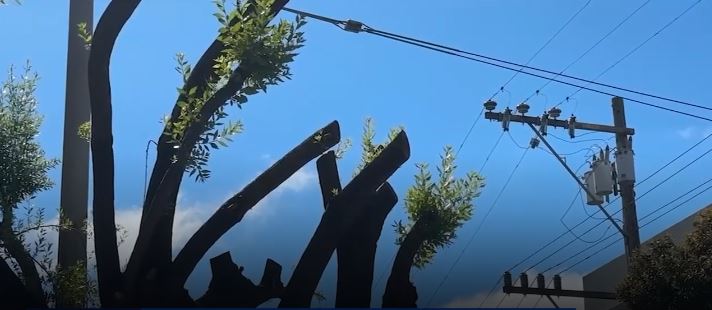
    SAN FRANCISCO (KGO) — A San Francisco homeowner is facing a series of fines totaling $50,000 for illegally trimming five trees believed to be on his property.

Trees located right outside his home.

But as the city explains, they’re not his, and he wasn’t authorized to do it.

Paul Dennes was trying to get his property in San Francisco’s Panhandle neighborhood insured.

“I got an email from my broker saying in order for you to qualify for insurance you need to trim the trees so many feet from the property,” Dennes said.

“You thought, OK?” Stephanie Sierra asked.

“Yeah! I’ll just take care of that,” Dennes said.

So Dennes trimmed down five trees in front of his unit that he says were touching the building and, in some cases, even power lines.

“You see that? I wanted to get them out of the power lines. I didn’t want to be responsible for that,” Dennes said.

Three trees in front…

“And on the other side,” Dennes said, there were two more.

His family has owned the home since 1988. Since then, Dennes always thought it was the property owner’s responsibility to trim.

“I’ve never seen the city trim these trees, never!” Dennes said.

Well, he learned the hard way, not in his case.

The trees aren’t his.

Two days before Christmas last year, Dennes got slapped with the first of several fines from the San Francisco Department of Public Works for illegal tree pruning.

In total, the city charged him $50,000.

“Whoa!” Dennes said. “Shocked. I’m like, are you kidding me? It’s just brutal, you know?”

“It feels like bullying,” he said. “I don’t want to start a big war!”

The city says a neighboring resident advised Dennes against his pruning method and suggested working with a certified arborist. Dennes says he did that. The city says the pruning was subsequently reported by a certified arborist.

The Bureau of Urban Forestry, which operates within the Operations division of San Francisco Public Works, is overseen by a superintendent who is a certified arborist.

Public Works told 7 On Your Side: “As stewards of San Francisco’s urban forest, it is our job to hold people accountable when they harm or damage a street tree… The necessary clearance was achievable without topping, which we demonstrated during the administrative hearing. Tree topping – the indiscriminate cutting of main branches back to stubs, often removing 50% to 100% of a tree’s canopy – can severely damage trees. This practice shocks the tree, limits its ability to produce energy, creates large wounds that invite decay, and often results in hazardous, structurally weak regrowth. In many cases, topping significantly shortens a tree’s lifespan and can increase liability when trees later fail.”

Public Works also added: “An initial Urban Forestry inspector determined the trees had been damaged to the point that removal would be necessary and recommended a fine of $10,000 per tree.”

“I know that the fines have been going up. $10,000 a tree seems like a lot of money,” said Christopher Campbell, a certified tree arborist and owner of CC Tree Design.

“Too high?” Stephanie Sierra asked.

“It seems pretty excessive,” Campbell said.

Campbell helps manage urban trees, offering services such as tree pruning and risk assessments.

“Do you see this tree confusion happen a lot?” Sierra asked.

“Yeah, actually, it’s pretty common. I think as time goes on, people are starting to learn. You know, the fines are really unfortunate,” Campbell said.

Tree trimming used to be under the homeowner’s purview. But the city assumed that responsibility for all public street trees in 2017 following implementation of the StreetTreeSF program approved by voters through Proposition E. The measure allocated more than $19 million annually from the city’s general fund to support street tree maintenance and sidewalk repairs related to tree root damage. The city first adopted pruning standards in 2006, which prohibited topping.

“People don’t realize, but the tree that grows in front of their home on the sidewalk in what we call a sidewalk basin, that’s actually city property. That’s the public right-of-way,” Campbell said.

And Campbell explains even certain trees on private property require a special permit for trimming.

“If there’s a tree that’s over 12 inches in trunk diameter, 20 feet in height or 15 feet in spread, that’s considered a ‘significant tree,’ and those are also protected,” Campbell said.

Public Works says it distributed flyers, door hangers and mailed postcards over the years alerting residents to the 2017 changes. But Dennes, who lives in Marin, says neither he nor his father ever received any notice.

“Kept in the dark!” said Dennes. “Why can’t they put that in with the tax bill?”

The city says “the municipal code doesn’t require” that.

Instead, Public Works refers property owners to its website, where information is posted about maintenance responsibilities, including a street tree map. But the primary owner at the time, Dennes’ father, was 94.

“He didn’t look at websites!” Dennes said. “So I think that’s not reasonable.”

Dennes tried to appeal the $50,000 fine, but he’s frustrated with the process.

“They’ve used photos where they’ve trimmed the trees after I’ve trimmed them,” Dennes said.

“What did they look like before?” Sierra asked.

“They were probably about four feet taller,” Dennes said.

Public Works acknowledges contracted arborists have been sent to Dennes’ street but denies any additional pruning was performed on the trees adjacent to his property.

As for his fine, Public Works told us: “After further review, a more senior inspector determined that the trees may recover, though with reduced lifespan and compromised structure. Based on that assessment, Public Works recommended reducing the fines to $12,950, or $2,590 per tree.”

“The information is out there,” Campbell said.

“I didn’t know. It doesn’t feel fair at all,” Dennes said.

SF Public Works told 7 On Your Side on Wednesday, they’ve lowered the $50,000 fine to $6,475, pending he follows through with a pruning plan.

“We will cut the reduced fine in half, to $6,475, if the property owner follows through with a pruning plan, requiring that the property owner brings in a certified arborist to properly prune the impacted trees over the next five years. The goal is to improve the condition of the trees to extend their life.”

As a general guideline, Public Works recommends that residents allow the Bureau of Urban Forestry to prune street trees located in the public right-of-way, such as on sidewalks.

If you want to arrange pruning outside the city’s maintenance schedule, you can submit a request by contacting Urban Forestry and working with a certified arborist. Requests are reviewed on a case-by-case basis.

Please note: This story was provided to CNN Wire by an affiliate and does not contain original CNN reporting. This content carries a strict local market embargo. If you share the same market as the contributor of this article, you may not use it on any platform.