Only 7 bathroom trips per week? Students question limits on new ePass


By Rebecca Klopf

Click here for updates on this story

    ARROWHEAD, Wisconsin (WTMJ) — Three Arrowhead Union High School students have spoken out against a new electronic pass (or ePass) system that limits how many times students can use the bathroom during the school day and week.

The ePass system functions as an electronic hall pass that students must use to take bathroom breaks during class. Students are restricted to three bathroom visits per day and seven total visits per week while in class; however, they also have the opportunity to go to the bathroom during passing periods, which are eight minutes long. The school noted that they have the longest passing period of any school in the area.

“I feel like this system should not have been implemented,” said JP Moen, an Arrowhead student who addressed the school board about the issue.

Moen, a cross-country athlete, said the system penalizes him for staying hydrated for his sport.

“Say I drank a lot of water that day, and I try to go to the bathroom two periods in a row, you can’t go. It’s messed up,” Moen said.

The system also limits how many students can check out passes simultaneously, creating additional barriers for bathroom access.

“You only get three a day and seven a week, and if you are having extenuating circumstances, it doesn’t matter, you literally can’t go to the bathroom,” said student Gabi Eggers.

Student Mariela Scarpaci described how crowded conditions further complicate bathroom access.

“If there is a line, I’m just like I will wait, and I end up not going to the bathroom all day,” Scarpaci said.

District defends system

The Arrowhead Schools superintendent, Conrad Farner, defended the ePass system in a statement, saying it “ensures safety, maximizes student learning, encourages responsibility, and minimizes inappropriate behavior.”

The superintendent added that the district provides accommodations to students who need extra passes or additional time.

Read Farner’s full statement:

The administration is responsible for ensuring students are as safe as possible. The administration is responsible for making sure students are adequately supervised. The administration is responsible for using district resources as effectively and efficiently as possible. The administration is expected to use data to drive decisions. The administration is responsible for improving student learning. The electronic pass system allows us to better meet all of those expectations/responsibilities. Like other area schools that have implemented such systems, we are seeing nothing but positive impacts after just two weeks.

The attached document captures just about everything I can think of regarding the ePass system. It is an excellent way for us to ensure safety, maximize student learning, encourage responsibility and minimize inappropriate behavior. The system enables us to respond to concerning behavior in the most timely manner and it gives us the ability to know where students are in the event of an emergency. Those are all incredibly beneficial aspects to the system and it is already proving to be tremendously beneficial.

The fact of the matter is any pass system (whether traditional hard copies or digital/electronic) means very little to the vast majority of students. Our students are diligently focused on preparing for their future so they make every effort to be fully engaged in their classes every possible minute…they do not ask to be out of class. They take advantage of the ample opportunities to use the restroom that exist throughout every school day. Students are supposed to be in class, not wandering the hallways.

Every organization has to adapt, not just to survive, but to thrive. Every change we make at Arrowhead is to ensure our students are as safe as possible and they are getting the most rigorous and relevant learning opportunities so they are growing and achieving at the highest possible levels.

Resistance to change is nothing new. We cannot stop moving forward merely because some changes make some people unhappy. Our block schedule is a great example of that. There was a lot of resistance to the block schedule, and a lot of false and inaccurate information was shared. After just one year, we are seeing some of the best academic results Arrowhead has realized in many years. It has proven to be a hugely positive change and it is just what we do now. If you are interested in doing a positive piece on our students’ outstanding academic performance last year, I am happy to provide more information.

We cannot get better by resisting change and doing the same things the way they have always been done. Any cost-effective system that improves safety, learning, accuracy, efficiency and accountability is worth implementing. This change has little-to-no impact on the majority of students, and helps keep students who need to be in class actually in class. We are a safer, more effective, more efficient school because of the electronic pass system. It is not clear why anyone would want us to be less safe, less effective and less efficient and less focused on improving student learning. We can easily make accommodations for any students who have extenuating circumstances. They merely need to talk to a teacher, counselor or administrator.

Other districts using similar systems

Arrowhead is not alone in implementing electronic bathroom pass systems. Both Pewaukee Schools and the Waukesha School District use similar technology.

The Waukesha School District said this is its second year using the system and that it works effectively.

After this story aired, Superintendent Farner reached back out to TMJ4 to further explain the policy. He provided the following bullet points:

-Arrowhead students have 30-40 opportunities to use the facilities each week…PLUS the passes during the class…PLUS any passes needed for emergencies/unusual circumstances. That number is similar to what other high schools provide throughout the state, especially those that use block schedules.

-The vast majority of students are not impacted by the new pass system. They have always used the facilities outside of class time and will continue to do so.

-Arrowhead students have 8 minute passing periods, allowing for ample time to use the restrooms. Most schools have passing times of 4-5 minutes. The 8 minutes have proven to be sufficient for students to use the facilities and get to class.

-All students can use the restrooms during study hall time, and it does not count against their pass limit.

-Students can use the restrooms at lunch without a pass.

-Any student taking a Physical Education class can use the restrooms at the beginning and end of that class.

-All staff can override the limits as appropriate, especially for any unusual situations or emergencies. We control the ePass system; it does not control us.

-The system actually allows students to communicate with teachers in a much more discreet manner than traditional paper passes.

-Students with specific health needs are absolutely accommodated.

-The longest an Arrowhead student ever has to go without a visit to the bathroom is 85 minutes. And they have passes available when needed to leave class.

-If a student needs more passes, we can work with the parents and students to determine how to best move forward.

-Students are not “blocked” from using the facilities; no one is going to impede a student who says they need to use the facilities, even if they have exceeded their pass limit.

-To this point, we have had zero issues of discipline in the halls and/or bathrooms, which is a significant improvement from past years.

This story was reported on-air by a journalist and has been converted to this platform with the assistance of AI. WTMJ’s editorial team verifies all reporting on all platforms for fairness and accuracy.

Please note: This content carries a strict local market embargo. If you share the same market as the contributor of this article, you may not use it on any platform.


Employee stuck in elevator at Mott Children’s Hospital rescued via rope

By Paula Wethington

Click here for updates on this story

    ANN ARBOR, Michigan (WWJ) — A hospital employee was rescued by rope after an elevator malfunctioned Sunday at C.S. Mott Children’s Hospital in Ann Arbor, Michigan.

It was a complicated rescue but resulted in no injuries, the Ann Arbor Fire Department said in its report.

“The composure of the employee throughout the incident is also to be commended,” firefighters said.

Four fire department vehicle crews, along with the battalion chief, responded to the scene. The University of Michigan’s Division of Public Safety and Security and Hospital Facilities also assisted on scene.

Upon arrival, first responders learned the elevator car was stuck in a blind hoistway about 30 feet below the eighth floor. That particular elevator does not provide access to floors 4 through 8, eliminating the option of accessing the car through landing doors, the report said. The elevator’s service brake had also locked, preventing the secondary option of lowering the car. An elevator technician on scene confirmed the car could not be moved from its location without major repairs.

The remaining options, firefighters said, were to break a hospital wall, “which would have caused significant infrastructure damage and destroyed the elevator car,” or do the rescue via rope.

Because the employee was not injured and remained calm despite the ordeal, firefighters chose to work with ropes.

The first step was to secure and lock out power to the elevator, as safety locks would keep the car from falling.

Then firefighters were lowered to the elevator car, placed the person in a harness, and safely lifted the person up to the eighth-floor access.

“The City of Ann Arbor is fortunate to have highly trained professionals ready to respond to these complex incidents,” the report said.

Please note: This content carries a strict local market embargo. If you share the same market as the contributor of this article, you may not use it on any platform.

Battle to save Lake Tahoe mama bear from being euthanized continues

By Tara Campbell

Click here for updates on this story

    LAKE TAHOE, California (KGO) — The fight to save the life of a mama black bear in Lake Tahoe is reaching a fever pitch. Tahoe residents recently gathered to say “no” to the killing of bear #753, more affectionately known as Hope, and always close behind, her cub named Bounce.

“It’s just no, we’re going to kill her. She’s going to die,” said Ann Bryant, Executive Director of the Bear League.

The Department of Fish and Wildlife has labeled the mama, a problem bear, announcing this summer it planned to euthanize her, citing multiple break-ins.

But despite public outcry, the department is doubling down: “Bear #753 has been approved for lethal removal with the hope of getting its cub into wildlife rehabilitation so that it has a chance to live in the wild free of human conflict. We continue to monitor the situation.”

“We’re right there with them,” said Bryant. “It’s a mother and her son, and it’s just heartbreaking that they’re going to kill her and orphan him and upset an entire community.”

Scenes of bears breaking into homes and cars are becoming increasingly common in the Tahoe Region. “Close and lock your doors and windows,” said Bryant. “That’s not a sure thing but it will resolve most incursions.

Meanwhile, advocates continue pushing for another solution for Hope and Bounce even if it means separating the pair.

“We don’t like relocation, but it’s better than death,” said Bryant. “We offered to pay for all the expenses and help in any way we can help get her trapped and keep them together.”

Wildlife officials say they’re trying to break a cycle of break-in behavior, and by targeting the mama bear, her baby could be spared.

Please note: This content carries a strict local market embargo. If you share the same market as the contributor of this article, you may not use it on any platform.
Spa manager accused of human trafficking, neighbor credited with helping investigation

By Samantha Chaney

Click here for updates on this story

    METHUEN, Massachusetts (WBZ) — A health spa in Methuen, Massachusetts has been shut down by police and the manager has been arrested and charged with trafficking two other women to perform sex acts there, police say.

Police said complaints from a neighbor led to an undercover investigation at Beauty Garden Spa on Wallace Street and the arrest of the manager, who lives in New York City.

Neighbor assisted in police investigation Beth Foote, who lives across the street, said she’s been working with police for about two years to stop the human trafficking that was allegedly going on. She said she saw men coming in and out of the spa, from 9 a.m. to 10 p.m., driving luxury cars and even company work vehicles. She also said she saw girls with suitcases being brought to the spa on buses multiple times a month.

“Did I think twice about reporting it? Yeah, I did,” said Foote. “Because, quite frankly, these women are not here because this is what their dream was. They’re here because they got caught up in something they couldn’t control.”

During the investigation, police said they found living quarters for two women in the building’s basement. That’s what ultimately got the business shut down.

“They live downstairs, these women didn’t speak English, they’re absolutely trafficked,” said Foote. “They didn’t come up except to leave or to come, you didn’t see anybody out, like, having a Coke. You saw people bringing food, supplies in and it was pretty blatant. It’s not a surprise that this was happening.”

Spa manager charged On Friday, police arrested 38-year-old Suping Zhu, the manager of the spa. She’s been charged with deriving support from prostitution, keeper of a house of ill fame and trafficking a person for sexual servitude. She’ll be arraigned Monday in Lawrence District Court.

In the meantime, Foote said she worries about the women who police said were victimized at the spa.

“They just got moved someplace else and until they start going after the guys that are doing this, we’re never going to resolve it and these women are going to be trafficked someplace else,” said Foote.

Please note: This content carries a strict local market embargo. If you share the same market as the contributor of this article, you may not use it on any platform.

Colorado shuts down lawyer who lied about credentials, created fake employee

By Logan Smith

Click here for updates on this story

    Colorado (KCNC) — An Evans woman who misrepresented herself as a licensed attorney with a Harvard law degree has agreed to shutter her businesses and never work in immigration services again, the Colorado Attorney General’s Office announced Thursday.

Shineth Gonzales operated two Greeley-based businesses, US Immigration Services and Colorado Global Schools, for at least the last three years, according to case documents. Gonzales advertised on social media and claimed in an email to clients that she graduated from Harvard Law School with a Doctor of Law (Juris Doctor) degree. She referred to herself as “Dr. Gonzales.”

State prosecutors claimed, however, that Gonzales never obtained a law degree from any school. Nor did she or her businesses employ a single paralegal, as advertised.

Additionally, state prosecutors stated in case documents that Gonzales overcharged her clients for services, going so far as to create a fake employee named “Shequioa Daniels,” and charging clients for the made-up legal consultant’s services.

The 48-year-old Gonzales “could not provide these services, much less charge for them,” prosecutors stated in the case’s initial filing. “These exorbitant fees exploited vulnerable consumers.”

Some of Gonzales’s clients were forced to hire licensed attorneys to fix problems she created, prosecutors stated.

“(Gonzales and her businesses) caused significant harm to the consumers who entrusted their legal matters to them by providing poor, unqualified legal and immigration advice that negatively impacted consumers’ immigration process through errors in paperwork.

“Gonzales has never been licensed or otherwise authorized to practice law in this state,” prosecutors said.

In a settlement agreement signed by Gonzales on Thursday, she agreed to cease working in immigration services, to close both businesses, to refer her remaining clients to other qualified attorneys, and to stop using the title “Dr. Gonzales” until she obtains a degree.

Gonzales was also fined $12,000 by the state. A payment plan was set up. She will pay $250 per month. The fine will increase to $50,000 if Gonzales fails to comply with the terms of the settlement agreement.

The penalties for violations of consumer law were increased in 2019 under the Colorado Consumer Protection Act.

“At a time when many immigrants and their families live in fear of deportation, the defendant in this case charged outrageous fees for poor quality work she was neither qualified nor licensed to perform,” Colorado Attorney General Phil Weiser stated in a press release. “Those looking for help navigating the immigration system should be able to turn to qualified professionals. As the action in this case makes plain, only an immigration attorney or a representative working for an authorized organization can give legal advice. Those who mislead immigrants will be held accountable.”

According to Weiser’s office, notaries public (or “notarios” in Spanish) have greater legal authority in Latin America than in the United States. That contributes to immigrants’ misperceptions and vulnerabilities to scams in the U.S. Colorado residents can receive guidance about navigating the U.S. legal system, and advice about identifying scams or fraud, at StopFraudColorado.gov and, in Spanish, at NoMasFraudeColorado.gov.

Please note: This content carries a strict local market embargo. If you share the same market as the contributor of this article, you may not use it on any platform.
Horses at prison need new homes as vocational training program ends

By Christa Swanson

Click here for updates on this story

    Colorado (KCNC) — A 30-year-old program giving 30 incarcerated individuals in Colorado an opportunity to care for wild horses is coming to an end.

The Wild Horse Inmate Program offers vocational training and rehabilitation to the state’s incarcerated population, while also supporting the need to manage and protect the population of wild horses and burros.

The Bureau of Land Management periodically removes groups of wild horses from Sand Wash Basin in order to protect natural resources and prevent overpopulation that could threaten the wild horses. The East Cañon City Prison Complex, a collection of state prison buildings and ranches, is one of the places the horses are taken. In 2021, CBS Colorado was given a rare tour of the ranch and horse pens where the mustangs are prepped for adoption.

The BLM says it is not renewing its contract with the Colorado Department of Corrections, which is set to expire Sept. 30. A 60-day extension on the program was granted through the end of November.

Now the bureau is working to find new homes for 100 horses at the prison in Cañon City.

“We are saddened by the discontinuation of this successful partnership and impactful program,” said Andre Stancil, Executive Director of CDOC. “The Colorado Department of Corrections is immensely proud of the legacy of this program and the positive impact it has had on participants, staff, and the community. While we regret the end of this chapter, we remain committed to working with BLM to ensure a smooth transition and to creating new opportunities that advance our mission of rehabilitation and public safety.”

Friends of the Mustangs President George Brauneis says that they will continue to work with BLM and other organizations on their wild horse program, and hope to make it a model for the nation.

The bureau said five state employees affected by the change will be reassigned to other roles within the department. The 30 incarcerated people in the WHIP will also be reassigned to other vocational programs.

Please note: This content carries a strict local market embargo. If you share the same market as the contributor of this article, you may not use it on any platform.

Man demands answers after wife was detained at scheduled green card meeting

By Laurie Perez

Click here for updates on this story

    LOS ANGELES (KCAL, KCBS) — A man from Pasadena is speaking out and asking for help after his wife was detained by federal agents at the end of a scheduled green card hearing in downtown Los Angeles in early September.

Tucker May says that his wife, Barbara Gomes Marques, 38, was on her way to becoming a U.S. citizen when they headed to the Edward R. Roybal Federal Building almost two weeks ago. He says that at the end of her meeting for her green card, someone asked his wife to accompany them down a hallway to make a copy of her passport, which they thought was the next step in her gaining citizenship after they were married last year.

Now, he believes it was a trick to get the two separated before she was taken into custody by U.S. Customs and Border Protection agents.

“Going home without her that night was one of the hardest things I’ve ever had to do,” May said. “She put so much effort into looking nice, because she was excited to take a step toward becoming an American, and I had to go home, and I had to put away the shoes that they took off her feet and gave to me in a plastic bag.”

He says that Marques is a documentarian without a criminal record who came to the U.S. on a tourist visa seven years ago.

“They put her in hand shackles and in leg shackles, and around the waist as well, like she’s some hardened criminal. She had tears streaming down her face, and she told me one of the ICE agents pulled out his cell phone, laughing, and took a selfie,” May said.

CBS News Los Angeles has reached out to both ICE and the Department of Homeland Security for further information on the incident. May said that they told his wife she was arrested for missing a court date regarding her status in 2019, something he says they were completely unaware of.

Marcelo Gondim is an immigration attorney who is helping represent the couple. He says that Marques spent a week at the Adelanto ICE Facility in Adelanto, CA, before she was transported to a different detention center in Arizona. She is set for transport to Louisiana, which he believes is her last stop before deportation. He claims that this is a tactic now being used to convolute the process.

“They’re trying to remove her as far away as they can from her counsel, from her family, so that kind of cuts on her ability to defend herself,” Gondim said. “Knowing that she’s married to a U.S. citizen, she has a legal way to become a permanent resident in a matter of months. If they just gave her a chance to find her paperwork.”

Gondim said that they’ve filed an emergency application for a temporary restraining order to stop her from being moved to a new detention center or deported.

While they wait to hear back from a judge, May is desperately calling for help, something he says that even goes above bringing his wife back.

“I’m a man trying to get his wife back home, and we need someone with more power than I have to help,” May said. “If we allow these types of things to happen to our most vulnerable people, it’s only a matter of time before it could happen to any of us.”

Please note: This content carries a strict local market embargo. If you share the same market as the contributor of this article, you may not use it on any platform.

ICE ads airing in Sacramento aim to recruit local law enforcement, promise big incentives

By Steve Large

Click here for updates on this story

    SACRAMENTO, California (KOVR) — United States Immigration and Customs Enforcement recruitment ads are airing in Sacramento and across the country, promising big incentives for law enforcement officers to leave their jobs and transfer to ICE.

The ICE recruitment ads that are airing in Sacramento, including in CBS Sacramento’s commercial breaks, are meant to attract the attention of local law enforcement officers.

“Attention Sacramento law enforcement, you took an oath to protect and serve, but in sanctuary cities, you’re ordered to stand down while dangerous illegals walk free,” one of the ads says.

ICE is airing ads in Democrat-led cities across the country, seeking law enforcement officers to transfer to their agency with six-figure salaries, student debt relief and a $50,000 signing bonus.

“This used to be a profession where you started at an agency and the majority of people stayed with that agency for life,” said Patrick High, the Stockton Police Officers Association president. “Maybe you changed one time in your career for one issue or another, but now it’s nothing for someone to jump from agency to agency to agency.”

High’s recruiting is also a year-round job. The ICE effort to attract officers is just one more competitor.

“They recruit at all the same places that we recruit,” he said. “We’re going to military bases, they’re going to military bases. We’re going to college campuses, they’re going to college campuses. They’re advertising at sporting events, they’re putting up billboards. So are we. So it comes down to like, what kind of job do you want to do?”

The ICE ads come as its enforcement is seeking to add 10,000 immigration agents by the end of the year.

Acting ICE director Todd Lyons says it’s partly for added protection during their raids.

“So we might have a team that goes out with four or five, six agents, now we’re having to double those numbers and send out a security team just for them,” Lyons said.

The ICE ads in Sacramento are currently set to run through the end of the month, although they could be extended.

President Trump’s recently passed budget bill included $75 billion extra for ICE, making it the highest-funded law enforcement agency in the federal government.

Please note: This content carries a strict local market embargo. If you share the same market as the contributor of this article, you may not use it on any platform.

One year after Helene, community unites at Swannanoa church event to heal and reflect

By Rian Stockett

Click here for updates on this story

    SWANNANOA, North Carolina (WLOS) — Music filled Valley Hope Church in Swannanoa, where community members met and looked back on that fateful September day one year ago.

“Remembering lives lost, remembering businesses and homes lost or how impacted our community was and above all, we’re remembering God’s faithfulness,” said Director of Discipleship at Valley Hope Church, Amy Berry.

At this Helene remembrance event organized by the church, the congregation heard stories and testimonies from community members who were impacted by Helene.

One of the speakers was Cortney Pauly, whose basement flooded and then in January, they found mold in the house.

“The mold is actually what made us sick for the first half of 2025. We’ve been out of our house for the last few months and now Valley Hope is helping us to put it back together,” said Pauly.

News 13 also spoke with Amy Geist, a church member who turned her house into a distribution center after Helene, bringing supplies to the wider area of the community.

“All of our emotions are just sort of brimming and we feel really grateful to be together on the anniversary of Helene,” said Geist.

North Carolina Governor Josh Stein was also in attendance today.

Following the service, he spoke to us about how churches like this play an integral role in helping people face the past and move toward a better future.

“It was a really moving event here at Valley Hope and this was an integral part of the recovery for Swannanoa and what is so clear is the recovery requires repair not only of physical things, of stores, of homes, of roads of bridges, but it requires a repair of heart,” said Stein.

To help the area recover, Valley Hope Church hosts Community meals every Monday.

You can volunteer to help serve by going to their website.

Please note: This content carries a strict local market embargo. If you share the same market as the contributor of this article, you may not use it on any platform.

Restored dress gives family a thread of hope after losing 11 relatives to Helene

By Jennifer Emert

Click here for updates on this story

    FAIRVIEW, North Carolina (WLOS) — Hurricane Helene’s wrath claimed 108 lives to date across western North Carolina. One single family, the Craig family, suffered tremendously, losing 11 loved ones to a landslide. Even in their deep grief, a thread of hope remains.

“You never know what’s going to bring it up. What song or smell or whatever, it just happens,” said Alicia Craig about the storm that forever changed her and her extended family’s lives.

To say Helene ripped apart the fabric of the Craig family hardly describes what they’ve endured over the last year.

“We were very close, we were very good friends, explained Alicia Craig of the relationship with her mother-in-law, Sandy Craig.

Among the 11 family members lost during Helene were her in-laws, Ronnie and Sandy Craig.

“It’s just a relationship you would want a mother-in-law and a daughter-in-law to have, so I was very fortunate for that,” said Craig. “The night before the storm, she had come over and got our dog, and she was like I’ll trade you a pizza for a dog. I remember her coming out with Hank, our dog and she had put a raincoat on him because it was raining so bad and I was like I’ll bring your pizza in and she was like no, no, I’ll bring him to the car and I was like if I’d only known, I would have gone in and stayed and talked to them, you know for hours. We didn’t know any of this was going to happen,” explained Craig, as tears gently rolled down her cheeks. “I guess that’s the hardest part, knowing we’re still here, and that they’re not. And we’ll never be able to get that back, at least we have the memories.”

Memories turned into keepsakes after some of Sandy’s treasures were pulled from the mud.

“It was just a picture of my mother-in-law, and it was one of her ficus trees she had, and a little bench that I had here at the house, and just made that her little special corner,” said Craig about the memorial set up in her home to honor her mother-in-law.

A separate tribute for her father-in-law, Ronnie, has also been created in another area of their home, built by Ronnie Craig.

The dress Strangers found countless belongings from the families’ homes and laid them out gently at the Garren Creek Fire Department.

“I kept walking by this dress and Bible. I was thinking to myself, when I would go by the dress, every few weeks, that would be so great if someone could figure out whose dress that is,” said Craig.

Covered in mud, it remained unmistakably familiar.

“I sent a picture of it to her sister, and I was like, ‘Do you think this is Sandy’s dress?’ and she was like, ‘I do,’” said Craig.

Determined to salvage what the storm had nearly shredded, Alicia Craig tried dry cleaner after dry cleaner.

“I’d walk in with this plastic bag, full of mud, with her dress in it, and they were like, ‘We’re not touching that.’ And I was like, ‘Okay, it’s okay if it can’t be restored, I get it, I just want it to be dry cleaned,’ and they were like, ‘No.’” said Alicia Craig.

All seemed lost when something needled Alicia to take it somewhere she hadn’t considered. That somewhere was Best Bride.

“I never thought of them as restoring dresses; I only thought you went there to buy dresses. I didn’t think, and then something just told me to take it there,” Craig said.

“It was a Saturday morning and we were just in here going crazy and my staff came and found me back here in the bridal department and said, ‘We have a lady up front, and she has a bridal gown in a trash bag, and we don’t think she’s real happy.’ and I said, ‘Well lets go find out what’s going on,'” said Denise Knapp, co-owner of Best Bride Prom & Tux.

“When we took the dress out of the bag, the bottom of the dress was shredded, and clumps of dirt were on this gown. And I held it up and I shook it and it just came off on the floor,” said Knapp.

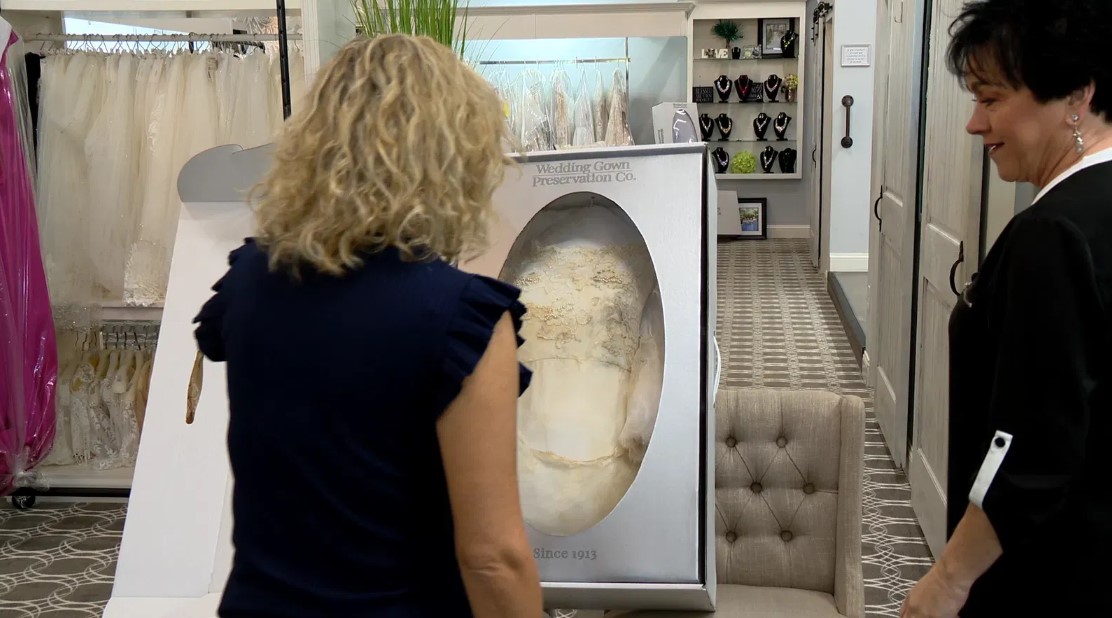
Best Bride works with Wedding Gown Preservation in New York and New Jersey, a business restoring gowns since 1913.

“So, the overlay over this dress is silk chiffon, and they were concerned that the chemicals in the cleaners would just continue to disintegrate it, so they really had to take their time,” said Knapp.

They worked gently, relentlessly to erase the storm’s touch, one stain at a time. Boxed up, it recently arrived back at Best Bride.

“It is perfect, in an imperfect way,” said Knapp about the dress’s return.

The return In a rare bright moment after so much loss, News 13 broke the news to Alicia.

“They have it at the store. Do you want to go see it?” News 13 asked.

“I do, yes, I do. I want to go see it and bring it home,” said Craig.

Just a thread in the greater effort.

“Hey, hey, I think Sandy would be proud,” said Knapp as she opened the box to reveal the dress.

“Oh, it’s perfect,” said Craig as she stared through the plastic at the cleaned, preserved dress.

“Isn’t that great?” asked Knapp.

“It does, it looks so good,” said Craig, gently touching the plastic protecting the cleaned dress.

It’s a thread of hope, stitching healing into the fabric of a grieving family.

“I just hope that this helps your family find some closure,” said Knapp, still looking at the dress.

“Yeah, no, it definitely will,” replied Craig, still looking over the cleaned garment.

“And she talks to me all the time, and so I’m glad to do this. It’s a pleasure,” said Knapp.

“She talks to me too,” replied Craig, though some light tears, “So it’s perfect, it looks so good, thank you. I can just see her, through it, yeah, so, it’s good.”

Honoring those lost to Helene Among the Craig family members killed when the land around their homes gave way on September 27, 2024, were Ronnie and Sandy Craig, Jimmy and Lois Souther, Freddie and Terri Pack, Dan and Evelyn Wright, and Angie Craig, along with Tony Garrison and Brandon Ruppe.

Two other residents unrelated to the family also died on September 27, 2024, as a result of the landslide. Neighbors Chase Garrell and Marsha Ball were also killed.

Please note: This content carries a strict local market embargo. If you share the same market as the contributor of this article, you may not use it on any platform.