HPL Welcomes Author Curtis Chin to Summer Reading Program

By Francis Page Jr.

Click here for updates on this story

    July 13, 2026 (Houston Style Magazine) — Houston’s summer heat may be relentless, but Houston Public Library is offering a refreshing change of menu: one celebrated author, one unforgettable memoir and an hour of conversation designed to feed both the mind and the spirit.

On Saturday, July 18, 2026, from 2 to 3 p.m., author, filmmaker and cultural advocate Curtis Chin will appear at the Alief-David M. Henington Regional Library, 11903 Bellaire Boulevard, as part of HPL’s Summer Reading Program. The in-person program is intended for adults, and advance registration is required through HPL’s official event page. Seating is limited, making this one Saturday reservation Houstonians should secure before the literary table fills up.

photo

Chin arrives with a title as inviting as the aroma drifting from a neighborhood kitchen: Everything I Learned, I Learned in a Chinese Restaurant. Published in 2023, the award-winning memoir follows his coming of age as a gay Chinese American in working-class Detroit, where his family’s Chung’s Cantonese Cuisine became far more than a place to eat. It was a classroom, community center, observation deck and unofficial city hall—with egg rolls.

The restaurant opened in Detroit’s original Chinatown in 1940, relocated after urban redevelopment displaced the district and remained part of the city until 2000. Its customers crossed boundaries of race, class, profession and identity, giving young Chin a front-row education in how a city survives, argues, laughs and keeps showing up. The memoir arranges memories like a restaurant menu, serving family history and social commentary in portions that are humorous, candid and deeply human.

That history carries special weight. Chin grew up during the era surrounding the 1982 killing of Vincent Chin, a watershed moment in Asian American civil-rights activism. Curtis Chin has explained that the tragedy helped shape his commitment to opening doors for Asian Americans and other people of color to tell their stories. His work reminds readers that storytelling is not decoration around history; it is one way communities protect themselves from erasure.

Chin also helped establish the Asian American Writers’ Workshop after its founders began gathering in New York City in 1991, seeking a supportive literary community for writers of color. The organization became a nonprofit in 1992 and has spent more than three decades publishing, mentoring and amplifying Asian diasporic voices. Chin served as its first executive director, helping build a platform that would support generations of writers.

His creative journey did not stop on the printed page. Chin wrote comedy for network and cable television before transitioning into social-justice documentaries. His films have screened at more than 600 venues in 20 countries, while his writing has appeared in CNN, Bon Appétit, the Detroit Free Press and The Emancipator/Boston Globe. His short documentary Dear Corky premiered through PBS’s American Masters, and Warren King: King of Cardboard, produced by Chin and Adam Wolman, premiered on PBS in May 2026.

Houston is an especially fitting stop for this conversation. The Bayou City understands what happens when cultures meet around a table. Alief, one of Houston’s most internationally flavored communities, speaks in countless accents, shops in multiple languages and knows that food often becomes the first handshake between neighbors.

Chin’s story begins in Detroit, but its questions—Who belongs? Who gets remembered? What do families teach without ever writing it down? — will feel right at home on Bellaire Boulevard. The appearance also continues a proud public-library tradition. Houston’s library roots reach back to the Houston Lyceum established in 1854, when a collection of fewer than 100 books helped create a civic space for lectures, debates and learning. More than 170 years later, HPL continues expanding that idea: the library is not simply where stories are stored, but where people gather to hear one another more clearly.

For readers, aspiring writers, filmmakers, history lovers and anyone raised in a family business, Chin’s visit promises humor, reflection and honest conversation. His memoir proves that some of life’s biggest lessons arrive without a syllabus—sometimes they come with a takeout menu, a crowded dining room and parents wise enough to tell their children to listen.

“I love making connections with audiences and seeing how universal our stories can be,” Chin said of his Houston visit.

On July 18, HPL will provide the room. Curtis Chin will bring the stories. Houston only needs to bring its curiosity—and perhaps an appetite for a second helping.

More information: houstonlibrary.org/home

Please note: This story was provided to CNN Wire by an affiliate and does not contain original CNN reporting. This content carries a strict local market embargo. If you share the same market as the contributor of this article, you may not use it on any platform.

Kierra Lee
KIELEESTYLE@GMAIL.COM
4096658446

Houston Is Ready to Rumble: WWE’s 40th Annual Survivor Series: WarGames Takes Over Daikin Park

By Francis Page Jr.

Click here for updates on this story

    July 13, 2026 (Houston Style Magazine) — Houston, clear your Thanksgiving weekend calendar—and perhaps practice your loudest “Let’s go!” WWE is bringing the 40th annual Survivor Series: WarGames to Daikin Park on Saturday, November 28, 2026, giving the Bayou City another opportunity to prove that when major entertainment comes calling, Houston answers with championship-level energy.

The announcement, made July 13 by WWE in partnership with Houston First Corporation and the Houston Astros, marks Survivor Series’ first return to Houston since 2017 and the first WWE Premium Live Event at Daikin Park since the 2020 Royal Rumble. For a city that knows a little something about dramatic entrances, unforgettable finishes and packed stadiums, the pairing feels less like a surprise and more like destiny wearing wrestling boots.

Survivor Series began in 1987 as a showcase for elimination-style team competition, with legendary names including André the Giant, Hulk Hogan, Randy Savage, Ricky Steamboat and Jake Roberts helping establish the event as WWE’s annual fall classic. Four decades later, the tradition has evolved into the high-stakes WarGames era, where rival teams settle their differences inside one of sports entertainment’s most intense environments. The names change, the rivalries deepen and the production grows larger, but the central promise remains the same: survive the night and make history.

Houston has repeatedly provided the perfect stage for WWE history. The city hosted WrestleMania in 2001 and 2009, Royal Rumble events in 1989 and 2020, and Survivor Series in 2017. That 2017 event at Toyota Center featured Brock Lesnar battling AJ Styles, The Shield confronting The New Day and Raw and SmackDown competing for brand supremacy. Houston fans did not merely attend; they became part of the soundtrack.

Now, Daikin Park is preparing to trade baseball diamonds for body slams. For the second consecutive year, Survivor Series will be staged in a major sports stadium, following the 2025 event at San Diego’s Petco Park, which WWE says established new gate and attendance records. With Daikin Park’s retractable roof, downtown location and reputation for hosting major national and international events, Houston has the infrastructure—and the swagger—to make the 40th edition feel suitably enormous.

WWE Chief Content Officer Paul “Triple H” Levesque called Houston the perfect host for this milestone chapter. Houston First President and CEO Michael Heckman emphasized the event’s potential to attract thousands of visitors and generate meaningful economic impact. Rachel Quan, vice president of special events for the Houston Astros, noted that Daikin Park takes pride in showcasing Houston through concerts, baseball showcases and other world-class attractions.

That impact should extend well beyond the ring. A major holiday-weekend event can fill hotel rooms, restaurants, rideshares, shops and entertainment districts throughout downtown and surrounding neighborhoods. Wrestling fans are famously loyal travelers, and many will arrive ready to turn a one-night spectacle into a full Houston experience—complete with barbecue, Tex-Mex, museums, nightlife and perhaps a spirited debate over which Superstar deserves the loudest entrance.

Ticket access will begin in stages. Club WWE members receive an exclusive presale Wednesday, August 5, at 10 a.m. Central. The general presale begins Thursday, August 6, at 10 a.m. Central, followed by the public on-sale Friday, August 7, at 10 a.m. Central through Ticketmaster. Fans may register through WWE’s official Survivor Series 2026 page for presale information.

Premium Survivor Series Pass packages from On Location are also planned, with options expected to include premium seating, pre-show hospitality, WWE Superstar appearances, ringside photo opportunities and other enhanced experiences. Deposits are being accepted for early access to those packages.

WWE’s weekly programming reaches audiences around the world, making the Houston event a rolling postcard for the city. From skyline shots to crowd reactions, the broadcast can spotlight Houston’s diversity, hospitality and unmistakable personality before an enormous international audience.

For Houston, Survivor Series: WarGames is more than another date on the entertainment calendar. It is a high-profile reminder that the nation’s fourth-largest city remains a first-choice destination for global sports, live entertainment and cultural spectacle. For WWE, it is a chance to celebrate 40 years of Survivor Series in a city whose fans understand loyalty, drama, comeback stories and the occasional perfectly timed finishing move.

This Thanksgiving weekend, the leftovers may be cold—but Daikin Park will be red-hot. photo

Ticket Purchase Link: Ticketmaster — WWE Survivor Series: WarGames Tickets go on sale Friday, August 7, 2026, at 10 a.m. Central Time. Fans can register for presale access here. Premium Ticket and Hospitality Packages: On Location Survivor Series Packages

Please note: This story was provided to CNN Wire by an affiliate and does not contain original CNN reporting. This content carries a strict local market embargo. If you share the same market as the contributor of this article, you may not use it on any platform.

Kierra Lee
KIELEESTYLE@GMAIL.COM
4096658446

“I just started drowning”: Woman recounts rescue on Kuna’s Indian Creek

By Brady Caskey

Click here for updates on this story

    KUNA, Idaho (KIVI) — What was supposed to be a fun weekend float down Indian Creek in Kuna quickly turned into a life-or-death situation for a Caldwell woman when her raft flipped and she became stranded in trees along the creek.

“I went over a rapid thinking I’ll be fine and I wasn’t. I flipped over backwards in my tube and just started drowning,” said Ashlynn Monroe

She believes she was stuck underwater for about 40 seconds before grabbing a branch strong enough to pull herself up.

“I was panicking. I was panicking like my first thought when I first flipped is you’re gonna die, you’re gonna die like this is it,” said Monroe.

Monroe held onto the trees and yelled for help while a nearby neighbor called Kuna Fire. Crews then began setting up a rescue operation.

“I introduce myself actually just like how you were a normal person at the grocery store. Hi hi my name is Trenton. What’s yours?,” said Firefighter Trenton Hogan — the who swam across the rapids to rescue Monroe.

“The way I found her was she was lodged under some debris with trees, so her main issue was that the current was pushing her into trees and overhang on the creek and she couldn’t get out herself,” said Hogan.

After getting Monroe into a life jacket, Hogan and his team used a rope rescue technique known as a pendulum to bring her to safety.

“They hold on as anchors on the other side so basically they stay stationary we become loose and then we swing on over through the current,” said Hogan.

Crews were able to safely bring Monroe to dry land, where paramedics made sure she was okay.

“This is what we trained for, and I felt confident in myself and I’m really thankful that we have the right equipment to do so,” said Hogan.

Just weeks ago, Kuna Fire conducted training exercises for water rescues ahead of float season.

RELATED | Kuna Fire trains for swift water rescues ahead of busy summer on Indian Creek

“It was scary. It was the scariest thing I’ve ever experienced in my life,” said Monroe.

While filming the story, Neighborhood Reporter Brady Caskey watched as a family capsized at the same spot where Monroe got into trouble, sending a baby wearing a life jacket into the water and leaving several people stranded in different areas of the creek. The family appears to have self-rescued from the situation.

Kuna Fire says the safest option is to avoid floating Indian Creek altogether. For those who choose to float, firefighters recommend wearing a properly fitted life jacket and going with an experienced guide.

Please note: This story was provided to CNN Wire by an affiliate and does not contain original CNN reporting. This content carries a strict local market embargo. If you share the same market as the contributor of this article, you may not use it on any platform.

WATCH: Arizona man still lacing up for ice hockey at 80 years old

By Cameron Polom

Click here for updates on this story

    PHOENIX, Arizona (KNXV) — Most people approaching 80 years old are slowing down, but Valley resident Mike McConnell is lacing up his skates.

Just weeks before his 80th birthday, McConnell is still taking the ice every Thursday night at the Peoria rink, competing in a recreational hockey league where he’s often 20 to 30 years older than everyone else on the ice.

And he’s not stopping there.

Later this month, he’ll travel to California to compete in the prestigious Snoopy Hockey Tournament in Santa Rosa, skating against other players in the 70-and-over division for the second time.

His wife says he’s become an inspiration not only to family and friends, but also to strangers who can’t believe his age when they see him flying across the ice.

ABC15’s Cameron Polom learned about what keeps him motivated, how he stays healthy enough to keep playing, and why he’s not ready to hang up his skates anytime soon. Watch the full Uplifting Arizona story in the video player above.

Please note: This story was provided to CNN Wire by an affiliate and does not contain original CNN reporting. This content carries a strict local market embargo. If you share the same market as the contributor of this article, you may not use it on any platform.

From Cavite to the CT Suite: Leland Bautista’s HCC Coleman Journey Comes Full Circle

By Francis Page Jr.

Click here for updates on this story

    July 13, 2026 (Houston Style Magazine) — Some success stories are measured in diplomas. Others are measured in doors opened, patients comforted and students inspired. For Leland Bautista, a 2019 graduate of Houston City College’s Coleman College for Health Sciences, success includes all three—and perhaps a few remarkably detailed CT images along the way.

Bautista’s journey began in Cavite, Philippines, where he completed his initial radiography education before relocating to Houston. He arrived with healthcare experience, ambition and a clear goal: build upon his professional foundation and practice radiography in the United States.

HCC Coleman College provided the bridge.

“I have always known that I would work in healthcare,” Bautista explained. He entered Coleman’s Radiography program as an advanced-placement student, allowing him to strengthen his previous training while learning the standards, technologies and patient-care practices required in the American healthcare system.

Founded in 2004, HCC Coleman College offers degrees and certificates in more than 20 health-science fields. As a member institution of the Texas Medical Center, the college connects students with educational resources and healthcare environments that can turn classroom preparation into real-world opportunity. Its two-year Radiography program combines lectures, laboratory instruction and clinical experience, while its Computed Tomography Enhanced Skills Certificate offers additional preparation in advanced medical imaging.

photo

For Bautista, Coleman’s appeal extended beyond equipment, laboratories and course catalogs. What impressed him most was the human touch.

He remembers receiving accessible information, timely responses and reassuring support throughout the enrollment process. Once classes began, Coleman staff members and Radiography instructors remained committed to helping students succeed.

That support mattered because healthcare education is not exactly a leisurely stroll with a stethoscope. It requires long hours, technical precision, emotional discipline and enough determination to keep going when the coffee has stopped cooperating.

Bautista’s motivation came from remembering his starting point.

“When I am tired, I always look back to where I started and see how far I’ve come,” he said.

That perseverance has produced an impressive career. Today, Bautista serves as a Diagnostic Imaging CT Supervisor at MD Anderson Cancer Center. He has also returned to HCC Coleman as an adjunct instructor of Computed Tomography, helping prepare students for the profession that changed his own life.

His journey is continuing academically as well. Bautista is pursuing a Master of Science in Radiologic Sciences, specializing in Medical Imaging Informatics, at the UT MD Anderson School of Health Professions, with an expected graduation date in 2027. The graduate program includes tracks in medical imaging informatics, administrative leadership and educational leadership—areas that reflect the expanding relationship between imaging technology, healthcare data, management and instruction.

Yet Bautista’s greatest satisfaction is not found in a title alone. He values helping patients during moments when answers, compassion and accurate imaging matter deeply. As a supervisor and instructor, he also finds fulfillment in mentoring professionals and watching students grow.

His story represents education at its best: knowledge received, opportunity earned and experience returned to the next generation.

For Houston’s international and immigrant communities, Bautista’s path carries an especially encouraging message. A degree earned in another country does not have to represent the end of a professional chapter. With the right institution, resources and determination, it can become the opening paragraph of an even greater American success story.

His advice to future students is direct: stay focused and use the college’s resources.

“My education at HCC Coleman College opened so many doors and opportunities in the radiology field,” Bautista said.

Now, as a healthcare leader, graduate student and HCC instructor, Leland Bautista is holding those doors open for others—and that may be the clearest image of success any technology could produce. photo

More info: hccs.edu/about-us/colleges/coleman-college-for-health-sciences

Please note: This story was provided to CNN Wire by an affiliate and does not contain original CNN reporting. This content carries a strict local market embargo. If you share the same market as the contributor of this article, you may not use it on any platform.

Kierra Lee
KIELEESTYLE@GMAIL.COM
4096658446

Arizona mom watches son lose everything to kratom sold at gas stations

By Kamilah Williams

Click here for updates on this story

    TUSCON, Arizona (KNXV) — Suzanne Sierra never heard of kratom before her 28-year-old son Christopher started buying small bottles of it from a smoke shop.

At first, he was taking it just to feel better. Then he needed it just to function. Within two years, Christopher was spending nearly $1,000 a day on the product, and had lost his job, his girlfriend, and his home.

“He shakes, he shakes really bad,” Sierra said. “He’s 28, and his whole life is ahead of him, and it destroyed it. For something that was called Feel Free.”

A Surge in Poisonings

Calls to poison centers about kratom have surged more than 1,200% over the past decade, according to a new CDC study. Last year alone, there were more than 3,400 reports of kratom poisoning across the country. Symptoms can range from vomiting and high blood pressure to seizures and hallucinations.

Kratom, pronounced KRAY-tom, is a psychoactive herb derived from a tropical tree native to Southeast Asia. In the United States, it is sold openly at gas stations and smoke shops in pill, powder, and liquid extract form. It is currently unregulated at the federal level, meaning there are no standard doses and no oversight of what goes into the products on shelves.

ABC15 found a Facebook group for people recovering from kratom addiction and met Ryan Wood of West Tennessee. He says he picked up kratom at a gas station five years ago thinking it was just another energy drink.

“I just ran across it, you know, I like energy drinks and stuff like that and just thought it was another pick me up,” Wood said.

Within one to two years, Wood was taking up to 100 pills a day. He has been to rehab three times. He says withdrawal was the hardest thing he has ever been through, including hallucinations, violent body tremors, and multiple emergency room visits that triggered pancreatitis.

“It’s very unsafe, it’s very unhealthy, and yes, people are losing their lives,” Wood said.

The Other Side

Not everyone believes kratom should be banned.

Fadi Fod is the owner of Kawana, an alcohol-free bar and cafe in the Valley that serves botanical beverages made with kratom. He says the problem is not kratom itself, but the synthetic, lab-made products that are often grouped with it, like a form known as 7-hydroxy.

“Please do not mix natural leaf kratom with other synthetic products like 7 hydroxy,” Fod said. “This is a natural leaf that grows naturally in nature, where this is synthetically made in a lab, synthesized by a human.”

Fod says at Kawana, every drink is carefully measured by portion and customers are educated before they order.

“Here at Kawana we work at education, not just selling, informing the customers the difference between the kratom leaves, and each cup of our drinks is measured per portion, so we know how much kratom, so it’s not being over poured,” Fod said.

The Push to Regulate

Arizona Attorney General Kris Mayes has said she plans to work with legislators to strengthen laws against kratom and similar products. It is currently illegal to sell kratom to anyone under the age of 18 in Arizona.

Tennessee banned all kratom products as of July 1. Wood says the rest of the country should follow.

“I think it needs to be banned all across the United States,” Wood said.

Sierra, who started a Facebook group for families affected by kratom, says she has heard from countless people with stories just like her son’s. She says she went to every store in her town that sold the product and asked them not to sell it to Christopher.

“I didn’t know what else to do,” she said.

Christopher is now living back home with his mother. Sierra says he still struggles every day.

“He doesn’t feel like he has any hope,” she said.

If you or someone you know needs help, call Poison Control at 1-800-222-1222.

This story was reported on-air by a journalist and has been converted to this platform with the assistance of AI. Scripps editorial team verifies all reporting on all platforms for fairness and accuracy.

Please note: This story was provided to CNN Wire by an affiliate and does not contain original CNN reporting. This content carries a strict local market embargo. If you share the same market as the contributor of this article, you may not use it on any platform.

The Place Where the Rainbow Never Ends A brick, a beach, and a lesson that never stopped moving

By Ben Jealous

Click here for updates on this story

    July 13, 2026 (Houston Style Magazine) — (TriceEdneyWire.com) – There is an old man in the movement who still brims with the courage and love forged on a Chicago beach.

His eyes do not work well anymore. It seems to bother him less than you would think. Norman Hill has always seen more with his head and his heart than most of us ever see with our eyes.

I met Norman in the summer of 1993, at the convention of the A. Philip Randolph Institute. He was its president. He and the labor leaders Bill Lucy, Richard Womack and Clayola Brown gathered two dozen young Black organizers who shared their vision. Lucy had helped lead the sanitation workers’ strike in Memphis the week King was killed.

Stacey Abrams was one of us. Derrick Johnson was one. Jena Roscoe was one. I was one.

They passed down what A. Philip Randolph and Bayard Rustin had taught them. Civil rights and workers’ rights are one fight. Racism splits working people apart. Economic injustice profits from that division. Our answer has to take on both.

Norman learned that from those two men. He also learned it on a Chicago beach.

In 1960, Rainbow Beach was public by law and White by custom. Velma Murphy was 21 years old and president of the South Side NAACP Youth Council. She decided to test it. If students in the South could sit down at a lunch counter, young people in Chicago could wade into Lake Michigan.

Norman helped her build a group, Black and White together. Some wanted an all-Black action. Norman and Velma said no. Black leadership and Black and White people standing side by side were not rival ideas. Together they were the plan.

In late August 1960, they walked onto Rainbow Beach. They spread blankets. They read books. They played checkers. They walked into the water.

A White mob gathered. Rocks and bricks flew. A brick hit Velma in the head and knocked her out cold. Norman picked her up and carried her off that beach. It took 17 stitches to close the wound.

They went back anyway. Again and again, through the next summer, they claimed their beach. The papers carried Velma’s story, and the crowds that came to stand with them grew. The city was forced to protect them. Rainbow Beach became a beach for everybody.

That victory was a blueprint. Black-led. Black and White together. Built on working people standing as one. Brave enough to take a beating. Disciplined enough to come back.

The lesson did not stay on the beach.

Soon after that summer, Stacey, Derrick, Jena and I went to Mississippi. Governor Kirk Fordice wanted to be rid of the state’s three Black public universities. He had already threatened to call out the National Guard rather than spend another dollar on them. Now he wanted to shut down Mississippi Valley State and put a prison on the campus.

He wanted Alcorn State gone. He wanted Jackson State made over into something else.

Alcorn is where Medgar Evers met Myrlie Beasley. They married on Christmas Eve. They worked side by side in the Mississippi NAACP office until the night Medgar was shot dead in his own driveway.

Saving Alcorn meant saving the ground where that love began.

We organized. We pulled in White Mississippians who understood that a state that shuts down its Black colleges will not stop there. Norman’s theory, tested again, 700 miles from the lake.

The plan died. All three schools are open today.

Derrick stayed in Mississippi and went deeper into the place where labor, civil rights and politics meet. Today he is president and CEO of the NAACP. One of his early mentors down there was Charlie Horhn. Charlie brought Black and White workers at a Jackson factory into one union. He started the state’s first Randolph Institute chapter. In 1993 he ran the campaign that sent Bennie Thompson to Congress.

Charlie is 91 now. His son John is the mayor of Jackson.

Clayola Brown is the president of the A. Philip Randolph Institute now. She sits in Norman’s chair. She was there in that room too, already carrying the same lesson forward.

The women and men Norman trained across the decades will gather in Chicago at the end of this week. Legions from labor. Leaders in civil rights and politics as well. Our titles have changed. The bond has not.

The late Rev. Jesse Jackson built the Rainbow Coalition into a national force. In Chicago’s moral history, there is no Rainbow Coalition without Rainbow Beach.

And then there is the love story.

Velma Murphy became Velma Hill. They married the year after the brick. More than six decades of love, labor and civil rights.

But the marriage was never the point. It was the workshop.

Two dozen of us sat in that room in 1993 because Norman and Velma had spent thirty years building something strong enough to hold us. That is what a movement marriage does. Medgar and Myrlie did it in Mississippi. Myrlie carried the work for decades after they killed him, and went on to lead the NAACP herself. The love did not end in that driveway. It went out into the world and made leaders.

It is what Derrick and Letitia do now, pouring into the organizers coming up behind them the way Norman poured into us.

I once asked Norman how he and Velma lasted so long.

“Find a woman who is as much of a warrior as you are,” he told me, “and marry her.”

What he built with her raised us. Stacey. Derrick. Jena. Me. Legions more across the decades. We came to them as students and they sent us out as leaders, and every one of us is proud to count ourselves among Norman and Velma’s children in the movement.

The rainbow did not stop at the water’s edge. It ran through Randolph and Rustin. It ran through Medgar and Myrlie. It ran through Norman and Velma. It reached two dozen students in 1993. It runs through Derrick and Letitia. And it runs all through the NAACP family.

Norman’s eyesight has dimmed. His vision has not. At Rainbow Beach, and in every life it still touches, the rainbow never ends.  Ben Jealous is a professor of practice at the University of Pennsylvania and former national president and CEO of the NAACP.

Please note: This story was provided to CNN Wire by an affiliate and does not contain original CNN reporting. This content carries a strict local market embargo. If you share the same market as the contributor of this article, you may not use it on any platform.

Kierra Lee
KIELEESTYLE@GMAIL.COM
4096658446

What Does America 250 Mean to the Black Family?

By Frederick Nickens, Coretta Graham

Click here for updates on this story

    July 13, 2026 (Houston Style Magazine) — America turned 250 on July 4, 2026, marking two and a half centuries since the signing of the Declaration of Independence. The official America250 observance invited the country to reflect on its past, honor the contributions of all Americans and imagine a stronger future. For Black families, however, this anniversary cannot be reduced to fireworks, flags and a birthday cake large enough for 50 states. It must also become an honest family meeting about the promise, progress and unfinished business of American democracy.

The Declaration proclaimed equality in 1776, but millions of Black people were denied liberty, citizenship and legal protection for generations. In August 1619, the White Lion brought captive Africans to Point Comfort in English-occupied Virginia—one of the defining beginnings of the Black experience in what became the United States. They arrived with names, families, skills, faith, intelligence and dreams, even as an emerging system attempted to reduce human beings to property.

Yet Black history is not simply a record of what America did to Black people. It is also the record of what Black people did for America.

Black labor helped build the nation’s wealth. Black soldiers defended American freedom, even when freedom did not fully defend them. Black churches sheltered movements, Black teachers opened minds, Black entrepreneurs created opportunity, and Black families turned survival into strategy.

During Reconstruction, newly freed citizens demanded a broader democracy grounded in racial equality. The 15th Amendment extended voting rights to Black men in 1870, although poll taxes, literacy tests, intimidation and Jim Crow later stripped that promise from millions. The Voting Rights Act of 1965 became a landmark federal response to that long betrayal.

That history answers the central question: America 250 means Black families have earned more than an invitation to the celebration. We are co-authors of the American story.

Houston knows that truth. From neighborhood churches and family businesses to Texas Southern University and Barbara Jordan—the Fifth Ward daughter who carried her commanding constitutional voice into Congress—Black leadership has continually strengthened both community and country.

But authorship carries responsibility. The next chapter must be written through education, voting, entrepreneurship, home and land ownership, mentorship, family stability and informed civic participation.

Democracy is not a spectator sport, and progress does not arrive by same-day delivery.

Communities gain influence when they organize, attend public meetings, study policy, support responsible institutions, question elected officials and prepare young people to lead.

This is the peaceful revolution America 250 should inspire: a revolution of reading, building, investing, voting and remembering. It should include serious discussion of the lasting economic consequences of slavery and discrimination, along with practical policies that expand opportunity, protect civil rights and help families create generational wealth.

Accountability must apply to government, corporations, schools, political parties—and to us.

Not every Black family will interpret America 250 in exactly the same way. That diversity of thought is itself part of democracy. Still, common ground remains: our history deserves truth, our children deserve preparation, our communities deserve investment, and our votes deserve protection.

For Black America, the 250th anniversary should be both celebration and summons. We may honor the nation without pretending its history was perfect. Honest patriotism loves America enough to tell the truth, and courageous democracy believes America can still improve.

Our ancestors survived conditions designed to erase their future. The task before this generation is not merely to inherit their resilience, but to convert it into lasting power and shared prosperity.

America 250 asks what kind of nation enters its next 250 years. Black families should answer clearly: one where our history is taught, our voices are heard, our businesses are supported, our children are prepared and our humanity is never negotiable.

The previous chapters were too often written about us.

This next one must be written by us.

Texas Democratic Black Caucus

photo

“Honoring Our Past. Empowering Our Future. Building the Next Generation of Leadership.”

Facebook: @TXBlackDems X: @TXBlackDems Instagram: @TXBlackDems Threads: @TXBlackDems TikTok: @TXBlackDems

Please note: This story was provided to CNN Wire by an affiliate and does not contain original CNN reporting. This content carries a strict local market embargo. If you share the same market as the contributor of this article, you may not use it on any platform.

Kierra Lee
KIELEESTYLE@GMAIL.COM
4096658446

From Ohio to Taylor Swift’s wedding: Local art studio’s creation gifted to the newlyweds

By Tessa DiTirro

Click here for updates on this story

    AKRON, Ohio (WEWS) — Taylor Swift and Travis Kelce tied the knot in a private ceremony at Madison Square Garden last weekend. Now, fans can own one of the same wedding gifts given to the newlyweds while supporting a longtime Akron business.

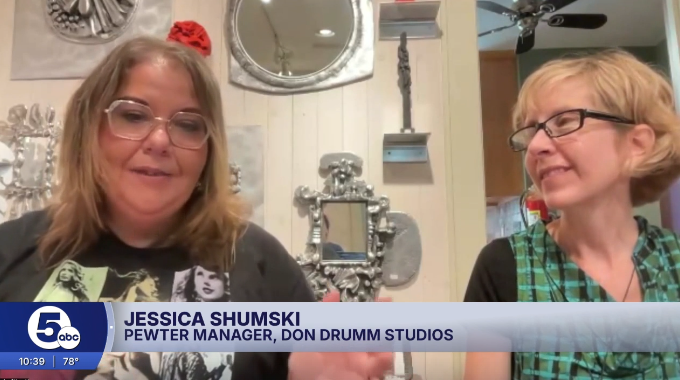
Don Drumm Studios in Akron said a customer recently stopped by the shop to purchase its pewter ornament called “The Wedding Couple.” The customer requested a gift note that read, “For Travis and Taylor,” leaving employees wondering who the gift was actually for.

Those suspicions were later confirmed when the studio learned the customer was a friend of the newly married couple.

The ornament wasn’t the only local gift making its way to the superstar couple. The wedding guest also purchased musical instrument measuring spoons and a casserole dish from Don Drumm Studios for the stars.

The moment was especially meaningful for Don Drumm Studios’ pewter manager, Jessica Shumski, who is both a fan of Swift and the employee who helped prepare the gift.

“To be a part of the happiest day of her life, just in a small way, to wrap a gift for her — just to bring her that tiny bit of happiness back, that she’s created for so many people, it just means so much,” said Shumski.

“The Wedding Couple” was created by Leandra Drumm, the daughter of Don and Lisa Drumm and the owner of Don Drumm Studios. It retails for $24.

Drumm said, “What we thought was special about this is that they chose a local gallery. We are a family-owned business. We are actually celebrating our 55th anniversary this year. My father is 91, still practicing his art, but each one of those items had a meaning to the customer that related to Travis and Taylor.”

Please note: This story was provided to CNN Wire by an affiliate and does not contain original CNN reporting. This content carries a strict local market embargo. If you share the same market as the contributor of this article, you may not use it on any platform.

One Kansas City family, two unforgettable moments with Lionel Messi

By McKenzie Nelson

Click here for updates on this story

    KANSAS CITY, Missouri (KSHB) — For many young soccer players, walking onto the field at the FIFA World Cup is nothing more than a dream.

That dream became reality for 8-year-old Kansas City native Enoch McCleery.

Just moments before Argentina’s World Cup match against Algeria at Kansas City Stadium, McCleery walked onto the field hand in hand with Argentine captain Lionel Messi — creating a memory he said he will never forget.

“I felt very nervous and thrilled at the same time,” McCleery said.

The opportunity came as part of FIFA’s player escort program, which gives children the chance to accompany players onto the field before kickoff.

After flipping a coin to determine which team they would join, McCleery ended up with Argentina and quickly made his way to the front of the line alongside Messi.

“So we flipped a coin to see what team we would walk out with, and then I ran to the front of the line since the captain goes first,” McCleery said.

With nearly 70,000 fans filling the stadium and cheering around him, the moment was overwhelming.

“I felt nervous because all I heard was yelling, but it was cool,” McCleery said.

McCleery’s uncle, Gerardo Flores, watched from home as his nephew shared the field with one of soccer’s biggest stars.

“It caught me off guard honestly,” Flores said. “I was like, ‘No way,’ and then with this guy — it was so cool to watch him.”

The unforgettable walkout was followed by an unforgettable performance. Messi led Argentina to victory, scoring the first FIFA World Cup hat trick of his career.

“It was amazing,” Flores said. “This guy, he’s unbelievable, breaking records. In a way, we kind of touched that through my nephew.”

What makes the story even more remarkable is that it is not the family’s first memorable encounter with Messi.

Two years ago, when Messi visited Kansas City with Inter Miami for a match against Sporting Kansas City, McCleery’s older brother, 14-year-old Dillon Duenaz, made headlines after running onto the field and taking a selfie with the soccer icon before security escorted him away.

“I’ve always been a fan of Messi, since I was born and growing up,” Duenaz said. “I had the opportunity to go watch him, and then I had seen a bunch of kids that had taken pictures with him who had run on the field, so I thought I could also take my chance.”

After snapping the photo, Duenaz said the interaction ended quickly.

“After I had taken the picture, they said, ‘He can go now,’” Duenaz said.

From a viral selfie to the World Cup spotlight, the family now has two extraordinary Messi memories that will be passed down for generations.

Please note: This story was provided to CNN Wire by an affiliate and does not contain original CNN reporting. This content carries a strict local market embargo. If you share the same market as the contributor of this article, you may not use it on any platform.