Sentencing delayed for Smith Rock mass shooting plotter Samson Garner as prosecutor recommends sentence

Barney Lerten

(Update: Adding video)

BEND, Ore. (KTVZ) — The sentencing of a Portland man convicted by a Deschutes County jury of planning a mass shooting at a 2023 Smith Rock climbing event has been delayed three weeks, at the request of his defense attorney. 

After a three-week trial, a jury took less than three hours last month to find Samson Garner, 41, guilty on 26 felony counts of attempted murder, assault and unlawful use of a weapon. 

In a motion to postpone the sentencing, defense attorney Joel Wirtz said, “Because of unexpected protracted contract negotiations with the state agency to provide public defense representation in 2025-2027, I have unable to meet and prepare for sentencing in this matter.” 

He requested a two-week delay “in order to clear this issue off the organization’s priority and (so) our team can focus on serving our clients.” 

Circuit Judge Alison Emerson instead rescheduled the sentencing for three weeks later, on October 23rd. 

Meanwhile, Chief Deputy District Attorney Mary Anderson submitted her sentencing memorandum this week, asking the judge to impose a 30-year prison term. 

Anderson wrote, “The defendant’s intent to kill multiple people, within categories of park goers at Smith Rock State Park, is a course of conduct and multiple offenses demanding consecutive sentences.

“While Oregon does not have a crime for attempting a mass killing event, the intent to kill multiple people is qualitatively different than the intent to kill a single person. The defendant’s intent to kill multiple people and plans and related actions designed to impose additional cruelty to the climbers demonstrates his focus on target selection for impact of the greatest potential harm and cruelty. The state asks the court to impose a sentence of 360 months.”

Related to the issue mentioned by Wirtz in his motion, Public Defenders of Marion County filed an “emergency lawsuit” this week against the Oregon Public Defense Commission, challenging enforceabiliity of the state contract for public defenders, which took effect Wednesday.

They are sharply critical of a new quota system for public defender caseloads, saying under its terms, “it would be impossible in most instances for public defenders to effectively protect and preserve their clients’ constitutional rights.”

They said under the contract, the state would eliminate funding for four Marion County public defenders and a supervising attorney position, while assigning new cases to attorneys whose caseloads are already full.

Click here to follow the original article.

Camp Fire Central Oregon to host 4th annual Autumn Family Faire, and volunteers invited to join the fun

KTVZ

BEND, Ore. (KTVZ) — Crisp air, colorful leaves, and plenty of community spirit can only mean one thing: It’s almost time for Camp Fire Central Oregon’s 4th Annual Autumn Family Faire!

The annual celebration takes place Saturday, October 18, 2025, from 11 a.m. to 3 p.m. at Troy Field in Bend—and it’s completely free for all ages!

Families can look forward to a lively afternoon filled with autumn-themed games, creative crafts, live entertainment, robotics fun, a festive photo booth, a giant bouncy castle from Bouncing Off the Walls, the popular zombie laser-tag tent, and delicious eats from local vendors, including Bobablastic refreshments and grub, Junior’s Grill Build Your Own Mac-N-Cheese, and Kona Ice.

Costumes are encouraged, and guests will also have a chance to win a 50/50 raffle supporting Camp Fire’s youth scholarship fund. Camp Fire partners will feature booths, and a highlight this year, weather permitting: aerial arts by Lava City Cirque.

The Autumn Family Faire is powered by volunteers, and Camp Fire is inviting both teens and adults to be part of the festivities. Teen volunteers can gain valuable experience (great for resumes and college applications), while adults will enjoy an easy way to connect with others and give back to the community.

“Every year, this event grows bigger and more joyful because of the people who show up—not just families attending, but also the volunteers who make it all possible,” says Joey Hamilton, Camp Fire’s marketing and development director. “We can’t wait to see Troy Field come alive with costumes, creativity, and community spirit. Locals, visitors, volunteers—everyone is invited!”

Volunteer Opportunities

Flexible shifts available for both teens and adults

Teens: Register through Camp Fire’s Teen Connects program and work alongside experienced event staff: https://campfireco.org/teenconnects/

Adults: Sign up online for one or more shifts: https://campfireco.org/specialevents/

Volunteer Perks: Morning shifts include complimentary coffee and pastries; all volunteers enjoy a pizza lunch (dietary needs can be noted in advance)

For more information about the 2025 Autumn Family Faire or volunteering, visit campfireco.org/specialevents or contact Camp Fire Central Oregon at 541-382-4682 or info@campfireco.org.

Click here to follow the original article.

Oregon adds oral nicotine tax to fund wildfire prevention and recovery; local lawmaker was behind the move

Claire Elmer

(Update: Adding video, Senator Broadman’s comments)

BEND, Ore. (KTVZ) — After being passed by the Oregon Legislature with bipartisan support earlier this summer, a tax on oral nicotine in House Bill 3940 has now taken effect.

The amendment of HB 3940 regarding oral nicotine was presented by Senator Anthony Broadman (D-Bend) as a solution to help fund Oregon’s wildfire efforts — both prevention and recovery.

The tax adds 65 cents on nicotine pouches with up to 20 units, plus an additional 3 cents per extra unit. Prior to the implementation, oral, synthetic nicotine was not taxed in the state of Oregon, unlike more traditional tobacco products.

KTVZ News spoke with Broadman on Wednesday about the tax and how it’s being implemented.

“We want to make sure that we’re working with our public health partners, and working with the rest of our revenue picture. to make sure that every tax, whether it’s nicotine or fuel, is applied fairly and equitably,” Broadman said.

“People see the importance of funding wildfire mitigation, and I think that’s why this bill was so popular throughout our state,” he added.

 One-third of the new oral nicotine tax’s proceeds will go to Oregon’s Landscape Resiliency Fund, and two-thirds will go to a Community Risk Reduction Fund.

“The most effective way to fund wildfire is to get it early is to prevent the fires from turning into conflagrations at all,” the lawmaker said.

With many Oregonians already struggling with cost of living, increasing the price of any product isn’t always the most popular decision, but officials say the tax is small compared to other states and helps discourage the use of addictive substances.

Broadman said he will continue to fight for more funding for Central Oregon, to ensure our forests and communities are healthy and safe.

Click here to follow the original article.

Bee Gees tribute coming to Bend’s Tower Theatre

KTVZ – News Team

BEND, Ore. (KTVZ) — “Stayin’ Alive: One Night of the Bee Gees” is returning to the Tower Theatre on October 19th.

This ultimate tribute to The Brothers Gibb captures the magic of the bee gees with spot-on vocal harmonies, dazzling visuals, and big-screen video that takes you back to the golden era of the ’70s.

It’s a full Bee Gees experience, from high-energy dance anthems to soulful ballads.

For tickets and show information, click here.

Click here to follow the original article.

Oregon agency announces upcoming federal changes to SNAP benefits

Barney Lerten

SALEM, Ore. (KTVZ) — The Oregon Department of Human Services is announcing federally required changes to the Supplemental Nutrition Assistance Program (SNAP) in Oregon.

These changes are required under House Resolution (H.R. 1), a federal law passed on July 4, 2025. More than 740,000 people in Oregon currently receive SNAP benefits, and ODHS expects more than 313,000 people enrolled in SNAP may be impacted by the H.R. 1 changes.

“We are announcing these changes today so that families can prepare for the impact we expect many Oregonians who depend on this resource will feel,” said Dana Hittle, who is co-leading ODHS’ federal response team. “Oregon families enrolled in SNAP receive an average of $300 a month, and any reduction makes it harder for families to put food on the table. Oregon has no choice but to follow federal law that will result in increased hardship across our communities, but we remain committed to helping families adjust and prepare.”

ODHS will begin notifying affected households in mid-October. The people who will be most affected by the new federal law include older adults, immigrants and people living in rural communities with limited access to transportation.

Governor Tina Kotek issued the following statement:

“The federal cuts to the Supplemental Nutrition Assistance Program (SNAP) are simply wrong, and they will hurt Oregon families. I strongly oppose these changes. Our top priority now is making sure every impacted Oregonian knows what’s changing and where to turn for help. No one should have to choose between food and rent, and my administration is mobilizing to ensure that those affected get the information and referrals for other help that they need.”

The changes won’t happen to everyone at once — they will roll out over the next year.

For people who already get SNAP: The changes will affect those who applied or recertified between July 4 and Oct. 1, 2025. Notices will be sent around Oct. 15, 2025 to this first group of people who are impacted. The first group will have SNAP benefit reductions or closures on Nov. 1, 2025. For people approved for SNAP before July 4, 2025, the changes will happen over time throughout the next year and a notice will be sent.

For people who apply or reapply for SNAP after Oct. 1, 2025: The new rules will apply right away.

Key changes affecting people in Oregon

These changes will affect three main groups of SNAP recipients: households receiving utility assistance, able-bodied adults ages 18 through 64 with no child under age 14 in their SNAP group, and certain lawfully present immigrants.

Utility assistance and SNAP benefits

Households previously eligible for the Heating and Cooling Full Utility Allowance (FUA) through energy assistance programs like Low-Income Home Energy Assistance Program (LIHEAP) or “Heat and Eat” will see changes.

Only households with at least one member who is age 60 or older or a member with a disability will automatically qualify for FUA.

Approximately 29,000 households will lose this allowance, reducing their SNAP benefits by an average of $58 per month.

About 9,600 households who applied or renewed between July 4 and Oct. 1, 2025 will get notices around Oct. 15, 2025. Their SNAP will be reduced Nov. 1, 2025.

Another 20,000 households will see benefits go down when their SNAP is reviewed.

Able-Bodied Adults Without Dependents (ABAWD)

Beginning Oct 1, 2025, people with ABAWD status in 6 counties (Multnomah, Washington, Clackamas, Yamhill, Benton, and Hood River) will be reviewed at application or renewal for required work rules.

People who don’t meet work rules may lose SNAP benefits after 3 months.

The work rules will apply to adults ages 18–64 without a disability or without children under age 14 in their SNAP household. Previously the work rules applied to adults ages 18 to 54 without a child under 18 in their SNAP household.

People with ABAWD status must work or participate in a qualifying activity for at least 80 hours per month.

Veterans, people experiencing homelessness and young adults aging out of foster care are no longer exempt from the work rules.

Tribal Members and people who meet the federal definition of “Indian, Urban Indian, or California Indian” are newly exempt from the work rules.

In January 2026 these ABAWD requirements will be implemented statewide.

It’s estimated that 310,000 adults will have to be newly evaluated to see if they have to meet the work rules.

Refugees, Asylees and certain other lawfully present immigrants

Refugees, asylees, trafficking survivors and other conditionally allowed non-citizens who were eligible for SNAP as of July 3, 2025, will lose eligibility under H.R. 1.

In Oregon, it’s estimated that at least 3,000 individuals will no longer qualify for benefits.

About 1,000 people who applied or renewed their SNAP between July 4 and Oct. 1, 2025 will get notices around Oct. 15, 2025. Their SNAP will end on Oct. 31, 2025.

Another 2,000 people will lose SNAP when their SNAP is reviewed.

Notifications to households

   Around Oct. 15, 2025, ODHS will mail notices to:

Roughly 9,600 households receiving energy assistance to notify them that their SNAP benefits will be reduced starting November 1, 2025.

Approximately 1,000 refugees, asylees and other lawfully present immigrants whose SNAP cases will close on Oct. 31, 2025.

Affected households do not need to take any action. ODHS will adjust benefits automatically.

Preparing for changes

If you think you may be in one of the impacted groups, go to www.oregon.gov/odhs to learn more.

Watch your mail for notices from ODHS and open them right away. The first wave of notices will be sent on Oct. 15, 2025.

If you think the ABAWD work requirements may apply to you, don’t wait to start planning how to meet them. Call the ODHS ABAWD team directly at 833-947-1694 or SNAP.ABAWDTeam@odhsoha.oregon.gov.

Know what other food resources are in your community.

The ODHS Food Resources website can help.

Older adults and people with disabilities can connect with Aging and Disability Resource Connection of Oregon to learn about government programs and community resources at 1-855-673-2372 or www.adrcoforegon.org.

Reach out to 211info by dialing 2-1-1, texting your zip code to 898-211 or visiting www.211info.org

Contact ODHS

If you have questions or need help understanding these changes, contact ODHS:

By phone: Call 1-800-699-9075 or 711 (TTY), relay calls welcome

In person: Visit a local office (find one online)

By Mail: (Requests must be received by the deadline)ONE Customer Service Center, PO Box 14015, Salem, OR 97309

By email: Send requests toOregon.Benefits@odhsoha.oregon.gov

Online: Submit requests through a ONE Online account

About SNAP in Oregon:

SNAP is a cornerstone of Oregon’s fight against hunger, helping more than 1 in 6 people in Oregon, approximately 27 percent of households, afford groceries. This includes children, working families, older adults, and people with disabilities. Every $1 in SNAP benefits generates $1.50 to $1.80 in local economic activity. SNAP drives an estimated $1.6 billion into the Oregon economy each year. But even with SNAP benefits, many families still struggle to meet their basic needs, especially amid the rising cost of food and housing. Everyone deserves access to healthy food, and the Oregon Department of Human Services (ODHS) is committed to making sure people in Oregon receive the right amount of SNAP food benefits they qualify for.

Click here to follow the original article.

The BLM just spent over $200K to clear out, clean up local homeless camps – here’s what else they did to avoid a repeat

Barney Lerten

(Update: Adding video)

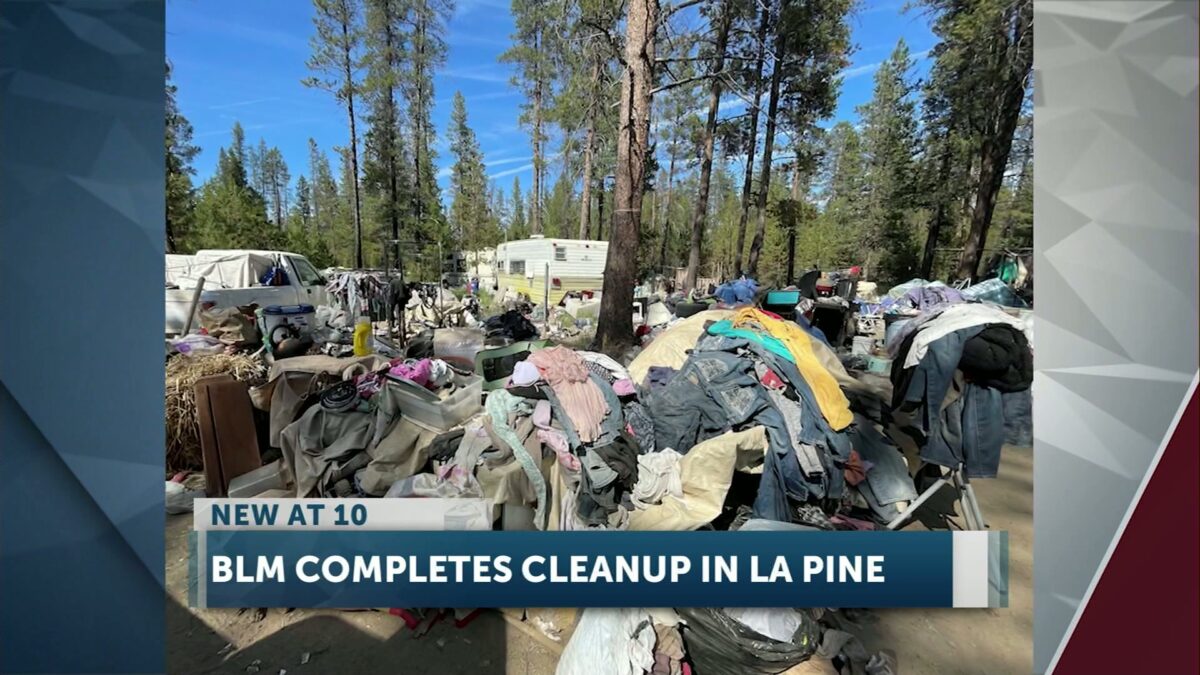
La PINE, Ore. (KTVZ) — The Bureau of Land Management has spent about $200,000 to remove five long-term homeless camps from BLM land near La Pine, a nearly month-long effort that also included using boulders and soft soils to block illegal access roads, in an effort to keep it from happening again.

The BLM’s Prineville District led a coordinated response with Deschutes County officials before the cleanup took place, which the agency said in a news release Tuesday “was necessary to address hazardous materials, trash and abandoned vehicles remaining in the area.”

The BLM said it worked closely with the City of La Pine and the Deschutes County Sheriff’s Office to carry out the cleanup of the eight-acre parcel, with direct involvement from the La Pine City Manager and Mayor.

“Partnering with the City provided the BLM with important local insight, helping ensure the response reflected the specific needs and priorities of the community and connected individuals in the camps with appropriate social services,” the agency said.

BLM Public Affairs Specialist Suzanna Burke told KTVZ News the project began August 29 and ended last Thursday.

“We normally don’t have access to funds like this,” she said, “but because it was the end of the (fiscal) year, we had the funding available.”

The area of the cleanup is about a half-mile southeast of Gordy’s Truck Stop in La Pine, east of Darlene Way and south of Rosland Road.

Five camps were located on the eight acres, the largest covering about a quarter-acre, Burke said. Three apparently had been abandoned for some time, while the other two appeared to be recently occupied.

The cleanup effort removed “probably about 300 cubic yards” of trash, she said, similar to what was removed during another camp clearing by the Newberry Regional Partnership last May of an area known for years as “Camp Covid.”

While there were not a lot of people who had to leave when the recent cleanup began, Burke said, “We did have communication with a couple people out there and led them know we were going to do a cleanup of the area, gave them time to gather the items they wanted.”

The total cost of the cleanup is expected to exceed $200,000, including staff time and materials from the BLM, Deschutes County and the City of La Pine.

The contracted cleanup itself was $165,000, she said, and part of the reason was “the sheer size of this area, the potential for hazardous materials, excess trash, drug debris and human waste.”

Mayor Jeannine Earls said, “As the Mayor of La Pine, I have listened to my community, both within city limits and outside. I want our residents of South Deschutes County to know that we hear you, we are responsive, and we live here too. I am proud of the measurable progress that has been made, and I am committed to our regional needs going forward.”

As the final piece of the effort, BLM staff decommissioned and barricaded illegal routes leading into the sites to help prevent future long-term use, using boulders and soft subsoil difficult or drive on..

“This kind of response requires participation from many agencies,” said Lisa Clark, BLM Deschutes Field Manager. “The BLM is tasked with managing public lands but has no resources to address the human component of the houseless issue. With support from the City of La Pine and Deschutes County, we’ve been able to develop a partnership that can take action to protect both the citizens and the environment.”

The BLM and Deschutes County have identified public safety concerns in several camp areas, including incidents that required coordination with local law enforcement.

The agency said, “These efforts align with the President’s Executive Order on reducing crime and reflect the BLM’s commitment to maintaining safe, accessible public lands through responsible stewardship and collaboration with community partners.”

La Pine City Manager Geoff Wullschlager said, “Collaborative efforts like this do not happen in a vacuum, and this project represents a clear commitment from all parties involved in responding to public health and safety concerns of the larger La Pine area.”

He added, “We could not be more pleased with the relationships and the subsequent outcomes of this initiative. Hopefully, we have collectively provided a baseline for other communities and districts to tackle similar challenges.”

“The BLM, the City of La Pine, and Deschutes County remain committed to ongoing collaboration to address public safety and community needs,” the release concluded. “All three partners look forward to continuing their work together to support the region and its residents.”

Click here to follow the original article.

A bomb scare locked down a local courthouse – here’s what happened, and how it turned out

Barney Lerten

PRINEVILLE, Ore. (KTVZ) — The Crook County Justice Center was locked down and the area around it blocked off for a a time Tuesday after a Prineville man told deputies he feared there was a bomb in his car, authorities said.

No device was found, and he was arrested on DUII and other charges.

Around 11:20 a.m., deputies stationed at the Justice Center information desk spotted the tan car heading north on the western sidewalk along NW Beaver Street between First and Second streets, along the east side of the court facility, Sergeant Javier Sanchez said.

The male driver parked, got out and went into the security checkpoint, where he told deputies “he was concerned there was an improvised explosive device in his vehicle,” Sanchez said in a news release.

As a result, the area around the Justice Center, including businesses, was blocked off for about a half-hour, and the facility was placed in lockdown, the deputy said.

The car was searched, and no device was found.

After an investigation, the 39-year-old Prineville man was arrested and lodged in the county jail on charges of DUII and first-degree disorderly conduct.

“The Sheriff’s Office would like to thank the Prineville Police Department, City of Prineville Public Works, Crook County Fire & Rescue, and STAR Towing for their assistance,” Sanchez said.

Click here to follow the original article.

Oregon sets maximum rent hikes for 2026 – but it’s no longer just one number

Barney Lerten

SALEM, Ore. (KTVZ) — Oregon’s Department of Administrative Services published Tuesday the maximum rent increases allowed by law for 2026 – but it’s no longer one flat percentage figure, due to a change in state law.

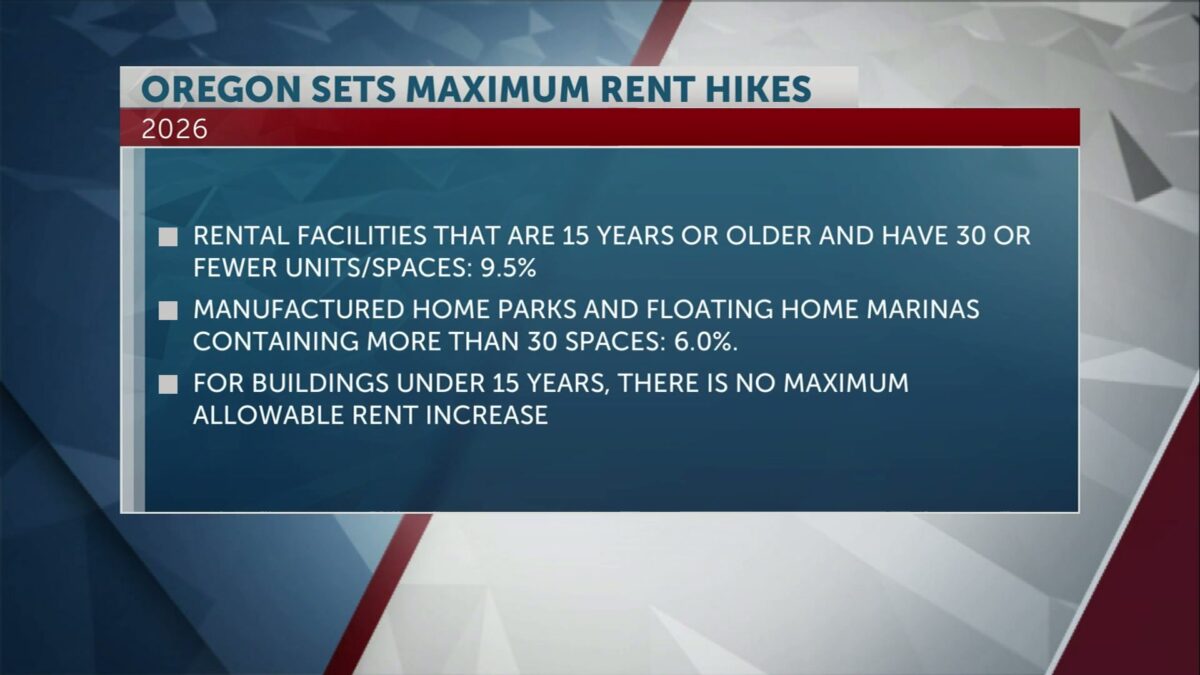
For rental facilities that are 15 years or older and have 30 or fewer units/spaces, the maximum rent increase is 9.5%.

For manufactured home parks and floating home marinas containing more than 30 spaces, the maximum increase is 6.0%.

For buildings under 15 years, there is no maximum allowable rent increase, a DAS representative told KTVZ News.

Under the statute, the Office of Economic Analysis calculates the maximum rent increase by adding 7% to the average change in the cost of living over the past year. Only one rent increase is allowed every 12 months, and the maximum increase is capped at 10%.

The cost-of-living change is measured using the Consumer Price Index for All Urban Consumers, West Region (All Items), published by the U.S. Bureau of Labor Statistics.

House Bill 3054, passed in 2025, changed how rent increases are calculated. Now, the size of the rental property affects the allowed increase.

Rent increase limits are designed to protect tenants from large, unexpected rent hikes.

Oregon law requires the Department of Administrative Services to publish the maximum rent increase allowed each year by September 30 online. DAS will post the 2027 rent increase limits by September 30, 2026.

Click here to follow the original article.

Oregon Health Authority lifts recreational use advisory for Ochoco Lake, but says pets should still stay away

Barney Lerten

PORTLAND, Ore. (KTVZ) — Oregon Health Authority said Tuesday it has lifted a recreational use health advisory issued for Ochoco Lake in Crook County.

OHA issued the advisory on Aug 27 for the lake, located seven miles east of Prineville, where Crook County Parks and Recreation operates and maintains a campground and day-use area.

The rest of Tuesday’s OHA announcement:

Water monitoring has confirmed that the level of cyanotoxins in Ochoco Lake are below recreational guideline values for people.

However, levels detected are still above OHA’s educational guideline values for dogs, and owners should keep their pets away from these areas.

OHA advises recreational visitors to continually be alert to signs of cyanobacteria blooms. This is because blooms can develop and disappear on any water body at any time when bloom conditions are favorable.

Only a fraction of water bodies in Oregon are monitored for blooms and toxins, so it’s important for people to become familiar with signs of a bloom, exposures and symptoms by visiting OHA’s Cyanobacteria (Harmful Algae) Blooms website at http://www.healthoregon.org/hab.

When recreating, people, and especially small children, and pets should avoid areas where the water is foamy, scummy, thick like paint, pea-green or blue-green, or if thick brownish-red mats are visible or bright green clumps are suspended in the water.

If you see these signs, avoid activities that cause you to swallow water or inhale droplets, such as swimming or high-speed water activities, and keep pets out of the area.

Cyanotoxins can still exist in clear water. When a bloom dies, toxins released may reach into clear water around the bloom.

Blooms can be pushed into other areas, leaving toxins behind. There also are species of cyanobacteria that anchor themselves at the bottom of a water body, live in the sediment, or can grow on aquatic plants and release toxins into clear water.

For health information or to report an illness, contact OHA at 971-673-0482, or visit OHA’s Cyanobacteria (Harmful Algae) Blooms website.

Click here to follow the original article.

More major health plans could leave St. Charles network soon, if talks don’t reach a deal

Barney Lerten

BEND, Ore. (KTVZ) — One week after St. Charles Health System said it reached contract agreements with two insurance providers, Aetna and Cigna, comes word that talks with several other insurers are still ongoing. One company, PacificSource, just warned their Medicare Advantage patients they could go out of network on Jan. 1.

A PacificSource Medicare Advantage customer passed along an email to KTVZ News on Tuesday that’s headlined: “St. Charles Health System may leave our network January 1, 2026.”

It continued, “Earlier this year, St. Charles Health System terminated its Medicare contract with PacificSource in order to negotiate a new contract for 2026. We’re working diligently to reach an agreement that allows St. Charles to continue participating in our network. If we’re unable able to do so, they will be out-of-network beginning January 1, 2026.”

Under a heading of “What’s next,” the insurer said: “We remain committed to finding a resolution and will continue working hard to reach an agreement with St. Charles. If we are unable to reach an agreement, our top priority will be to support our members through the transition.”

“We will keep you informed with any updates as this situation develops,” the company added.

KTVZ News reached out to St. Charles Public Information Officer Alandra Johnson, who shared this statement:

“We are continuing to negotiate with PacficSource and several other insurance companies. No final decisions have been made at this time. Please consult our website for the latest information on which plans are currently in network for St. Charles providers and facilities.”

Johnson was unable to share specifics of what other insurers they are negotiating with. But she stressed that the PacificSource notice only involves Medicare Advantage supplemental plans – not traditional Medicare, which is always covered. Negotiations are also underway between St. Charles and PacificSource, as well as others, for their commercial and/or Medicare Advantage contracts.

“St. Charles is always in network for traditional Medicare” patients, Johnson said.

She also said “each contract is different” in terms of timing.

KTVZ News has reached out to PacificSource for any additional statement or details.

Click here to follow the original article.