State Senator Broadman of Bend, colleagues to try again on bill to allow small Kei trucks on Oregon highways

KTVZ

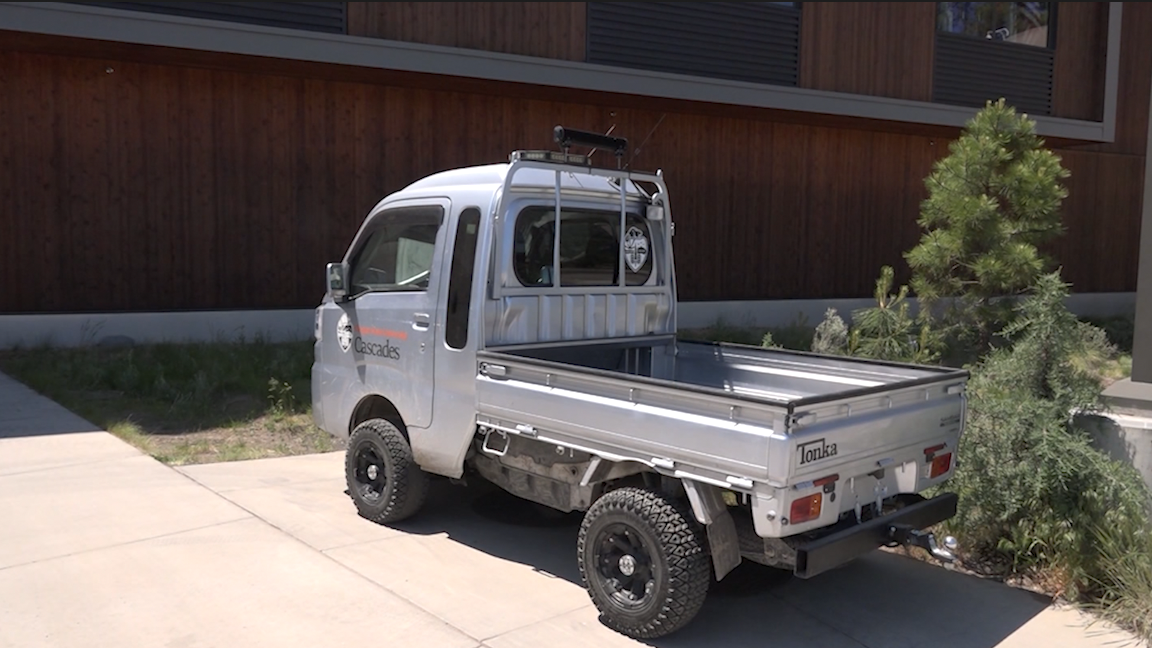
SALEM, Ore. (KTVZ) — State Representatives Virgle Osborne (R-Roseburg) and Alek Skarlatos (R-Canyonville) and Senator Anthony Broadman (D-Bend) are reintroducing bipartisan legislation for the 2026 legislative session to allow the registration and on-road use of Kei trucks in Oregon.

“The bill responds to continued interest from small businesses, farmers, contractors, and community members seeking affordable, practical transportation options that better match their needs and scale,” the news release said, continuing below:

This bill is a continuation of efforts in the 2025 session to modernize Oregon’s vehicle laws in response to rising transportation costs and evolving workforce needs.

Kei trucks are compact, lightweight utility vehicles commonly used in other states for agriculture, maintenance, deliveries, and job-site operations. While legal to own and operate on private property in Oregon, current law prevents these vehicles from being registered for on-road use, limiting their usefulness for many working Oregonians.

“Across much of Oregon, functionality and efficiency are more important than vehicle size. Kei trucks are affordable, well-suited for a wide range of jobs, and meet real needs in rural and working communities.” said Representative Osborne. “This bill provides flexibility while maintaining Oregon’s existing safety standards.”

Supporters of the legislation say allowing on-road registration would help reduce transportation costs, expand access to reliable equipment, and give small businesses and rural operators more flexibility to move between job sites and communities.

Senator Broadman said, “Expanding access to affordable, right-sized transportation helps remove cost barriers for small businesses and working Oregonians and supports stronger local economies across the state.”

Representative Skarlatos said, “Our laws should reflect the freedom to use the right vehicle for the right job. We have an opportunity to ensure our transportation system reflects the real needs of Oregonians.”

The bill establishes clear parameters defining Kei trucks by size, engine capacity and age, and allows them to be registered within Oregon’s existing motor vehicle framework. The approach aligns Oregon with neighboring states that have already adopted similar policies while maintaining existing safety and roadway standards.

Click here to follow the original article.

AAA: Oregon gas prices stay ‘calm,’ though Bend’s edged upward last week

Barney Lerten

PORTLAND, Ore., (KTVZ) -– It’s been another calm week for gas prices across the country, with 45 states seeing pump prices change by a nickel or less, AAA Oregon/Idaho reported Tuesday.

Higher crude oil prices have kept the national average for regular gas from falling, while prices in Oregon and other West Coast states continue to inch down. The national and Oregon averages remain at their lowest prices in nearly five years.

The national average is at its cheapest price since March 2021 and the Oregon average is at its lowest price since May 2021. For the week, the national average for regular gas remains at $2.82 a gallon. The Oregon average slips two cents to $3.33 a gallon, while Bend’s edged upward about a penny, to $3.24 a gallon. Some spots in the Willamette Valley also saw gas prices rise a small amount.

“We’re seeing small increases in a number of markets this week, but not enough to send the Oregon average higher, at least not yet,” Marie Dodds, public affairs director for AAA Oregon/Idaho, told KTVZ News.

Here’s the breakdown and the rest of AAA’s news release:
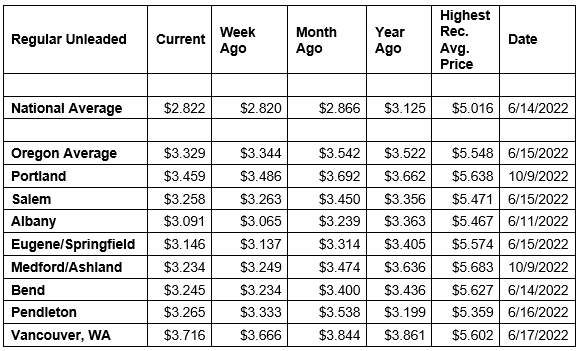
National State Local Gas Prices 1-20-26

“Crude oil prices are around $60 per barrel after spending several weeks in the mid-$50s and that’s putting upward pressure on gas prices ahead of the usual seasonal increases. For now, gas prices in Oregon and most other West Coast states continue to tick lower. However, we only have a few weeks before California begins the process to switch to summer-blend fuel, which kicks off the seasonal increases in pump prices,” says Dodds.

The Oregon average for regular gas began 2026 at $3.42 a gallon, which is the highest price of the year so far. The lowest price of the year so far is today’s price of $3.33.   

The national average began 2026 at $2.83 a gallon, which is the highest price of the year so far. The lowest price of the year so far is $2.795 on January 11.

The average price for the national average for regular gas in 2025 was $3.11 per gallon. The average price of the Oregon average for the year was $3.87.

Demand for gasoline in the U.S. gasoline increased from 8.17 million b/d to 8.30 million b/d for the week ending January 9. This compares to 8.33 million b/d a year ago. Total domestic supply of gasoline increased from 242 million barrels to 251 million. Gasoline production increased last week, averaging 9.03 million barrels per day compared to 9.0 million barrels the previous week.

Gas prices typically rise starting in mid-to-late winter and early spring as refineries undergo maintenance ahead of the switch to summer-blend fuel, which is more expensive to produce and less likely to evaporate in warmer temperatures. The switch occurs first in California, which is why pump prices on the West Coast often rise before other parts of the country. The East Coast is the last major market to switch to summer-blend fuel. Most areas have a May 1 compliance date for refiners and terminals, while most gas stations have a June 1 deadline to switch to selling summer-blend. Switch-over dates are earlier in California with some areas in the state requiring summer-blend fuel by April 1. Some refineries will begin maintenance and the switchover in February.

Gas prices usually drop in the fall, due to the switch from summer-blend to winter-blend fuel, which costs less to produce. The switch starts in September. Many areas, including Oregon, can sell winter-blend fuel starting September 15. However, Northern and Southern California require summer-blend fuel through October 31. Prices usually decline to their lowest levels of the year in late fall and early winter before increasing again in the late winter and early spring.

The U.S. price of crude oil (West Texas Intermediate) has mostly been in the upper $50s to mid-$70s since September 2024.

WTI is trading at $60 today, compared to $61 a week ago and $76 a year ago. In 2025, West Texas Intermediate ranged between $80.04 (January 15) and $57.46 (October 16) per barrel.  In 2024, WTI ranged between $66 and $87 per barrel. In 2023, WTI ranged between $63 and $95 per barrel. WTI reached recent highs of $123.70 on March 8, 2022, shortly after the Russian invasion of Ukraine, and $122.11 per barrel on June 8, 2022. The all-time high for WTI crude oil is $147.27 in July 2008.

Crude prices are impacted by economic news as well as geopolitical events around the world including the current economic uncertainty, the current situation in Venezuela, tensions over Greenland, protests in Iran, unrest in the Middle East, the conflict between Israel and Hamas, and the war between Russia and Ukraine. Russia is a top global oil producer, behind the U.S. and Saudi Arabia. Crude prices were volatile after the attack on Israel by Hamas in October 2023. While Israel and the Palestinian territory are not oil producers, there were concerns that the conflict could spread in the Middle East, which could potentially impact crude production in other oil-producing nations in the region. Crude oil prices declined after October’s fragile peace agreement between Israel and Hamas. In addition, production cuts by OPEC+ in previous years tightened global crude oil supplies, which continued to impact prices. But in 2025, the cartel boosted production which put downward pressure on crude oil prices. For 2026, OPEC+ says it’s not planning any production hikes in the first quarter of the year due to lower demand.

Crude oil is the main ingredient in gasoline and diesel, so pump prices are impacted by crude prices on the global markets. On average, about 47% of what we pay for in a gallon of gasoline is for the price of crude oil, 16% is refining, 20% distribution and marketing, and 17% are taxes, according to the U.S. Energy Information Administration.

Meanwhile, crude oil production in the U.S. remains at or near record highs. The U.S. Energy Information Administration (EIA) reports that crude production in his country is at 13.76 million barrels per day for the week ending January 9. Production has been at 13.5 million barrels per day many times since October 2024. The U.S. has been the top producer of crude oil in the world since 2018 and has been increasing its oil production since about 2009.

Quick stats

Oregon is one of 27 states and the District of Columbia with lower prices now than a week ago. Ohio (-8 cents) has the largest week-over-week decrease in the nation. Colorado (+10 cents) has the biggest week-over-week increase in the country.

Hawaii ($4.41) has the most expensive gas in the nation for the sixth week in a row. California ($4.20) is second. These are the only states with averages at or above $4 a gallon. This week five states and the District of Columbia have averages in the $3-range. There are 43 states with an average in the $2 range this week.

The cheapest gas in the nation is in Oklahoma ($2.31) and Arkansas ($2.43) and. No state has had an average below $2 a gallon since January 7, 2021, when Mississippi and Texas were below that threshold. At the time, the COVID-19 pandemic drove significant declines in crude oil and gasoline demand in the U.S. and around the world.

The difference between the most expensive and least expensive states is $2.10 this week, compared to $2.19 a week ago.

Oregon is one of 40 states and the District of Columbia with lower prices now than a month ago. The national average is four cents less and the Oregon average is 21 cents less than a month ago. Oregon has the largest month-over-month decline in the nation. Michigan (+19 cents) has the largest month-over-month increase.

Oregon is one of 49 states and the District of Columbia with lower prices now than a year ago. The national average is 30 cents less, while the Oregon average is 19 cents less. Wisconsin (-46 cents) has the largest year-over-year drop in the nation. Alaska (+15 cents) is the only state with a year-over-year increase.

West Coast

The West Coast region continues to have the most expensive pump prices in the nation with six of the seven states in the top 10. It’s typical for the West Coast to have six or seven states in the top 10 as this region tends to consistently have fairly tight supplies, consuming about as much gasoline as is produced. In addition, this region is located relatively far from parts of the country where oil drilling, production and refining occurs, so transportation costs are higher. And environmental programs in this region add to the cost of production, storage and distribution.

Rank
Region
Price on 1/20/2026

1
Hawaii
$4.41

2
California
$4.20

3
Washington
$3.81

4
Alaska
$3.45

5
Nevada
$3.36

6
Oregon
$3.33

7
District of Columbia
$3.10

8
Pennsylvania
$3.03

9
Vermont
$2.99

10
New York
$2.98

As mentioned above, Hawaii has the most expensive gas in the country for the sixth consecutive week. California, Washington, Alaska, Nevada, and Oregon round out the top six. Arizona is 11th. Oregon is sixth for the second week in a row.

Five of the seven states in the West Coast region have week-over-week decreases: Alaska (-4 cents), Oregon (-2 cents), Hawaii (-1 cent), California (-1 cent), and Arizona (-1 cent). Washington (+2 cents) and Nevada (+1 cent) have small week-over-week increases.

The refinery utilization rate on the West Coast climbed from 80.0% to 84.4% for the week ending January 9. This rate has ranged between about 70% to 93% in the last year. The latest national refinery utilization rate rose from 94.7% to 95.3%.

The refinery utilization rate measures how much crude oil refineries are processing as a percentage of their maximum capacity. A low or declining rate can put upward pressure on pump prices, while a high or rising rate can put downward pressure on pump prices.

According to EIA’s latest weekly report, total gas stocks in the region increased from 31.35 million bbl. to 31.60 million bbl. for the week ending January 9. An increase in gasoline stocks can put downward pressure on pump prices, while a decrease in gasoline stocks can put upward pressure on pump prices.

Oil market dynamics

Crude oil prices are again above $60 this week as investors weigh the Greenland situation and President Trump’s threats of tariffs on European nations, unrest in Iran, he impacts from the U.S. action in Venezuela and how it might impact that country’s large oil reserves, and the ongoing war between Russia and Ukraine.

Meanwhile, the EIA reports that crude oil inventories decreased by 3.8 million barrels from the previous week. At 419.1 million barrels, U.S. crude oil inventories are about 3% below the five-year average for this time of year. 

At the close of Friday’s formal trading session, WTI gained 25 cents to close at $59.44. U.S. markets were closed Monday in observance of Martin Luther King, Jr. Day. Today crude is trading around $60, compared to $61 a week ago. Crude prices are about $16 less than a year ago. ($75.89 on January 21, 2025)

Drivers can find current gas prices along their route with the free AAA Mobile app for iPhone, iPad and Android. The app can also be used to map a route, find discounts, book a hotel and access AAA roadside assistance. Learn more at AAA.com/mobile.

Click here to follow the original article.

Dudley’s Bookshop to open second location in Bend’s Old Mill District

KTVZ – News Team

BEND, Ore. (KTVZ) — Dudley’s Bookshop Café will open a second location this spring, coming to Bend’s Old Mill District. It will be the Old Mill’s first and only independent bookstore.

“The Old Mill District has always been one of the few places in town that makes sense for a small business like ours,” said Tom Beans, owner of Dudley’s Bookshop Café in a press release Tuesday. “We rely on people walking by, stopping in, and discovering us. That happens naturally down there.”

For more information on Dudley’s, click here.

Read the full press release from the Old Mill below:

“Dudley’s Bookshop Café has announced plans to open a second location in Bend’s Old Mill District this spring, bringing the district its first and only independent bookstore while also adding a new retail category to one of Central Oregon’s premier shopping and recreation destinations.

To be located between Will Leather Goods and lululemon, the new Dudley’s Bookshop will sit just steps from the Deschutes River, with its back door facing the river trail. The approximately 900-square-foot shop is expected to open in late spring, ahead of Bend’s busy summer season.

“The Old Mill District has always been one of the few places in town that makes sense for a small business like ours,” said Tom Beans, owner of Dudley’s Bookshop Café. “We rely on people walking by, stopping in, and discovering us. That happens naturally down there.”

Dudley’s and the Old Mill District have been in conversation for more than two years about this opportunity. According to Beau Eastes, Marketing Director at the Old Mil District, both sides recognized a strong alignment between the district’s walkable layout and the foot-driven-traffic Dudley’s receives at its Downtown Bend location.

“We’ve long felt that a bookstore would be a great fit here,” Eastes said. “It’s a category we don’t currently have, and Dudley’s will add a different flavor to the district. We’re excited to welcome a locally owned business that people naturally want to wander into while they’re shopping, walking the river, or spending the day down here.”

For Beans, the expansion has been years in the making. He purchased the downtown Bend bookstore in 2015 and has since seen both the city and the independent bookstore scene evolve dramatically. In fact, he sees the store’s growth as part of a broader cultural shift away from tech.

“People are tired of screens,” Beans said. “There’s a real push-back happening. Analog is back. You see it with books, with vinyl, with people wanting to slow down a little. Supporting local businesses matters to people in this town, and that energy has been huge for independent bookstores.”

While still in the planning phase, Dudley’s co-owner and manager Amy Rose said she anticipates the satellite store will carry mostly newer books, with a curated selection designed for the smaller footprint. Expect more face-out displays, rotating feature titles, staff recommendations, and a strong emphasis on Pacific Northwest topics and authors, she added. Dudley’s in the Old Mill District will focus almost exclusively on books initially and not feature an espresso bar like its downtown location.

The space itself will reflect the Old Mill District’s industrial roots. Beans and Rose plan to reuse reclaimed materials in the buildout, including old brick and scrap metal, as a nod to the site’s history.

“There’s a certain feeling when you walk into a bookstore,” Rose said. “That sense of nostalgia, comfort, and curiosity. Our goal is for people to feel that the moment they step inside, whether they planned to stop in or not.”

For more information about Dudley’s Bookshop Café, visit dudleysbookshopcafe.com.

ABOUT THE OLD MILL DISTRICT Once home to one of the largest sawmill operations in the world, the Old Mill District has evolved into one of the Pacific Northwest’s most iconic mixed-use destinations. With spectacular views, an extensive trail system, and over 60 local and national businesses, the district offers an unmatched experience for shopping, dining, living, and working in Central Oregon. Learn more at www.oldmilldistrict.com.”

Click here to follow the original article.
Flock debate: Oregon lawmakers poised to tackle ‘fishing expedition’ searches of license plate data

Oregon Capital Chronicle

By Shaanth Nanguneri, Oregon Capital Chronicle

SALEM, Ore. — A powerful Oregon legislative committee chair is calling for increased “safeguards and protections” on the use of data collected by a controversial crime-fighting technology scanning license plates that critics fear the Trump administration will weaponize.

Sen. Floyd Prozanski, a Eugene Democrat who chairs the Senate Judiciary Committee, helped convene a group of law enforcement stakeholders, privacy advocates and legislative leaders, which met in December to tackle the issue as cities across the state have debated whether to turn off their cameras employing the technology.

One vendor in particular, the Atlanta-based Flock Safety, has drawn condemnation from U.S. Sen. Ron Wyden, who previously said the company is “unable and uninterested” in addressing abuses of its products.

But views among workgroup stakeholders were diverse, including law enforcement who have defended license plate readers as a valuable tool for intercepting crime to progressive activists who say such technology itself is far too vulnerable for abuse by the federal government.

Critics of some license plate reading technology have pointed to instances where the software’s data has been accessed by federal immigration enforcement agencies or used to target out-of-state abortion seekers.

“At this point, Prozanski is leaning more towards putting up some guardrails that will make it safe,” Ky Fireside, an Oregon House candidate and Springfield-based progressive organizer who is part of the workgroup, told the Capital Chronicle in December. “But the fact of the matter is, there’s not anything you can do to make this kind of technology safe. It’s just designed to be abused.”

Prozanski, however, said in an interview that he values the technology for “legitimate, lawful enforcement purposes,” pointing to its use in the arrests of suspected criminals tied to a Pacific Northwest burglary ring targeting Asian American households, including in the Eugene-Springfield area. 

He said he was also concerned about inappropriate data-sharing with the federal government or other states, as well as data brokers who are mining and selling such data for unlawful use. He added that law enforcement agencies across the state may be entering into contracts for the software without adequate data privacy protections, calling for similar protections employed by other Oregon state agencies for safeguarding information.

“They have protocols in place already on the duration of the length that can be held, (to) cross check for if someone’s making inquiries, to ensure that there has been something assigned to it, like a case number, and someone’s not going on what some people would call a fishing expedition and just picking out this request or that request,” Prozanski said. “That’s the type of stuff that we’re working on.”

New funding formula

Key to the debate over the license plate readers have been Oregon’s sanctuary laws, which prevent state and local law enforcement from assisting federal immigration enforcement without a court order. U.S. Border Patrol employed automated license plate reading technology in the 1990s, and it spread to police departments across the country in the next decade. 

A November state court ruling in Washington found that the images captured by Flock’s license plate readers are not exempt from disclosure under public records law. Prozanski confirmed he is still considering a public records exemption for such information as well as increased audits, a pathway to allow individuals whose data is improperly accessed to receive redress and certification requirements for license plate reading software vendors. 

A Flock company spokesperson did not respond to requests for comment about legislative efforts in Oregon, but company leadership have previously accused opponents of spreading misinformation, pointing to improved filters for sanctuary states. 

“We’re working under state law of Oregon, and if someone is making queries for something that happened or potentially could be actionable in a different state, it’s not what their state law provides, it’s what Oregon provides,” Prozanski said. “So we’re going to maintain safeguards and protections for those within this state.”

The state has already funded the proliferation of the technology’s use across Oregon, though in cities such as Eugene, police have backed away from their contracts with Flock. In that instance, local authorities confirmed that a license plate reading camera in the area was turned on without the city’s consent.

Meanwhile, hundreds of thousands of dollars in funding for law enforcement agencies across the state has gone toward the technology, drawing from an Oregon organized retail theft grant program, according to the state’s Criminal Justice Commission. As of December, however, there have been no instances where the agency has needed to investigate reports of state law violations involving the use of state funds for license plate reading technology, according to Ryan Keck, the commission’s director. 

He said that his agency uses quarterly reports from recipients and can also conduct information audits within the scope of its grant agreements. If there were a reported violation, Keck said the agency would forward the matter for investigation. 

For new grants issued after Dec. 1, 2025, however, the agency has tightened its purse strings. New contracts include additional language for returning any funds that have been spent outside the scope of the agreement, which includes requirements to comply with state laws, Keck said. The commission in October also agreed to establish a new methodology for determining how the retail theft grant money would be awarded.  

“The Commission’s methodology prioritized applications to support local programs specific to organized retail theft (to include equipment) over applications solely requesting equipment with no specified support (ex: personnel, operations) to address organized retail theft,” he wrote in a statement.

“Moving forward, CJC will continue to monitor its grants in accordance with the terms of executed grant agreements, and remain responsive to any legislative changes,” he added.

Future legislation, continued debate likely

In an interview Friday, Fireside said that while they appreciate the work the legislative workgroup has done, the deck felt stacked in favor of law enforcement. 

The line in the sand they and other privacy advocates are drawing has to do with support for end-to-end encryption, the process by which secure data is encoded before it is transferred to its destination and decoded. Having such a safeguard would make it difficult for federal authorities to subpoena vendors for information stored securely by a law enforcement agency, Fireside said. 

“They are trying to push for like, ‘Oh, well, it’s, it’s encrypted in transit, and it’s encrypted at rest’, and that just doesn’t mean anything,” they said. “It doesn’t provide any protection.”

Prozanski, in the meantime, suggested there would be more than one proposal in the works, potentially for future sessions. Some ideas involve allocating additional funding, which is not feasible given the state’s current financial outlook, he told the Capital Chronicle, but could be in the future.

“This is probably the first beginning of more than one session dealing with this,” he said. “We’re not going to get everything done the first time.”

Click here to follow the original article.

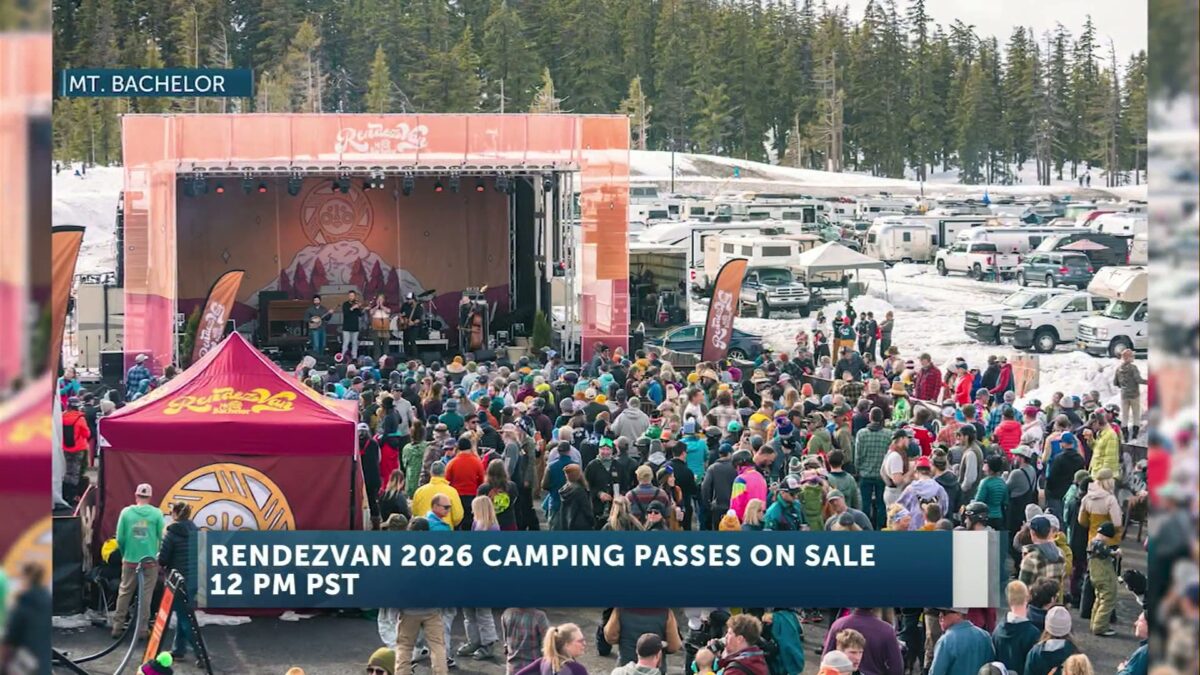
Mt. Bachelor’s RendezVan 2026 camping passes go on sale Wednesday

Kelsey Merison

BEND, Ore. (KTVZ) — Camping passes for Mt. Bachelor’s RendezVan 2026 will go on sale at 12:00 p.m. PST on Wednesday, January 21st.

The resort’s signature spring event will happen April 16th-19th and guests can look forward to new entertainment, programs, and amenities. Entrance to the festival center is free but overnight access requires a 3-day camping pass, which must be purchased online.

You can purchase passes and find more information by clicking here.

Here’s the full press release from Mt. Bachelor:

“Mt. Bachelor’s signature spring festival, RendezVan, is slated for April 16-19, 2026, promising an unforgettable celebration of skiing, snowboarding, camping, music, food and more. 3-Day Camping Passes will be available for purchase online at 12:00 p.m. PST on January 21, 2026. Booking early is encouraged, as these tend to sell out quickly – especially the powered RV spots.

Pricing

Powered RV: $899

20×40 Non-Powered RV: $369

20×20 Van/Car Space: $319

Extra Vehicle*: $120

*This is an add-on option when purchasing a regular camping pass

Camping VIP Upgrade*: $149

*This is an add-on option when purchasing a regular non-powered camping pass for upfront parking close to the festival center

For more information about 3-Day Camping Passes, visit: https://www.rendezvan.com/the-festival/general-faq/ and scroll down to “CAMPING FAQS.”

This year, the festival will adopt new policies in regard to re-entry and check-in. Guests can also look forward to new entertainment, programs, and amenities.

New at RendezVan 2026

An additional band will be added to both Friday & Saturday’s music lineup (see below for details)

Silent Disco footprint will be doubled, allowing for twice the number of dancers

Every day from noon to 12:30 p.m., Marty the Pine Marten will be dancing with kids of all ages at the main stage

On Friday, line dancing will take place on the main stage from 1:00 – 2:00 p.m.

Guests can enjoy a skate park in the Festival Center, presented by Boardhouse

New & expanded food & beverage options

Music

This year’s music lineup features a wide spectrum, from acoustic-rooted folk and bluegrass to indie pop, funk jams, and electronic mashups. 

Thursday, April 16 – Local Showcase 

Rum Peppers  

mamasboy 

Friday, April 17:  

The 502s 

Kitchen Dwellers  

DUG 

Saturday, April 18:  

Andy Frasco & The U.N. 

Horseshoes & Hand Grenades 

Vincent Antone 

About RendezVan 

RendezVan is the celebration of the amazing community of RVers, campers, and van-lifers who make the annual pilgrimage to Mt. Bachelor in the springtime to enjoy the slopes, live music, and the best après tail-gate scene in the Pacific Northwest. All walks of life are welcome at RendezVan. Entrance to the festival center, including music, vendors, activities, and fun competitions are free. Overnight access requires a 3-Day Camping Pass, which must be purchased online. RendezVan offers DJ entertainment, a silent disco, food trucks, bars, photobooths, guided slopeside yoga, and competitions for the dogs. For the full schedule, more information about RendezVan, visit RendezVan.com.  

About Mt. Bachelor 

Mt. Bachelor is the premier ski area in the Pacific Northwest, offering 4,323 acres of lift-accessible terrain with 360-degree descents from its 9,065’ volcanic peak. The mountain resort is served by three carpets and 12 lifts, seven of which feature high-speed quads and one high-speed 6-pack lift. Mt. Bachelor also features 9 Woodward Mountain Parks, 56 km of groomed cross-country trails, snowshoeing, and sled dog rides. Summer attractions include downhill mountain biking, ZipTour ziplining, and whitewater rafting with Sun Country Tours. Mt. Bachelor is part of POWDR, a family-owned and operated Adventure Lifestyle Company©. For more information visit www.mtbachelor.com.”

Click here to follow the original article.

BLOOD SHORTAGE: American Red Cross urges blood donations

Kelsey Merison

(UPDATE: Adding Video)

BEND, Ore. (KTVZ) — It’s National Blood Donor Month, and right now, the American Red Cross says there’s an urgent need for donations.

According to the organization, about 400 blood drives were impacted due to extreme winter weather last month alone, and requests from hospitals have exceeded the available supply of blood–leading to about a 35% drawdown of blood products in the past month.

There are several opportunities across Central Oregon for you to help out now through February 3rd. Those who donate between now and January 25th will be entered to win a trip for two to Super Bowl LX. Then, from January 26th to February 28th, those who donate will receive a $20 e-gift card to a merchant of choice.

Here’s when and where you can donate in Crook, Deschutes, and Jefferson counties through February 3rd:

-DESCHUTES COUNTY

BEND:

Bend Blood Donation Center, 815 SW Bond Street Suite 110 – Visit RedCrossBlood.org to see times.

1/20/2026: 9 a.m. – 3 p.m., State & County Offices, 1300 NW Wall Street

1/21/2026: 10 a.m. – 3 p.m., Central OR Community College Campus Center, 2600 NW College Way

1/23/2026: 11:30 a.m. – 3:30 p.m., Break Room Building, 1055 NW Newport Ave

1/26/2026: 9 a.m. – 2 p.m., City of Bend Police Department, 555 NE 15th St

1/27/2026: 1 p.m. – 6 p.m., Foundry Church, 60 NW Oregon Ave

1/28/2026: 12 p.m. – 5 p.m., Unitarian Universalist Fellowship of Central Oregon, 61980 Skyline Ranch Road

1/29/2026: 1 p.m. – 6 p.m., Community House, 2558 NE Daggett Ln

REDMOND:

1/23/2026: 9 a.m. – 2 p.m., Redmond Senior Center, 325 NW Dogwood Ave

1/26/2026: 10 a.m. – 3 p.m., Redmond Library, 827 SW Deschutes Ave

1/29/2026: 8 a.m. – 1 p.m., Redmond Fire & Rescue Station 401, 341 NW Dogwood Ave

SUNRIVER:

2/2/2026: 12 p.m. – 5 p.m., Community Bible Church, 1 Theater Drive

-CROOK COUNTY

PRINEVILLE:

1/30/2026: 10:30 a.m. – 3:30 p.m., Juniper Canyon Baptist Church, 9180 SE Juniper Canyon Rd.

-JEFFERSON COUNTY

TERREBONNE:

1/21/2026: 12:30 p.m. – 5:30 p.m., Fire & Rescue, 6971 Shad Rd

Click here to book a donation appointment.

Below is the full press release from the American Red Cross:

“The American Red Cross is facing a severe blood shortage as requests from hospitals exceed the available supply of blood, leading to about a 35% drawdown of blood products in the past month. Individuals are urged to give now so patients don’t face delays in lifesaving care. The shortage is especially serious for platelets, types O, A negative and B negative blood.

High flu activity in nearly every state may be sidelining donors, slowing efforts to rebuild the Red Cross national blood supply. At the same time, hospitals already feeling the strain of the worst flu season in nearly 20 years are now also forced to triage critical blood products. Without immediate action, patients who count on transfusions — including trauma victims, mothers in childbirth and people with sickle cell disease or cancer — face serious risk. 

There’s no time to wait — book an appointment to give blood or platelets now by using the Blood Donor App, visiting RedCrossBlood.org or calling 1-800-RED CROSS (1-800-733-2767).

As a thank-you to donors for helping tackle the blood shortage, those who come to give through Jan. 25, 2026, will be automatically entered for a chance to win a trip for two to Super Bowl LX in the San Francisco Bay Area. The winner and guest will receive two tickets to Super Bowl LX, access to day-of, in-stadium pregame activities, tickets to the official Super Bowl Experience, round-trip airfare, three-night hotel accommodations (Feb. 6-9, 2026), plus a $1,000 gift card for expenses. See RedCrossBlood.org/SuperBowl for details.

All who come to give Jan. 26-Feb. 28, 2026, will receive a $20 e-gift card to a merchant of choice. See RedCrossBlood.org/Heart for details.

Weather disrupts vital donations

About 400 blood drives were impacted due to extreme winter weather last month alone — more than three times the number of blood drives impacted during the same time the previous year. As a result, thousands of blood donations have gone uncollected. With intense winter weather and freezing temperatures expected across much of the country in the coming weeks, more blood drives could potentially be delayed or canceled at a time when every unit of blood could be the difference for doctors facing difficult choices about which patients receive blood transfusions and who will need to wait.

“Winter always puts pressure on the blood supply, and this year widespread flu and rough weather are making it even tougher,” said Paul Sullivan, senior vice president of Red Cross donor services. “If you’re able, now’s a great time to make and keep blood donation appointments, during National Blood Donor Month. Every donation can be a lifeline for a patient who isn’t able to hold off on critical care.”

Upcoming blood donation opportunities Jan. 20-Feb. 3: 

Crook:

Prineville

-1/30/2026: 10:30 a.m. – 3:30 p.m., Juniper Canyon Baptist Church, 9180 SE Juniper Canyon Rd.

Deschutes:

Bend

Bend Blood Donation Center, 815 SW Bond Street Suite 110 – Visit RedCrossBlood.org to see times.

-1/20/2026: 9 a.m. – 3 p.m., State & County Offices, 1300 NW Wall Street

-1/21/2026: 10 a.m. – 3 p.m., Central OR Community College Campus Center, 2600 NW College Way

-1/23/2026: 11:30 a.m. – 3:30 p.m., Break Room Building, 1055 NW Newport Ave

-1/26/2026: 9 a.m. – 2 p.m., City of Bend Police Department, 555 NE 15th St

-1/27/2026: 1 p.m. – 6 p.m., Foundry Church, 60 NW Oregon Ave

-1/28/2026: 12 p.m. – 5 p.m., Unitarian Universalist Fellowship of Central Oregon, 61980 Skyline Ranch Road

-1/29/2026: 1 p.m. – 6 p.m., Community House, 2558 NE Daggett Ln

Redmond

-1/23/2026: 9 a.m. – 2 p.m., Redmond Senior Center, 325 NW Dogwood Ave

-1/26/2026: 10 a.m. – 3 p.m., Redmond Library, 827 SW Deschutes Ave

-1/29/2026: 8 a.m. – 1 p.m., Redmond Fire & Rescue Station 401, 341 NW Dogwood Ave

Sunriver

-2/2/2026: 12 p.m. – 5 p.m., Community Bible Church, 1 Theater Drive

Jefferson:

Terrebonne

-1/21/2026: 12:30 p.m. – 5:30 p.m., Fire & Rescue, 6971 Shad Rd

About the American Red Cross:

The American Red Cross shelters, feeds and provides comfort to victims of disasters; supplies about 40% of the nation’s blood; teaches skills that save lives; distributes international humanitarian aid; and supports veterans, military members and their families. The Red Cross is a nonprofit organization that depends on volunteers and the generosity of the American public to deliver its mission. For more information, please visit redcross.org or CruzRojaAmericana.org, or follow us on social media.”

Click here to follow the original article.

Volunteers lend a hand at Stirrup Purpose equine therapy in Bend 

Tracee Tuesday

BEND, Ore. (KTVZ) — Volunteers rolled up their sleeves Monday at Stirrup Purpose, an equine therapy nonprofit, on the east side of Bend known for using horses to help people heal — physically and emotionally. 

The ranch offers equine-assisted therapy to people of all ages, providing mental wellness support through human-animal connection. Riding and working with horses can also benefit balance, strength, and motor skills for those undergoing physical rehabilitation. 

As part of a regional “Day of Service” event, volunteers spent the day painting posts and completing maintenance projects around the property. Executive Director Penny Campbell said the organization relies heavily on volunteer support to keep things running smoothly. 

“Volunteers are in every part of what we do,” Campbell said. “They sidewalk with the horse, they handle the horse, and they help with facility maintenance and events. So volunteers are incredibly important to Stirrup Purpose.” 

Many of Monday’s volunteers came from Heart of Oregon Corps, a local program that provides young adults with job training, education, and career pathways. 

Connect Central Oregon also played a key role — coordinating volunteers and connecting them with local nonprofits taking part in the Day of Service. 

Click here to follow the original article.
It’s National Passenger Safety Week: Speaking up can help save lives on Central Oregon roads

Claire Elmer

(Update: adding video)

BEND, Ore. (KTVZ) — The phrase “backseat driver” usually gets a bad rap — but safety advocates are giving it a new, potentially life-saving meaning this week.

The National Road Safety Foundation is leading National Passenger Safety Week, January 19th-26th, aiming to empower passengers to speak up when they notice unsafe driving behavior such as speeding or distractions behind the wheel.

“What the driver can’t see, the passenger can see,” Michelle Anderson, director of operations for the NRSF, told KTVZ News. “We need to empower passengers, because this may be the very thing to help lower the deaths that are on our roadways.”

Crash fatalities remain a growing concern nationwide, including here, where 539 people lost their lives on Oregon’s roads in 2024. Teen drivers are among those most at risk: Drivers ages 16-19 are nearly three times more likely to be involved in a fatal crash than adults.

“Teen drivers are inexperienced, yet they are behind the wheel,” Anderson said. “They often allow more than one other passenger in their vehicle — they (passengers) also have the right to say something.”

Still, speaking up isn’t always easy, especially when the driver is a friend. That’s why the NRSF offers suggestions to help passengers find their voice in uncomfortable moments.

You might tell the driver you’re not feeling well and ask to pull over, or casually mention you heard police are in the area — anything that diffuses the situation before it turns dangerous.

“You may be a passenger, but you have power,” Anderson said. “You have authority, and you have to utilize it. It can certainly help save the lives of those in the vehicle, as well as the driver.”

Organizers hope National Passenger Safety Week sparks conversations beyond the campaign — starting at home, with friends, and long before anyone gets behind the wheel.

Click here to follow the original article.

UPDATE: Most Bend, Deschutes County leaders back six-month extension of Juniper Ridge ‘safe stay area’

Barney Lerten

(UPDATE: Adding video and quote from Bend Mayor Melanie Kebler)

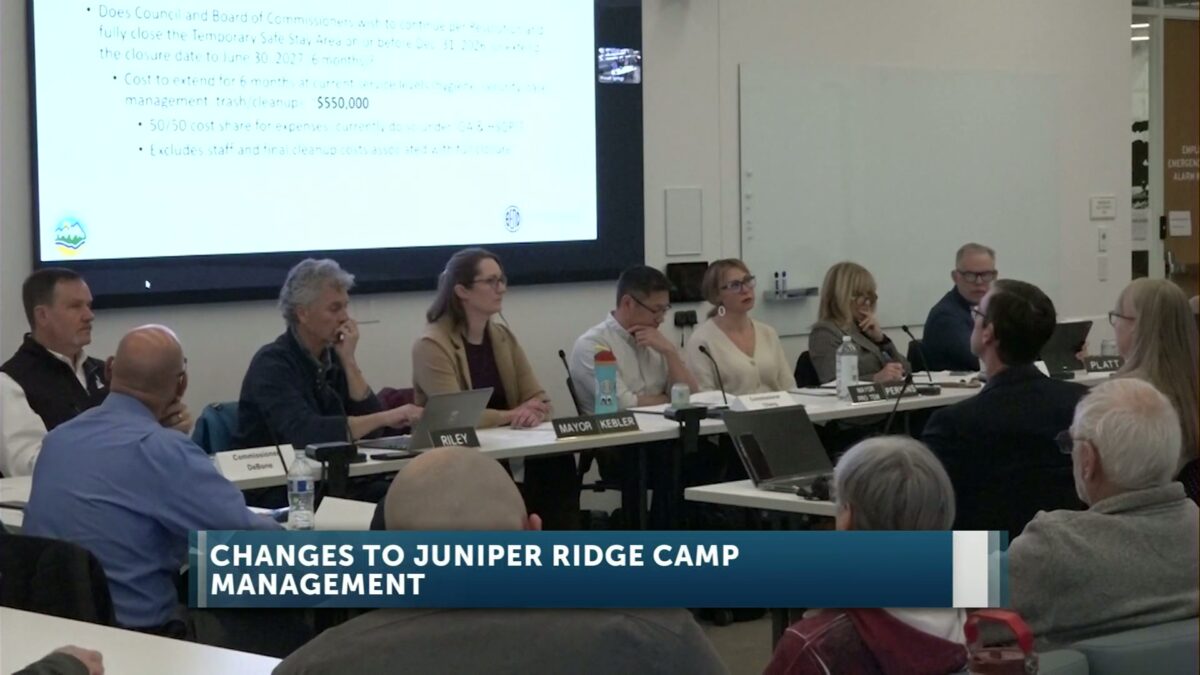
BEND, Ore. (KTVZ) — BEND, Ore. (KTVZ) — A majority of Bend and Deschutes County leaders agreed at a joint meeting Tuesday to extend the Juniper Ridge Temporary Safe Stay Area six more months, to mid-2027. But there was reluctance and some opposition from both elected boards amid an end to federal funding and a desire to fully close the area to homeless campsites as soon as possible. 

The staff presentation KTVZ News reported on earlier (see below) brought some questions for clarity from city councilors and county commissioners during the joint meeting, which somewhat ironically took place at the city’s new Public Works Campus – located at Juniper Ridge. 

Bend Mayor Melanie Kebler said earlier council discussions on what to do next found general support for the six-month extension, in part to not force large numbers of people to move in the middle of winter, then “starting the process all over again.” 

Mayor Kebler told KTVZ News, “I’m really grateful that we had Commissioner Chang and Commissioner Adair agree that we want to look at extending by about another six months, to avoid some of the pitfalls of maybe displacing people in the middle of winter, but also to take a look at how we can really kind of, get people moved into housing.” 

The closure of two northern sections by this June also will mean anyone who stays will be in a more concentrated area of 75 acres. Staff said that should make case management, safety and efforts to find more people new places to live will be somewhat easier. 

County Commissioner Patti Adair drew general support when she asked about putting a lid on any new residents or campsites, so they can say, “we are full.” 

Adair also noted there was another trailer fire a few days ago in the area. Staff said any such negligence is grounds for removal, as was an arson fire last year. 

But fellow Commissioner Tony DeBone pointed to the still-standing code enforcement case in the area. He repeatedly noted that with federal dollars running out, future expenses – such as the county’s half of the estimated $550,000 for a six-month extension – would have to come from the general fund, at a time when costs are rising. 

“If somebody has an idea where these dollars come from,” that would be different, DeBone said – but as it stands, “I’m not going to be supportive” of an extension. 

“If we do extend this six months, where are we going to be then? What’s the vision?” he asked. 

“The real solution,” DeBone said, is “leadership out of the governor’s office, from state legislators.” 

While city Councilor Mike Riley said an extension would “give us more time to work with the governor,” fellow Councilor Gina Franzosa said she couldn’t support the extension, going so far as to call the current situation a “dereliction of what we were elected to do.” 

Kebler agreed – to a point.  

“We’re not saying this is the best way to do it. It’s the best option we have right now,” she said, as opposed to a year’s-end closure that would raise more fire concerns, with “people going further into the forests.” 

Commissioner Phil Chang agreed that progress has to come on where those who must move can go safely. 

Adair also said that only 35 people moving to new, safer locations in recent months is too low, with close to 200 people still living there: “We need to do at least 50 (leaving) in the next six months. We need to hear that we’re making greater progress.” 

City Senior Program Manager Amy Fraley said there are some “creative ways to bring down costs” for more needed permanent supportive housing. 

City Manager Eric King said councilors will discuss the financial strategy at a February 25th work session, possibly including, ironically, some one-time proceeds from recent property sales at Juniper Ridge.  

Earlier story:

BEND, Ore. (KTVZ-Jan. 19) — Bend and Deschutes County leaders return to a familiar and tricky topic at their joint meeting on Tuesday: whether to close the Juniper Ridge “Temporary Safe Stay Area” as planned, at the end of this year – and if they do, how they could provide enough safe places for them to go next.

City and county staff will lay out the options and costs, much as they did at their last joint meeting in late September. (You can see the full new presentation below).

As of Jan. 9, officials say nearly 200 people were living in 150 camps in the safe stay area, part of the undeveloped area at Bend’s north end that some refer to as “Dirt World.”

There has been progress on options such as shelters and safe parking sites, but most are full or nearly so, the report says. And fewer than 50 new beds or spaces are in the works for this year, including a 35-space Redmond campground expected by late spring.

The TSSA, a mix of city- and county-owned land, has been divided into four sections.

Unless things change, those living in sections 1 and 2 will get notice in March that they must move by June. But they will be allowed to move to the two southern areas, for now.

People staying in sections 3 and 4 will get a similar notice in September, with a full closure of the TSSA by November, to meet the year-end deadline set earlier.

The staff update also revisits efforts to get the more troublesome people living at Juniper Ridge to follow the rules. Nearly 50 have been told since last July they might have to move for breaking those rules, and 10 have been issued notices to leave for non-compliance with the proposed remedies.

The TSSA is costing the city and county nearly $850,000 to operate, from water, toilets and dumpsters to security, trash cleanup and other costs, officials say.

Meanwhile, several organizations, from NeighborImpact to Shepherd’s House Ministries, have received a share of $1.2 million in grants for case management work at the TSSA.

The staff presentation also breaks down the millions it costs for new shelter beds, and lesser costs for Safe Parking spots or outdoor shelters, including the Central Oregon Villages site that will be moving to city-owned land this year. For example, a new campground for 70 people, if land can be secured, would cost about $1 million to set up and operate in its first year.

If the TSSA were to continue, it would cost about $1.1 million a year, based on what’s been spent so far – much less costly than new shelter beds, though the goal all along has been to transition the people at Juniper Ridge to safer, long-term housing.

Another telling breakdown is anecdotal – that 25% each might qualify for permanent supportive housing, be interested in safe parking, interested in a “non-congreate” shelter beds or would like to stay in a managed camp.

But providing all four options, at 50 beds or spaces each, is estimated to cost nearly $28 million.

City and county staff also are warning of “funding cliffs on the horizon,”” such as American Rescue Plan Act dollars that expire at the end of 2026, not to. mention a projected $1.7 million deficit in the current biennium for city-backed shelter services.

So the key up-front question, as it was last fall, is whether to hold to the end-of-2026 closure of the Temporary Safe Stay Area or extend it for six months, at an estimated cost of $550,000.

The meeting begins at 3 p.m. Tuesday at the city’s new Public Works Campus on NE Talus Place, will be livestreamed and has other agenda items to tackle. You can find more details here: https://www.bendoregon.gov/government/city-council/city-council-meeting-agendas-video.

Heres the full staff update on Juniper Ridge:

TSSA Options Joint Meeting 20260120Download

Click here to follow the original article.

Overhaul of Oregon’s school funding formula, public education goals has lawmakers at odds

Oregon Capital Chronicle

By Alex Baumhardt, Oregon Capital Chronicle

SALEM, Ore. — There’s an ambitious effort underway at the Capitol to overhaul how the state determines funding levels for schools, but lawmakers are torn over the timing and larger questions about the goals of Oregon’s public education system.

Sen. Janeen Sollman, D-Hillsboro, and Rep. Ricki Ruiz, D-Gresham, co-chairs of the six-member Joint Public Education Appropriation Committee, are spearheading the overhaul of Oregon’s school funding process, including what schools must demonstrate to receive funding.

On Thursday, the two shared with the committee a proposal that would entirely do away with Oregon’s 27-year-old Quality Education Model, the 11-member Quality Education Commission that produces recommended school funding levels every two years, and the education appropriation committee the two lawmakers lead. Lawmakers would have one month to debate and pass the bill that has generational impact during the legislative session beginning Feb. 2.

“I think the job of our committee is really to dig in and do a lot of this work and look at the issues,” Sollman explained, adding that Oregon’s system is outdated and that “no other state has a QEM-type model.”

Since 1999, the Quality Education Commission, staffed by the Oregon Department of Education, has researched best practices and determined how much money is needed for a successful public education system, with the main target of reaching a 90% statewide graduation rate. The commission gives its findings, presented as the Quality Education Model, to the education appropriation committee and governor every two years to guide budget decisions.

Notably, in the history of the model and commission, the Legislature has only fully funded schools to the recommended level once, when they passed in 2025 a record $11.4 billion for schools during the 2025-26 and 2026-27 school years.

Under Sollman’s and Ruiz’s bill, the task of researching and determining how much money schools need would instead go to the Legislative Policy and Research Office, which would contract and work with a public or private firm that undertakes school finance analysis. As part of the analysis, researchers would have to hold panels with educators across the state about school needs.

The policy and research office would then present recommendations for school funding levels to the Legislature’s budget-writing Joint Ways and Means Committee every eight years. During intervening two-year budget cycles, the Department of Administrative Services would adjust the recommended spending levels to account for inflation and other costs.

Split over standards

The bill would also modify what the state’s “quality goals for public education” are, Sollman and Ruiz explained to lawmakers. It would define a “standard school district,” able to receive state and federal funding, as one where all teachers are licensed.

Schools would be expected not just to meet a 90% graduation rate but to hit goals and standards established in a 2024 education accountability law. That law requires  school districts to set goals with the Oregon Department of Education for improving third grade reading scores, eighth grade math scores, ninth grade on-track rates, four- and five-year graduation rates, and regular attendance rates.

But lawmakers said the state education department is still working out some of the goals and standards discussed in the education accountability bill and how they’ll be reported.

Rep. Emily McIntire, R-Eagle Point, said schools have been begging lawmakers to stop passing legislative changes that cost them more time and money in reporting.

“I think that our schools are saying, ‘please stop. Please leave us alone. Please don’t do anything else. Please halt.’ And this, to me, is such a ginormous change, especially when we don’t have the overhaul of (the 2024 law) done yet,” she said. “It feels like one of these things that we’re going to do, and then we’re going to find out what actually is required.”

Rep. Susan McLain, D-Forest Grove and a 40-year teacher who has played a large role in state education policy in the Legislature, told her colleagues on the committee that “there’s a lot in this bill that shocked me.”

The group had been discussing for years doing away with the old school funding model and the commission in charge of it, she said, but she was not prepared to completely change what schools have to demonstrate in order to receive funding.

“This bill is not just about doing away with the quality education model, or doing away with the appropriation committee. It also has to do with responsibilities for other parts of our system, and it has standards for other parts of our system,” she said.

Ruiz said enforcing more nuanced targets and standards that schools need to demonstrate in receiving funding would bring greater public trust in the schools and in the Legislature’s ability to ensure schools are improving and meeting the Legislature’s expectations.

“I’m just sick and tired that we put so much money into the education system and we’re seeing little to no progress,” Ruiz said.

The committee ultimately agreed to advance the bill and debate it during the legislative session.

“I don’t think I’ve ever been in a committee where I’ve had to say: ‘OK, I’m going to give a courtesy yes,’ and think, ‘Oh my gosh, what would happen if it passed?’ And that’s where I’m at,” McLain said.

Click here to follow the original article.