Hundreds of Missourians rally for pause of data center development, man arrested

Jazsmin Halliburton

JEFFERSON CITY, Mo. (KMIZ)

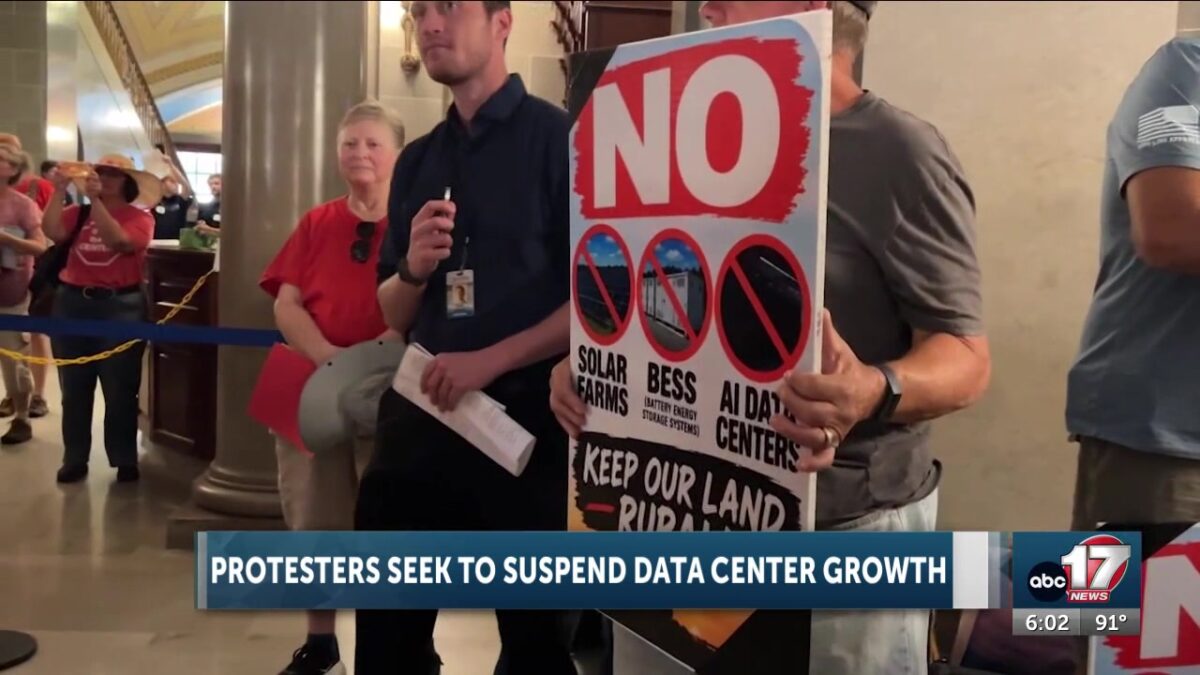
Hundreds of Missourians from across the state met at the Capitol rotunda Wednesday afternoon in support of placing a moratorium on data centers until state regulations are in place.

“Now they are building one within a mile of our house, it’s taking up good cropland, In fact, my two sons lost 500 acres.” Montgomery County Farmer Bob Ridgley said.

This rally comes after months of community pushback against an Amazon data center in Montgomery County that officially broke ground in June. Water use is one complaint shared by residents at public meetings for the project. Other complaints include the high power loads required by data centers and the use of productive farmland for the project.

According to Data Center Map, there are at least 95 data centers in the state.

“Everything’s been so hush-hush and quiet about it. And first thing you know, they just kind of dump on you,” Ridgley said.

Residents have other demands, including health and environmental protections, transparency with local residents and shared prosperity between data centers and the community. The group also wants guarantees that data companies cover all energy costs and that they would not receive tax incentives.

Groups involved included NoMo Data Centers, The Missouri Rural Crisis Center and the Missouri Workers Center.

“We want a moratorium because there’s nothing in place right now, there’s no one in Missouri that can oversee these sites,” Franklin County Farmer Patricia Schuba said.

The Missouri Department of Economic Development clarified with ABC 17 News that state statutes regulate utility costs. Adding that the creation of data centers are up to local leaders and their citizens.

“State statute contains consumer protections for electrical infrastructure costs associated with projects like data centers, ensuring that companies, not residents, pay for one hundred percent of the power data centers use and any new infrastructure costs that are directly driven by operations,” The MDEC said in a statement.

Ridgley adds that he did not feel like he had a say in local development.

We need more information,” Ridgley said. “We’re going to need it [AI], but not the way they’re trying to push it on us, is what they’re doing.”

Governor Mike Kehoe has been a vocal supporter of data centers, praising the projects for their economic benefits to small communities, which many protesters pushed back on.

“The small town will be overwhelmed, so they’ll try to ramp up, maybe more motels, maybe more restaurants, whatever,” Eric Vimont, a farmer from Lawrence County, said. “Those workers will then finish the job and go home, and what do the little towns have? No employment surge whatsoever.”

Vimont added that he has concerns about privacy.

“There’s no good that will come from them anyway, we want none of them,” Vimont said. “If the data centers and the whole AI technology thing ever gets in place, that will be the mechanism that they use to steal all the rest of the freedoms that we have.”

Before the rally, State Rep. Colin Wellenkamp (R-St. Charles) announced plans to lead legislation in regulating AI data centers and placing guardrails on companies.

“Protections are especially needed to secure water and power resources while also requiring transparency and prohibiting increased utility costs from being passed to Missourians that only benefits private AI companies,” Wellenkamp said in a statement.

State Sen. Joe Nicola (R-Grain Valley) similarly has supported legislation that regulated AI.

“Senator Nicola is very concerned about both data centers and Ai. He believes Missouri needs some common sense guardrails in place and plans on filing legislation for the upcoming session,” Jodi Widhalm, Nicola’s Chief of Staff said in a statement.

There are now discussions about a proposed data center development in Callaway County. Local officials describe the multi-billion-dollar development as the largest private investment in Callaway County history.

The project includes two data center buildings of about 800,000 square feet each, creating a sizable new industrial and technology footprint in what is now a rural area. According to Crusoe Director of Economic Development Morgan Alu, each building would have about 204 megawatts of power, with the entire campus capped at 500 megawatts.

Following the rally, the group began a protest in downtown Jefferson City to the Governor’s Mansion. On the way, one 31-year-old Kansas City man was arrested by police.

The Jefferson City Police Department claimed in a statement that the man failed to use the sidewalk during the protest.

“The demonstration was organized and remained peaceful. However, the group did not haveauthorization or a permit to occupy the roadway, resulting in the obstruction of vehicular traffic.Officers with the Jefferson City Police Department responded to the area and observed the groupwalking eastbound on Capitol Street from Jefferson Street. Several verbal warnings were issuedadvising demonstrators that occupying the roadway was unlawful and directing them to use theavailable sidewalks,” JCPD Lieutenant Curtis Finke said in a statement.

Click here to follow the original article.

Man charged with promoting child porn in Montgomery County

Ryan Shiner

COLUMBIA, Mo. (KMIZ)

A Jonesburg man was charged on Tuesday with two counts of promoting child sex abuse materials.

An initial court appearance for Tevis Forrest was held on Tuesday. He is being held without bond.

The probable cause statement says the child victim provided law enforcement on July 30 with illicit images taken of them by Forrest. The victim also showed law enforcement a screenshot of the same video that Forrest allegedly shared to TikTok.

Forrest was arrested for other charges on Aug. 26, and deputies were able to get a search warrant for Forrest’s phone, the statement says. The deputy found four videos and one image of child sex abuse materials involving the victim, court documents say.

Forrest is also charged in another case with two counts of second-degree domestic assault, two counts of third-degree domestic assault and one count of misdemeanor fourth-degree domestic assault. A hearing in that case was held on Tuesday morning.

In another case, he is charged with second-degree burglary and first-degree property damage. He pleaded not guilty to those charges last week. A case review is scheduled for 9 a.m. Tuesday, Nov. 10.

Click here to follow the original article.
3 men accused in Jefferson City armed robbery involving BB gun

Ryan Shiner

COLUMBIA, Mo. (KMIZ)

Three men have been arrested and charged after authorities claim they involved in an armed robbery on Saturday afternoon in Jefferson City.

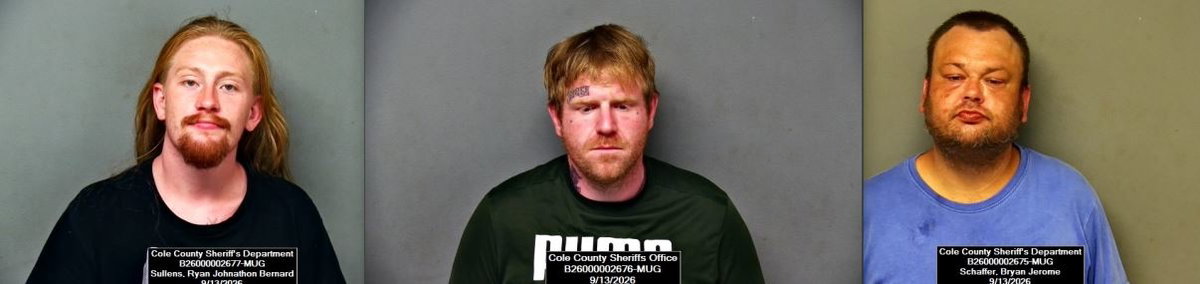
Brandon Watts, 31, and Bryan Schaffer, 36, both of Jefferson City, are charged with first-degree attempted armed robbery, two counts of armed criminal action and one count of first-degree accessory to burglary.

Ryan Sullens, 24, of Jefferson City, is charged with first-degree attempted robbery, two counts of armed criminal action, one count of first-degree burglary and one count of tampering with evidence.

All three men are being held at the Cole County Jail without bond. Court dates have not been scheduled.

They were detained during a traffic stop near East High Street and Benton Street, according to the probable cause statement. The victim had allegedly told officers that three men went to his residence on Cherry Street and that one of them had pointed a gun at his head.

Police found a BB gun near the intersection, that Sullens reportedly tossed out the window before the traffic stop, the statement says. Sullens allegedly pointed the gun at the victim and demanded money.

Court documents claim that Watts and Schaffer admitted to going into the home with Sullens. Schaffer allegedly knocked on the door to get the victim’s attention and Watts allegedly told the victim that the money could be collected later in the month.

Click here to follow the original article.
Delia’s Mexican Grill appeals liquor license suspension

Ryan Shiner

COLUMBIA, Mo. (KMIZ)

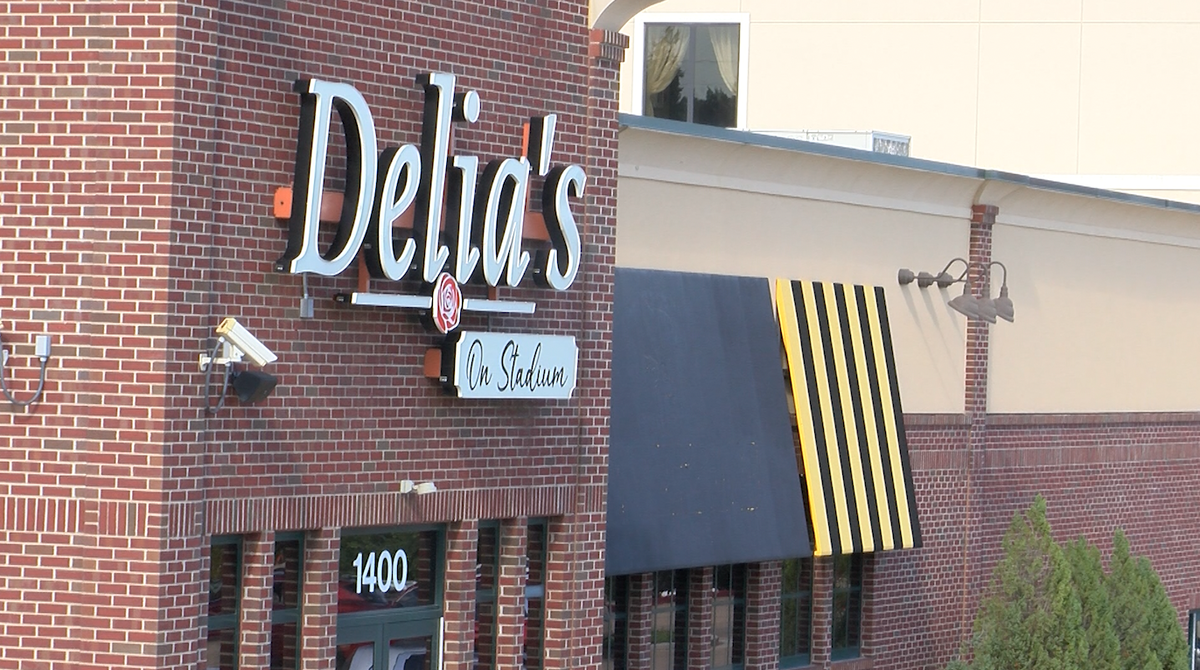
Delia’s Mexican Grill on Stadium Boulevard in Columbia is appealing a suspension of its liquor license.

A filing with the Division of Alcohol and Tobacco Control shows a 10-day suspension was issued on Aug. 18 in connection with an investigation from 2023 that involves allegations of “unlawful sale or supply to intoxicated person” and “fail to cooperate with law enforcement/ATC during investigation.”

Delia’s is accused of failing to cooperate with authorities. The document showing the suspension was updated on Friday, Sept. 11.

The restaurant also was ordered to pay $500 last month in connection with a case where they reportedly sold alcohol without a license in 2024.

suspensions-jc-081826Download

Click here to follow the original article.
Hoskins seeks ‘clarity’ as election officials warn it’s too late to switch congressional maps

Mitchell Kaminski

COLUMBIA, Mo. (KMIZ)

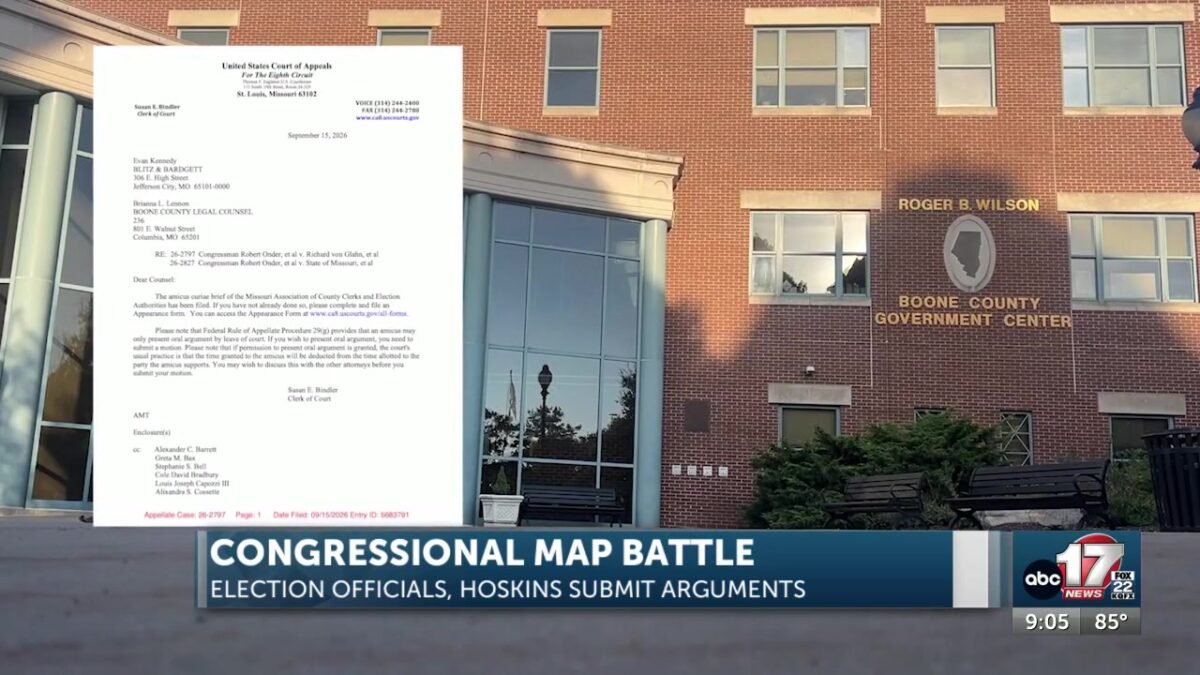
Missouri’s county clerks and election directors told a federal appeals court on Tuesday that it is too late to switch congressional maps for the Nov. 3 general election.

Boone County Clerk Brianna Lennon and the Missouri Association of County Clerks and Election Authorities filed an amicus brief in the 8th U.S. Circuit Court of Appeals supporting a bid to reverse a Sept. 8 temporary restraining order. That order, issued by U.S. District Judge Stephen R. Clark in St. Louis, blocked the state from using the 2022 congressional map.

The MACCEA represents election officials in all 116 local jurisdictions. Those officials, not the secretary of state, design, print, and mail ballots.

Lennon said the practical impact of the legal battle is why the group wanted to weigh in.

“I think it’s important in the election cases, the practical effects of a court case are important,” Lennon told ABC 17 News. “And so given how late this is in the election schedule, we just wanted to make sure that the court was aware of what it was that we were doing on the ground. Local election officials are the ones running the elections, and we wanted to share that context.”

Last year, Gov. Mike Kehoe signed HB 1 into law, creating new congressional district lines that would carve up Democratic U.S. Rep. Emanuel Cleaver’s 5th District and give Republicans a potential 7-1 advantage in Missouri’s congressional delegation.

MACCEA argues changing the congressional district lines this late in the election cycle would create significant financial and practical burdens.

On Sept. 3, the Missouri Supreme Court ruled the state Constitution allows voters to weigh in on a congressional redistricting map. Secretary of State Denny Hoskins had initially rejected the referendum petition in August, preventing the proposed map from appearing on the November ballot.

The Missouri Supreme Court also ruled the map approved by lawmakers in HB 1 cannot be used for the November election. Instead, the 2022 congressional district map will remain in effect unless voters approve the new map in November.

Following that ruling, election officials received conflicting instructions from Hoskins on Sept. 8. The first email told them to use the 2022 map when preparing ballots, while a second email, sent just over an hour later, directed them to use the HB 1 map. Hoskins was determined to have been in contempt at the time.

Most election officials delayed finalizing their ballots while the legal fight continued. Two days later, Hoskins directed them to use the 2022 map, citing the Missouri Supreme Court’s ruling. Election officials then began producing ballots under the 2022 map. Court documents say most jurisdictions had ballots in production by Tuesday.

Lennon said the delays have put election officials behind their normal schedule.

“It has been tricky to not be able to print ballots until this week, and we are a little bit behind on our usual schedule for that,” Lennon said. “But I am hopeful, given that we knew that this was kind of coming, that we can make up for lost time.”

The brief argues another late map change could jeopardize the state’s ability to meet the Sept. 18 deadline for sending ballots to military and overseas voters, as well as the Sept. 22 start of regular absentee voting. Federal law requires those ballots to be sent 45 days before an election.

Lennon said election officials now have little room for another change.

“We now have this very short timeline when it comes to printing the ballots to have them in hand, because we want to make sure that they’re ready to go,” Lennon said. “And we also don’t want to have to end up in a situation where we have voters that cast absentee ballots and then the next week we have to change the absentee ballots, redo all of the work that we’ve done and let voters know that the ballot has changed because we’ve seen that happen in other states.”

MACCEA estimates that reprinting ballots would cost hundreds of thousands of dollars in printing and staff time, ranging from several hundred dollars in small counties to $15,000-$30,000 in larger jurisdictions.

Lennon said counties would have to absorb some of those unexpected expenses.

“The state does have some appropriation for it. They pay a proportional cost of it, but it’s the counties that have to pay for everything,” Lennon told ABC 17 News. “And so if we have these unanticipated costs that we didn’t think about when we were doing our original budgets way back in January, those are things that we have to find from the county budget.”

The group argues those costs would amount to an unfunded mandate because the Legislature did not appropriate money for the changes when it passed HB 1.

The brief asks the 8th Circuit to lift the restraining order so clerks can finish ballots under the map already in use.

People Not Politicians and Richard von Glahn also filed a brief Tuesday asking the 8th Circuit to vacate the Sept. 8 temporary restraining order. They argue the order may soon become irrelevant because it expires Sept. 22, the same day regular absentee voting begins.

They also argue the case should have been heard by a three-judge panel and that changing congressional maps this close to an election would disrupt the state’s election process.

Oral arguments are scheduled for Thursday morning.

Hoskins filed his own brief late Tuesday. While acknowledging the 2022 map will likely appear on the ballot, he urged the court to rule that a referendum cannot suspend a congressional map passed by the Legislature and that switching maps after the primary elections violates the U.S. Constitution.

“More than anything, Missourians need clarity about the map that they will vote under in the November General Election. Because the Supreme Court has already granted a stay forcing Missouri to use the 2022 congressional map for the 2026 General Election, the Secretary is complying with that ruling,” Hoskins and the state argued in the brief.

Hoskins’ office said the Missouri Supreme Court’s Sept. 3 order requiring use of the 2022 map for the Nov. 3 general election, after the Aug. 4 primary was held under the HB 1 map, leaves hundreds of thousands of voters facing a different set of candidates than they nominated. The state claims that arrangement violates Article I, Section 2 and the Equal Protection Clause.

The brief also argued the Elections Clause bars a petition signed by about 3.3% of registered voters from suspending a map enacted by the General Assembly and signed by the governor. Hoskins said such a process would let a political minority freeze maps after every redistricting.

“This case may involve the first attempt in American history to suspend a congressional map based on a referendum petition signed by a small minority of voters. But it certainly will not be the last. The Secretary anticipates that small fractions of Missouri’s electorate will attempt to suspend duly-enacted congressional redistricting plans every time the State redistricts in the future,” the brief states.

Hoskins said he is following the Missouri Supreme Court’s ruling and using the 2022 lines, but he asked the 8th Circuit to decide the constitutional questions anyway because similar referendum campaigns could arise after future redistricting efforts.

Click here to follow the original article.

Missouri sees declining vaccination rates

Demetra Alarcon

COLUMBIA, MO. (KMIZ)

Editor’s Note: The spelling of the doctor’s name has been corrected.

One doctor at MU Health Care said that she is seeing a declining vaccination rate and, because of this, we could see a more intense flu season.

Dr. Amruta Padhye, a pediatric infectious disease doctor at the University of Missouri, said the state is seeing a decline in vaccinations.

“Therefore, we could anticipate that this flu season could be severe because of declining vaccination rates. However, you know, every flu season is very unpredictable,” said Padhye.

When looking at the numbers from last flu season, Padhye said across the country there were 32 million illnesses reported, 390,000 hospitalizations, and 24,000 deaths.

According to America’s Health Rankings, 41.3% of adults in Missouri said they got a seasonal flu vaccine in 2023-24. Padye said the typical flu season peaks in January or February, but some seasons can see two peaks.

“The flu season is really long, starting all the way from October. And kind of, and then ending in May. But the peak of the flu season is the coldest part of the winter months,” said Padhye.

MU Health Care plans to host influenza and COVID-19 vaccine drive-thru event; the first one 9 a.m.-1 p.m. Saturday at Fulton Family Health at 2613 Fairway Dr.

Measles is also on the rise in Missouri. As of last Thursday, there have been seven cases reported in the state.

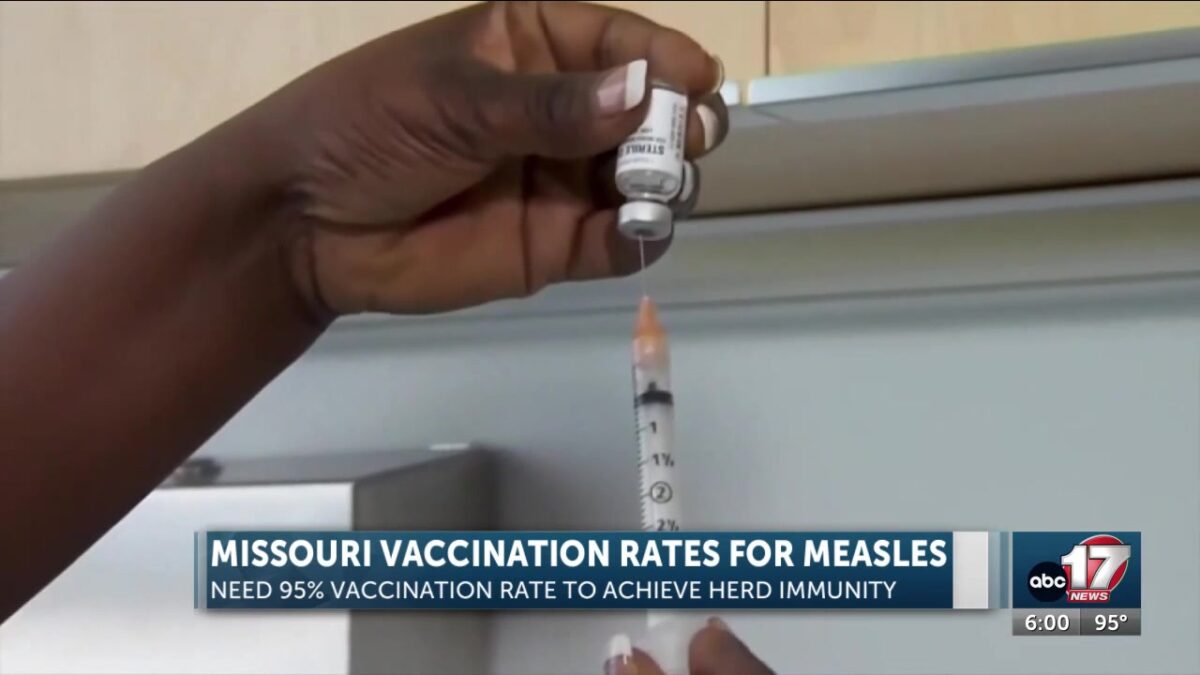
According to the Missouri Department of Health and Senior Services, to achieve herd immunity, 95% of the community needs to be vaccinated with two doses of the measles MMR vaccine.

Missouri has a measles vaccination rate of 89.5%; Cole County has the highest rate at 96.2%, while Benton County has the lowest rate at 64.7%. Boone County is at 94.5%. Padye said herd immunity is very important in communities to avoid outbreaks.

“So herd immunity is important for certain. Of course, it’s important for all vaccine-preventable diseases. But in cases of measles, which is highly infectious, we need a higher level of herd immunity,” Padhye said.

The Missouri Department of Health and Senior Services advises contacting a doctor to schedule a measles vaccine if you do not already have one. Pharmacists can also administer the vaccine to children 7 years old and older without a prescription.

Click here to follow the original article.
DNR awards $2.86 million to Bunceton for wastewater improvements

Ryan Shiner

COLUMBIA, Mo. (KMIZ)

The City of Bunceton will receive $2.86 million in financial assistance from the Department of Natural Resources to upgrade its wastewater treatment system, a Tuesday press release from the DNR says.

Funding from the DNR includes a $1.1 million loan and a $1.7 million grant through the Clean Water State Revolving Fund, the release says. The city is also getting a $449,287 Community Development Block Grant.

The DNR wrote that it expects the funding to save the city in $1.7 million in principal and $540,00 in interest during the loan’s 20-year term.

“While we often take it for granted, adequate drinking water and wastewater infrastructure is critical to the quality of life of every Missourian and the sustainability of communities and industries throughout the state,” DNR Director Jake Buxton was quoted in the release.

The release says the city expects the project to be completed by November 2027.

Click here to follow the original article.
Katy Station, Broadway Diner locations ‘under contract’

Ryan Shiner

COLUMBIA, Mo. (KMIZ)

The president of Maher Real Estate confirmed to ABC 17 News on Tuesday that the Katy Station building and the location of Broadway Diner are under contract in an active transaction.

Company President Jack Maher III confirmed the contract.

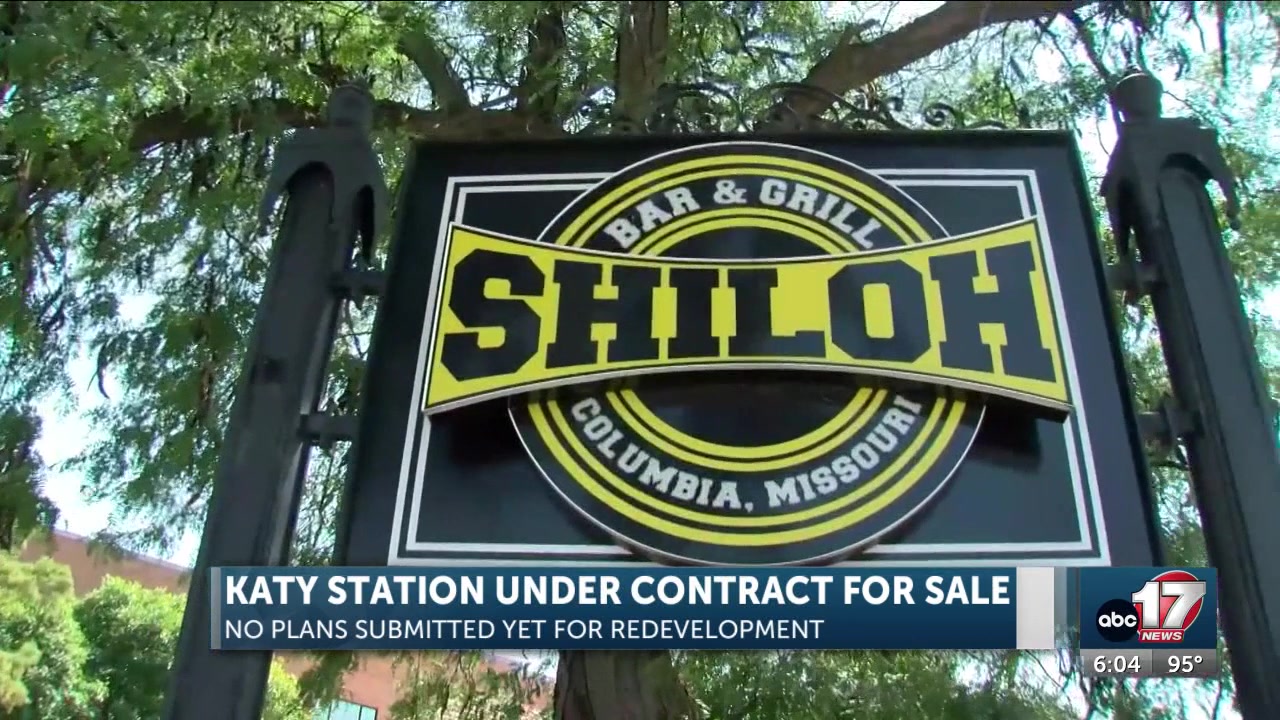
Katy Station, located at 402 E. Broadway, was added to the Columbia Historic Register on Jan. 29, 1979. The building originally served as a depot for the Missouri-Kansas-Texas Railroad.

Shiloh Bar and Grill currently resides in that location, and owner Nic Parks confirmed earlier this month the bar will close in December. Parks said earlier this month the closure is tied to the landlord’s plans to sell the property and alluded to a potential buyer’s plans to redevelop the historic Katy Station building.

A petition has started in an effort to save the Katy Station building from demolition

Click here to follow the original article.
Amendment 7 could eliminate all state-imposed taxes, but the timeline is unclear

Alison Patton

COLUMBIA, Mo. (KMIZ)

Missouri voters will see Amendment 7 on the November ballot, and they’ll have to decide whether to create a permanent public endowment that will grow until it reaches an amount sufficient to eliminate all state-imposed taxes.

How much the fund would need to eliminate taxes and how long it could take are not clear.

Traci Gleason from the Missouri Budget Project said the bill that put Amendment 7 on the ballot requires lawmakers to define those things if it passes.

A “yes” would establish the “Show-Me Prosperity Fund,” and lawmakers would have to decide how much money to appropriate to the fund before the Missouri treasurer can invest the funds, according to the Senate Joint Resolution 95 bill summary. The funds will be invested in exchange-traded funds.

Missouri is facing a long-term $2 billion budget shortfall, according to Gov. Mike Kehoe, and the bill doesn’t provide a dedicated funding source, so the appropriation would need to come from the already stretched budget.

“Any state dollars put into that fund would mean real cuts to existing services – like education, healthcare, or services for older Missourians,” Gleason wrote in an email.

The fund would need to grow big enough to eliminate income tax, sales and use tax, corporate income tax and all other taxes, according to the bill. Income tax alone makes up about two-thirds of the state’s general revenue.

Gleason said the state generates more than $18 billion in taxes each year, and the fund would need to generate at least $600 billion, but it could be more based on what lawmakers define as “state-imposed taxes.”

“So there are a lot of unanswered questions about the fund. In any case, it would take decades – maybe generations – for it to grow large enough to eliminate state taxes,” Gleason wrote.

The law caps how much money can be taken out of the fund, which is where Gleason got the $600 billion number.

If the fund has enough money to eliminate taxes, the treasurer will notify the General Assembly, and then the fund can be used, according to the bill. The state won’t be able to impose taxes if the fund fully eliminates them, unless the program fails.

In August, Missourians turned down the Republican-backed plan to phase out the state income tax, known as Amendment 5. Critics said the amendment lacked a solid plan to eliminate and replace the revenue generated by the state income tax.

The Amendment 7 ballot language can be found on the secretary of state’s website.

Click here to follow the original article.

MU responds after alleged threat involving YikYak account shared online

Ryan Shiner

COLUMBIA, Mo. (KMIZ)

The University of Missouri has responded to more than one Republican group online over concerns of an alleged threat made on the social media website YikYak.

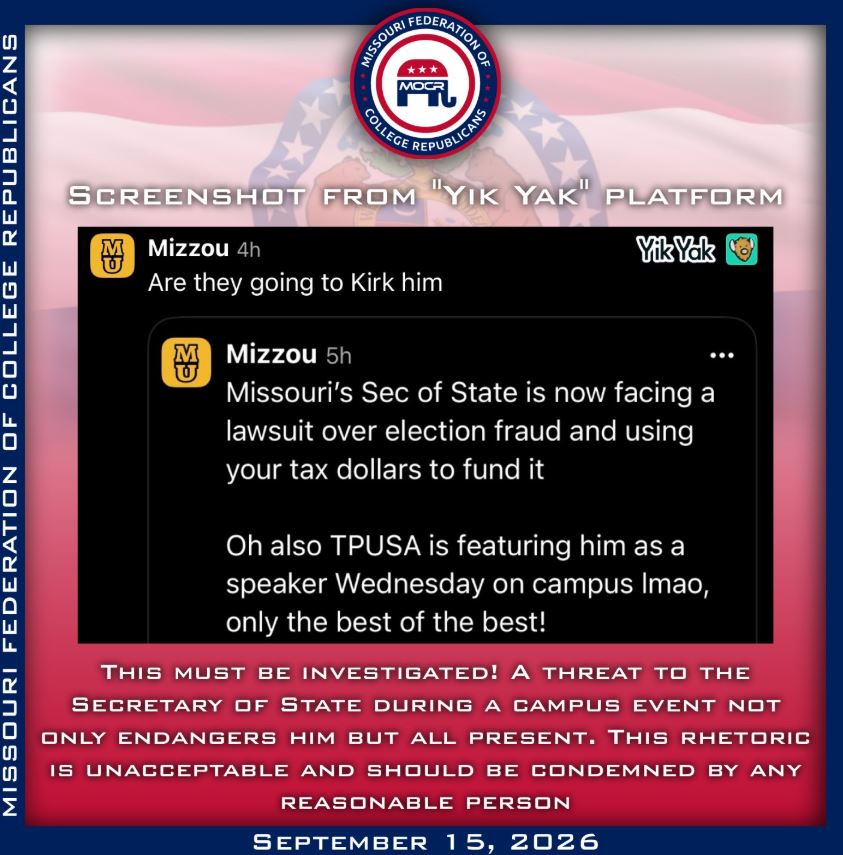
The threat involved a screenshot of an account called “Mizzou” involving Secretary of State Denny Hoskins’ campus visit planned for Wednesday with the school’s Turning Point USA chapter.

A screenshot from the Missouri Federation of College Republicans and Mizzou College Republicans shows the account asking if “they are going to Kirk him,” in a likely reference to Charlie Kirk, the TPUSA founder who was shot and killed last year during an event at a college campus.

The university responded to both tweets, stating that the “Mizzou” account shown in the screenshot is not affiliated with MU and that the post has been reported to authorities.

“We are aware of the post, which is not affiliated with the university, and have reported it to MUPD. Safety is our top priority, and we do not tolerate violence or threats of violence,” the responses from MU say.

MU sent the same statement to ABC 17 News.

We are aware of the post, which is not affiliated with the university, and have reported it to MUPD. Safety is our top priority, and we do not tolerate violence or threats of violence.

— Mizzou (@Mizzou) September 15, 2026

Click here to follow the original article.