Mitchell Kaminski
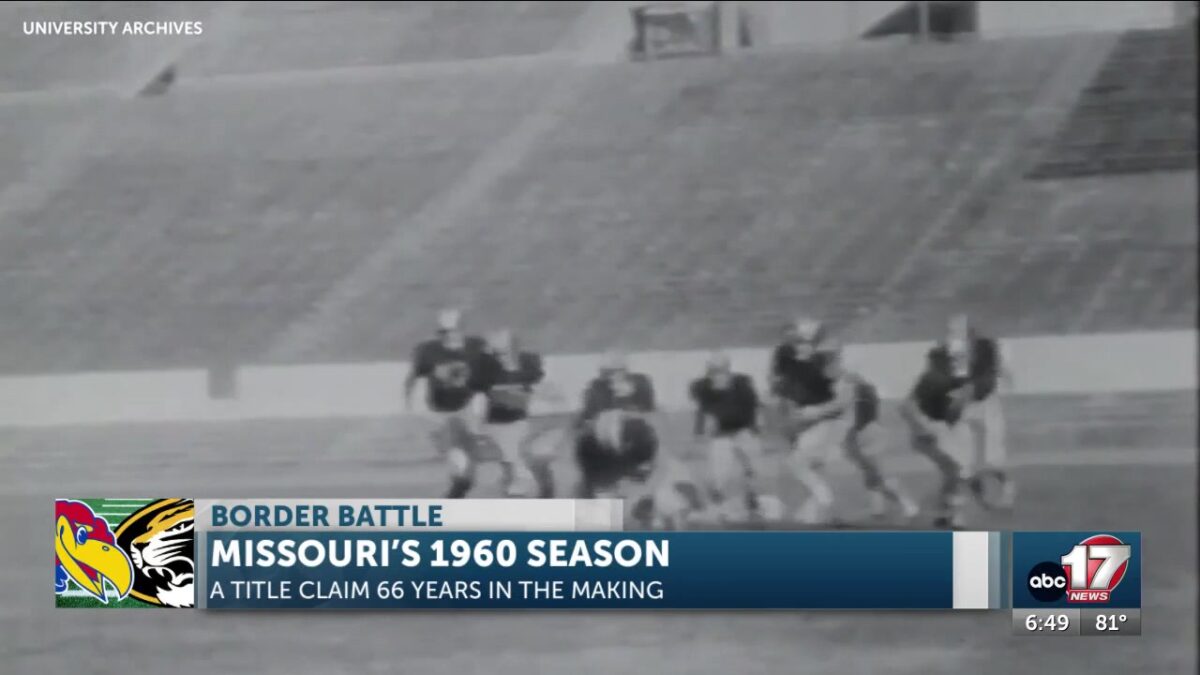
Sixty-six years after reaching No. 1 for the first time in Missouri football history, Mizzou Athletics will formally recognize the 1960 Tigers as national champions during a halftime ceremony Sept. 19 against Troy in the Memorial Stadium 100th Anniversary Game. ABC 17 News caught up with two surviving members of the team to relive a season they will never forget.
COLUMBIA, Mo. (KMIZ)
When Don Wainwright told his father he wanted to attend the University of Missouri, his father told him he was making the biggest mistake of his life.
In 1959, it seemed like a foregone conclusion that he would play football at Purdue. Everyone in Wainwright’s family was an engineer from Purdue. Wainwright was a standout athlete at Kirkwood High School, winning the Missouri state discus championship in 1959 while earning All-League and All-District honors as the team captain of the football team. His success on the field attracted recruiting interest from across the country and eventually led to a scholarship offer from Purdue.
Then, Dan Devine invited him to come to Columbia for a weekend. Devine had been named head coach at the University of Missouri, and after leading the Tigers to a 5-4-1 record in 1958, he was looking to vault the program to the next level.
“I went on up there, and he had his arm around me, and he said, ‘I’m going to build a powerhouse here, and I need you. I really want you to come to Missouri,’” Wainwright recalled.
Shortly afterward, Wainwright called his father to tell him he had changed his mind and intended to become a Tiger rather than a Boilermaker.
“My dad was furious,” Wainwright said. “He said, ‘Son, the only thing I will tell you is that you will never make it in business because you gave your word that you were going to Purdue and you changed.’”
Despite his father’s stern warning, Wainwright packed his bags after graduating in June and traveled to Columbia. After seasons playing tight end and defensive end from 1960-62 — which included two Orange Bowl appearances and a No. 1 ranking in 1960 — Wainwright’s father had changed his tune.
“Son, best decision you ever made,” Wainwright remembered his father telling him.
A presidential welcome to end the 1960 season
Former Mizzou tackle Jerry Wallach doesn’t brag about many things, but there’s one accomplishment he says his wife, Allana, has probably heard him mention a thousand times.
“Jack Kennedy is the only president in the United States that’s ever saw me nude,” Wallach exclaimed.
The Tigers were coming off their first bowl victory in program history, a 21-14 win over No. 4 Navy in the 1961 Orange Bowl in front of 71,217 fans, including President-elect John F. Kennedy.
Kennedy had decided to pay the Tigers a visit in the locker room.
“When he came in, I was coming out of the shower. Well, you don’t even have a towel when you’re coming out you have to find your towel,” a smiling Wallach said. “I come out of the shower and there’s the president-elect of the United States. What do you say? I went up, and I said, ‘Hi, Jack, good to see ya.’”
Devine’s words to Wainwright had come true. He had built a powerhouse. Missouri was 11-0 on paper, Big Eight champions, Orange Bowl champions and had shattered nearly every program record along the way.
But the perfect season didn’t come without controversy. An asterisk seemed to hang over the Tigers, courtesy of their hated rivals just 164 miles away in Lawrence, Kansas.
Entering the 1960 season
Unlike Wainwright, Wallach was focused on Missouri from Day 1. He had a cousin who had played football at Missouri in the 1940s, and while he looked up to Devine, he saw Columbia as an opportunity to carry out a plan he had developed after losing his father at a young age: Use football as a path to an education.
As Wallach entered his junior year, expectations were low for the 1960 Tigers.
“Danny LaRose, who was a real star on that team, was an all-American and he has since passed on. But he spoke to me in the process of writing this book, and he said he was one of the taller guys on the team, and I think it was like 6’2,” said Brendon Steenbergen, who interviewed 18 former players for his detailed account of the 1960 season in his book “Respectable Roughnecks.” “He said he looked to his left and his right and everybody was like a full head shorter than him. They were a very undersized team and so expectations were pretty muted.”
After the 1959 season, Devine had a clear vision for where he wanted the program to go. He laid out four goals for his team:
Win the season opener. Missouri had not won its season opener since 1947, when the Tigers defeated St. Louis University 19-0.
Beat Oklahoma in Norman. The Sooners had not lost at Owen Field — commonly known as “The Snake Pit” — since 1942. Just two years earlier, Oklahoma had handed Devine’s Tigers a crushing 39-0 loss in Norman. After that defeat, Devine promised his team they would win the next time they returned to Norman, giving them a chance to avenge the seniors who had suffered that loss.
Win the Big Eight title. It was something Missouri had never accomplished.
Win the first bowl game in program history.
“Going into ‘60 we had no idea we were particularly special or had any particular talent,” Wallach said. “It just came together.”
Missouri quickly checked off the first goal, walloping SMU 20-0 in the season opener. They also made quick work of Oklahoma State in their first conference game the following week, taking down the Cowboys 28-7.
The victories earned Missouri a No. 19 ranking as it headed to Penn State for its first ranked matchup of the season. Despite the 21-point victory over Oklahoma State, Missouri had dropped three spots in the AP Poll and entered the game as a 10-point underdog.
But Oct. 1, 1960, was the day Wallach says he first realized Columbia was home to one of the best football teams in the country.
“There was a World Series in Pittsburgh. That day it was adjourned for the series and we played Penn State at State College, Pennsylvania. Since there was a day off at the World Series, the press came to the game. We were just nobodies,” Wallach said.
Despite a scoreless first quarter, Wallach said the Tigers’ confidence began to grow as Missouri’s talented group of running backs started to heat up.
About halfway through the second quarter, Wallach’s unit came off the field. In that era, players routinely played on both sides of the ball, with many starters logging more than 50 minutes per game. Substitutions were limited, so players rotated in units to keep as many players fresh as possible.
“I’d play 60 minutes a game a lot of times. I mean, I’d lose 25 pounds a game, and I wasn’t that big,” Wainwright said. “I was about 185 to 190; I think they had me on the program at 206, but that was considered a pretty good-sized tight end at the time. It was just amazing how tough it was playing 60 minutes.”
As Wallach’s unit watched from the sideline, the offense began moving the ball downfield. With each first down, a growing sense of confidence spread across the Missouri sideline.
In the second quarter, quarterback Ron Taylor found Danny LaRose down the right sideline for the first touchdown of the game, and the floodgates opened.
“There was like a wind on the bench, it’s like, ‘Hey, we can beat these guys,’” Wallach said. “Once we beat Penn State, then we knew we could beat anybody.”
When the clock hit zero, Missouri was heading back to Columbia with a 21-8 win, and LaRose and the Tigers had suddenly become the center of attention. The future Mizzou Hall of Fame inductee had recovered two fumbles, caught a touchdown pass and booted several punts that pinned Penn State deep into its own territory.
When the team hit the locker room, the national media in town for the World Series began to swarm LaRose.
“The win over Penn State on the road I think, was very unexpected and it got a lot of national media attention to the Missouri Tigers, who were a team that people didn’t expect to be as good and as powerful as they were,” Steenbergen said.
‘Student-Body Right’

Missouri running back Donnie Smith avoids a tackle. [Courtesy MU Athletics]
Aside from LaRose, the Tigers’ offense was spearheaded by a pair of talented running backs, Norris Stevenson — who became the first Black player in Missouri history in the winter of 1957 — and Mel West, who joined Stevenson six months later as the second Black player to wear the black and gold.
Devine’s offense was simple, centered around a power sweep known as “student-body right” or “student-body left,” depending on which side of the field the play was designed to attack.
“There was nothing sophisticated or fancy about it,” Wallach said. “We just took it right to him and ran over him.”
Mizzou was physical, and opposing defenses had to guess which side the power sweep was coming.
“It was simply gut it out, hit nose-to-nose, helmet-to-helmet and try and find an opening,” Steenbergen added. “Essentially what they did was they threw every blocker in the world, including the quarterback at the defense, and they just ran sweeps left and right.”
Despite being undersized, Missouri averaged nearly 27 points per game, with Donnie Smith, Norris Stevenson and Mel West combining for 20 of the team’s 27 rushing touchdowns. Smith led the Big Eight with 11 rushing touchdowns, while Stevenson led the conference with an impressive 7.2 yards per carry.
“Devine, when he recruited people, he always said I recruit men of character, and I’ll make athletes out of them,” Wainwright said. “On Sunday, you’d pick the paper up after we played a game and Devine would be quoted as saying, ‘These are the worst damn athletes I’ve ever coached, but they’re so damn smart, they can’t help but move the ball from one end zone to the other.’”
Devine’s demanding personality could be difficult for some players to understand at the time, but it was part of what made him effective. Wallach recalled an interaction with Devine years later.
“He was the biggest a**hole in town. I use that term now because after the season we would do a postseason banquet at high schools and that kind of stuff. Devine and I would frequently show up as speakers,” Wallach said. “I’m sitting next to him one night and this is a guy we treated with reverence, he was like God or something. I’m sitting next to him and I say ‘Hey can I call you Dan?’
“Sure, of course,” Devine replied.
“I got a question Dan? When I played for you, you were the biggest a**hole in town. But coming to these banquets and talking to you, you’re really a pretty nice guy. How do you square that?
“It’s not easy everyday waking up the biggest asshole in town,” Devine responded, according to Wallach. “But if you want to win major college football games, that’s what you got to do.”
While quarterback Ron Taylor didn’t get many opportunities to throw the ball downfield, he was also a key cog in the offense, and was often entrusted to call his own plays.
“Everybody had wonderful things to say about Ron Taylor. Field General. That’s exactly how he was described, because he was undersized. I think he was 5’8 and he was the new quarterback. The previous year’s quarterback and backup quarterback were no longer part of the team,” Steenbergen said. “A lot of college football teams at this time didn’t have really heavy pass offenses. So his responsibility was to hand it off, to occasionally keep the defenses honest by throwing it and then to throw blocks. I think that was the thing that earned his teammates the most respect was that he threw the first block on their student body, left student body, right plays, and he was a pretty devastating blocker for a guy of his size.”
Eventually, defenses adapted, and a few years later, Devine abandoned the power sweep. But not before Missouri rode the play to an 8-0 start to the 1960 season.
The defense was the real star. Through the first eight weeks of the season, it did not allow a touchdown in the first quarter while limiting opponents to fewer than five points per game.
“There was such a dynamic among us. Devine always said ‘We own the goal line to the 20 yard line.’ Nobody ever got inside there and that was pretty much the way it was nobody could score on us,” Wainwright said. “We were so tough defensively. We broke all the records at Mizzou.”
As the victories piled up, so did the buzz in Columbia.
“The crowds just kept getting bigger and bigger and bigger in the stadium,” Wainwright said. “The professors and pretty much everybody were talking about the team. You were pretty much a ‘big man on campus’ if you were a part of the team.”
“When they’d come back to Columbia on campus, they’d start getting all this attention from girls and from their fellow students and people talking to them and waving at them and they knew that they were becoming stars,” Steenbergen added.
Facing discrimination

Mizzou running back Mel West, of Jefferson City, runs the ball during the 1960 season. [Courtesy MU Athletics]
For all the success Stevenson and West found on the field, their experience away from it was far different. As two of the first Black players at Missouri, they faced discrimination their white teammates did not.
“Norris Stevenson and Mel West were very different guys. Stevenson grew up in St. Louis in a predominantly Black neighborhood and a predominantly Black school; and Mel West grew up in Jefferson City and was surrounded by a lot of white students and white players. His experience was such that he was accustomed to being in an environment where he was maybe the only Black person in the room. Norris hadn’t had that experience nearly as much and so Norris felt it more acutely,” Steenbergen said.
That discrimination followed the Tigers on the road. During the Orange Bowl trip to Miami, Stevenson and West were kicked out of the team hotel’s pool because of the color of their skin. After Missouri’s victory over Navy, the two were also asked to leave the team’s banquet.
“They were both really embraced by their teammates. But it was 1960, I think a lot of the players didn’t have a sense of what those guys were going through,” Steenbergen said. “There were stories of like when they played at Texas A&M, the hotel restaurant wouldn’t allow the black players and so Dan Devine made sure that the whole team was not going to eat someplace that wouldn’t allow two of his players to eat.”
The mistreatment extended well before the 1960 season. Wallach recalled traveling back from a game in Lawrence, Kansas, his freshman year when the team stopped for dinner. As he got off the bus, he noticed some players from the first bus, which had already arrived, walking out of the restaurant. Then, some of the players who had already gone inside began walking back out.
“You don’t have to be Dick Tracy to figure out what was going on. I mean the guy’s coming back out, couple of white guys, a couple of Black guys. Why are they coming back out? I know why they are coming back out. Well, it’s in Missouri, and then some woman comes out and says, ‘Those boys aren’t coming in here.’ And she’s very irate. Dan Devine bragged it was one of his finest moments and frankly it was.”
The woman began yelling at Devine, insisting the Black players could not come inside and demanded to know who was going to pay for the food that had already been ordered.
“He really has reason to be proud of his record on civil rights. But he would talk about that incident, and he said he reached in his pocket, pulled out a $100 bill, because she said ‘Who’s going to pay for the food?’ And he said ‘I threw the $100 bill down on the gravel, put my team back on the bus,’ and we left. I would always follow him in the after-dinner speeches by saying, ‘I was there, I saw it happen.’ Which was basically true, except it wasn’t a $100 bill it was a $50 bill. The guy had to up it to $100. It made a better story.”
Nov. 12, 1960

Norris Stevenson runs up field during the 1960 season. [Courtesy MU Athletics]
When the Tigers took to the field in Norman, Oklahoma, they had a No. 2 ranking next to their name, but a tough task stood in front of them.
The Sooners were virtually unbeatable at home at Owen Field, having gone 13 consecutive seasons without losing on their home turf to a Big Eight school. During that stretch from 1953-57, they also won 47 straight games, a record that still stands.
The Missouri seniors who had been part of the 39-0 bloodletting in 1958 were among the 61,000 fans in attendance, anxiously waiting to see if Devine could deliver on his promise to avenge them.
“Devine stood up before the game and said, ‘No one in this room was alive the last time Missouri won in this stadium,’” Wallach recalled.
Things got off to a rough start. For the first time all season, Missouri allowed a rushing touchdown and quickly found itself trailing 6-0.
But Stevenson, who had unfairly blamed himself for the Tigers’ loss to Oklahoma in 1958, had a chance at redemption. He found the end zone twice, including a 60-yard touchdown run in the fourth quarter that helped Missouri pull away for a 41-19 victory, the program’s first win in Norman since 1936. Stevenson’s 169 rushing yards also set a record in Norman for the most by any Oklahoma opponent in history.
“We beat Oklahoma in the Snakepit at Oklahoma, I think that was probably one of our great wins in the 1960s,” Wainwright said.
With Purdue losing to Minnesota earlier that same day, the Tigers had put themselves in prime position to claim the No. 1 ranking.
Usually, plane rides carried an uneasy feeling for the football team. The Tigers traveled aboard DC-3s, aging aircraft that had first entered service during World War II, making every flight an experience the players approached with some trepidation.
“One of the players said that they weren’t so much planes, but a collection of nuts and bolts that were in loose configuration together,” Steenbergen said. “It was a scary experience. These were Missouri farm boys, and many of them had not been on any airplane before. So when they’re getting on a World War II-era DC-3, that’s rattling as it goes through the sky and sometimes literally landing in in grass fields like in College Station, Texas. Yeah, pretty scary experience for them. The joke was part of the reason they took two planes was that if one didn’t make it, they’d have half the team at least left to play the game.”
But on this particular plane ride, fear gave way to something far more powerful: Joy.
“We knew on the plane coming back we would be No. 1 in the country. We followed that stuff and the press was on the plane and said, ‘You guys are going to have it. You’re going to be the No. 1-ranked team in the country by the time you land,’” Wallach said. “We fly back on the DC-3s, and when we circled Columbia, the city was lit up. It was just magic. We circled Columbia and the city is lit up, and Broadway lit up; and from the plane you can see thousands of people. I’m not exaggerating, lining the streets of Broadway and Columbia. We get off the plane and it was one of the real highlights of my life.”
Bert Coan’s controversy

Kansas running back Bert Coan [Courtesy Kansas Athletics]
“The fact that the coaches at Kansas were that bad, they had to cheat and they knew what they were doing. Take a thug like that and let him play, that was terrible.”
Don Wainwright
The only thing that stood between Missouri and a perfect season was the Kansas Jayhawks. Not that the Tigers needed any extra motivation.
“I remember somebody saying there are people who don’t like the University of Kansas, but let me tell you something. I really don’t like the University of Kansas,” Wallach recalled one of his coaches saying. “After the game there would be certain saloons that you went to, there would be major, major fights if the players from each team showed up.”
Tension around the regular-season finale had already started to grow weeks earlier.
During the 1959 season, Kansas alumnus Bud Adams saw an opportunity to lure speedy TCU freshman running back Bert Coan to Lawrence. A two-sport star at Pasadena High School, Coan helped lead the school’s track team to a state championship in 1957 after winning four gold medals.
Adams was a business man and had helped found the upstart American Football League with his friend Lamar Hunt, founder of the Kansas City Chiefs. But the league needed future players, and Adams saw Coan as someone who could benefit not only the AFL but also the Kansas football and track teams.
In August 1959, he purchased a plane ticket to Chicago for Coan to attend a game between the Baltimore Colts and college all-stars.
“There are several components to why it was illegal,” Steenbergen said. “One, is they started recruiting him during the previous season. He was down in Texas, and Kansas approached him illegally to begin with. Bud Adams — who was a big time oilman out of Oklahoma and a Kansas alum and ended up founding AFL teams later on — he knew what he was doing and Kansas used him. He wasn’t officially an employee of the University of Kansas, but he was a donor and an alum and he was in close coordination with their coaching staff.”
Also aboard the plane to Chicago were Kansas football coach Jack Mitchell and the university’s track coach, who joined Coan and Adams on the trip.
“There was just so little money in college football at the time that was a big deal. It wasn’t just necessarily the flight itself, but because what made it really illegal was that it was at a time you couldn’t do that and then actively recruit,” Steenbergen said. “They did nothing but talk about coming to Kansas and how there’d be great playing time and how a running back like him would fit in well. And the track coach was there. Bert Coan cared about his track and field career as much as his football career.”
When news broke that Coan was transferring to Kansas, Missouri athletic director Don Faurot was furious. An NCAA investigation later found that Kansas had illegally recruited Coan, allegations the university publicly denied.
But Faurot believed the conference needed to take action as well. He demanded that Kansas suspend Coan for the remainder of the season, while the Big Eight also voted to hold a hearing at the end of the season to determine whether Kansas should face further punishment.
Before that meeting, Missouri officials went a step further, threatening to seek retroactive punishment against Kansas for any games in which Coan appeared before the end of the season.
“They knew what they were doing, but they’ve had experience with that. They got Wilt Chamberlain to completely build their basketball program in a similar way. They bought him a Cadillac. They knew at the time the NCAA was pretty toothless and it was much better to ask for forgiveness than permission. But with the conference, they held their ground and they ended up forfeiting those games and it came back to bite them,” Steenbergen said. “Kansas built their athletic department by pushing boundaries and breaking the rules.”
“The fact that the coaches at Kansas were that bad, they had to cheat and they knew what they were doing,” Wainwright said. “Take a thug like that and let him play, that was terrible.”
The off-field drama between the two schools didn’t distract the Tigers. The new No. 1 ranking did.
“Devine didn’t know how to manage it. The team didn’t know how to manage it,” Wallach said. “There were reporters on the field every day on the practice field and they would intermingle with the players.”
Wallach said Devine later apologized, saying he could have handled the week leading up to the game better.
“We all could have handled it better. The rule should have been no press,” Wallach said.
Despite Kansas’s 6-2-1 record entering the final game of the season, Missouri knew it would have its hands full.
“They had a dream backfield,” Wallach recalled, referring to Coan and quarterback John Hadl, who combined for 15 touchdowns and 863 yards on the season.
Kansas was also coming off a pair of convincing victories, beating Nebraska 34-0 and Colorado 34-6 the week before.
A then-record crowd of 42,000 packed Memorial Stadium to watch the top-ranked Tigers take the field in Columbia. But for the Tigers, there was little to cheer about in the first half.
Kansas had clearly prepared for Missouri’s vaunted power sweep. The Jayhawks stacked defenders on both sides of the field, clogging the lanes Missouri typically used to attack the edge and neutralizing the Tigers’ bread-and-butter play.
“I think we’ve all replayed that game a hundred times. A thousand times! The score at halftime was 0-0. The thing is we had gotten there on the strength of the power sweep. Nobody ran it better nobody ran it more effectively,” recalled Wallach, who played 58 minutes in the game. “The way to stop the power sweep was to put everybody on defense out on the corners. Give them the middle. And that’s what the University of Kansas did.”
Quarterback Ron Taylor had seen the wide-open holes in the middle of the field and urged coach Devine to attack them. But Devine insisted on continuing to run the power sweep. It was what had gotten Missouri ranked No. 1, after all, and Devine was convinced the Tigers could wear the Jayhawks down, much like they had done to the Sooners a week earlier.
“We pulled Al Onofrio aside, our head line coach at the time, one of the smartest football guys I know,” Wallach said. “We pulled Al aside and said ‘Al we can beat these guys with quarterback sneaks. They are giving us the middle.’ ‘I got it’ he says.”
As the team got to the locker room, Wallach said they saw Onofrio put his arm around Devine and begin talking.
“When it settles down in the locker room Devine says ‘I know you guys want to change the gameplan but we’re gonna dance with the girl that brought us.’ And that was the power sweep. It was over. The game was over then,” Wallach said. “So there goes a National Championship.”
The Jayhawks broke the scoreless tie in the second half, and Missouri had no answer. Coan scored two touchdowns and the Jayhawks left Columbia with a soul-crushing 23-7 victory.
“Bert Coan was something else. That guy was a machine,” Wainwright said. “He was fast, quick, I mean everything. He was outstanding. Just a total thug, but he was an unbelievable athlete.”
Inside the Missouri locker room, it was silent after the game.
“It was just a blow like we’ve never received. I mean, that was unbelievable. It was just quiet,” Wainwright said. “We just couldn’t believe it.”
The championship question
Despite the loss to Kansas, Missouri was awarded a trip to the Orange Bowl to face No. 4 Navy. While the possibility of the Big Eight stripping Kansas of its victory still loomed, the national championship picture remained unsettled.
Because the Big Eight wasn’t set to meet until two weeks after the regular season ended, media outlets were left to determine a national champion, with several teams making a case for the title.
“Missouri’s team, they did not get caught up in that a lot and they felt like Kansas put 11 guys out on the field. They put 11 guys out on the field and they got beat that day,” Steenbergen said.
When the final polls came out, 9-1 Minnesota was declared the champion.
“The notion that somehow we weren’t legitimately there because of the Bert Coan situation be all as it may from the players perspective it doesn’t matter. Bert Coan played, he was an outstanding football player. He’d been illegally recruited or whatever,” Wallach said. “But that hung over the game.”
Five schools laid claim to the 1960 national championship, with Missouri becoming the last to do so — 66 years after the season ended. In August 2026, Missouri Sen. Eric Schmitt introduced a resolution recognizing the Tigers’ 1960 team as having a legitimate claim to that year’s national title. Nobody objected, and the resolution passed the Senate.
“The fact that five schools lay claim to it is an indication of how bad the system was. There shouldn’t be a way that five schools can claim the national championship. Missouri is the last one to lay claim to it, even though, in my opinion, they have the best case for the national championship,” Steenbergen said. “Whether you count [the Kansas game] as a win for Missouri with forfeit or a loss, I don’t think it matters because whether they’re 10-1 or 11-0. The reality of the whole body of work was Missouri had the hardest schedule and the best record.”
The Tigers’ résumé included wins over three ranked opponents and a 295-93 point differential.
Gas on the fire
On Dec. 8, 1960, the Big Eight held its hearing. The conference voted that Kansas had illegally recruited Coan. Kansas was stripped of its Big Eight title, barred from the Orange Bowl and forced to forfeit its wins over Colorado and Missouri.
That changed Missouri’s official record from 9-1 to 10-0 and gave the Tigers sole possession of the Big Eight title heading into the Orange Bowl.
“I talked to [Coan] on multiple occasions,” Steenbergen said. “He said when they were interviewed about it by the Big Eight, they asked, ‘Did Kansas recruit you on that trip?’ And they informed him to say ‘no,’ because all they ever did was recruit from the time they took off to the time the game was over and they flew him back.”
Kansas, however, still recognizes the 1960 victory over Missouri in its official records, leaving the schools with different all-time head-to-head records.
“They should accept the fact that they cheated in a game,” Wainwright scoffed. “You’re not supposed to do that. You can win anything by cheating.”
The rivalry boiled over again in January 1961, when Missouri and Kansas players fought during a basketball game in Brewer Fieldhouse.
“This was like, blood on the court, fans, players, everybody. It was a melee and the band was playing the national anthem to try and calm things down,” Steenbergen said. “One of the sportswriters for the Missourian at the time in 1961, told me that he had a camel hair suit and it was covered in blood from punches to the face. These guys were throwing haymakers. It was not just a heated college rivalry, it was hate.”
The 1961 Orange Bowl

Photo courtesy of MU Athletic DepartmentMU Hist FB Bk 1909-200819610102 MU FB v Navy-Orange BowlOrange Bowl prep 12/27/60Coach Dan DevineMU coach Dan Devine (center) with three of his Orange Bowl starters: quarterback Ron Taylor (12), guard Paul Henley (68) and halfback Donnie Smith (45).
The following month, Missouri took its newly recognized 10-0 record into the Orange Bowl and put an exclamation point on its historic season.
“We turned around and beat the heck out of Navy,” Wainwright said.
The Tigers’ defense held Navy’s Heisman Trophy-winning running back Joe Bellino to just four rushing yards. Even more impressive, Missouri limited the Midshipmen to just eight rushing yards and 168 total yards of offense.
Following bowl season, Steenbergen believes Missouri’s already strong case for a National Championship became even stronger.
“Minnesota goes to the Rose Bowl and loses badly to Washington, who then claimed the national title because they beat Minnesota, who had been named national championship. Ole Miss had no losses, but they had a tie on their record and their bowl win was a not great win over Rice. Then University of Washington lays claim to the title as well. But nobody’s body of work, nobody’s record and nobody’s strength of schedule matched Missouri’s,” Steenbergen said. “When Missouri went on to have a very convincing win over the number four team in the country and Heisman Trophy winner in the Orange Bowl, that cemented it. I think if there had been a poll at the end of the bowl season, the AP, the UPI, it would have been unanimous. Missouri would have been national champions.”
The 1960 Missouri Tigers football team set a number of impressive marks, including an undefeated 11-0 record and a 7-0 mark against Big Eight opponents. They won the Big Eight championship and finished No. 5 in the final AP poll.
“I’d like to see the athletic department give the remaining guys national championship rings. Dan Devine promised them that and they never got that. They were a special team,” Steenbergen said. “I understand why people maybe would scoff at naming them national champions this long after the fact. But I think if you dug in and you looked at what this team did and what they went through, they make a really good case for it.”
Click here to follow the original article.




 Phil McGuire’s groom cake.
 Signs that hang in the McGuires’ home.