Mitchell Kaminski
COLUMBIA, Mo. (KMIZ)
In November 1958, University of Missouri head coach Dan Devine stood before a dejected group of players in the visitors’ locker room at Owen Field and made a promise.
The Tigers had just been shut out 39-0 by the sixth-ranked Oklahoma Sooners in Norman, snapping their four-game winning streak. Owen Field had earned the nickname “The Snake Pit” and for good reason. The Sooners had gone 13 consecutive seasons without losing at home to a Big Eight opponent, part of a dominant stretch that included 47 straight victories from 1953 to 1957 — a record that still stands today.
Devine climbed onto a training table to address his team, vowing that the next time the Tigers left Norman, they would avenge the seniors who had endured the defeat but wouldn’t be around to see that promise fulfilled. Keeping that promise, however, would require a player capable of changing the course of Missouri football.
His name was Norris Stevenson.
On Nov. 12, 1960, the Tigers returned to Norman, and Stevenson carried the weight of unfinished business. He had unfairly shouldered the blame for Missouri’s loss to Oklahoma two years earlier.
Now, the Tigers had a chance at redemption, arriving at the Snake Pit with an unblemished 8-0 record and a No. 2 national ranking.
“One of the few African-American players on the team, and then you have to go on to Oklahoma, and you have to play this game, and it’s a high-stakes game, under pressure,” Stevenson’s daughter Jennifer Stevenson told ABC 17 News. “That is always the game that kind of comes up as one of the special memories of his.”
Stevenson delivered when it mattered most.
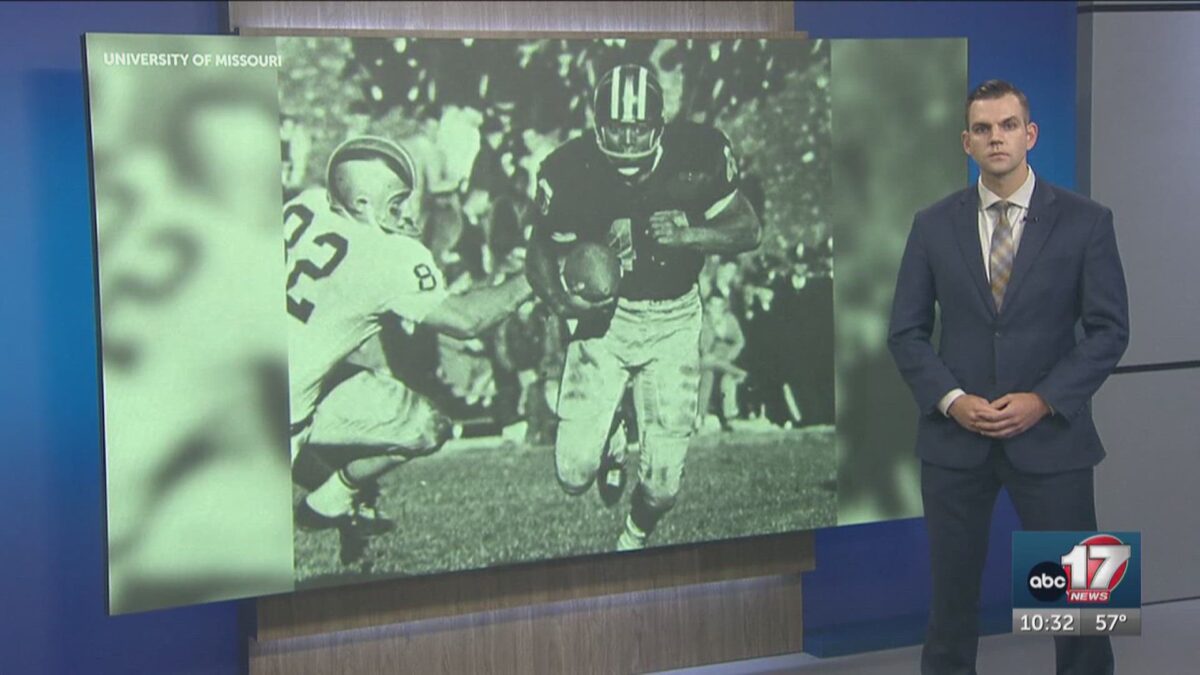
In the second quarter, he took a sweep 77 yards down the left sideline for a touchdown, giving Mizzou a 24-12 lead heading into halftime. With the Tigers clinging to a 24-19 advantage in the second half, Stevenson broke free for a 60-yard touchdown run in the fourth quarter, helping Missouri pull away for a 41-19 victory, the program’s first win in Norman since 1936.
Stevenson’s 169 rushing yards that day set a record for the most an Oklahoma defense had ever allowed in Norman. By the time the Tigers returned to Columbia, they had a No. 1 ranking next to their name for the first time in program history.
“Maybe the highlight of the season was going to Norman, Oklahoma. Before the game, Devine stood up and said, ‘No one in this room was alive the last time Missouri won in this stadium,’” said Jerry Wallach, a tackle who played at Mizzou from 1959 to 1962. “We knew on the plane coming back we would be No. 1 in the country. We followed that stuff, and the press was on the plane, and said, ‘You guys are going to have it. You’re going to be the number one ranked team in the country by the time you land.’”
A film clip in Corpus Christi
Hundreds of miles away in Corpus Christi, Texas, a teenage Johnny Roland was watching.
Five years later, Roland would become the program’s first Black team captain. At the time, he was an only child who spent much of his free time at the movie theater.
“I saw a film on Norris Stevenson when they played Oklahoma, and that’s when Missouri kicked the dog out of Oklahoma. I used to go to a lot of movies, because that was like a babysitter to me as an only child,” Roland told ABC 17 News. “They had the serials of the news, the sports news and all that. So I was watching that and saw Norris Stevenson take off on the Missouri sweep, and they had no way of catching him.”
The footage left an impression on Roland and helped sway his decision to attend Missouri. A highly recruited athlete, he had multiple college football offers on the table. When he arrived at baseball practice later that day, someone in the bleachers asked whether he had decided where he would go to school.
“I said, ‘Yeah, I’m going to Missouri.’ Shit, I didn’t know if I was going to Missouri or not. But I had just seen the film clip of Missouri playing Oklahoma and Norris Stevenson taking off on the Missouri sweep, and that just hit me. It swayed me,” Roland said.
A trailblazer’s influence
In 1958, the Tigers became one of the last teams in the Big Eight Conference to integrate their football program. The University of Missouri had admitted its first Black student in 1950, and Stevenson broke another barrier in the winter of 1957, becoming the first Black player in program history.
Six months later, Mel West joined him as the second.
At the time, Stevenson didn’t fully grasp the significance of what he was accomplishing. He was keenly aware of the racial barriers he faced, but his focus remained on getting an education and playing football. Only with time did he begin to understand the lasting impact of his place in Mizzou history.
“He’s even said that he didn’t realize the significance of being there when he was just going to school,” Jennifer Stevenson said. “As he went through life and as Mizzou got bigger and other people started going, the impact of what he did just became more evident to him, I think, over time.
“You would think the further out we get from that time, from the 1960s, more people would forget, and it wouldn’t matter anymore. But it almost seems to be more significant the further away we get from that time.”
West and Stevenson helped pave the way for generations of Black athletes at the University of Missouri. But for Stevenson, navigating life in Columbia meant overcoming obstacles without a clear blueprint.
“Norris Stevenson and Mel West were very different guys. Stevenson grew up in St. Louis, in a predominantly Black neighborhood and attended a predominantly Black school, while Mel West grew up in Jefferson City and was surrounded by a lot of white students and white players,” said Brendon Steenbergen, who interviewed 18 former players for his book, “Respectable Roughnecks,” about the 1960 season. “His experience was such that he was accustomed to being in an environment where he was maybe the only Black person in the room. Norris hadn’t had that experience nearly as much, and so Norris felt it more acutely.”
Columbia was a small town of roughly 30,000 people. The University of Missouri had yet to hire any Black educators or administrators, and many downtown businesses allowed African American students inside only if they presented their university IDs.
“It was different because he had grown up in a community that was predominantly African-American, and back then, segregation, Jim Crow, all of those things. So he didn’t really have a lot of opportunity to interact with white individuals and deal with discrimination and things like that. That was all new,” Jennifer Stevenson said. “When he went to Mizzou, it was something he had to learn.”
Raised in a strict Baptist household in St. Louis, Stevenson was the son of a preacher and spent Sundays attending church with his mother. His faith and his parents’ support helped him navigate the challenges of his new environment.
“He kind of maintained his Christian presence there, even at the University of Missouri. Then, he settled down and married my mom,” Jennifer Stevenson said. “It was almost like all of this, all of the things that happened to him, kind of molded him into the man that he became.”
The transition was made more difficult by a change in coaching staff.
Stevenson had been recruited by Frank Broyles, a Decatur, Georgia, native who promised him immediate playing time. But Stevenson never got the chance to play for Broyles.
By the time he took the field for his first varsity season as a sophomore in 1958, Broyles had left for the University of Arkansas, and 34-year-old Dan Devine had taken over as head coach.
Devine played a pivotal role in bringing Roland to Missouri. After helping lead Corpus Christi to a 13-1 record and a state championship, making it the first integrated team in Texas to claim a state title, Roland had six offers on the table. His recruitment included visits to Cal Berkeley, Nebraska, Arizona, Indiana and Oklahoma.
Roland knew he wanted to play college football, but he also wanted to attend a school where his parents could watch him play. That meant looking beyond his home state.
“You gotta know what time of day it was,” Roland said. “Southwest Conference wasn’t recruiting minority athletes. So if I was going to play college football, I was going to have to leave the state anyway.”
Roland initially committed to Oklahoma, where he would have been just the second Black player in program history. But Devine had other plans.
“Coach Devine worked his magic on me,” Roland said. “Not that my mom had anything to do with me going to Missouri, but she was giving me the pros and cons and all those kinds of things that moms do. So I ended up making a decision to go to Missouri, and Dan kind of swayed her too. He had a pretty good knack of schmoozing the mothers.”
Ultimately, a visit to Columbia sealed the decision.
“When I came to my visit, pretty nice campus, people seemed to get along, and I just kind of fell in love with Missouri,” Roland said. “As it turns out, it probably ended up being the best decision I ever made.”
His decision, however, meant an uncomfortable conversation with Oklahoma’s coaching staff. The Sooners even sent a coach to Columbia in an attempt to persuade him to reconsider.
“My mom, she was bugging me, ‘Are you going to call those Oklahoma coaches?’ and I said, ‘Yeah, I’ll call them. I’m still trying to make up my mind.’ I knew when I made that visit, ’cause it was the last visit, that’s where I was going to lay my hat,” Roland said. “They wanted to kick my ass when we played Oklahoma.”
Unlike Stevenson, Roland had grown up playing football on an integrated team. He arrived at Missouri as an All-American after helping lead Corpus Christi to a state championship, but he still benefited from the support of the Black players who had come before him, including Stevenson and his brother Gerald, as well as his future roommate, George Seals.
“Going back to my high school days, because we were state champs in Texas at the time, to me race wasn’t nothing but a name. We had full integration in Texas high school football. I had been fortunate enough to be All-American coming to Missouri,” Roland said. “Mel was a good guy. Norris Stevenson was a real good guy. Norris had a brother, Gerald Stevenson, that had gone to Missouri and George Seals was a contemporary, so there were no more than maybe a handful of guys, maybe 10 guys that were there of minority descent.”
Seals also played a pivotal role in keeping Roland at Missouri. A native of Higginsville, Seals offered Roland a place to stay on his family’s farm, where he laid low while Oklahoma coaches visited campus in an attempt to persuade him to reconsider.
Navigating a segregated world
By the time Roland arrived, Stevenson and West had already learned the unwritten rules of being among the only Black players on the roster. Those barriers extended beyond the football field to the team’s travel, lodging and meals.
“They were both really embraced by their teammates. But it was 1960. I think a lot of the players didn’t have a sense of what those guys were going through,” Steenbergen said.
Stevenson and West were roommates at Mizzou, but their transitions to college life appeared quite different. Steenbergen described West as a “happy-go-lucky guy” who made friends easily.
Stevenson, meanwhile, was popular on campus because of his prowess on the football field but more reserved and studious off the field.
“That specter of racism kind of impacted everybody. I don’t know if it was as big of an issue when they were all together as a team. I think it’s more when they went out, and they were traveling to games and things like that because they had to stop somewhere to eat and there was a division. They can’t come, but they can,” Jennifer Stevenson said. “I think that’s when it was felt the most.”
Devine did his best to support both players, but the number of incidents the team faced was hard to ignore. Wallach recalls stopping at restaurants and having to bring food back out to the Black players who were forced to wait on the team bus.
“Dan definitely did a lot of things that helped Mel and Norris. There were stories of like when they played at Texas A&M, the hotel restaurant wouldn’t allow the Black players, and so Dan Devine made sure that the whole team was not going to eat someplace that wouldn’t allow two of his players to eat,” Steenbergen said.
The discrimination wasn’t limited to road trips in the South.
Wallach recalled a trip back from Kansas during his freshman year when the team bus stopped at a restaurant in Missouri on the way home. As he got off the bus, he noticed some players who had already gone inside walking back out.
“You don’t have to be Dick Tracy to figure out what was going on,” Wallach said. “I know why they are coming back out. Well, it’s in Missouri, and then some woman comes out and says, ‘those boys aren’t coming in here.’ And she’s very irate. Dan Devine bragged it was one of his finest moments and frankly it was.”
The woman began to yell at Devine, insisting that the Black players could not come in and demanding to know who was going to pay for the food that had already been ordered. Wallach said Devine reached into his pocket and threw down a $100 bill on the gravel, loaded the team back onto the bus and left.
“He really has reason to be proud of his record on civil rights,” Wallach said. “I would always follow him in the after-dinner speeches by saying, ‘I was there, I saw it happen.’ Which was basically true, except it wasn’t a $100 bill; it was a $50 bill. The guy had to up it to $100. It made a better story.”
A complicated relationship with Dan Devine
Despite those acts of support, Stevenson later questioned whether Devine had always stood up for him.
Stevenson finished his career with 1,184 rushing yards and seven touchdowns across three seasons. But his numbers could have been even higher had he not been relegated to the role of second-string running back.
After rushing for 169 yards and two touchdowns against Oklahoma, Stevenson was named the NCAA’s “Back of the Week.” He was later recognized as the Big Eight Conference’s second-best halfback, honors that seemed at odds with his limited role in Missouri’s backfield.
A year after Stevenson died in 2012, his younger brother, Gerald, revealed a conversation Norris had with the coaching staff in 2009. During that conversation, an assistant coach allegedly told Stevenson that Missouri boosters had influenced Devine’s roster decisions. According to Gerald, influential Mizzou backers had prevented Devine from starting two Black running backs in the same backfield.
But there was one incident in particular that bothered Stevenson years later.
“There were other opportunities to kind of defend the guys that maybe Norris or Mel didn’t feel like [Devine] had their back as much,” Steenbergen said. “Most notably was in Miami during the Orange Bowl the year before.”
The team was in Miami for a matchup against Navy in the 1961 Orange Bowl, and the trip had already gotten off to a rough start. The team was staying at the Ivanhoe Hotel in Miami Beach, a facility co-owned by Stan Musial. But Wallach said that when they arrived, a manager came out and said that West and Stevenson could not stay at the hotel.
“We go to Devine and say that won’t stand either. We all go, or we all stay. We’re not sending the Black guys somewhere else,” Wallach said. “So the hotel backed down, they let them in, and it was no big deal.”
Due to the intense heat in Miami, the Tigers would practice in the morning, return to the hotel and hang around the pool before heading back out for evening practice. But that turned into another issue.
“Well, then it came down to the swimming pool at the hotel. Well, you can’t have Black guys in the pool with white people. That just won’t work,” Wallach said. “So they’re kicking the Black guys out of the swimming pool. Somebody went with me; we went to the hotel manager’s office. No coaches there, I said, ‘Put a bill together for our team.’”
“What are you talking about?” the hotel manager replied.
“I said, ‘We’re going to Missouri. We’re here in your hotel with the entire football team, and the entire football team cannot use your facilities. We are going back to Missouri,’” Wallach responded. “Then somebody else comes out with a suit and tie, and they say, ‘Well, we’re sorry about the whole ordeal, and as far as I know, the Black guys didn’t contaminate anybody.’”
The Tigers went on to defeat Navy 21-14 in front of President-elect John F. Kennedy to claim their first bowl victory in program history. But the Orange Bowl banquet left a lasting impression on Stevenson.
The banquet was held at the Miami Beach Convention Hall, located on a barrier island between the Atlantic Ocean and Biscayne Bay. When the team arrived, Stevenson and West were escorted off the island. Stevenson felt Devine had failed to stand up for him.
“He loved his coach. It was painful. There were some painful things that happened. It’s like when you have a complicated relationship with anyone; sometimes it’s just you love them, but then there are those hard points in life,” Jennifer Stevenson said. “When Dan Devine passed away, his son was given the instruction to go talk to Norris and see if he would be willing to speak at his service. So it’s like that pain was there, but that relationship was never broken.”
A star with standing

Johny Roland with Dan Devine
Wallach would later say Roland was the first Black player at Missouri with enough stature to force real change. One conversation in particular stuck with him.
“I had said to John one day, ‘I don’t know what you guys complain about. You’re treated just like we’re treated.’ And he said, ‘We’re treated just like you’re treated because we’re better players than you.’ What an eye-opener,” Wallach said. “He was right. You look around and how many second-string Black players were there? Zero. You’re either a star or you’re not on the team in those days.”
Roland certainly fit the mold of a star. During his three seasons at Missouri, the Tigers won 22 of 32 games, capped by a victory over the Steve Spurrier-led Florida Gators in the 1966 Sugar Bowl.
It didn’t take long for his teammates to realize that he was a special player. Wallach still remembers Roland’s first play from scrimmage against the University of California in 1962, a game the Tigers won 21-10.
“John comes in the huddle, and he’s second string, first game, first play from scrimmage as a varsity college football player,” Wallach said. “Quarterback comes in and calls an ‘A Power,’ which means the running back is going to come off the left tackle, me, and then it’s up to me to signal the back which side they should run on. Quarterback calls the play, and John Roland looks right at me and says to me, ‘Where’s it breaking?’ I’m thinking, ‘It’s your first play in your first varsity game, and you look at the key blocker.’ How the hell did he know? I said, ‘Watch my left cheek,’ and John had like 208 yards.”
Roland made his mark in all three phases of the game. In 1962, he led the Tigers with 820 rushing yards and 12 touchdowns. He also led the team in punt returns in 1964 and 1965, while recording the most interceptions on the team after being moved to defensive back. His six interceptions in 1965 have been surpassed only twice in Mizzou history.
“I was talented enough that I could play all positions,” Roland said. “Probably because I was a baseball player and I had good judgment.”
One of his finest performances came against the University of Kansas during his senior season in 1965. He intercepted a pass, recovered a Jayhawk fumble, set up a touchdown drive with a 35-yard punt return, completed a pass, and scored three touchdowns with 178 total yards from scrimmage.
“He played a game, and there was another Black running back named [Ray] Thorpe. Thorpe takes one, a kickoff or a punt, and runs it back for a touchdown. Thorpe wasn’t a big guy, but he was really good. The next deep kick, John Roland takes it, and he runs it back for a touchdown. Then Thorpe runs one back for a touchdown. Then Roland runs one back for a touchdown; then Thorpe doesn’t, and Roland runs another one. Then afterward John, being John, said, ‘I couldn’t let it stand on two and two,’” Wallach said. “He was really remarkable.”
Roland was forced to sit out the 1963 season after being accused of swapping tires with another student, an incident that got him dismissed from school.
“In those days freshmen couldn’t have cars on campus, and if you did you better park far, far, far away. So as it turns out we had just moved one car from over there to over there,” Roland said. “I knew where it was, but someone had come and moved it again, so it was a big kerfuffle.”
The University of Missouri later walked it back and suspended him for the 1963 season.
“I went to Kansas City and worked a construction job because what else was I going to do? I mean, I did it,” Roland said. “As it turns out, it was a blessing in disguise cause I was able to milk one more year out of Missouri. At that time, they had the AFL-NFL merger, and I was able to play both ends against the middle, and it worked out for me.”
Despite the setback, Roland had already earned the respect of his teammates. In 1965, he was named a team captain, becoming the first Black player in Missouri football history to hold the title.
“He was, in my opinion, the first real superstar from Mizzou. Obviously, there were great players at Missouri before that, but in the television era, Johnny Roland was a real star and a great, great football player, and his opinion mattered,” Steenbergen said. “He was a player who recognized that his success and his popularity as an athlete could translate into making real change.”
“John Roland in many senses is kind of a hero to me, because he was the first Black guy at Missouri with a real stature to do what he did,” Wallach added.
That stature also gave him standing on matters that had nothing to do with the playbook. Roland, however, downplayed the significance.
“It was an honor that they had confidence in me, that they felt I would be a leader and a capable leader,” Roland said. “The players had faith and confidence in me. I tried to be a leader, but you know, I ain’t got time for that; let’s play football.”
Challenging a Confederate tradition
But according to Wallach and Steenbergen, Roland also helped put an end to a long-standing Mizzou tradition that had troubled Stevenson during his playing days.
“When Missouri would score a touchdown, the fans would wave big Confederate flags, huge Confederate flags, and the band would play ‘Dixie,’” Wallach said. “There was a big Confederate rock right outside the law school with a big plaque dedicated to the heroes of the Confederacy. Boone County was called Little Dixie.”
The tradition was a source of frustration for many Black students on campus. Before the 1960 Orange Bowl, activists with the Congress of Racial Equality urged Missouri’s band not to play “Dixie” against Georgia. Although there is no single, definitive account establishing when the tradition ended, historical accounts place its demise around 1964.
Wallach and Steenbergen said Roland played a role in bringing it to an end by confronting Devine about the continued use of Confederate symbols and music.
“John Roland went into Devine’s office, I’ve heard the story often, and I believe it, and said, ‘Coach, here’s what you can do. You can continue to play me, and I’ll continue to play, or you can have that Confederate rock and play ‘Dixie’ and wave the Confederate flag all you want, and I’m gone,’” Wallach said. “Devine always bragged he was a big civil rights guy, but it was John Roland who backed him down.”
Steenbergen offered a similar account after speaking with Roland, while acknowledging that versions of the story differ.
“The story goes that Johnny Roland told Dan Devine, ‘If you want me to score touchdowns at Missouri, you’re not going to have this music, which is an insult to my people,’ and that Dan Devine did listen, and he talked to the band director and athletic director at the time, and they got that stopped,” Steenbergen said. “Now, this is 60-some years later, and I have heard different accounts of it, but that’s kind of the version that I’ve heard from Johnny and from others.”
However, when asked by ABC 17 News for his version, Roland denied having any involvement.
“Yeah, they played ‘Dixie.’ It didn’t bother me,” Roland said. “I was singing ‘Dixie’ too. If we scored a touchdown. Shit, come on.”
A legacy that opened doors
Roland’s number was later retired by the University of Missouri. Asked about the honor, he kept it brief.
“I don’t know. It was a great honor because they can’t take it down,” he said. “Norris Stevenson should probably be on there.”
Stevenson had broken the barrier; Roland had arrived with enough stature that his opinion carried weight inside the program. Both navigated the same town, the same travel and the same coach, but their experiences were not identical.
“I’ve always been an easygoing kind of guy. Roll with the punches,” Roland said. “But I didn’t take no mess either.”
Roland went on to build a career in the NFL, playing for the St. Louis Cardinals from 1966 to 1972. He earned Rookie of the Year honors in 1966 before finishing his playing career with the New York Giants in 1973.
Devine later hired him as an assistant coach in Green Bay, launching a coaching career that spanned three decades. Among his stops was the 1985 Chicago Bears, where he coached Hall of Fame running back Walter Payton.
Stevenson’s playing career ended at Mizzou, but his impact extended far beyond the football field. He remained active in helping the University of Missouri recruit more Black players and became a pastor and Sunday school teacher, carrying his faith into the next chapter of his life. He also spoke at Devine’s funeral, maintaining a final connection to the coach who had shaped his playing career despite the painful moments in their relationship.
Both men’s legacies are memorialized inside Memorial Stadium. Roland’s name and No. 23 are displayed along the sideline, while the words “1960 National Champions” overlook the field.
Stevenson’s 1960 team was honored at Memorial Stadium on Sept. 19. While Stevenson wasn’t alive to see the team formally recognized as national champions, his two daughters, Jennifer and Lauren, stood in his place.
“It was a little overwhelming. My sister, Lauren, and I were just so proud of him and were proud to be able to represent him when the team got recognized,” Jennifer Stevenson said. “He was a big personality, but he was very humble. He didn’t look for the spotlight. He didn’t look for attention or anything like that. He just kind of had this quiet strength about him. I think that just kind of drew people in.”
Both Jennifer and Lauren followed in their father’s footsteps and attended the University of Missouri. While Jennifer admitted that her mother and father warned her that she might face racism and discrimination, her father instilled in her the belief that she had the strength to overcome it.
“When he talked about it, even though the discriminatory things that happened to him were painful, what defined him was the fact that he overcame it,” Jennifer Stevenson said. “He opened the door. He paved the way. You know how when they build highways and how they have to blast the sand rock and clear the trees out and it’s not easy to do that. As a trailblazer, that’s what he did.”
Years later, after Stevenson’s death, Jennifer said she hoped people would remember her father for more than the obstacles he faced.
“I don’t want people to remember all the suffering and the discrimination,” she told ABC 17 News. “I want them to remember him as an overcomer, as someone who overcame his pain to do so many other things.”
Click here to follow the original article.