Idaho Falls Zoo mourns the loss of Sid, a gray gibbon

News Release

The following is a news release from the City of Idaho Falls.

IDAHO FALLS, Idaho (News Release) The Idaho Falls Zoo is deeply saddened to announce the passing of Sid, the zoo’s male gray gibbon. Sid’s story has long been a special one, and his loss is felt profoundly by zoo staff, volunteers and visitors who came to know and love him.

Sid was born at the Idaho Falls Zoo under unique circumstances. His mother, Shannon, refused to care for him and ultimately abandoned him. After repeated attempts to encourage maternal bonding, the zoo’s animal care team stepped in to provide round-the-clock care, ensuring Sid received the nourishment and attention he needed to survive.

As Sid matured, reintroducing him to his gibbon family was initially successful, but over time he faced social challenges that made it unsafe for him to remain with the other gibbons. Zoo staff created a separate habitat designed for Sid’s safety and comfort, with enrichment and continuous care.

Over the past two years, Sid exhibited physical indicators of a gastrointestinal medical condition. Despite multiple treatments, sedated procedures and ongoing monitoring by the zoo’s veterinary team and external primate experts, his condition worsened. While he received constant attention, it is believed that the stress of living apart from his family may have exacerbated his medical condition. After extensive consultation, it became clear that his suffering could not be alleviated, and the difficult decision was made to humanely euthanize him to prevent further suffering.

Sid, a gray gibbon, passed away at the Idaho Falls Zoo.

“Sid’s lack of response to all therapies and treatment was disheartening, to say the least,” said Dr. Kasey Lucore, veterinarian for the Idaho Falls Zoo. “However, our keepers and vet team couldn’t allow any more suffering, and while euthanasia was the hardest choice for us, it was the kindest choice available for Sid.”

Sid received extensive care from medical professionals and was deeply cherished by the zoo staff, who supported him every day and are heartbroken by his loss.

“This decision was not made lightly,” said David Pennock, Executive Director for the Zoo. “Sid’s care team loved him deeply—they’ve been part of his story since the day he was born—and saying goodbye was incredibly hard for everyone who knew him.”

Sid was known for his playful curiosity and frequent interactions with guests near the viewing glass. He brought joy and laughter to countless visitors over the years and will be greatly missed by his keepers, volunteers and the entire zoo community.

A video memorial celebrating Sid’s life can be viewed on the Idaho Falls Zoo’s Facebook page.

Click here to follow the original article.

Dick Cheney, influential Republican vice president to George W. Bush, dies

CNN

CNN

By Stephen Collinson, Veronica Stracqualursi, CNN

(CNN) — Dick Cheney, America’s most powerful modern vice president and chief architect of the “war on terror,” who helped lead the country into the ill-fated Iraq war on faulty assumptions, has died, according to a statement from his family. He was 84.

“His beloved wife of 61 years, Lynne, his daughters, Liz and Mary, and other family members were with him as he passed,” the family said, adding that he died due to complications of pneumonia and cardiac and vascular disease.

“Dick Cheney was a great and good man who taught his children and grandchildren to love our country, and to live lives of courage, honor, love, kindness, and fly fishing,” the family added.

“We are grateful beyond measure for all Dick Cheney did for our country. And we are blessed beyond measure to have loved and been loved by this noble giant of a man.”

The 46th vice president, who served alongside Republican President George W. Bush for two terms between 2001 and 2009, was for decades a towering and polarizing Washington power player.

Bush described Cheney in a statement Tuesday as a “decent, honorable man.” “History will remember him as among the finest public servants of his generation – a patriot who brought integrity, high intelligence, and seriousness of purpose to every position,” Bush said.

In his final years, Cheney, still a hardline conservative, nevertheless became largely ostracized from his party over his intense criticism of President Donald Trump whom he branded a “coward” and the greatest-ever threat to the republic.

In an ironic coda to a storied political career, he cast his final vote in a presidential election in 2024 for a liberal Democrat, and fellow member of the vice president’s club, Kamala Harris, in a reflection of how the populist GOP had turned against his traditional conservatism.

Cheney was plagued by cardiovascular disease for most of his adult life, surviving a series of heart attacks, to lead a full, vigorous life and lived many years in retirement after a heart transplant in 2012 that he hailed in a 2014 interview as “the gift of life itself.”

Cheney, a sardonic former Wyoming representative, White House chief of staff and defense secretary, was enjoying a lucrative career in the corporate world when he was charged by George W. Bush with vetting potential vice-presidential nominees. The quest ended with Cheney himself taking the oath of office as a worldly number two to a callow new president who arrived in the Oval Office after a disputed election.

While caricatures of Cheney as the real president do not accurately capture the true dynamics of Bush’s inner circle, he relished the enormous influence that he wielded from behind the scenes.

Cheney was in the White House, with the president out of town on the crisp, clear morning of September 11, 2001. In the split second of horror when a second hijacked plane hit the World Trade Center in New York, he said he became a changed man, determined to avenge the al Qaeda-orchestrated attacks and to enforce US power throughout the Middle East with a neo-conservative doctrine of regime change and pre-emptive war.

“At that moment, you knew this was a deliberate act. This was a terrorist act,” he recalled of that day in an interview with CNN’s John King in 2002.

Cheney reflected in later years on how the attacks left him with overwhelming sense of responsibility to ensure such an assault on the homeland never happened again. Perceptions however that he was the sole driving force behind the war on terror and US ventures into Iraq and Afghanistan are misleading.

Contemporary and historic accounts of the administration show that Bush was his own self-styled “The Decider.”

Multiple former presidents paid tribute to Cheney on Tuesday, with Bill Clinton and Joe Biden highlighting the former vice president’s “public service.”

A changed man

From a bunker deep below the White House, Cheney went into crisis mode, directing the response of a grief-stricken nation suddenly at war. He gave the extraordinary order to authorize the shooting down of any more hijacked airliners in the event they were headed to the White House or the US Capitol building. For many, his frequent departures to “undisclosed” locations outside Washington to preserve the presidential chain of succession reinforced his image as an omnipotent figure waging covert war from the shadows. His hawkishness and alarmist view of a nation facing grave threats was not an outlier at the time – especially during a traumatic period that included anthrax mailings and sniper shootings around Washington, DC, that exacerbated a sense of public fear even though they were unrelated to 9/11.

The September 11 attacks unleashed the US war in Afghanistan to overthrow the Taliban, which was harboring al Qaeda, though the terror group’s leader Osama bin Laden escaped. Soon, Cheney was agitating for widening the US assault to Iraq and its leader, Saddam Hussein, whose forces he had helped to eject from Kuwait in the first Gulf War as President George H.W. Bush’s Pentagon chief.

The vice president’s aggressive warnings about Iraq’s supposed weapons of mass destruction programs, alleged links to al Qaeda and intent to furnish terrorists with deadly weapons to attack the United States played a huge role in laying the groundwork for the US invasion of Iraq in 2003. Congressional reports and other post-war inquiries later showed that Cheney and other administration officials exaggerated, misrepresented or did not properly portray faulty intelligence about weapons of mass destruction programs that Iraq turned out not to possess. One of Cheney’s most infamous claims, that the chief 9/11 hijacker Mohamed Atta, met Iraqi intelligence officials in Prague, was never substantiated, including by the independent commission into the September 11 attacks.

But Cheney insisted in 2005 that he and other top officials were acting on “the best available intelligence,” at the time.

While admitting that the flaws in the intelligence were plain in hindsight, he insisted that any claim that the data was “distorted, hyped, or fabricated” was “utterly false.”

The conflicts in Iraq and Afghanistan also led the US down a dark legal and moral path including “enhanced interrogations” of terror suspects that critics blasted as torture. But Cheney – who was at the center of every facet of the global war on terrorism – insisted methods like waterboarding were perfectly acceptable. Cheney was also an outspoken advocate for holding terror suspects without trial at Guantanamo Bay, Cuba – a practice that critics at home and abroad branded an affront to core American values.

No regrets

Cheney became a symbol of the excesses of the anti-terror campaigns and the fatally false premises and poor planning that turned the initially successful invasion of Iraq into a bloody quagmire. He left office reviled by Democrats and with an approval rating of 31%, according to the Pew Research Center.

To the end of his life, Cheney expressed no regrets, certain he had merely done what was necessary to respond to an unprecedented attack on the US mainland that killed nearly 3,000 people and led to nearly two decades of foreign wars that divided the nation and transformed its politics.

“I would do it again in a minute,” Cheney said, when confronted by a Senate Intelligence Committee report in 2014 that concluded enhanced interrogation methods as brutal and ineffective and responsible for damaging US standing in the eyes of the world.

Of the Iraq war, he told CNN in 2015: “It was the right thing to do then. I believed it then and I believe it now.”

‘He’s a coward’

Cheney’s aggressive anti-terror policies fit into a personal doctrine that justified extraordinary presidential powers with limited congressional oversight. That was in line with his belief that the authority of the executive branch had been mistakenly eroded in the aftermath of the Vietnam War and the Watergate scandal that led to the resignation of his first presidential boss, President Richard Nixon.

Yet in his final years, Cheney emerged as a fierce critic of a man who had an even more expansive view of the powers of the presidency than he did – Trump. Cheney had supported Trump in 2016 despite his criticism of Bush-Cheney foreign policies and his transformation of the party of Reagan into a populist, nationalist GOP. But the ending of the president’s first term, when his refusal to accept his 2020 election defeat led to the January 6 insurrection, caused Cheney to speak out, in a rare, public manner.

The former vice president’s daughter, then-Wyoming Rep. Liz Cheney, meanwhile, sacrificed a promising career in the GOP to oppose Trump after his attempt to overturn the 2020 presidential election and the US Capitol insurrection on January 6, 2021. In an ad for his daughter’s unsuccessful campaign to fight off a pro-Trump candidate’s primary challenge in 2022, Dick Cheney – who was, by then, rarely seen in public – looked directly into the camera from under a wide brimmed cowboy hat and delivered an extraordinary direct message.

“In our nation’s 246-year history, there has never been an individual who is a greater threat to our republic than Donald Trump,” Cheney said.

“He is a coward. A real man wouldn’t lie to his supporters. He lost his election, and he lost big. I know it. He knows it, and deep down, I think most Republicans know.”

Early days out West

Richard Bruce Cheney was born January 30, 1941, in Lincoln, Nebraska. While living in the small mountain town of Casper, Wyoming, he met his high school sweetheart and future wife Lynne Vincent. Cheney was accepted to Yale University on a scholarship, but he struggled to fit in and maintain his grades. By his own admission, he was kicked out.

He returned West to work on power lines and was twice arrested for driving under the influence. In a turning point for Cheney, he was given an ultimatum from Lynne, who had “made it clear she wasn’t interested in marrying a lineman for the county,” he told The New Yorker. “I buckled down and applied myself. Decided it was time to make something of myself,” he told the magazine.

Cheney went back to school and earned a bachelor’s and master’s in political science from University of Wyoming. The couple was married in 1964.

Cheney is survived by Lynne, his daughters Liz and Mary Cheney and seven grandchildren.

A veteran Washington power broker

Cheney began honing his inside power game – at which he became a master – as an aide to Nixon.

He was later picked by Donald Rumsfeld as his deputy White House chief of staff under President Gerald Ford and then succeeded his mentor and close friend in the job in 1975 when Rumsfeld departed to become defense secretary. Cheney was instrumental in reviving their partnership in 2001 when he recalled Rumsfeld from the political wilderness to return to the Pentagon.

The pair formed an extraordinary backroom alliance in the Bush administration throughout the war on terror and the Iraq war – much to the frustration of more moderate members of the administration including then-Secretary of State Colin Powell and National Security Adviser Condoleezza Rice – who took over from Powell in the second term.

While Democratic President Jimmy Carter was in the White House, Cheney decided to run for Congress and was elected to Wyoming’s sole US House seat in 1978. Cheney served six terms, rising to become House minority whip, and racked up a very conservative voting record.

In 1989, President George H. W. Bush, who had served with Cheney in the Ford administration, tapped him to serve as his defense secretary, calling him a “trusted friend, adviser.” He was confirmed by the Senate in a 92-0 vote.

As Pentagon chief, Cheney showed considerable skill in directing the US invasion of Panama in 1989 and Operation Desert Storm in 1991 to push Iraq’s troops out of Kuwait. Following his stint as defense secretary, Cheney briefly explored a run for president in the 1996 election cycle but decided against it.

During Clinton’s presidency, Cheney joined Dallas-based Halliburton Co. serving as its chief executive officer.

It wouldn’t be until the younger Bush decided to run for office that Cheney was chosen to lead the Republican candidate’s search for a running mate and, after initially turning down the job, ended up being added to the GOP ticket.

“During the process, I came to the conclusion that the selector was the best person to be selected,” Bush said in the 2020 CNN film “President in Waiting.”

Cheney brought a wealth of knowledge and experience to areas where critics complained Bush was weak. As a former Texas governor, Bush had no elected experience in Washington and little military and foreign policy background compared with Cheney.

Early in Bush’s presidency, Cheney led a task force to develop the administration’s energy policy and sought to keep its records secret in a fight that lasted Bush’s first term and went all the way to the US Supreme Court.

He was, however, at odds with Bush over the issue of same-sex marriage, saying that it should be left to the states to decide. In a 2004 town hall, he noted his daughter Mary’s sexual orientation reportedly for the first time publicly, according to The Washington Post. “With respect to the question of relationships, my general view is that freedom means freedom for everyone.People … ought to be free to enter into any kind of relationship they want to,” he said, the Post reported.

His relationship with Bush was complicated in later years, including by Bush’s refusal to pardon Cheney’s chief of staff Scooter Libby, who had been convicted of perjury and obstruction of justice in 2007 after a probe into who leaked the identity of a CIA operative. Libby was eventually pardoned by Trump in 2018.

In one of the most notorious moments in his personal life, which added to his grizzled legend in 2006, Cheney accidentally shot a hunting partner in the face with birdshot, causing relatively minor wounds.

Health issues

Cheney’s health issues began in 1978, when he had his first heart attack at age 37 while running for Congress. Three more followed in 1984, 1988 and November 2000, just a few days into the Florida presidential ballot recount that resulted in a Bush-Cheney win.

Cheney at the time said that he’d be the “the first to step down” if he learned he’d be unable to do the job and had a resignation letter in case he was deemed incapacitated.Cheney completed both terms under Bush, attending Barack Obama’s inauguration in January 2009 in a wheelchair.

A year after a fifth heart attack in 2010, Cheney received a heart pump that kept the organ running until his transplant in 2012.

Life after the White House

After leaving office, Cheney returned to private life, penning two memoirs — one about his personal and political career and the other about his struggles with heart disease as well as a book with his daughter, Liz. He became one of the most strident GOP critics of President Barack Obama, who had based his election campaign on promises to end the wars and other changes from what he called failed policies of the Bush-Cheney administration.

Years later, Cheney was decrying his own party — especially its leadership’s response to the attack on the Capitol — when he returned to the US Capitol with then-Rep. Liz Cheney on the one-year anniversary of January 6, 2021.

“I am deeply disappointed at the failure of many members of my party to recognize the grave nature of the January 6 attacks and the ongoing threat to our nation,” he said in a statement.

In a remarkable moment, Democrats lined up to greet the former Republican vice president and shake his hand. Former Democratic House Speaker Nancy Pelosi hugged Cheney. The former vice president slammed Republican leaders in Congress, saying they do not resemble the leaders he remembered from his time in the body.

It was a scene that would have been unthinkable two decades earlier and an illustration of how the extraordinary changes in American politics wrought by Trump had made former bitter political foes find common cause in the fight for democracy.

“It’s not leadership that resembles any of the folks I knew when I was here for 10 years,” Cheney said at the Capitol in 2022.

Cheney continued his criticism of Trump in the following years and went as far as to endorse then-Vice President Kamala Harris, a Democrat and Trump’s opponent in the 2024 presidential campaign. He said he would vote for Harris because of the “duty to put country above partisanship to defend our Constitution.” Cheney emphasized his disdain for Trump at the time and warned that he “can never be trusted with power again,” though Trump would go on to win the presidency a couple of months later.

CNN’s Jamie Gangel and Shania Shelton contributed to this report.

This story has been updated with additional information.

The-CNN-Wire™ & © 2025 Cable News Network, Inc., a Warner Bros. Discovery Company. All rights reserved.

Click here to follow the original article.

Idaho growers taking losses despite bountiful season

Ariel Jensen

IDAHO FALLS, Idaho (KIFI) — Idaho’s growing season is over, and the Idaho Farm Bureau Federation says local farmers are facing tough times to make ends meet.

When people think of Idaho, images of potatoes, fertile land, and agriculture usually come to mind. For generations, farming has been the backbone of the state’s economy. Now, that foundation is cracking under financial pressure, with many struggling to stay in business.

“This year’s growing season in Idaho was a really good actually. In some cases, maybe nearing record yields,” said Sean Ellis, spokesman for Idaho Farm Bureau Federation. “Remember, farmers are price takers, not price makers. They take what’s offered to them. And so they’re being offered prices for their farm commodity, for their crops that are well below what it costs them to produce those crops.”

The cost to grow a crop is at a record high, while the prices farmers receive for those crops continue to decline. Ellis says farmers are getting less for their work when the average consumer is paying more for food. 

“It’s the middlemen, that’s the reason prices are higher at the retail level than at the farm level: it’s the middlemen. Transportation, you know, retail markups, wholesale markups, promotion and marketing the whole bit. It’s not the farmers that are getting that money. It’s the middlemen that’s getting it,” said Ellis.

This economic squeeze isn’t new, and the impact is visible across the state. Between 2017 and 2022, Idaho lost over two thousand farms, an alarming rate of about one farm per day.

“The problem is, this current period of down commodity prices has been extended. This has been going on for several years now. It’s getting to get to a head right now. So something’s got to change,” Ellis warned.

On a brighter note, Ellis mentioned that the outlook for ranchers appears significantly better than for row crop producers right now.

Click here to follow the original article.

Time capsule from Japanese Church of Christ revealed to public Saturday

CNN Newsource

Originally Published: 03 NOV 25 19:05 ET

By Joe Wirthlin

Click here for updates on this story

    SALT LAKE CITY (KSL, KSL TV) — Leaders from the Japanese Church of Christ unveiled artifacts found in a 101-year-old time capsule on Saturday, showcasing the story of early Japanese immigrants to Salt Lake City.

According to a press release from Michelle Schmitt, the previously unknown time capsule contained three newspapers, Sunday school records, an American and Japanese flag and two small bibles, one of which had been brought to Utah by a Japanese immigrant in 1906.

“Finding the time capsule without any record of its existence feels like a miracle, especially as we celebrate together 100 years of our sacred church building,” Japanese Church of Christ Reverend Andrew Fleishman said. “It’s a blessing to reflect on the Japanese spiritual pioneers who took care and attention to leaving this special gift for today’s generation to find.”

Discovery of the time capsule According to Schmitt, Lorraine Crouse, a trustee of the Japanese Church of Christ and former University of Utah historian, suspected a time capsule may exist, considering the popularity of time capsules at the time of the building’s construction.

Based on Crouse’s hunch, Japanese Church of Christ elder Alan Shino performed a geophysical radar scan of the building, discovering an unknown object hidden in the cornerstone of the church building. Officials then drilled into the interior of the church and discovered a 23 lb. bronze box, which contained the above treasures.

“Removing the box was exciting,” said Japanese Church of Christ elder Lynne Ward. “We were apprehensive about the contents. Was there anything in the box? What could be in the box? Would the contents be intact? We knew that whatever was inside was at risk of damage from simply opening the box. It must be done properly to preserve the artifacts that were hand-selected over one hundred years ago.”

Preserving the artifacts The University of Utah’s Marriott Library Preservation Department offered to assist and safely remove the artifacts from the time capsule in their lab. A small number of congregants from the Japanese Church of Christ were there to witness the event.

The Marriott Library Preservation Department released a report about the capsule itself and the contents found within.

Many of the items were in good condition, although the newspapers and a letter with the names of Sunday school teachers were damaged when workers accidentally pierced the box with drill bits while extracting the capsule.

The Marriot Library Preservation Department repaired the damages to the newspapers, removed creases from the papers and the flag and cleaned the items for easier display to the public.

Fleishman commended Japantown community members for their joint talents and efforts in finding the capsule. A video was shown at the ceremony that summarized the history of the Japanese Church of Christ, the time capsule’s discovery, each artifact within the capsule and their individualized care.

A diverse group of religious leaders attended the unveiling ceremony, along with hundreds of other guests. Religions represented included the Presbyterian Church USA, Church of Jesus Christ of Latter-day Saints, Cathedral of the Madeleine, United Church of Christ, Salt Lake Buddhist Temple, Tongan-American Free-Weslyan Church, Kachin Trinity Church, and the Salt Lake Interfaith Roundtable.

Japantown’s place in Salt Lake City Fleishman said the important historical finding came during a time of lively debate surroundingJapantown and its place in the future of Salt Lake City. According to the press release, generational changes are being made to the downtown landscape to prepare for the upcoming Salt Lake Olympics.

According to the release, Salt Lake City’s Japantown was settled in 1900, with the Japanese Church of Christ and the Salt Lake Buddhist Temple operating as Japantown’s core. A Japanese garden is maintained by the Salt Palace ground crews, which provides urban green space and is home to a plaque honoring WWII Japanese American soldiers.

Japantown was bounded by South Temple, State Street, Third South and Seventh West. Japanese-owned restaurants, markets, service stations, hotels, professional offices, boarding houses and dry cleaners were all located within Japantown, though the expansion of the Salt Palace Convention Center in the 1990s reduced the original buildings.

Japantown continues to serve Japanese religion and culture, with the two churches hosting the Nihon Matsuri and Obon festivals and sponsoring community activities.

This story was provided to CNN Wire by an affiliate partner and does not contain original CNN reporting.

Please note: This content carries a strict local market embargo. If you share the same market as the contributor of this article, you may not use it on any platform.

The-CNN-Wire™ & © 2025 Cable News Network, Inc., a Warner Bros. Discovery Company. All rights reserved.

Click here to follow the original article.

The Art Museum of Eastern Idaho secures grant to launch Education Center construction

News Release

IDAHO FALLS, Idaho (KIFI) — A local art museum is one step closer to a notable milestone, thanks to a new grant. The Art Museum of Eastern Idaho in Idaho Falls has received a generous grant from the CHC Foundation, helping kick off the initial construction phases of its new education center.

“The foundation has supported TAM for decades, and we are proud to honor that relationship with the museum’s current CHC Gallery. Their latest investment is a meaningful vote of confidence in TAM’s expansion and the future of the arts in Eastern Idaho,” TAM stated in a news release.

The CHC Foundation is a private foundation in Idaho Falls dedicated to providing grants to nonprofits in eastern Idaho. 

The project will add classrooms, studios, and gallery space, expanding art classes and community programs year-round.

The CHC Foundation has supported the museum for more than two decades, and museum leaders say this grant will help continue turning their vision of making art an accessible reality. Museum director Alexa Stanger says the grant is both a financial boost and a vote of confidence in the project’s value to the community.

Click here to follow the original article.

ISU launches new Master’s in Geology with Geology Management Concentration

News Release

POCATELLO, Idaho (KIFI) — The worlds of minerals, magma, and management are converging in a new degree offered by Idaho State University. 

Recently, ISU added a master’s in geology with a concentration in geology management. Differing from the already offered research concentration, students will be required to take graduate-level geology classes and courses focused on being effective managers. 

“This degree is specifically intended for people who are chomping at the bit to enter their geosciences career and move up into managerial roles,” said Shannon Kobs Nawotniak, professor and chair of the geosciences department at Idaho State. “While the traditional research-track offers a student an opportunity to gain expertise in a very narrow application, the new master’s with a concentration in geology management replaces the thesis work with targeted courses from the Master’s of Business Administration (MBA) program at Idaho State to ensure that the student has training in how businesses and management actually work.”

On the business side, students pursuing the new degree will take courses related to leading in organizations, managerial decision making and negotiation, applied economics, and more.

“We are delighted by this partnership and the opportunity to offer courses toward this degree,” said Alex Bolinger, interim dean of ISU’s College of Business. “These courses address an array of skills that are crucial to successfully managing projects and teams in the geological sciences, from managing conflict and fostering collaboration to making strategic decisions and negotiating effectively across competing interests and priorities.”

“This is a relatively unique degree that can help launch students into their careers,” said Kobs Nawotniak. “Graduates of this program are not only qualified for careers as working geologists and environmental scientists, they are strategically positioned for management roles or to start their own consulting firms due to their increased knowledge of business.”

If you are interested in pursuing a master’s in geology with a concentration in geology management, email geology@isu.edu

For more information on ISU’s Department of Geosciences, visit isu.edu/geosciences

Prospective students can schedule a campus tour at isu.edu/visit.

Click here to follow the original article.

Pocatello Police launch 7th annual “Give the Cops a Bird” Thanksgiving food drive

Seth Ratliff

POCATELLO, Idaho (KIFI) — For the 7th year in a row, the Pocatello Police Department is bringing back a seasonal partnership with the local Idaho Food Bank ahead of the Thanksgiving holiday.

From now until November 20th, PPD is encouraging residents to donate frozen turkeys, non-perishable canned goods, and monetary gifts at the police department as part of the annual “Give the Cops a Bird” turkey drive. This annual initiative ensures local families facing food insecurity have food on their tables for the holiday.

The PPD shared a clear message on Facebook: “Don’t miss your chance to ‘Give the Cops a Bird’ and help us help the community!”

For more information on how to donate or get involved, click HERE.

Click here to follow the original article.

Wyoming Governor Gordon steps in amid SNAP crisis

Seth Ratliff

CHEYENNE, Wyoming (KIFI) — As millions nationwide brace for reduced Supplemental Nutrition Assistance Program benefits this month due to the ongoing government shutdown, Governor Mark Gordon signed two executive orders aimed at bolstering food security across the Cowboy State.

On Friday, October 31, Governor Gordon declared a Public Welfare Emergency. This declaration immediately unlocks up to $10 million in state emergency funds specifically designated to ensure Wyoming families maintain access to necessary food resources, directly addressing the impact of the ongoing federal funding crisis.

“Food insecurity does not care about political parties,” Governor Gordon stated on Facebook. “Wyoming will not allow its citizens to go hungry because Washington cannot do its job.”

Executive Order Targets Unhealthy SNAP Purchases

The second order targets the quality of food assistance. It mandates that SNAP recipients utilize the benefits for nutritional foods, excluding purchases with “little to no nutritional value,” such as sugary beverages and candy.

Data from the U.S. Department of Agriculture shows about 20% of all SNAP spending goes towards sugary drinks and snacks, highlighting the potential impact of these restrictions. The National push to limit unhealthy food choices within the SNAP program has been a staple of Health and Human Services (HHS) Secretary Robert F. Kennedy Jr.’s “Make America Healthy Again” campaign. 

Unlike neighboring states such as Idaho, Nebraska, Utah, and Colorado, the Equity state has not yet passed a Bill to request a federal waiver from the USDA to limit such purchases on Food Stamps. While such a bill has been adopted by the Wyoming Legislature’s Health Committee, it would still need to be considered and passed by the full Legislature during the 2026 session. Meaning the order by Governor Gordon effectively circumvents the typical process to limit unhealthy purchases with SNAP funds.

USDA Contingency Fund Controversy

This swift state response arrives as the federal government signals a significant reduction in aid. The Trump Administration recently announced it would provide only 50% of eligible households’ November SNAP allotments as federal warnings suggested full benefits might be stalled due to the government shutdown.

A sworn statement from a USDA official in federal court revealed that approximately $4.65 billion from the SNAP contingency fund will be used to cover this partial allotment. This decision follows a legal challenge in Rhode Island, where a federal judge had ordered the USDA to either deliver full November benefits or use contingency funds for partial payments. This contrasts with previous administration claims, maintaining that USDA contingency funds were not “legally available” to fund the program.

RELATED: Trump administration can provide only half of usual food stamp benefits in November

National figures show nearly 42 million Americans rely on SNAP, including an estimated 28,000 Wyoming residents.

Click here to follow the original article.

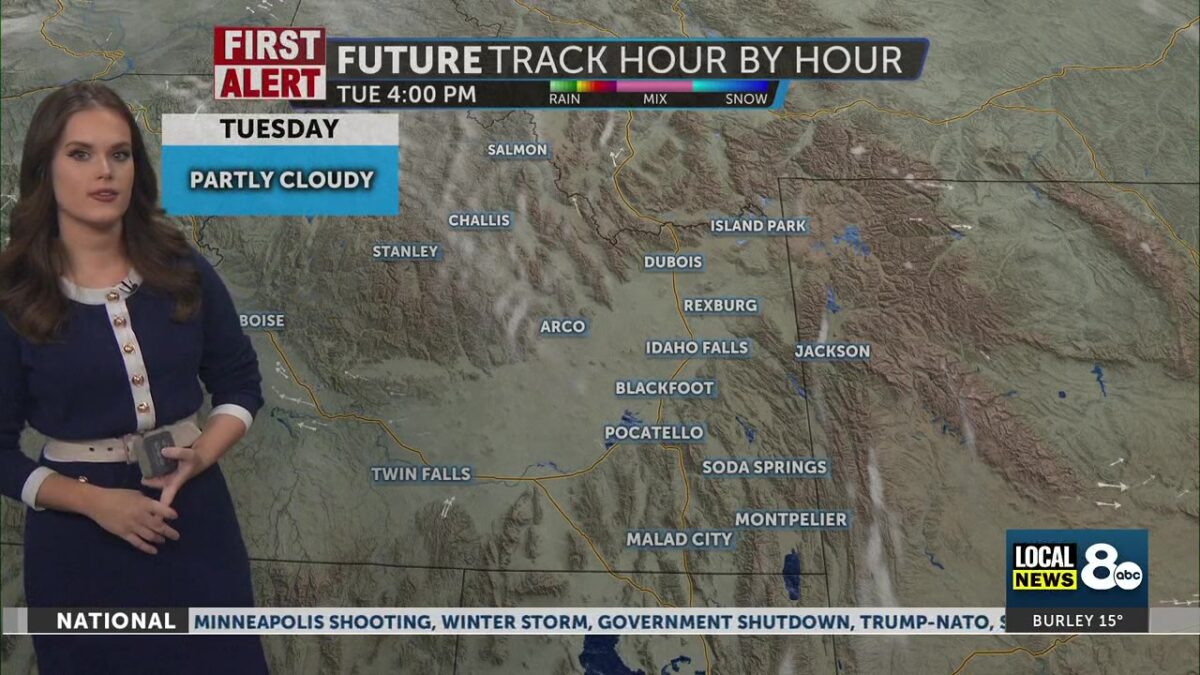
A slight chance of showers for Tuesday with more scattered rain and snow expected later this week

Michael Coats

Several disturbances roll through the region this week. We’re not expecting a ton of rain, but gusty conditions with a few scattered hit of rain and snow are possible.

Overnight. Partly cloudy, with a low around the lower 40’s. South southwest wind around 10 mph, with gusts as high as 20 mph.

For Tuesday, there is a slight chance of showers between 8am and 1pm. Cloudy, with a high temperature in the mid 50’s. Southwest winds around 15 to 20 mph, with gusts as high as 30 mph. The chance of precipitation is 20%. Cloudy for Tuesday night with an overnight low in the lower 40’s. South southwest winds around 10 mph becoming east after midnight. Winds could gust as high as 20 mph.

A sunny and breezy Wednesday with partly sunny skies. Winds from the southwest around 10 to 15 mph. Winds could gust as high as 25 mph. Stormy weather possible for Wednesday night with a chance of rain. A low temperature around 40°.

On Thursday, there is a chance of showers with breezy winds. High temperatures in the lower 50’s.

Click here to follow the original article.

Suspicious Death Investigation underway in Bannock County

Seth Ratliff

POCATELLO, Idaho (KIFI) — The Bannock County Sheriff’s Office has opened an investigation into the suspicious death of a young man following the discovery of his body Saturday morning, November 1st, on private property in Inkom, Idaho.

Details surrounding the discovery of the body, as well as the victim’s identity, have not yet been officially released. However, the victim’s grandfather, Ronald Diaz, shared Local News 8’s coverage of the investigation on Facebook with the caption “RIP Grandson Jonas Diaz.”

The grandfather’s posts have received an outpouring of words of comfort, condolences, and donations as the family grapples with Jonas’s passing.

The Bannock County Sheriff’s Office and the County Coroner’s Office have ordered an autopsy to officially determine the cause and manner of death.

In a news release, BCSO assured the public that there is no ongoing threat to the community and has requested patience as the investigation proceeds.

This is a developing news story. Local News 8 will provide more details as they become available.

Click here to follow the original article.