Minnesota State Fair removes anti-Trump crop art after artist allegedly receives threats

By Jason Rantala

Click here for updates on this story

    MINNEAPOLIS (WCCO) — Workers at the Minnesota State Fair removed a piece of crop art protesting President Trump over the weekend.

A spokesperson for the fair says the person who made the art asked to have it taken down.

The piece that was removed read “8647.”

The Merriam-Webster dictionary describes “86” as “slang meaning ‘to throw out’ or ‘get rid of,'” and Mr. Trump is the country’s 47th president.

Tyler Breuch watched the exhibit supervisor take down the “8647” crop art piece. He says according to that supervisor, the artist had received death threats over the work and had to leave the state.

“Over this piece, which just seems ludicrous that someone who misunderstands slang is threatening to kill somebody over dried beans,” said Breuch.

For Brenda Butler, a first-time artist, crop art is political.

“My piece is RBJ up on the wall, between Renee Good and AOC,” said Butler. “We’ve had a very political year. We Minnesotans are really proud of ourselves and the political action that we’ve had going on.”

Donni Torres, attending the fair from Deephaven, Minnesota, says the fair owes its visitors an explanation for the now missing art.

“Both sides are expressed here,” Torres said. “I think they should have put up a sign that said ‘removed at the artist’s request.'”

The Department of Justice indicted former FBI director James Comey for posting a picture on social media with “8647” made out of seashells. They claim it was a threat to kill the president. That case is set for trial this fall.

Please note: This story was provided to CNN Wire by an affiliate and does not contain original CNN reporting. This content carries a strict local market embargo. If you share the same market as the contributor of this article, you may not use it on any platform.


Detectives re-arrest man after skulls, Ed Gein shrine found in basement

By Stephen Cohn

Click here for updates on this story

    FOND DU LAC COUNTY, Wisconsin (WISN) — Fond du Lac County Sheriff’s detectives re-arrested Benjamin Larson on Monday, just days after police investigating a stalking case in the town of Taycheedah uncovered human remains, skulls, and a shrine to Wisconsin serial killer Ed Gein in Larson’s basement.

WISN 12 News has learned Larson was booked on three counts of receiving stolen property and one count of felony bail jumping. He has not yet been charged in Fond du Lac County.

According to a Dane County criminal stalking complaint by a Madison woman, officers in Larson’s house discovered a padlocked plywood room containing a bed and walls covered with “multiple framed images of nude females, skulls and skeletons.” The complaint also stated that shelves in the room held “five human skulls and one partial skull along with two large bones in the shape of a cross.”

He is not expected to appear in court until Wednesday.

Larson was free on $15,000 bail related to the stalking charge before being re-arrested on Monday.

Please note: This story was provided to CNN Wire by an affiliate and does not contain original CNN reporting. This content carries a strict local market embargo. If you share the same market as the contributor of this article, you may not use it on any platform.
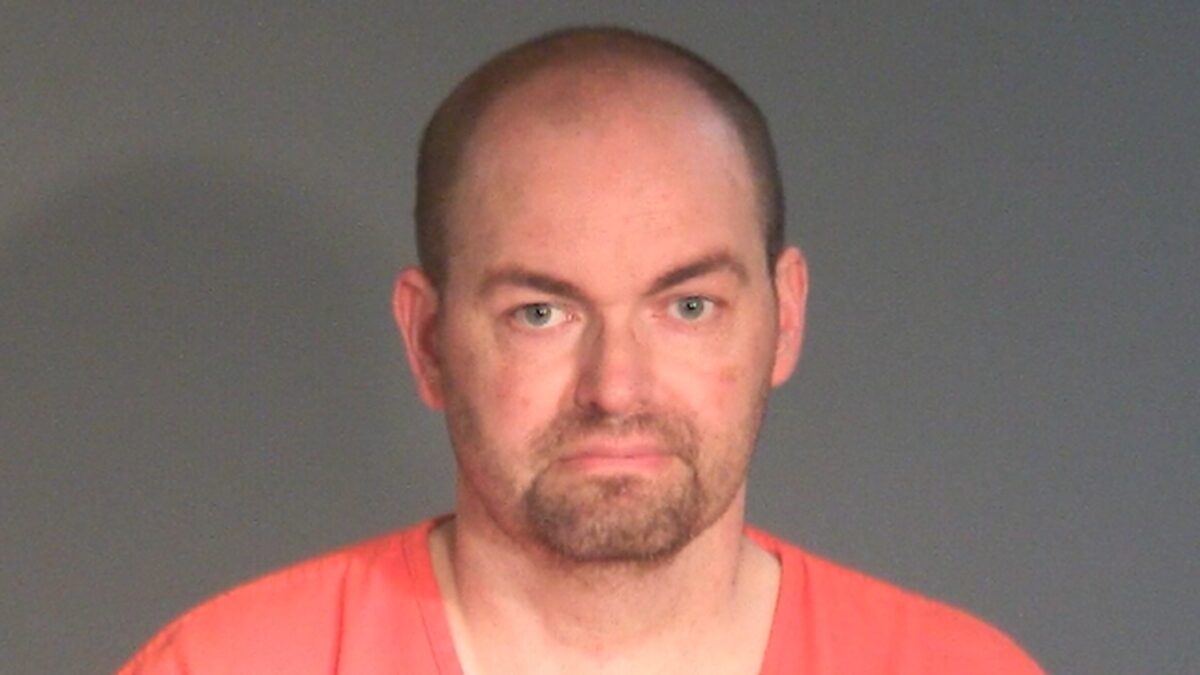
Woman attacked by otter while swimming in Lake Tahoe, receives nearly 40 stitches

By Brady Halbleib

Click here for updates on this story

    SACRAMENTO, California (KOVR) — An open-water swimmer says a routine morning swim in Lake Tahoe turned into a frightening encounter when an otter attacked her underwater.

Lynnette Bellin said she was swimming near Hidden Beach in Incline Village when something suddenly grabbed her leg and pulled her underwater.

“Something grabbed my leg and pulled me under,” Bellin said. “And it was so powerful I thought it was a human.”

The attack happened around 8 a.m. as Bellin was swimming in an area she regularly visits.

“I turned around and I saw this otter, and it immediately started lunging at me and biting and scratching,” Bellin said.

Bellin fought back with her hands and feet while trying to reach a nearby set of rocks.

“It was very painful,” she said. “Yeah, it was just ruthless. It just kept coming after me.”

The first rocks Bellin reached were too slippery for her to climb onto. She yelled for help but said no one responded.

She eventually made it to another set of rocks and was able to pull herself out of the water.

But the otter remained nearby.

“Once I got out and he stopped pursuing me, he kept circling the area,” Bellin said. “I could hear his heavy breathing. It was very menacing.”

Bellin eventually made her way back to the beach, where first responders treated her before she was taken to the hospital.

She received nearly 40 stitches and began a series of rabies vaccinations.

Experts say otter attacks are extremely rare Megan Isadore, executive director of the River Otter Ecology Project, said encounters between people and river otters rarely become violent.

“We don’t always expect an attack when it happens,” Isadore said.

She said one possible explanation is that Bellin may have unknowingly gotten too close to a mother otter and her young.

“They don’t know what we’re doing. They don’t know why we’re there,” Isadore said. “They can be frightened of us. They’re usually not after us.”

Bellin said she doesn’t blame the otter for what happened, but the experience has made her reconsider where she swims.

“It’s very disconcerting, but also I love Tahoe too much,” she said.

There’s also an unusual connection between Bellin and the animal that attacked her.

She’s an infant swim instructor and often uses a small otter toy while teaching children.

After the attack, she said she may be ready to retire the toy from her classes.

Please note: This story was provided to CNN Wire by an affiliate and does not contain original CNN reporting. This content carries a strict local market embargo. If you share the same market as the contributor of this article, you may not use it on any platform.
LMU digital archive tells stories of Angelenos who lost Chavez Ravine homes to make way for Dodger Stadium

By Laurie Perez

Click here for updates on this story

    LOS ANGELES, California (KCAL, KCBS) — A new digital archive from Loyola Marymount University is retelling the stories of the thousands of Angelenos who lost their Chavez Ravine homes to make way for Dodger Stadium.

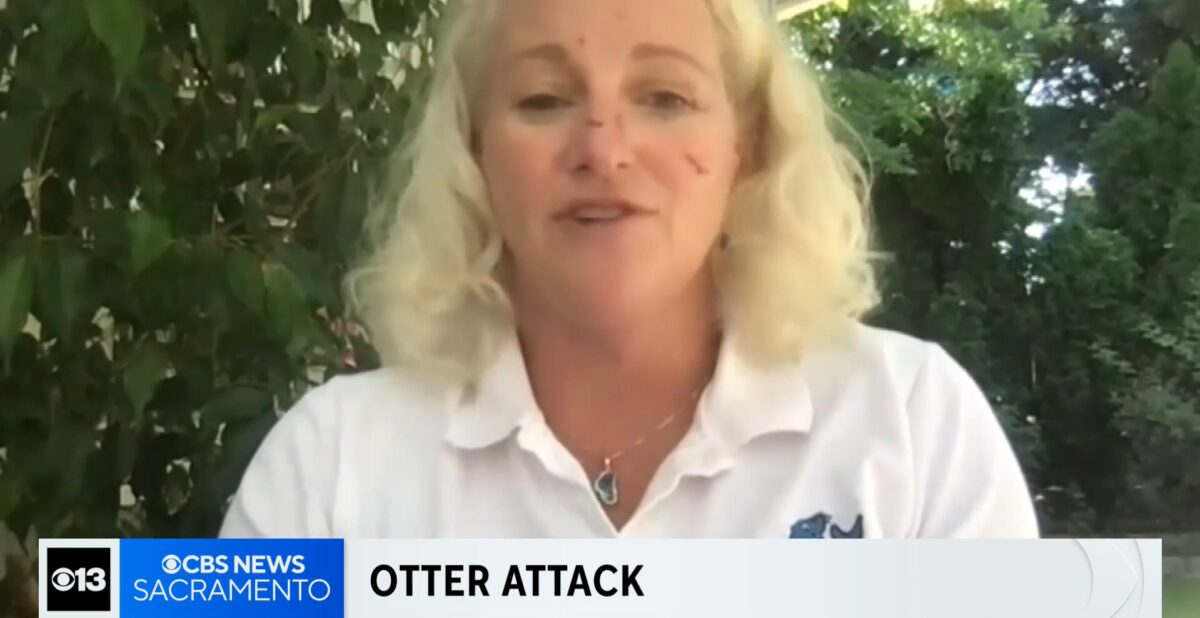
It’s been more than 70 years since Carol Jacques’ family lived in the area, and she still dreams of her childhood home. It once stood in the Palo Verde neighborhood, before they became some of the many who were pushed out for the development of the stadium in the 1950s.

“It was like living in a park, and it was pitch black, and we could see the stars, and the crickets would sing us to sleep,” Jacques said. “What we had, I think, that was very special that a lot of people don’t write about. We had a main street. We had a huge church that had a rectory for the priests, a place for the nuns, a place to have a lot of things.”

Jacques says that she and her family would walk up the hill after church to stop at the tienditas to pick up any necessities along the way.

“There was also kind of a camaraderie, because people would be watering or on their front porch and they’d say, ‘Buenos dias,'” Jacques recalled.

Now, her family’s story is just one of the many captured by LMU’s online archive that features interviews, photos and other documents from the largely Mexican-American community displaced by eminent domain so the ballpark could be developed.

The stories have been told before, but one large change is that they’re told directly by community members, and their stories and memories are protected by copyright, so no one else can profit like what’s happened in the past.

“Many people came, wrote stories about us, and then some of them came back and wanted to sell us books after we invited them in and introduced them to our neighbors,” Jacques said. “They were selling what we had given them.”

LMU Professor Priscilla Leiva co-founded the archive with Jacques, calling it a community-curated collection.

“It’s not about an academic or an archivist coming in and telling the story for them. They are the ones telling us what the captions on these photos should be; they are the ones giving us the information,” Leiva said.

So far, there are more than 200 pieces included in the collection. They said it’s just a fraction of what they’ve collected over the last 11 years. Leiva said that their research has revealed much more about the history of Chavez Ravine, beyond the removal of thousands of people, and just as important.

“This is a community of people who showed up in LA in the 1910s and 20s, literally built their own houses with permits, created thriving communities, weathered the Great Depression, served in the war, and then even after the removal, people like Carol became activists, other people became other types of change makers in the city,” Leiva said.

Jacques said that her family’s proud, but painful story is one of endurance that’s more relevant than ever.

“We have stories about how, you know, things were going on right here that were really very ugly, that people survived,” she said. “So, I think it’s important that we learn that. But I think it’s also really important that we learn from history, because a lot of these things are happening again.”

She said that while she doesn’t hold any resentment towards the Dodgers, with both of her sons being huge fans of the Boys in Blue, Jacques does wish for some sort of acknowledgement for the sacrifices that were made and the part they all played in bringing the team to Los Angeles.

“I think that the Dodgers are part of Los Angeles. We’re part of Los Angeles. It’s all a Los Angeles story,” Jacques said. “I wish that they would recognize the fact that we shared the land at one time, at least some recognition that we were there, because we are part of their story and they are part of our story.”

Please note: This story was provided to CNN Wire by an affiliate and does not contain original CNN reporting. This content carries a strict local market embargo. If you share the same market as the contributor of this article, you may not use it on any platform.
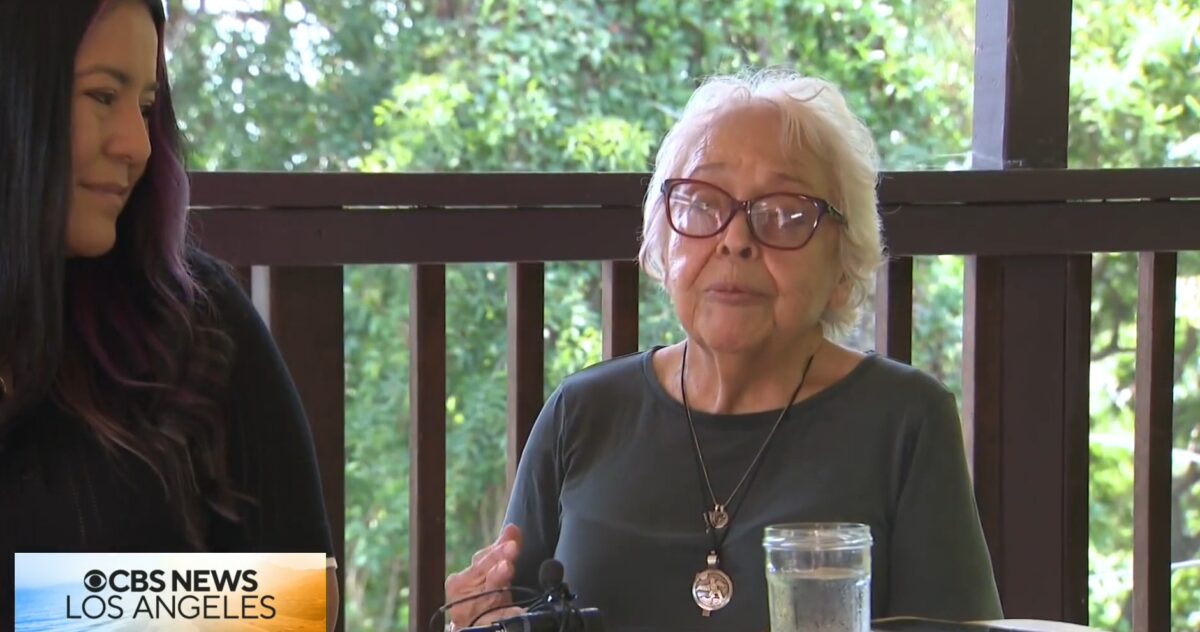
Woman accused of pointing Magnum revolver at victim, then claiming it was fake

By Daniel V. Ramirez

Click here for updates on this story

    IDAHO FALLS, Idaho (eastidahonews.com) — A dispute over the estate of a recently deceased person escalated when a woman allegedly threatened another woman with a Magnum revolver, leading to her arrest.

Suzan Mary-Elise Naughton, 65, of Idaho Falls, is facing one felony count of aggravated assault with a deadly weapon.

Details from a police booking affidavit state that on Aug. 25 around 12:50 p.m., officers with the Idaho Falls Police were dispatched after a caller had reported that a woman had pointed a firearm at her in the Park Place subdivision near South 5th West.

Once officers arrived at the residence, the victim told authorities she was there to help in settling the affairs of a deceased person who lived in the subdivision, when Naughton came out of the property with a gun in hand.

The victim said that Naughton used the firearm to tap her car’s window. A witness confirmed that the 65-year-old raised the gun and aimed it at the victim.

The documents state that the victim believed her life was being threatened.

Officers then spoke with Naughton, who said that the victim had come to the residence and had threatened her with a fight.

Naughton did admit to walking outside of the property with a gun, but claimed that it was “not real,” and that it was a replica. She also admitted to pointing the alleged fake gun at the victim after the victim told her she was going to “f*** her up.”

Officers asked Naughton if anyone who saw the incident could mistake the alleged fake gun for a real gun. She responded that the victim would.

Looking for the alleged fake gun, officers went into the property and found an antique flintlock-style firearm that was not a replica, but real. Naughton confirmed that it was a real firearm, and she was placed under arrest.

Talking with the victim and the witness, both of them reported that the gun used was not a flintlock, but a stainless steel revolver.

When officers asked Naughton about this claim, she told them that she would rather just go to jail if that is what the victim was telling them. She also denied having a stainless steel gun, but claimed anything she had was made of wood.

Naughton was taken and booked into the Bonneville County Jail in connection with the incident.

A search warrant was obtained and officers found a stainless steel .357 magnum revolver hidden underneath a bed.

The gun was shown to the victim, and the victim confirmed that this gun was the one used by Naughton.

A preliminary hearing is scheduled for Naughton before Magistrate Judge Michael Kirkham at 1 p.m. on Sept. 9.

According to Idaho’s Crime Repository, Naughton does not have an attorney assigned.

Though she has been charged with these crimes, it does not necessarily mean she committed them. Everyone is presumed innocent until they are proven guilty.

Please note: This story was provided to CNN Wire by an affiliate and does not contain original CNN reporting. This content carries a strict local market embargo. If you share the same market as the contributor of this article, you may not use it on any platform.
The vice president who came to eastern Idaho — then returned as president

By Rett Nelson

Click here for updates on this story

    IDAHO FALLS, Idaho (eastidahonews.com) — Vice President JD Vance’s recent visit to Jackson raised a historical question: Who was the first sitting vice president in modern times to visit eastern Idaho?

The answer takes us back more than 70 years — to Richard Nixon, who came to Pocatello and Idaho Falls in 1954 as vice president and returned 17 years later as president.

Vice President Nixon gave a speech in Pocatello in October 1954. The purpose of the trip, according to a 2016 report, was to campaign for Sen. Henry Dworshak, a Burley Republican seeking re-election during one of the most contentious political periods in Idaho history.

The backdrop was the Red Scare.

Idaho’s two Republican senators — Dworshak and Herman Welker — supported the fight against Communism. Welker, a Payette attorney, was closely aligned with Sen. Joe McCarthy of Wisconsin and became known as the “Little Joe from Idaho.”

By 1954, Welker had become one of the most aggressive voices in Idaho politics. His involvement in the campaign against Wyoming Sen. Lester Hunt — one of the darkest episodes associated with McCarthyism — would eventually contribute to his political downfall. But that was still ahead.

Dworshak’s political standing was different. A former newspaperman, he had served in the Senate since 1948 and had established himself as a conservative Republican. He was also seeking another six-year term against former Democratic Sen. Glen Taylor.

Taylor was a political lightning rod of his own.

He had served in the Senate from 1945 to 1951 and was one of Idaho’s most liberal senators. He had publicly criticized McCarthy and, during the 1950s, was repeatedly targeted by Republicans with accusations of Communist sympathies. Taylor had also been the Progressive Party’s vice presidential nominee in 1948 alongside former Vice President Henry Wallace, further cementing his reputation among Idaho Republicans as a left-wing politician.

Welker, who was not on the ballot in 1954, attacked Taylor as one of “the Communist Party’s most pathetic and willing dupes.”

Nixon joined the campaign, although his language was somewhat more measured. Speaking before a crowd of about 2,300 people in Pocatello, the vice president called Taylor “a dedicated left winger” and urged Idaho voters to return Dworshak to the Senate.

The strategy worked.

Dworshak defeated Taylor by a wide margin, winning 142,269 votes, or 62.8%, to Taylor’s 84,139 votes, or 37.2%, according to voting records.

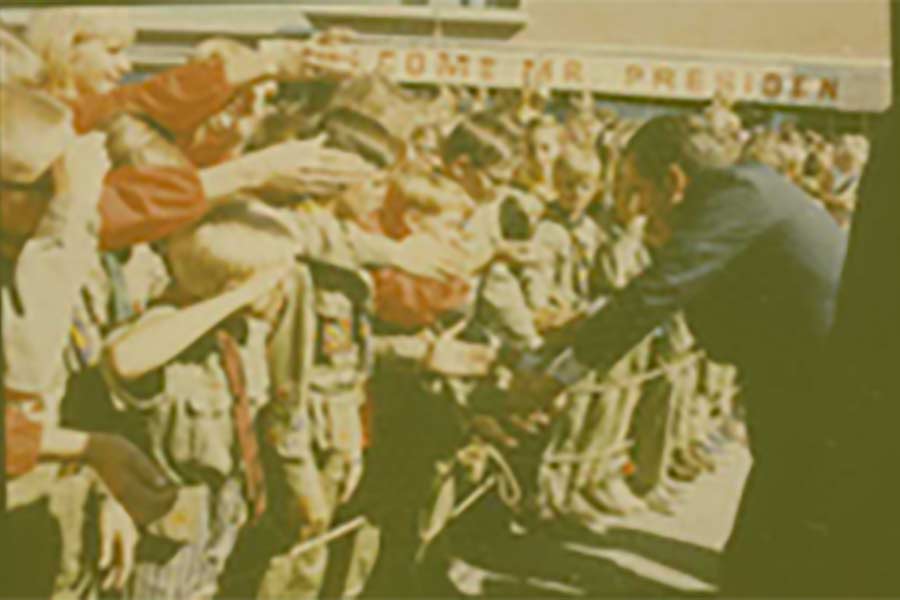
‘When I was here last time…’ Seventeen years later, on August 18, 1971, President Richard Nixon stood before an enthusiastic crowd at Fanning Field — what is now Idaho Falls Regional Airport.

It was one stop on a three-day cross-country trip, according to the daily diary from the Richard Nixon Presidential Library & Museum.

Historical records do not specify a specific purpose for the 1971 visit. Earlier that day during a stop in Springfield, Illinois, Nixon signed a bill that established Abraham Lincoln’s home as a national historic site. During his visit to Idaho Falls, he gave a brief address about America’s economic strength, Idaho’s agricultural economy, the qualities of the people who settled the West, and national unity and patriotism. His next stop on the trip out West was a visit to Grand Teton National Park.

During his remarks at Fanning Field, he referenced his previous visit. The second trip to Idaho Falls may have been tied to his familiarity with the area. It also could’ve been about political optics and public relations.

At 4:20 p.m., Air Force One landed at the Idaho Falls airport and Nixon was greeted by local, state, and Congressional delegates from both parties, a fact he noted in his remarks.

“I think it would be of very great interest to all of you … to meet some of the distinguished leaders from your State who are here, because I would like to have them stand up here … to show just what a bipartisan trip this is,” Nixon said to the crowd.

America’s 37th president introduced Gov. Cecil Andrus, U.S. Senator Frank Church, and Idaho Falls Mayor Eddie Pederson, all of whom were Democrats. He also recognized the Republican Congressmen — U.S. Senator Len Jordan and Rep. Orval Hansen. Also in attendance were Secretary of the Interior Rogers Morton and Nixon’s daughter, Julie Eisenhower.

“We will have a chance to shake hands with some of you after I have made a few brief remarks. But I would like for all of you to know that as I looked down from the airplane and saw those cars parked for miles around, I realized what a chore it had been for you to come to the airport. I realized, too, that some of you must have been standing here quite a while. I am indeed most grateful,” the president said.

Nixon noted the size of the crowd and recalled his visit to Idaho Falls as vice president years earlier.

“I don’t think, incidentally, the crowd was near this big. That shows you the difference between being Vice President and President,” Nixon said. “I remember it was snowing, very heavy snow. Does it still snow in October in this time?”

While flying in that day, Nixon said he noticed the beauty of the mountains, and told those in attendance they were “very fortunate to live … where the air is so clean, where the scenery is so beautiful.”

The president continued with a message about the qualities of the people who settled the west and the value of the country’s frontier heritage.

“As I looked down on this country, I realized what kind of people it took to come here. It had to be a rugged people; it had to be a strong people to come across those plains, to come up those mountains, and then to find this valley and develop this State — a strong people, a competitive people, a frontier people,” Nixon said.

“That is the kind of people that made Idaho,” the president added. “That is the kind of people that developed the West, and that is the kind of spirit that America needs today and that you are going to help give America, I am sure.”

Nixon spent time shaking people’s hands following his remarks, which you can see in the video above.

At 4:58 p.m., the president left Fanning Field by helicopter for Willow Flats Overlook in Grand Teton National Park. He spent the night in Jackson Hole with his daughter and members of his staff.

The next day, Nixon spent time around Jackson Lake, including boating with Julie Eisenhower and other members of his party, before departing for Dallas.

Nixon reportedly noted in his diary that he appreciated the warm reception of the crowd in Idaho Falls.

Before Nixon’s visit to eastern Idaho in 1954, the earliest known visit from a vice president was Theodore Roosevelt. He paid a visit to Rexburg while on the campaign trail in 1900.

Please note: This story was provided to CNN Wire by an affiliate and does not contain original CNN reporting. This content carries a strict local market embargo. If you share the same market as the contributor of this article, you may not use it on any platform.
DA Brian Middleton Drives Down Crime In Fort Bend County

By Burt Levine

Click here for updates on this story

    September 1, 2026 (Houston Style Magazine) — FORT BEND COUNTY, TEXAS — Democracy is ultimately judged close to home—not only at the ballot box, but on the streets where families live, businesses invest and citizens expect the justice system to work fairly. In Fort Bend County, District Attorney Brian Middleton is making the case that public safety, civil rights and accountable government do not have to compete with one another.

Middleton, elected in 2018 and sworn into office in 2019, made history as Fort Bend County’s first African American district attorney, a milestone officially recognized by Fort Bend County. Today, he also serves as 2026 president of the Texas District and County Attorneys Association, representing prosecutors across Texas.

At his annual State of Criminal Justice panel on Friday, August 28, Middleton gathered leaders from nine law-enforcement agencies to discuss coordinated crime suppression and what he described as measurable gains in public safety.

“For the past eight years, I’ve delivered on my pledge to strengthen the justice system in Fort Bend County,” Middleton told attendees, crediting Sheriff Eric Fagan, municipal police departments, county officials and prosecutors with helping build what he called a safer, fairer and stronger system.

And this is no small county anymore.

Fort Bend’s population has grown from 225,421 residents in 1990 to an estimated 975,191 in 2025—more than quadrupling in 35 years. The Census Bureau says the county grew another 18.3 percent just between 2020 and 2025.

Growth that fast can test everything from highways to courtrooms. Yet Middleton said figures presented during the panel show crimes against people declining 9.4 percent and property crime falling 15.9 percent. He also cited a 2025 violent-crime rate of approximately 1.34 incidents per 1,000 residents, saying it compared favorably with other counties across the Houston region.

photo

The formula, he said, comes down to three T’s: technology, teamwork and tenacity.

But Middleton’s public-safety philosophy extends beyond prosecution numbers. His office created Fort Bend County’s Public Integrity Division in 2019 to investigate alleged criminal wrongdoing involving government officials and employees. That unit later expanded its work to include pandemic-relief fraud.

That matters in a democracy. The power to prosecute is extraordinary power, and public confidence depends upon citizens believing that the rules apply to everyone—including the people entrusted with enforcing them.

Fort Bend also presents a uniquely American challenge and opportunity: governing one of the nation’s most diverse major counties. Census estimates put the population at roughly 25.4 percent Hispanic or Latino, 23.9 percent Asian and 22.5 percent Black, with only 26.4 percent identifying as non-Hispanic White.

Middleton’s own path reflects Houston-area history. A Lamar High School graduate, University of Houston alumnus and honors graduate of Texas Southern University’s Thurgood Marshall School of Law, he previously served as a Fort Bend assistant district attorney, municipal prosecutor, judge, private attorney and law professor.

He has also earned peace-officer certification—an unusual credential for an elected district attorney—giving him experience from both sides of the badge.

The larger story, however, belongs to Fort Bend County itself: nearly one million people of different races, cultures and backgrounds sharing neighborhoods, schools, businesses—and one justice system.

That experiment works best when citizens participate.

The November 3, 2026 General Election is approaching. The voter-registration deadline is Monday, October 5; early voting runs October 19 through October 30; and Election Day is Tuesday, November 3.

Houston Style Magazine encourages every eligible citizen—regardless of party—to get informed, verify registration and vote. Because democracy is strongest when justice is accountable, communities are safe—and everybody has a voice.

Fort Bend County District Attorney’s Office Texas My Voter Portal — Check Your Registration Official Texas Voting Information — VoteTexas.gov

Please note: This story was provided to CNN Wire by an affiliate and does not contain original CNN reporting. This content carries a strict local market embargo. If you share the same market as the contributor of this article, you may not use it on any platform.
Kierra Lee
KIELEESTYLE@GMAIL.COM
3465287733

Lindsay Clancy trial jury “unable to come to a unanimous decision,” but judge tells them to keep deliberating

By Mike Toole, Matt Schooley, Kristina Rex

Click here for updates on this story

    BOSTON (WBZ) — The jury in Lindsay Clancy’s murder trial is deadlocked, they told a judge after entering their fourth day of deliberations Tuesday in Massachusetts.

They met for less than an hour to start the morning and then had a question for Plymouth Superior Court Judge William Sullivan just after 10 a.m.

“After many hours of deliberation, we are unable to come to a unanimous decision,” Sullivan said as he read the note from the jury in court.

He sent them back to continue their deliberations in private.

According to WBZ-TV’s Kristina Rex, who was in the courtroom, there were no noticeable reactions to the deadlocked jury from Clancy or her family. Rex reported that Clancy’s attorney, Kevin Reddington, had whispered to them before the announcement so they presumably knew what was coming.

The jury of nine women and three men has deliberated for about 18 hours since they were given the case last Thursday in Plymouth Superior Court.

Clancy, 36, has pleaded not guilty to first-degree murder in the deaths of her three children, Cora, 5, Dawson, 3, and Callan, 8 months, in their Duxbury home on Jan. 24, 2023.

Reddington said she was not criminally responsible because she was overmedicated and suffering from postpartum psychosis. Prosecutors said Clancy planned the killings and knew right from wrong when she strangled the children.

The jury heard testimony from 85 witnesses and they’re also looking at more than 200 pieces of evidence.

If they come back deadlocked again, Judge Sullivan will meet with the attorneys from both sides and then read what are called the “Tuey-Rodriguez” instructions to the jury.

In Massachusetts, this is a last resort instruction aimed at getting the jurors to reach a verdict. This instruction, also known as the “dynamite charge,” happened in Karen Read’s first trial in 2024.

If the jury comes back deadlocked a third time, a mistrial will be declared.

“If a mistrial is in fact declared, the prosecution then needs to make a decision about whether or not they re-try Lindsay Clancy again,” said WBZ-TV legal analyst Jennifer Roman.

In Read’s case, she was re-tried.

“The prosecution would have the ability to do that same thing here with Lindsay Clancy’s case. There’s no double jeopardy because she’s never been convicted of anything. That’s what allows the prosecution to re-try the same case again,” Roman said.

“If it ends up being a hung jury and the prosecution decides to re-try the case, I think they’re going to present their case a little bit differently from the get go with the hopes for a different result at the end of a second trial.”

“The judge will give the jury as much time as they need, but the jury has signaled to us they are reaching the end of their deliberations,” Roman said Tuesday.

“This jury just doesn’t seem to have another 20 hours left in them, for example. So, I suspect we’ll hear something again from the jury before the end of this day.”

If Clancy is convicted of first-degree murder, second-degree murder, or manslaughter, she will go to prison. If jurors find her not guilty by reason of insanity, she will be required to continue her stay at Tewksbury State Hospital, where her case will be reviewed periodically.

“I just have really strong faith in them that they’re so attentive, so diligent, so hard working. I think they really listened to the judge and his instructions,” Reddington told reporters as he entered court Tuesday.

Please note: This story was provided to CNN Wire by an affiliate and does not contain original CNN reporting. This content carries a strict local market embargo. If you share the same market as the contributor of this article, you may not use it on any platform.

Teen mother wanted in newborn’s murder near Moss Landing; her father accused of incest

By Felix Cortez

Click here for updates on this story

    MONTEREY COUNTY, California (KSBW) — The Monterey County Sheriff’s Office is investigating a case involving a 14-year-old girl accused of murdering her newborn baby, who was found dead on the side of a road near Moss Landing on Aug. 1, and her father, who is wanted for incest and lewd acts on a minor.

Monterey County Sheriff’s Office officials confirmed that Sergio Galves Perez, 38, is the biological father of both the 14-year-old suspect and the deceased newborn, who investigators have named Angelito.

“We can now confirm that Sergio Galves Perez is the biological father of the 14-year-old murder suspect and the biological father of baby Angelito,” Sheriff Tina Nieto said.

Investigators said the newborn, who still had its umbilical cord attached, showed signs of trauma. Perez is believed to be on the run with his daughter, and authorities are seeking public assistance to locate them.

“We just need the public’s help to locate the 14-year-old so we can get her to safety and then listen to her side of the story,” Nieto said. “And we need to locate Mr. Perez, because in my opinion, he’s a serious felon offender, a parent who betrayed everything, every piece of trust that a child puts in their parent.”

A breakthrough in the case came when Flock cameras identified a car associated with the investigation.

The vehicle, registered to Perez and his wife, Ofelia Garcia Ortega, was located. Ortega has been arrested and charged with child endangerment.

“I can say without that information we received from that camera, we may have never solved that case,” said Monterey County Sheriff’s Office spokesperson Eric Bixler. “So that was very instrumental in solving this case, especially the speed in which it was done. Without it, it may have taken years or never.”

Authorities believe the 14-year-old girl may be in danger while on the run with her father, who allegedly impregnated her when she was 13 years old.

“I believe the 14-year-old might be in danger. That’s my gut feeling as a sheriff,” Nieto said. “She’s 14, for God’s sake. She’s 14. She’s a victim, too, even though she’s a suspect.”

Investigators have not disclosed details about how they determined the teen mother’s alleged involvement in the murder.

Perez remains wanted for incest and lewd acts on a minor.

Anyone with information about their whereabouts is urged to contact the Monterey County Sheriff’s Office.

Please note: This story was provided to CNN Wire by an affiliate and does not contain original CNN reporting. This content carries a strict local market embargo. If you share the same market as the contributor of this article, you may not use it on any platform.

Train blockages in Calera fuel frustration as city leaders push for $32 million bridge project

By Lisa Crane

Click here for updates on this story

    CALERA, Alabama (WVTM) — Frustration is growing among drivers and emergency responders in Calera, where stopped trains regularly block major roads and create lengthy delays. A train blocked Highway 25 for nearly four hours last Thursday. According to the Calera Police Department, that blockage created significant traffic backups.

Police Chief David Hyche said it also affected the department’s ability to respond to emergency calls. “I don’t like it when we can’t respond,” Hyche said. “We were very, very lucky” that no serious medical emergency or major police incident occurred during the delay.

Train blockages have affected Calera for decades. City leaders are now working with the railroad, state officials and federal leaders on a proposed bridge over the tracks that would allow traffic to continue moving even when a train is stopped. The project is estimated to cost $32 million.

Calera Mayor Kenny Cost said progress has been repeatedly delayed. “It just keeps getting pushed and pushed and pushed,” Cost said. “We can’t keep pushing this. This has got to happen for our citizens.”

The Alabama Department of Transportation released this statement about its commitment to the project saying, “This is a worthwhile project, and we hope it can be completed. However, the project remains in the developmental phase. With a new administration taking office in a matter of months, we do not have the authority to bind that administration to a $10 million funding commitment for a project that is not yet ready to move forward.”

City leaders say joint infrastructure projects can take years to complete. Even if funding were secured immediately, they say construction of the bridge would still likely take several years. Hyche said the impact extends beyond Calera, affecting central Alabama drivers and traffic along Interstate 65. “I want our political leaders to understand how serious this is,” Hyche said. “This is a huge effect on all of central Alabama and Interstate 65 traffic as well.”

City officials said they are continuing to work with their partners to move the bridge project forward, warning that a future train blockage could create consequences far more serious than traffic delays.

Please note: This story was provided to CNN Wire by an affiliate and does not contain original CNN reporting. This content carries a strict local market embargo. If you share the same market as the contributor of this article, you may not use it on any platform.