ABC-7 Xtra Investigation: Can the City of El Paso collect debt from Trump campaign rally without this key document?

Lesley Engle
EL PASO, Texas (KVIA) — Seven years after thousands crowded the El Paso County Coliseum to see then-President Donald Trump campaign for re-election, the El Paso City Council has renewed its efforts to collect on a half-million-dollar bill for services related to the rally.
However, collecting payments may be more complex than they thought.
Records obtained by ABC-7 reveal that the City of El Paso did not discuss costs with President Trump’s campaign prior to his 2019 rally. The finding comes despite ongoing discussions among city leaders and elected officials about the $569,204.63 the city says the campaign still owes it.
At a March council meeting, District 7 Representative Lily Limon requested an update on the outstanding Trump campaign debt and called for quarterly reports.
Following that meeting, ABC-7 filed an open records request to determine whether any cost discussions or agreements existed before the February 11, 2019, rally.
We reviewed the records the city sent, which did not show any discussions with the campaign, including cost estimates, quotes, draft agreements, or contracts, prior to the rally. ABC-7 found the city still does not have a formal cost-recovery plan in place for events such as political campaign rallies.
“You cannot make people pay for things after the fact,” Carliss Chatman said. “If the city didn’t anticipate it, the city assumed the risk.”
Carliss Chatman, a professor of law at the SMU Dedman School of Law, told ABC-7 that many cities fail to account for the scale of political events beyond basic venue rental fees. When a city provides services without a contract, the law may view the work as a “gift” or an “accord and satisfaction,” leaving the municipality responsible for the expenses.
“It’s disappointing because we went into that and now we’re suffering the consequences,” Rep. Limon said. “But the good thing is it may lead to change. Those are important questions to ask—were we prepared, were we ready? I think we’ll be smarter moving forward.”
The bill the Trump campaign did pay
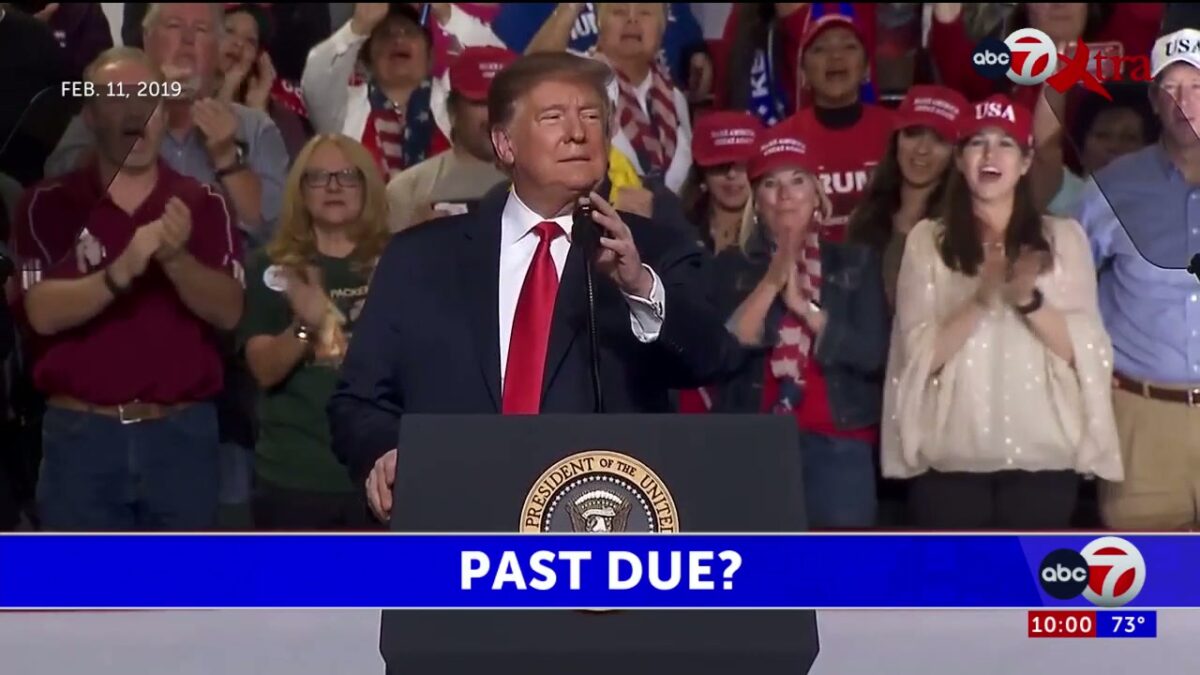
Donald Trump announced his visit to El Paso on February 6, 2019, just five days before the rally. His “Make America Great Again” event filled every seat available inside the El Paso County Coliseum, with thousands more gathered outside.
Records show the campaign paid a $5,000 rental fee and an additional $1,000 non-refundable deposit for the Coliseum, and ABC-7 obtained a copy of the wire transfer confirming the payment.
“I think that the one really critical person in this Trump visit was Brian Kennedy. He was the president of the Sports Commission, who, pretty much four hours before, said ‘hey if we don’t get payment by such a time your event is cancelled,’” Representative Lily Limon said.
Kennedy told ABC-7 he negotiated a contract in advance with the Trump campaign. Under that agreement, the campaign was required to pay before Trump stepped on stage. The commission, which manages the Coliseum for El Paso County, also required the campaign to cover all venue-related expenses.
No agreement with the City of El Paso
A day after the Feb. 11 rally, city officials confirmed to ABC-7, in response to the station’s inquiry, that taxpayer resources were used to support the event. At the time, officials said costs were still being calculated and would be billed to the campaign once finalized.
The city billed Trump’s campaign more than $470,000 a month after the event, according to city records obtained by ABC-7 at the time. A one-time 21% delinquency fee later increased the total bill to nearly $570,000.
Records show reimbursements covered a range of costs, including equipment, personnel and services such as security, cleanup, setup and logistics.
According to City of El Paso billing records for the rally, the police department incurred the highest costs at $380,942.12, followed by the fire department at $60,630.84, Sun Metro at $15,577.52, Streets and Maintenance at $6,452, the Department of Aviation at $6,286.57 and the Health Department at $528.
Security alone drew 476 officers from the El Paso and Anthony police departments and the El Paso and Socorro independent school districts, according to the itemized bill reviewed by ABC-7. That was in addition to El Paso County sheriff’s deputies and Secret Service personnel.
ABC-7 asked to interview City Manager Dionne Mack and City Attorney Karla Nieman to walk us through the bill, explain how the city develops cost estimates for larger events, discuss how it plans to collect payment without an agreement, and any plans to create a policy to guide future event planning.
City spokeswoman Laura Cruz-Acosta declined, saying there were no new developments to warrant additional interviews. “You’re welcome to reference prior interviews and KVIA’s previous coverage as the most current information available,” she wrote in an email.
City Representative Limon told ABC-7 she was not aware that the city had no prior agreements or documented discussions with the Trump campaign when asked. She described efforts to collect the outstanding amount as “uphill” but worth pursuing.
She said she placed the issue on the March 3 agenda to ensure the debt is not forgotten, and questioned why such a large amount of money has been left unpaid, comparing it to unpaid traffic violations or parking meter fees that are always collected.
Chatman, the SMU professor who specializes in contract law, corporate governance, legal ethics, and fiduciary duties, said when cities host large rallies, they must look beyond simple venue rentals to consider the costs of additional security and the size of expected crowds.
“The first is just a contract with the terms between the city or the county, whatever municipality is hosting and the organization that is hosting the rally,” Chatman said.
Chatman says contracts for these events typically include provisions for police support that go beyond everyday operations, including the cost of closing or barricading roads to manage traffic.
Chatman said some cities include clauses that allow them to charge more if the scale of the event exceeds what was originally anticipated. She said without those written terms, a city may have no legal mechanism to recover those costs.
El Paso does not have a formal policy for recouping costs associated with large campaign events like Trump’s in 2019, according to city spokesperson Laura Cruz-Acosta.
“So, there is no formal policy that is in place as it relates to it, but we do have procedures and forms that are filled out for special events, for example.” She said the city has a special events form where people can describe the event’s footprint and whether there will be a need for street closures for things like parades.
“So, there’s really no one-size-fits-all when it comes to the process, but at the very minimum there’s a starting point in terms of filling out a form in order to capture all of the details and information related to that kind of special event,” Cruz-Acosta said.
Cruz-Acosta said creating a formal policy for campaign events would require City Council action. She noted the council hired the Law Offices of Snapper L. Carr, which was in November of 2022, according to city records. We asked Cruz-Acosta how much it cost to hire the Austin-based law firm, which also serves as the city’s lobbying group during Texas legislative sessions, and she said an open records request would be required.
According to the records we obtained through our request, the city hired the firm on a contingency basis—meaning the law firm is paid only if it recovers money on the city’s behalf.
Limon believes cities need to become “smarter” about securing payment for services. She noted that providing services for campaigns is a “tremendous drain on public service,” particularly on first responders. She said if the $570,000 were recovered, it would directly benefit departments, which she said are often in need of funding.
Limon stressed the need for a clear policy outlining expectations for campaigns.
“We can’t just say, ‘well, welcome to the city and we’ll be there, we’ll protect you, um, we’ll close roads, we’ll do whatever is necessary, and then afterwards we’re going to send you a bill and we hope that you’ll pay for it,'” Limon explained. She affirmed the city’s responsibility to offer protection but asserted that entities using city services should pay for them, regardless of the campaign. “It’s — You have received a service from this city, and you should be paying for that service that you received. Whether it’s Bernie Sanders, whether it’s Donald Trump, it doesn’t matter who it is,” Limon said.
Professor Chatman said large cities often have standardized protocols and checklists in place for event permits to ensure every host is treated the same regardless of their political affiliation. Chatman noted that smaller cities may lack these procedures because they do not regularly host large-scale events.
“Best practices are to have checklists and standards and protocols in place so that you eliminate human error and human judgment and human bias. That’s what you want to do,” Chatman said.
Chatman recommended that municipalities use a “360 approach” for future event planning, including evaluating the profile of speakers, the potential for counter-protests and the total burden on city resources.
“Once it happens the first time and you see what a burden it is on a city budget, then you have to put protocols in place and have best practices for hosting these sorts of events,” Chatman said.
In Tucson, Arizona, the city declined to pursue about $80,000 in public safety costs from a 2016 Trump rally and about $40,000 from a Bernie Sanders rally that same year, concluding legal action would cost more, Andy Squire, public information officer in the City Manager’s Office, told ABC-7. When Trump returned in September of that same year, however, the city required his campaign to prepay estimated public safety and facility rental costs—a total of $145,222, including nearly $116,000 for police.
“In the end it came down to modifying the language in the facility use agreements at the Tucson Convention Center, which is city owned and operated under contract with Legends Global,” Squire said in an email response to ABC-7.
ABC-7 reached out to the Republican National Committee seeking comment on the costs related to President Trump’s campaign rally in El Paso. A former campaign official said, “All questions related to local law enforcement and first responder costs we defer to the U.S. Secret Service.”
A Secret Service spokesperson told ABC-7 that the agency coordinates security planning with local law enforcement partners but “currently lacks a mechanism to reimburse local governments for their support during protective events.”
The spokesperson added that the agency will continue working with Congress to seek resources for state, county, and city law enforcement agencies assisting in security operations.