Meta suggests total shutdown in New Mexico

By Peyton Spellacy
Click here for updates on this story
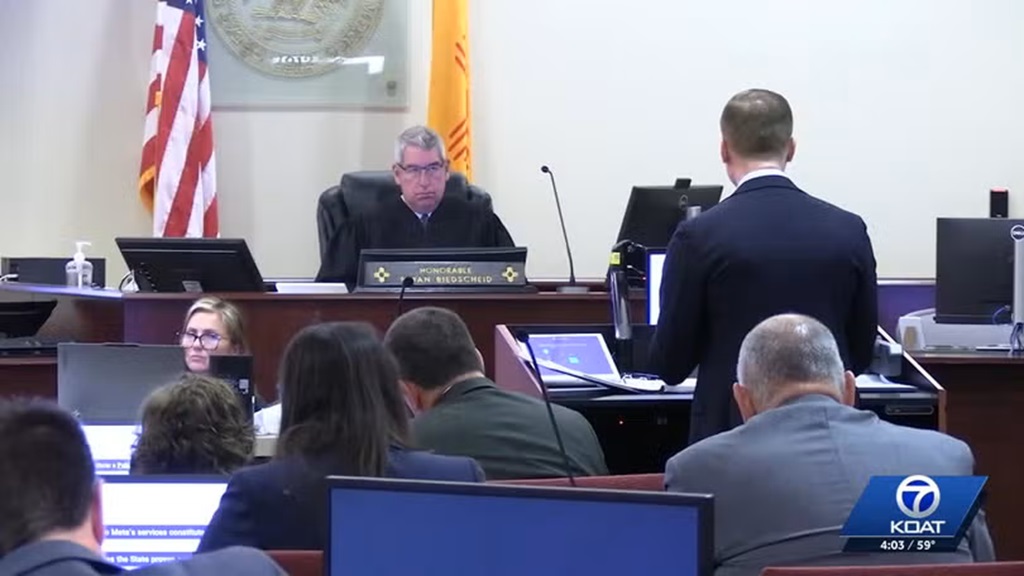
SANTA FE, New Mexico (KOAT) — The trial between the State of New Mexico and Meta moved into its second phase this week as the court begins to determine what operational changes the tech giant must implement. Following a March decision where a jury ordered Meta to pay a $375 million financial penalty, the current bench trial leaves the final decision on future regulations to the judge.
Meta, the parent company of Facebook, Instagram, and WhatsApp, has suggested it may stop operating within New Mexico if the judge approves a seven-page list of demands submitted by the state. The company characterized the state’s demands as over the top, arguing the restrictions would require them to develop a completely new version of their platforms that would be exclusive to New Mexico users. Court filings indicate Meta has mentioned this potential exit 38 times.
“If granted in full, would genuinely make it untenable to continue offering menace products in this state,” said Alex Parkinson, a Meta attorney. “I am telling you that as an officer of the court who understands my client’s position, this is not a PR stunt. It is not a threat. It is the reality of the seven-page relief plan.”
New Mexico Attorney General Raul Torrez addressed the claim, stating that any decision to leave the state rests with the company. “They can make a different choice,” Torrez said. “The choice, instead of leaving the state of New Mexico, is to listen to the state of New Mexico, to listen to our citizens, to listen to the jury and respect what they have said about the law.”
Academic experts from the University of New Mexico and New Mexico State University expressed skepticism regarding the likelihood of a complete shutdown.
Dr. Jagdish Khubchandani, an NMSU professor of public health, said, “There’s nothing to freak about or can be concerned about for, especially, businesses and others who use monetization apps.”
Gabe Gomez, Managing Director of Marketing and Communications at UNM, noted that the cost of compliance and engineering changes makes a total exit less realistic. He questioned the strategy of reducing the company’s reach.
“You’re shrinking your audience, right?” Gomez said, “I don’t think it’s necessarily an idle threat.”
Experts noted that Meta has utilized similar tactics globally when facing government pressure in the European Union and Brazil. “That’s always been their practice,” Khubchandani said. “They threaten shutdowns and such, which they have done worldwide, fighting with governments.” He noted that while Meta often takes an initial stand against compliance, they have eventually compromised in other regions. “Was it easy for the EU, Australia, and UK to get these things done? No, Meta always took a stand that we are not complying. And then eventually they compromised,” Khubchandani said.
Torrez pointed to international examples where social media regulations are already in effect.
“Australia has banned social media for anyone under the age of 16. What does that mean? It means they’re already working on age verification. They’re just not doing it in America,” Torrez said.
Khubchandani questioned why these global changes are not being applied locally, saying, “They are making changes in different parts of the world, almost more than two dozen countries. So my question is, why cannot they make these changes here in the United States?”
Meta maintains that the New Mexico requirements are uniquely burdensome. “The state is asking you to develop, from scratch, a completely new regulatory regime that far exceeds anything in Europe, in Australia, anywhere. And frankly, and we don’t say this lightly,” Parkinson said.
If Meta were to cease operations in New Mexico, experts suggest the impact would be felt through technical friction rather than a total loss of access. “If anything actually changed, it wouldn’t feel like a blackout, but more like friction, right?” Gomez said. “So you’d still get in, there’s VPN, there’s mobile networks, there’s platform workarounds.”
However, Gomez warned that such a move would lead to login disruptions, degraded features, and inconsistent advertising. “Then, eventually, the local information would thin out. With that, a lot of trust, erosion, and all kinds of other things,” he said.
The potential disruption could have significant consequences for the local economy. “Think about how many businesses are using these services and how much trouble they would have to face, even with a short outage,” Khubchandani said.
Gomez noted the vulnerability of local businesses that rely heavily on the platforms for growth.
“They’ve built their growth on rented land, if you will, and now the landlord’s making noise, right?” Gomez said.
Please note: This story was provided to CNN Wire by an affiliate and does not contain original CNN reporting. This content carries a strict local market embargo. If you share the same market as the contributor of this article, you may not use it on any platform.