Income tax elimination bill goes back to the Missouri House after Senate amendment

Alison Patton
JEFFERSON CITY, Mo. (KMIZ)
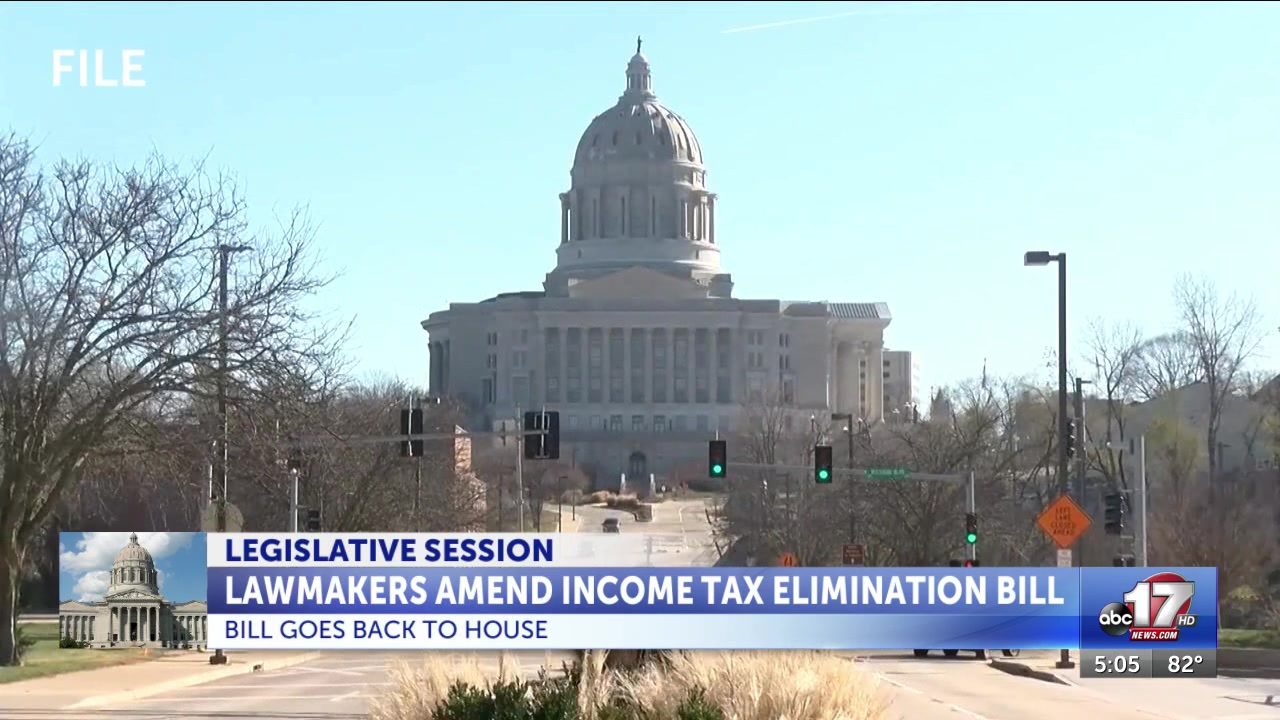
Missouri senators stayed late Wednesday to pass a new amendment to the income tax elimination plan and sent it back to the House just after midnight.
The Missouri Senate GOP posted on Facebook at 11:30 p.m. on Wednesday, letting people know House Joint Resolutions 173 and 174 were on the Senate floor, and another update just after 12:30 a.m. stating they had passed.
Senators approved the income tax elimination plan 18-11, with Republican Sens. Lincoln Hough, Mike Moon and Joe Nicola voting against the new amendment. The amendment would get rid of the automatic triggers in the House version, allowing the 2027 General Assembly the ability to impose triggers they see necessary.
Republican Gov. Mike Kehoe showed his support for the advancement of his top legislative priority on social media Thursday morning.
“Following its passage in the Missouri Senate last night, HJR 173/174 now returns to the House — moving us one step closer to putting the future of modernizing our tax code where it belongs: in the hands of Missouri voters,” Kehoe wrote on Facebook.
Nicola, of Grain Valley, spoke to reporters about his decision to vote against the bill.
“I didn’t like how the process was handled last night,” Nicola said. “I’d love to see taxes go away. As many taxes as we possibly can get it. I would love it. But I’m very concerned about this process and even the process of how the bill came to the floor.”
He said he felt like the process was rushed, and the bill could have gone on the Senate floor at any time, instead of voting and debating it after the public had left the Capitol for the day.
The version introduced and passed by the House would establish a loose framework for next year’s lawmakers to work under. One of those frameworks was the trigger system, which would slowly phase out the income tax while expanding the sales and use tax base.
Sen. Curtis Trent (R-Greene County) said his amendment wouldn’t get rid of the trigger system, but it would loosen the requirements for triggers.
“While it would still be great policy to eliminate the income tax 30 years from now or 50 years from now, much of the benefit that we’re going to derive from this policy economically would not occur on a time frame that would be meaningful to the public,” Trent said.
Senate Minority Leader Doug Beck (D-St. Louis County) said after Wednesday’s 12-hour-long session, Democrats didn’t debate much and relied heavily on their interactions with constituents, as it will ultimately be the voters’ decision.
“We’ve been working on this for a while, and at the end of the day, this was the governor’s priority, and at the end of the day, we didn’t have enough Republicans, anti-tax, Republicans to defeat this bill,” Beck said.
The amended bill will need to be reviewed and discussed by the House. If passed out of the legislature, voters will be asked in November if they want lawmakers to proceed with eliminating the state income tax.
House minority leader Ashley Aune (D-Kansas City) said Democrats on the other side of the building are fighting against the bill.
“I was surprised that I didn’t see more robust opposition or serious filibuster effort from the Senate Democrats,” Aune said. “I can’t imagine a scenario where I would ask my caucus to sit down on that. I would fight to the very end. We have been fighting. We’ve been screaming on this side of the building.”
Aune also said her caucus has been talking with voters.