Santa Maria Police Begin ‘Blue Envelope’ Initiative For Autism Awareness Month

Jarrod Zinn
SANTA MARIA, Calif. (KEYT) – The Santa Maria Police Department is participating in the “Blue Envelope” program, highlighting it for Autism Awareness Month.
Support organizations have been thrilled to hear it.
The nicknamed “Blue Envelope” program started in Connecticut during 2020 and it has spread across the country since then.
It’s aimed at improving communication between officers of law enforcement and people on the autism spectrum.
“We’ve had nothing but positive, feedback from community members from other departments, other entities,” says Santa Maria Police Department’s Sgt. Oscar Corral.
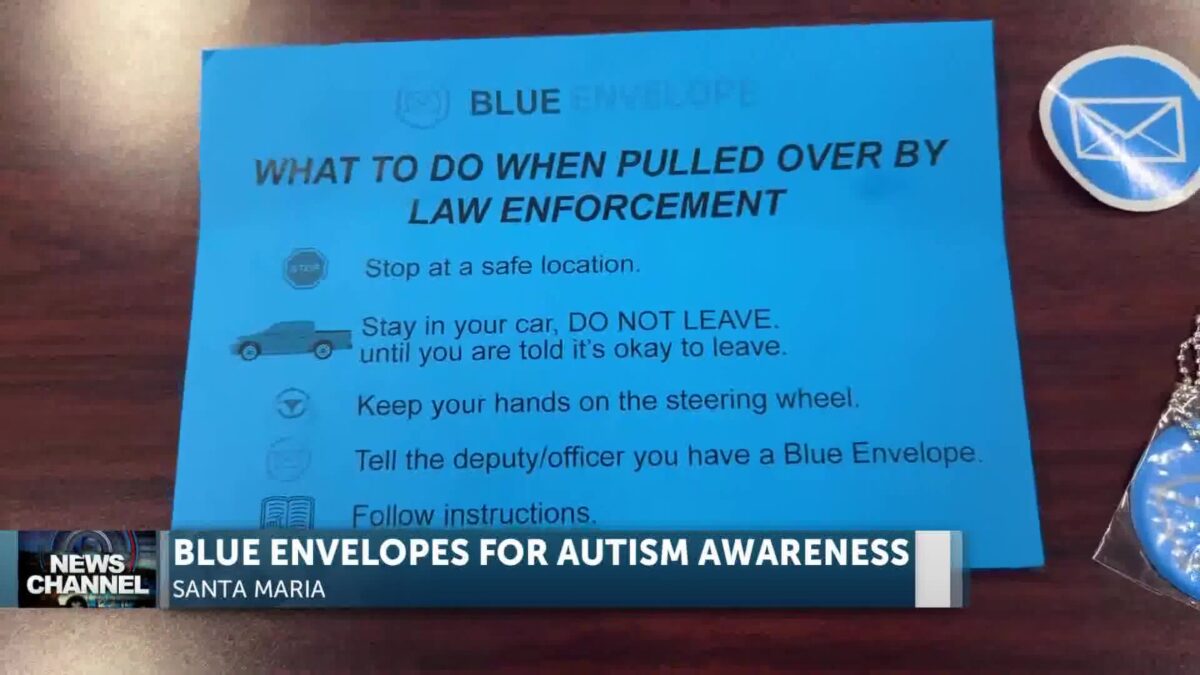
The blue envelope simply holds the driver’s license, registration, and insurance information, and is a visual cue for the officer to implement certain accommodations.
“April is Autism Awareness Month,” says Kiwanis Aktion Club Advisor Julie Posada. “And so this is perfect time to introduce the blue envelope.”
In addition to the envelopes, there are now car decals, bracelets, lanyards, and additional items that have the same purpose in public settings.
“The goal is to obviously make sure everybody has a positive contact with emergency services,” says Sgt. Corral.
Last year’s Senate Bill 664 aimed at making it a statewide mandate failed to pass, but many communities are implementing the program at local levels of their own accord.
“It goes to the resiliency and, the interest for it,” says Sgt. Corral.
Officials at the Central Coast Autism Awareness Center hope it will serve as impetus for neighboring communities to follow suit.
“This is actually been coming up a lot recently,” says Carly Spears, the Central Coast Autism Awareness Center’s executive director. “From what I understand, it’s a great tool for police officers, people with autism to better understand each other.”
Not limited to autism, drivers who are deaf or hard of hearing can qualify, as can those with epilepsy, cerebral palsy, and developmental disabilities.
“Someone who maybe is hearing impaired or completely deaf, and they walk away from a police officer because they don’t even know the police officers talking to them,” says Posada. “But if that person had a blue envelope, keychain on the back of their backpack, as they were walking away, the officer would say, oh, ‘Okay, there’s something that I need to think about before I jump to thinking that they’re taking off and maybe handle it a little bit differently.’”
The program is self-implemented, voluntary, and best of all, free of charge.
The Latest Breaking News, Weather Alerts, Sports and More Anytime On Our Mobile Apps. Keep Up With The Latest Articles by Signing Up for the News Channel 3-12 Newsletter.