ISU Graduate manning Mission Control in Houston for Artemis II Mission

David Pace
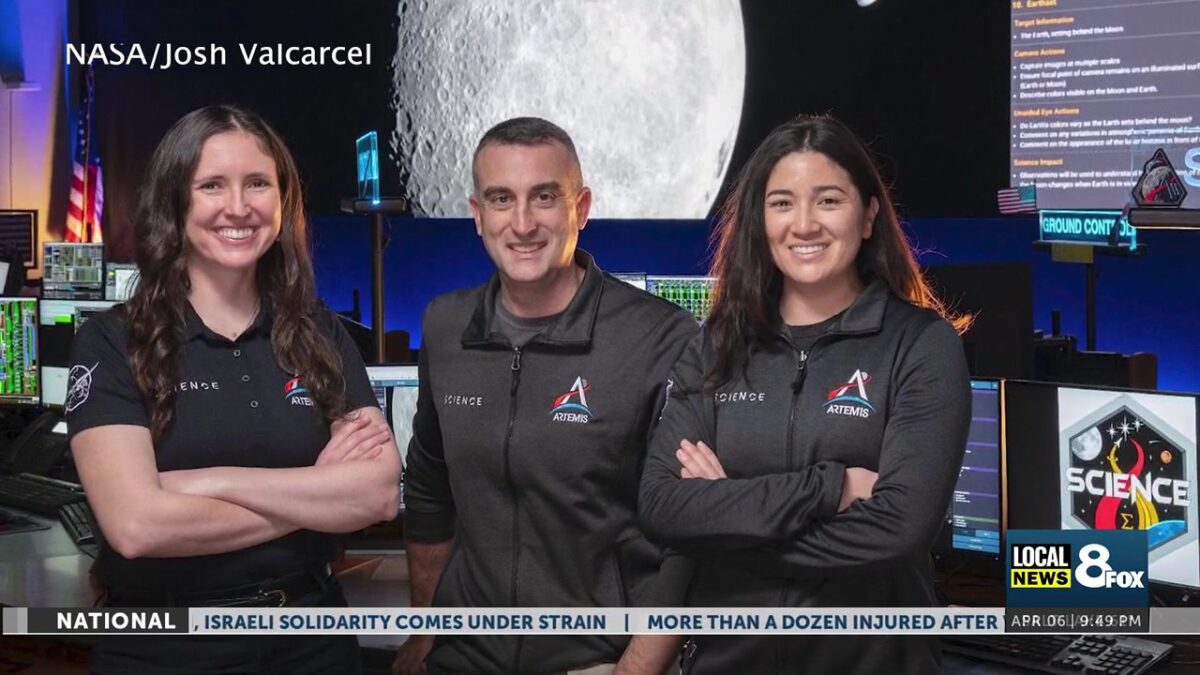
POCATELLO, Idaho (KIFI) – As astronauts today journeyed to the furthest distance in deep space ever reached by humankind, an Idaho State University (ISU) graduate is one of three scientists advising the Artemis II team from Mission Control at the Johnson Space Center.
Angela Garcia graduated from ISU with a master’s degree in geosciences around 2019, and has taken her career to new heights ever since.
“She’s just a brilliant scientist and researcher who’s been working with NASA in the years since, doing a lot of work to be able to prepare for these missions, and has been qualified as a flight controller to be in the flight control room supporting science for Artemis II,” said Dr. Shannon Kobs Nawotniak, a professor and chair of Idaho State University’s Geosciences Department.
“She is going to be monitoring all the science work that the astronauts are doing up there – answering questions for them, relaying questions that they have to the science evaluation room in the back, helping make sure that we’ve got solid support for those astronauts as they do science.”
Dr. Kobs Nawotniak said the astronauts will be researching the impact of meteorites on the far side of the moon.
“This is our first human return to the moon, circling around it in over 50 years. … You can imagine if we’re trying to ultimately put a lunar base up there, it really behooves us to know a lot more about how the stuff is going to go,” she said. “We’re also interested in sort of the size of the distribution, the changes, all of these different things. So that’s going to be one of their key things, is looking for these micrometeorite impacts through flashes on the surface as they’re going by.”
Researchers from ISU have been heavily involved with NASA from 2014 to the present, performing work at Craters of the Moon for the FINESSE (Field Investigations to Enable Solar System Science and Exploration), BASALT (Biologic Analog Science Associated with Lava Terrains), and IDEAS (Integrated Display and Environmental Awareness System) programs.
“The FINESSE program, we’re actually doing work out here with the lava tubes, with the alteration of the rocks, things like that, to understand how the shapes of the landscape and the geochemistry of the rocks all tie together,” Dr. Kobs Nawotniak said.
The research was vital preparing for the Artemis program and an eventual mission to Mars.
“BASALT was about using volcanoes here, in the space here, and in Hawaii as a testbed for high-fidelity simulations of crewed missions,” Dr. Kobs Nawotniak said. “In that case, we were actually aiming it for Mars, but all the stuff we were doing there was also relevant to this, and we used s some of those lessons learned also to be able to inform later tests where they’re actually preparing for Artemis to be able to design the backroom team. How do you support these phenomenal astronauts?”
The lunar-like volcanic landscape at Craters of the Moon is also ideal for practicing astronauts’ navigation techniques required on the moon.
“We’re also working on navigation systems to be able to help astronauts as they’re working around the surface of the moon,” she explained. “We don’t have GPS or compasses for the moon, so they’re actually going to be doing dead reckoning navigation, using printed paper atlases with air photos and alphanumeric grids. It turns out that’s really easy to get yourself turned around. … How we can better support the astronauts for their training and the back corrections afterwards, to be able to ensure that we actually have them in the right place at the right time?”
The ISU researchers and rangers at Craters of the Moon hope the Artemis program and its work will help inspire the next generation of scientists.
“What I love about being a park ranger is that I’m able to work with a lot of young people and people that they get really excited about science,” said Craters of the Moon Chief of Education and Interpretation Michael Irving. “I’m able to help nurture and help grow that love and hopefully get them to go on and pursue fields or pursue careers in those types of fields.”
 ISU graduate Angela Garcia and Dr. Shannon Kobs Nawotniak smile at Mission Control in the Johnson Space Center.