Last known living squadron member shares WWII story

By Crystal Flintrop
Click here for updates on this story
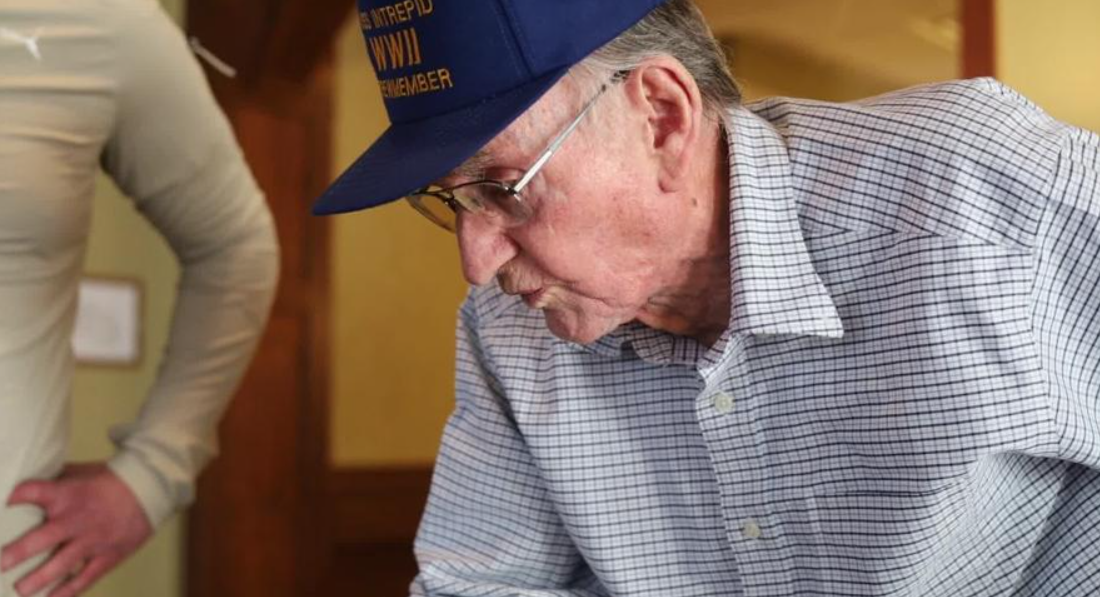
LA CROSSE, Wisconsin (WXOW) — A 103-year-old La Crosse veteran who served during World War II is sharing his story as part of a growing effort to document his experiences while he is still able to tell them.
James E. Bice, a Northside La Crosse native, served as an aviation radio technician first class aboard the USS Intrepid.
More than 80 years later, his memories are now being recorded through a series of in-person interviews with author and Intrepid Museum volunteer Mike Fink.
The effort began with a social media post.
Bice’s family shared photos celebrating his 100th birthday, noting his service aboard the Intrepid — now a museum in New York City.
That post caught Fink’s attention.
He had spent nearly a decade researching Fighting Squadron 18, the unit Bice served with, for his book, The Fighting Squadron: Intrepid’s Fighting Squadron 18.
“To hear that Jim, James Bice, was still with us at 103, to hear that he was willing and excited to speak with me and knowing that I would have the opportunity to be in the same room with him,” Fink said. “It’s almost hard to put into words.”
Fink traveled to La Crosse to meet Bice in person, conducting interviews aimed at capturing firsthand accounts to add depth to the historical record he had spent years building through documents, photos and research.
“To Mike’s knowledge, which is a very well-educated knowledge,” Grandson Jon Bice said. “Grandpa’s the only remaining survivor from this fighting squadron, and he’s able to meet him in person.”
During World War II, Bice supported aircraft operations aboard the Intrepid, working with critical avionics that helped keep missions running.
In November 1944, the ship was hit during a kamikaze attack — one of the most significant moments in its history.
“Shrapnel went right through the walls, right through our room,” James said. “It got my one leg and some small pieces in the face.”
He described how he made his way to safety after the explosion.
“I went down that walkway and there was a ladder going up. I got on the ladder and went up. And that took me right up under the island,” James said.
For years after returning home, his family said those experiences were rarely discussed — something they say was common among that generation.
“That generation, the Greatest Generation, really didn’t talk about their service in real time,” Jon said. “A lot of people served, a lot of people had war stories, so it wasn’t unique. And you were going about life. You were raising your kids, going to work. So, a lot of these war stories weren’t talked about.”
Now, those conversations are bringing forward both well-known moments and new details, from memories of the attack to entries in James’ personal diary and stories that had not previously been shared.
Fink said capturing those perspectives is especially important as fewer World War II veterans remain to tell their stories firsthand, and because many of the roles that made missions possible are often less visible.
“As an enlisted man, supporting the squadron and working on their planes was really important,” Fink said. “If something goes wrong, that can mean life or death for the person who’s in the cockpit, in that plane on that day.”
The interviews are also helping organize and preserve artifacts James kept from his time in the Navy, adding context to the experiences he is now describing.
Fink said the goal is to create a product that can be shared through the Intrepid Museum to tell the story of James and the squadron he served with.
Please note: This story was provided to CNN Wire by an affiliate and does not contain original CNN reporting. This content carries a strict local market embargo. If you share the same market as the contributor of this article, you may not use it on any platform.