Peregrine falcons thrive in Wisconsin thanks one man’s brilliant idea 40 years ago

By Mallory Anderson
Click here for updates on this story
MILWAUKEE (WISN) — Peregrine falcons, once nearly extinct in Wisconsin, have made a remarkable recovery due to one man’s conservation efforts that began 40 years ago.
Decades ago, Greg Septon could only dream of seeing a peregrine falcon in the wild.
“When I was a kid, I used to daydream in high school about what we could do to bring them back, because they were gone. I never saw a Peregrine growing up,” Septon said.
Now, he encounters them almost daily, thanks to an unconventional idea in 1986.
“I met actually with the president of We Energies at the time, and I said: ‘I’ve got this plan. I think we can bring peregrines back. We need to get nest boxes up on all your power plants.'”
Septon, an avid bird lover and conservationist, knew captive-produced peregrine falcons released into the wild would move into the boxes if they were placed high in the sky near waterways. That’s also where you’ll find massive power plants.
“Peregrine falcons migrate and have movements up and down the lakefront, and they’ll look for a tall building or tall structure,” Septon said. “As far as they’re concerned, this is a cliff overlooking a body of water, and if there’s a nest box, and they’re happy.”
After his initial meeting, We Energies hesitantly agreed, kicking off a decades-long program that has repopulated the nearly extinct species.
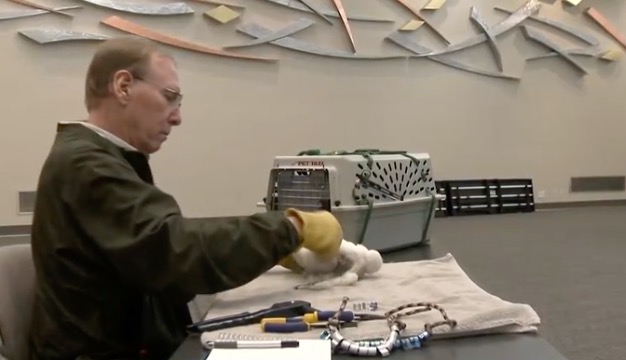
When asked about the number of birds that have come out of those boxes, Septon said, “I’ve banded over 1,500, and there’s birds that I’ve not been able to band over the years, so I’d say probably 1,700 over the last 40 years.”
It’s a tremendous improvement for a population that was nearly zero in 1960.
While the birds can be counted, Septon’s impact is innumerable. On Wednesday, We Energies, the Wisconsin Humane Society, and even the governor tried their best to articulate what his work means to the state. Septon received a special plaque from the governor and now has a raptor cage named in his honor at the Humane Society’s Wildlife Rehabilitation Center.
Through it all, Septon remains humble and says he’s just glad he could save his favorite bird.
“How much does it mean to you to know you’ve had a big role in repopulating peregrine falcons?” asked 12 News reporter Mallory Anderson.
“Well, it’s not just me, it’s everybody. It’s all the corporations that have been involved,” said Septon. “Again, without corporate support and sponsoring nest boxes, they wouldn’t be here. So I just try to facilitate whatever I can, keep being involved, and hopefully keep some things on track as much as I can. Now I can take my daughter out almost any day I want and show her a Peregrine, which is pretty cool.”
Septon’s conservation efforts have been covered by WISN 12 News for years. WISN has video of him climbing a power plant ladder to check on a nest box in 2002. Septon says the evolution of technology, namely 24/7 live streams filming the boxes, has made his job much easier and less dangerous. Though he still makes physical checks on boxes multiple times a year.
The peregrine falcon mating season is starting soon in Wisconsin. Septon says the first chicks usually start hatching in late March or early April.
Please note: This story was provided to CNN Wire by an affiliate and does not contain original CNN reporting. This content carries a strict local market embargo. If you share the same market as the contributor of this article, you may not use it on any platform.