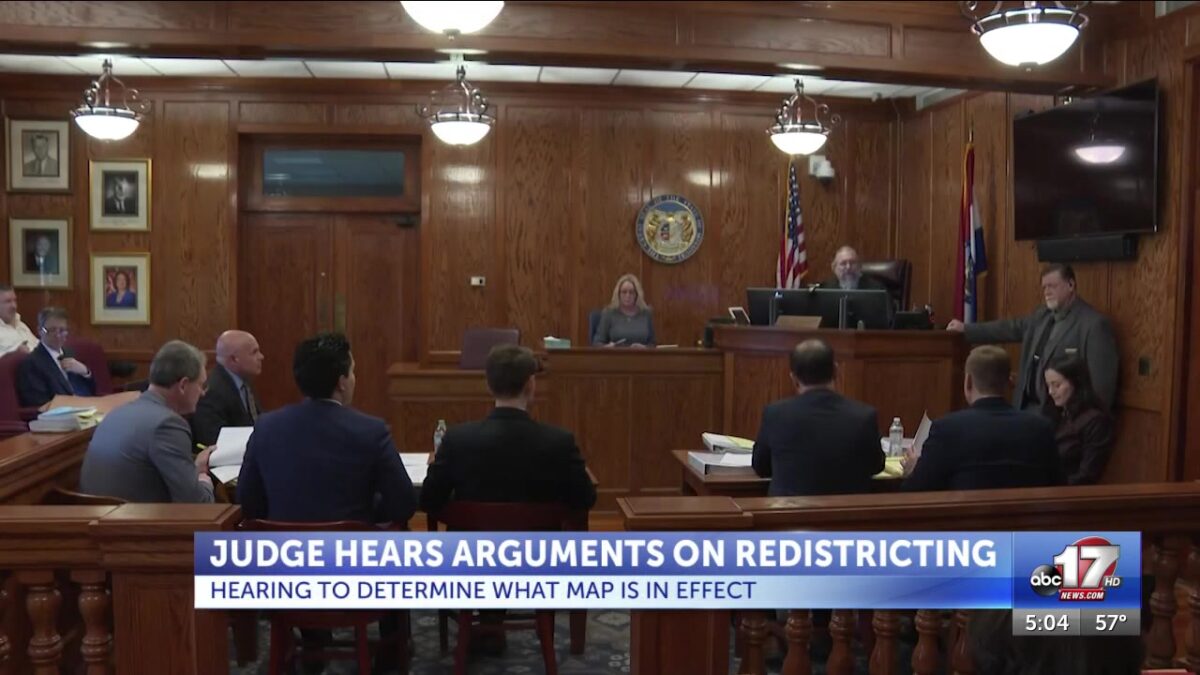
Cole County Courthouse hosts another bench trial over congressional map

Marie Moyer
Editor’s Note: AI has been used in background research for this article
COLUMBIA, Mo. (KMIZ)
The battle for Missouri’s true congressional district map continued Tuesday as the state and the ACLU returned to the Cole County Courthouse for a bench trial on whether a new mid-decade congressional map is already in effect.
The ACLU, representing two Kansas City voters, is seeking a preliminary injunction to pause the use of the map established by House Bill 1.
The lawsuit, filed by the ACLU in December 2025, challenges the state’s claim that the new map is active. The group argued that the Missouri Constitution requires a law to be suspended once a referendum process begins. The group claims the map became frozen when the secretary of state received 305,000 signatures for the ballot initiative on Dec. 9. According to the lawsuit, the map should remain frozen until a public vote in the November election.
During the hearing, the ACLU argued that previous Missouri Secretaries of State and Attorneys General followed the signature drop-off rule.
The ACLU also argued the design of the legislative process matches the signature drop-off rule. The group cited passed bills become active 90 days after the end of the legislative session, the same number of days voters have to turn in petition signatures. They added if laws only become suspended at the certification of the Secretary of State, the period during which they are active violates the purpose of the referendum.
“The purpose of referendum is to suspend or annul a law that has not gone into effect,” ACLU Representative Jonathan Hawley said. “That can’t be the rule because it would allow legislation to take place in the meantime, violating the referendum process.”
Filing for Missouri’s August primary, including U.S. House seats, begins later this month. The new map would likely eliminate a safely Democratic U.S. House seat in Kansas City.
The Missouri Attorney General’s Office argued the ACLU and the group People Not Politicians, which handed in the petitions, are presenting a false narrative. State attorneys claimed a law is only frozen after the Secretary of State validates the submitted signatures. Louis Capozzi, an attorney representing the state, argued that the ACLU can only sue after that certification is complete.
The state also argued that the signature drop-off rule goes against common sense.
“In this uncertainty, who do we favor? Do we favor a duly enacted law or do we assume a referendum petition submitted by a small minority meets constitutional requirements?” Capozzi said. “We can’t just assume they have the signatures.”
The State also called into question possible connections between PNP and the ACLU, arguing that PNP’s Executive Director, Richard von Glahn, knew of the ACLU’s suit before they filed it. The State also questioned the ACLU’s donations and whether there was an overlap or funding with PNP. The ACLU’s donation sources are kept anonymous through the First Amendment.
The State previously took PNP to federal court in November, attempting to block the referendum in the first place. The case was thrown out; however, the State argues that PNP never opposed the petition review process that included validation by the Secretary of State. This is different from the ACLU whose arguments push back against the petition review process.
The State argues that if the ACLU and PNP are collaborating in litigation, while also having opposing arguments across different court cases, the ACLU’s argument is invalid.
PNP representatives were present at Tuesday’s hearing and argued that several testimonies from PNP and ACLU prove the groups are not working together.
“There’s no coordination, as we’ve told you and them repeatedly,” ACLU Representative Matthew Gordon said.
To qualify for the ballot, referendum petition signatures must equal 5% of legal voters in each of two-thirds of the state’s congressional districts. County election offices have until July to verify the signatures. The state maintains that it has not yet been confirmed if enough valid signatures were submitted to meet these requirements.
The political action committee Put Missouri First was permitted to join the lawsuit as a defendant. In court documents, the group argued it should be involved because it opposes the redistricting referendum and is responsible for funding and organizing opposition efforts.
Both parties have until Feb. 17 to submit proposed judgments for Judge Brian Strumpe’s final decision.