Math, Not Myths: Inside the renewed search for Amelia Earhart

By Scott McDonnell
Click here for updates on this story
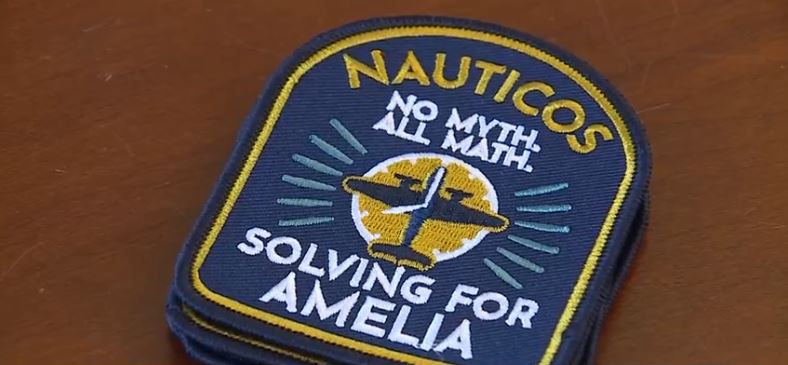
KENNEBUNKPORT, Maine (WMTW) — Dave Jourdan’s office has become mission headquarters for an ambitious effort to solve one of aviation’s greatest mysteries: the disappearance of Amelia Earhart.
Solving the mystery has been part of Jourdan’s life for decades. He has been building an archive over the years. “The archive I’ve been working on over the years now amounts to 27,000 pages,” Jourdan said.
The search began in 1997, when Jourdan, who founded Nauticos, a company specializing in deep-ocean exploration, began his effort to find Earhart.
“I had recently told my team that we had been so successful at finding everything we saw on the first try that we needed to try something harder,” Jourdan said.
Since then, Nauticos has launched three expeditions across the globe, searching for Earhart’s lost Lockheed Electra. “And I do regret those words,” Jourdan said. “Because this has been a really tough one.”
So far, the team has scanned an area roughly the size of Connecticut using custom-built equipment designed specifically for deep-sea exploration.
Now, Jourdan believes the next expedition could change history.
Advances in technology have transformed the search, particularly with the rise of autonomous underwater vehicles. “The autonomous vehicle has come into being for three reasons,” Jourdan said. “Battery power has improved, navigation has improved, and we now have the ability to process and store massive amounts of data.”
But technology is not the only breakthrough — at least not recent technology.
A key piece of the puzzle came from an unexpected place: an old radio, identical to the one aboard Earhart’s plane. “Was this found at basically a tag sale — a garage sale?” Jourdan was asked.
“Yep,” he replied.
That radio became the final missing component.
Using it, the team located a similar aircraft, flew it out to sea and brought in a boat to replicate the position of the Coast Guard cutter Itasca, which was stationed near Earhart and her navigator, Fred Noonan, on the day of her disappearance in 1937.
Precise measurements followed — nearly everything the team needed.
Almost.
“Except her actual voice,” Jourdan said. “Because that was never recorded.”
Instead, researchers relied on transcripts and interviews with eight men who heard Earhart’s final radio transmissions, allowing them to recreate her last known calls. “KHQQ calling Itasca. We must be on you but cannot see you. Gas is running low.”
Jourdan believes those transmissions now point to a specific location and helped his team determine where they believe Earhart was during her final transmissions at 8 a.m. “Right,” Jourdan said. “So, that helps a lot.”
The focus is near Howland Island — a tiny speck of land about 1,600 miles southwest of Hawaii. “It’s a whole lot of blue,” Jourdan said.
Howland Island is smaller than the National Mall in Washington, D.C., surrounded by vast, open ocean.
But this time, Jourdan says the search is guided by math — not myths — and he believes the ocean may finally be ready to give up its answer.
Please note: This story was provided to CNN Wire by an affiliate and does not contain original CNN reporting. This content carries a strict local market embargo. If you share the same market as the contributor of this article, you may not use it on any platform.