Missouri Department of Conservation puts pause on post-hunting season deer cull

Marie Moyer
COLUMBIA, Mo. (KMIZ)
EDITOR’S NOTE: AI was used for background in researching this story.
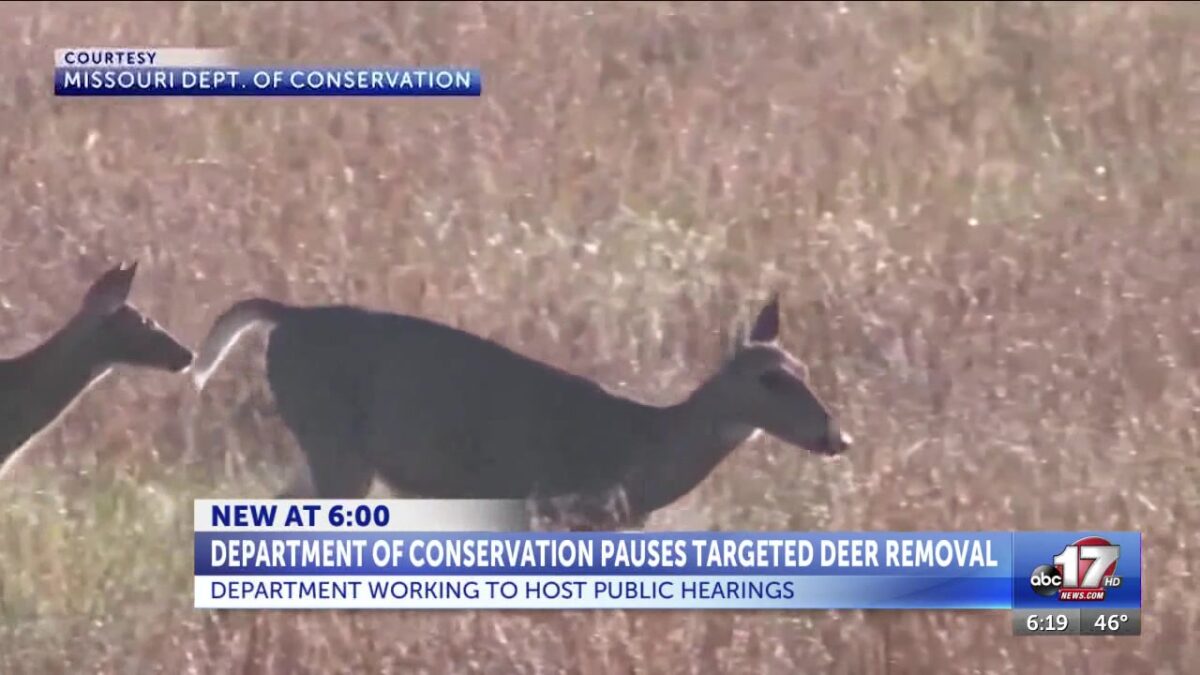
The Missouri Department of Conservation is pausing its chronic Wasting Disease management efforts to find a more sustainable option.
The disease was detected in the state in 2010, and is reportedly on the rise but relatively low, with around 1% of samples last year testing positive for CWD. However, MDC experts add that a 5% positive test rate tends to be at risk for outbreaks.
“As with many diseases, early detection and aggressive management have the greatest impact on the future distribution of the disease. So we embarked on an aggressive strategy to minimize the likelihood of spreading the disease within Missouri,” MDC Director Jason Sumners wrote in an open letter Monday.
The Missouri Department of Conservation implemented a series of strategies aimed at controlling the spread of CWD. Among these is a mandatory sampling procedure conducted annually during deer season, during which hunters can have their deer tested at no cost. The department has also implemented regulations for feed use and carcass disposal to prevent the spread.
The department typically uses the findings from the November sampling in conjunction with an annual targeted deer removal program that runs from January to mid-March.
This program is intended to help control the population of infected deer in areas where CWD is prevalent. The department gets approval from local landowners to hunt on their land, and all non-CWD-affected meat harvested from the hunts is either returned to the landowners or donated.
According to MDC Deer Program Leader Jason Isabelle, following a mandatory sampling event in November, the department received around 22,000 samples with 32 positive cases of CWD.
Last year, the department reported having hunted 4,700 deer alone through targeted deer removal with local partners and hunters across the state removing around 275,000 deer.
The post-season program is being put on hold for this upcoming year.
“We remain committed to keeping our deer herd healthy and working collaboratively with the hunters and landowners that are critical to our conservation mission,” Sumners wrote. “We cannot be successful in this work, and at the scale needed, without hunters’ and landowners’ support and participation. At this time, MDC will be pausing our post-season targeted removal efforts to work with hunters and landowners to adapt and identify a more sustainable path forward.”
Deer culling has been a criticized strategy in the past, with opponents arguing that the action causes ecological impacts and affects local hunters.
Anthony Weeks from Vandalia sees benefits from targeted deer removal but adds that it can be dangerous if misused.
“A local area to me, they did it and they realized, ‘hey, there really is no CWD in this area,’ and so now they decreased a little of the population,” Weeks said. “Normally, I harvest between 3 to 4 deer, one buck and a couple of does, this year I only have one buck and one doe and that was it.”
Weeks adds that he is excited about the idea of public hearings with the department. “That they are listening to both the hunters and landowners and the community,” Weeks said. “Not everything is going to be able to get put into place or be a new law for next year, but it is a good starting point.”
Allen Morris from Jackson argues that targeted deer removal does more harm than good.
“You just killed a whole population and they can’t tell you that those deer will die of CWD because there’s 100 different ways that deer will die before ever getting CWD,” Morris said. “A deer is going to die of getting hit by a car, chronic blood loss from a bullet or an arrow, predators, weather, there’s so many different things that nobody comes into account.”
Morris adds that trust in the department for some hunters needs to be built back up following previously unsuccessful public hearings.
“They’ve hosted forums for the last 12 years, I’ve been to three of them in Perry County, and they won’t they won’t let the people talk,” Morris said. “They have their little meetings, a little sit down around the table, and they don’t want people to have a public output on this, because when you start asking questions, they get uncomfortable.”
Morris adds that the department must be more forward with finances and details on the operations of targeted deer removal to rebuild trust.
“It would be complete transparency, and instead of me having to file so many open records request, all that should be on their website for anyone,” Morris said.
“Regardless of where you stand on the issue of CWD, most share the same goal — a healthy sustainable population of deer in Missouri that can be appreciated and utilized by future generations,” Sumners said.