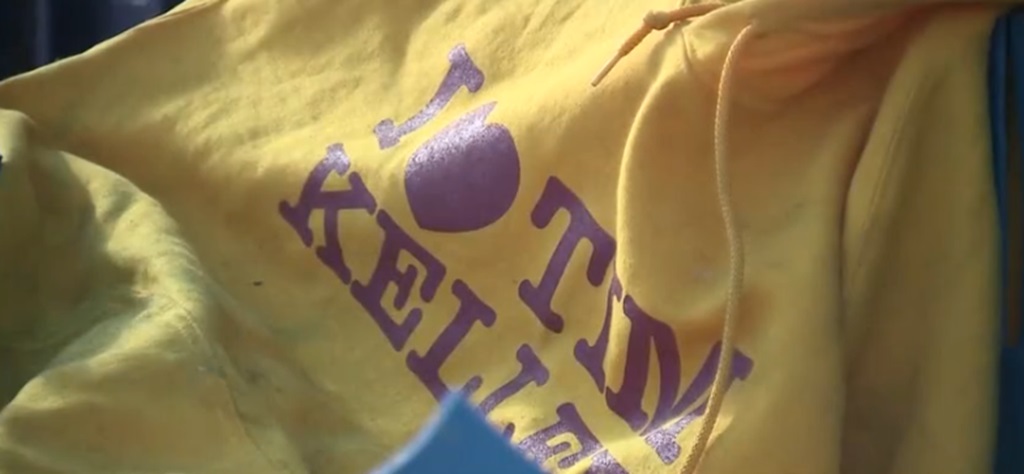
Do “I Love Mayor Keller” sweatshirts violate Albuquerque election code?

By T.J. Wilham, Jason McNabb
Click here for updates on this story
ALBUQUERQUE, New Mexico (KOAT) — The distribution of “I Love Mayor Keller” sweatshirts to the homeless in Albuquerque has sparked controversy and questions about potential election law violations just days before the mayoral election.
Under the city’s election code, anyone spending more than $250 to support a candidate must report it, but so far, no one has claimed responsibility for purchasing the sweatshirts, and each campaign is pointing fingers at the other.
The sweatshirts have become popular on the streets, with one recipient saying, “they’re very nice, comfy and warm, you know. That’s a good gift.” Another added, “I like it ’cause it’s cold and I mean, it keeps me warm.” However, the source of the funding remains a mystery. “We really don’t know much about these sweatshirts, who’s behind it, whether it was a simple joke or whether there are other nefarious reasons behind them,” said a local observer.
The issue has become contentious, with homelessness and crime being top concerns for voters. Mayor Tim Keller implied that supporters of his opponent, Darren White, are behind the distribution, calling it “disgraceful.” Meanwhile, the Republican Party accused Keller of using the homeless as political pawns.
Some homeless individuals believe Keller is responsible, with one saying, “Tim Keller is actually for homeless people, which I am now currently homeless. So, you know, I kinda do support that, you know what I mean? And then it’s like kinda like a you know, a good gesture that he sent out some some hoodies, you know, for kinda keep you warm.”
Paul Gessing of the taxpayer watchdog group Rio Grande Foundation posted about the sweatshirts on his blog, stating, “I am aware of the individual who passed the shirts out, yes.” He added, “I can’t tell you because they don’t want to be notified or made public as somebody who’s doing this kind of I guess you would call a guerrilla marketing or guerrilla campaign tactics.”
Gessing said the person who paid for the shirts is not a Keller supporter and did it to highlight the city’s failure to address the homeless crisis. “Personally, I think it’s brilliant. I think it’s a very interesting technique to highlight an issue and put it in front of the media, in front of average New Mexicans, Albuquerqueans specifically, who may be going to the polls and make sure that they’re aware of this real problem,” he said.
However, whoever is behind the distribution might be violating the city’s election code. “Basically, city law is pretty clear. If a group or an individual supports or opposes a candidate, they have to file or register with the city clerk. Assuming that they spend more than $250,” said KOAT political expert Brian Sanderoff.
He believes the sweatshirts are politically motivated and could fall under election law, noting, “Think about how close this is to the election. If this had happened after the election, probably no one would think twice about this. But here we are, right before an election, and these sweatshirts that say I love Tim Keller given out to homeless people are all around town.”
To determine if the sweatshirts meet the $250 threshold, Todd Martinez of Fully Promoted, who makes similar sweatshirts in bulk, was consulted.
“At at our shop, if we did twenty-four with a similar print like this, you’d be at about twenty-two to twenty-three dollars per hoodie. So a little over five hundred, five hundred twenty bucks to do a job of twenty-four,” he replied.
Martinez said he is not aware of who made the shirts and would have turned the business away if approached, stating, “Whatever your stance is on the mayor, I just think it’s a little bit of a demeaning way to hand them out.”
The city clerk’s office stated that if a complaint is launched, an investigation would be initiated to determine if the distribution is connected to a campaign, and the city’s ethics commission could impose a $500 fine.
Sanderoff noted, “it’s possible that after the fact, if we find out who’s behind it, that city government, ethics commission or the like, someone might file a complaint and some people might be held accountable after the fact.”
This story was provided to CNN Wire by an affiliate and does not contain original CNN reporting.
Please note: This content carries a strict local market embargo. If you share the same market as the contributor of this article, you may not use it on any platform.