Jurassic Living Jewels: The chance to catch an arapaima in Florida

By Alex Howard
Click here for updates on this story
ARCADIA, Florida (WBBH) — An exotic fish native to the Amazon is now drawing anglers to Southwest Florida for a rare fishing experience, and raising questions about whether it could one day become invasive in Florida waters.
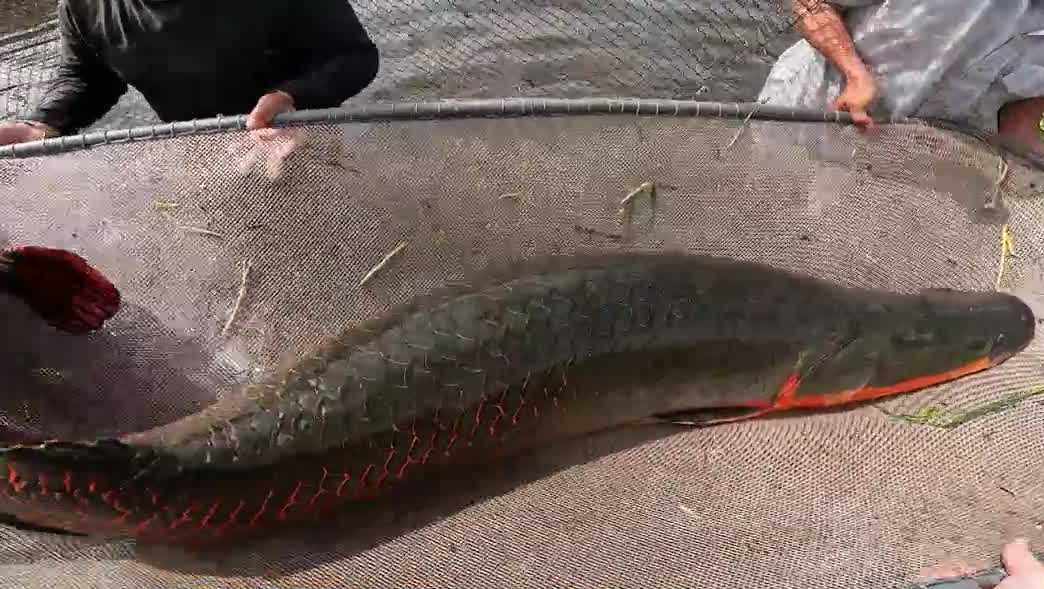
The arapaima, one of the largest freshwater fish in the world, has recently appeared in Florida through experimental fish farms and specialty aquaculture operations. The massive South American species, known for its voracious appetite and immense strength, is now the centerpiece of a new fishing resort outside Arcadia operated by Jurassic Living Jewels.
Five years ago, a dead arapaima was discovered at Jaycee Park in Cape Coral. Investigators later determined the five-foot fish had been stolen from an experimental fish farm in Charlotte County.
Today, Jurassic Living Jewels says its Arcadia property is the only place in North America where anglers can legally catch arapaima. The remote farm also houses a variety of exotic species, including Golden Dorado, Pacu and several species of catfish.
“The only place in North America where you can come and catch them,” said Hunter Vogel from Jurassic Living Jewels. “It’s a great fish, it’s like a tarpon on steroids, It’s a very primitive fish, very bony, the head is armor pretty much. You’ve probably seen a video, and if it launches itself at your chest, you will be out of breath for a while.”
The fish themselves are enormous, with some arapaima capable of weighing more than 400 pounds. Staff members recently transferred the fish from greenhouse ponds into larger outdoor stock ponds using large nets. During the move, we experienced firsthand just how powerful the fish can be after being struck in the face by one of their tails.
Jurassic Living Jewels says the fish are bred for sport fishing, with customers paying as much as $2,500 a day for the chance to catch one. The breeding program has become so successful that the facility has also begun selling some of the fish for food.
Still, questions remain about whether arapaima could survive in Florida waterways if they escaped captivity.
“They will kill anything that gets in that pond that isn’t man,” Vogel said. “Birds, anything gets in that pond, they will kill it.”
The owners of the facility argue the fish are unlikely to become invasive because Florida winters are too cold for them to survive. They pointed to studies dating back to 2013 that found arapaima struggle when temperatures fall below roughly 60 degrees Fahrenheit.
But not everyone agrees.
FGCU ecologist Serge Thomas said the species could potentially survive in Southwest Florida under the right conditions, especially during warm-weather flooding events that could allow fish to escape into waterways like the Peace River.
“Really, if it were to be released, especially in the southeastern U.S., because it is a tropical equatorial fish, it does not bear well with low temperatures below 60 or 61 degrees Fahrenheit,” Thomas explained.
Thomas compared the arapaima’s temperature tolerance to the peacock bass, another tropical species that already survives in South Florida by taking refuge in warmer groundwater-fed canals and waterways. He also warned that warm-water discharges from power plants, such as the one on the Orange River in Fort Myers, could potentially help the fish survive year-round.
“I believe firmly that it could potentially be a threat and be able to thrive down here,” Thomas said. “If you look at the peacock bass, they have the same thermal range. I think definitely it could be a problem.”
Experts say the fish’s feeding habits are another concern. Juvenile arapaima feed on small fish and insects, while adults are capable of consuming frogs and much larger prey as they grow.
Please note: This story was provided to CNN Wire by an affiliate and does not contain original CNN reporting. This content carries a strict local market embargo. If you share the same market as the contributor of this article, you may not use it on any platform.