Warsh Defends Fed Independence, Signals Overhaul in Confirmation Hearing

By Juliegrace Brufke | Quincy News Correspondent

Click here for updates on this story

    Washington (Quincy News) — WASHINGTON – Kevin Warsh, President Donald Trump’s nominee to chair the Federal Reserve, testified before the Senate Banking Committee on Tuesday, defending his independence from the White House and calling for sweeping changes to how the central bank operates.

Warsh argued the Fed’s slow response to inflation in recent years was a serious policy failure and said he would pursue what he called a “regime change” if confirmed, including a new inflation framework and changes to the Fed’s communication practices. He would not guarantee the current eight annual meetings would continue and declined to commit to holding a press conference after each one.

“Right now, Fed chairs and other central bankers around the FOMC, they speak quite frequently. There was no lack of transparency. But I would say this, I think truth seeking is more important than repetition,” Warsh told lawmakers. “If a press conference were held, I think it would be incumbent to hear what the reporters of the day had in mind.”

Democrats on the committee pressed Warsh repeatedly on whether he could remain independent from a president who has publicly demanded rates as low as 1% and encouraged a Justice Department investigation of sitting Federal Reserve Chair Jerome Powell over cost overruns on a building renovation. Sen. Elizabeth Warren (D-Mass.) told Warsh that Trump wants the Federal Reserve to artificially boost the economy for political reasons and questioned whether any nominee could withstand that pressure.

The sharpest exchange centered on reports that Trump privately told Warsh he wanted interest rates cut before his confirmation, which Warsh denied.

“The president never asked me to predetermine, commit, fix, decide on any interest rate decision in any of our discussions, nor would I ever agree to do so,” he told the committee.

Sen. Ruben Gallego (D-Ariz.) told Quincy News the conflicting accounts put the Fed’s credibility at risk regardless.

“We have to protect the independence of the Federal Reserve,” he said. “It threatens me that we have public reporting that the president told Kevin Warsh he wanted to see interest rates cut, and that Kevin Warsh under oath said that did not occur. So someone is lying right now. Either Kevin Warsh just lied under oath or the president is lying. Either way, it doesn’t help build the credibility of the Federal Reserve.”

The hearing comes one week before the Federal Open Market Committee (FOMC) meets April 28-29, and Powell’s press conference on April 29 is expected to be his last as Fed chair. Powell has said he would remain in place on a temporary basis if needed.

While Republicans are broadly expected to support Warsh in a confirmation vote, he faces some hurdles along the way.

Sen. Thom Tillis (R-N.C.) has said he does not want to see a vote until the Justice Department drops its criminal probe against Powell, an investigation ostensibly over cost overruns on the Fed’s headquarters renovation that a federal judge has already moved to block.

Tillis made clear his objection is not with Warsh personally, telling the nominee, “Let’s get rid of this investigation, so I can support your confirmation.”

With Republicans holding only a 12-10 majority on the Banking Committee, Tillis has enough leverage to stall the nomination before it reaches the full Senate floor.

Other Republicans were unambiguous in their support. Sen. Jim Banks (R-Ind.) told Quincy News that he believes Warsh is the right choice.

“Kevin Warsh understands the importance of keeping inflation low and making sure our economy works for working people,” he said. “He is highly qualified for this role and we need to confirm him ASAP.”

Senior sources close to the process tell Quincy News they believe Warsh will ultimately be confirmed despite the obstacles.

Former Fed Chair Janet Yellen has said she doubts Warsh could quickly move the 12-member FOMC to cut rates, noting that a majority of members remain reluctant to act while inflation remains above the 2% target.

Please note: This story was provided to CNN Wire by an affiliate and does not contain original CNN reporting. This content carries a strict local market embargo. If you share the same market as the contributor of this article, you may not use it on any platform.


Prep scores for beach volleyball, baseball, softball, lacrosse, and golf

Mike Klan

SANTA BARBARA, Calif. (KEYT) –

CIF-SS High School Girls Beach Volleyball First Round Playoffs:

Division 3: Dos Pueblos 4, Downing 1: Chargers are at Camarillo on Thursday in second round.

Division 4: Bishop Diego 4, Costa Mesa 1: Cardinals play at Pacifica Christian on Thursday in second round

High School Baseball:

Rio Mesa 2, Dos Pueblos 0

Oxnard 5, Ventura 4

High School Softball:

San Marcos 8, Pacifica 1

High School Boys Lacrosse:

Santa Barbara 20, San Marcos 2: Dons share Channel League title with Dos Pueblos

High School Girls Lacrosse:

San Marcos 15, Santa Barbara 2: 30 straight league victories for Royals

High School Boys Golf:

San Marcos 339, Ventura 368

Santa Barbara 403, Pacifica 459

Bishop Diego 205, Grace 218: Cardinals repeat as Tri-Valley League champions

Click here to follow the original article.

Cape Cod researcher says newly found 1949 whale recording is critical discovery: “I’m getting goosebumps”

By Jacob Wycoff

Click here for updates on this story

    BOSTON, Massachusetts (WBZ) — More than 76 years ago, a research team from Woods Hole Oceanographic Institution was working in the Atlantic Ocean near Bermuda when they lowered a microphone into the ocean. What they recorded that day would sit quietly in storage for decades.

At the time, no one knew exactly what they were hearing. The audio was etched onto a thin plastic disk using equipment originally designed for office dictation, labeled simply “fish noises,” and filed away in the archives.

Dr. Ashley Jester, who oversees these archives now, said the recordings were easy to miss. They were buried in boxes, very nondescript with their labels. Then researchers gave a modern listen to an old mystery. What Jester heard was not fish. It was a humpback whale.

“I hit play on that WAV file and it was goosebumps. The recording starts, and the voice comes on, and he says ‘It’s the 7th of March, 1949, a little note about the hydrophone, and then you hear the plop. And then right there is the song. I’m getting goosebumps right now thinking about it,” Jester said.

Scientists now believe it could be the oldest recorded whale song ever discovered.

Whale recording from 1940s The find is remarkable not only because of its age, but because it offers a rare snapshot of what the ocean may have sounded like in the late 1940s.

Back then, underwater recording required bulky equipment, long cables, and systems researchers often built themselves. Today, that technology can fit in the palm of your hand.

Dr. Laela Sayigh, a marine bioacoustics researcher at Woods Hole, said modern hydrophones can record for days at a time using compact digital devices.

But for scientists, this historic recording may be most valuable for what it does not contain.

“To potentially be able to look at the levels of ambient noise, which almost certainly would be much, much lower. Because now, you can hear shipping traffic, seismic exploration,” Sayigh said.

Why noise pollution matters In other words, the ocean is not as quiet as it once was. That matters because whales and other marine mammals depend on sound the way humans depend on sight.

“Considering noise as a pollutant is something that has only kind of recently gotten a lot of attention, but marine mammals as a group really rely on sound. It’s their essential mode. It’s as important to them as vision is to us,” Sayigh said.

Sound helps whales communicate, navigate, find food, and survive. As human activity increases underwater noise, researchers say those natural behaviors may be changing.

And this discovery may be only the beginning.

“There are 212 discs in the collection. So we probably have at least 200 hours of underwater recording,” Jester said.

Hundreds of hours of forgotten sound may now help scientists better understand how ocean life, and the ocean itself, has changed over time.

Please note: This story was provided to CNN Wire by an affiliate and does not contain original CNN reporting. This content carries a strict local market embargo. If you share the same market as the contributor of this article, you may not use it on any platform.

Warmer weather could impact miller moths during migration

By Lauren Lennon

Click here for updates on this story

    DENVER (KMGH) — It’s almost that time for miller moths to return to the Front Range. With unseasonably warm temperatures we have been seeing, there may be some good news for people who dread this time of year.

Horticulture specialist and entomologist at the Colorado State University Extension in Arapahoe County Lisa Mason said if we continue to see warm temperatures, the moths may not hang around the Front Range for too long since they prefer cooler mountain temperatures.

“I’ll be interested to see what miller moths are like this year,” Mason said. “They could potentially, just like, book it, to the mountains if we continue to have warmer temperatures, which, for anyone that thinks miller moths are a nuisance, that that could be a good thing for them.”

She said there are a couple different factors that play into their migration.

“There might not be a lot of food for them along their migration path, so they’re right now on the Eastern plains and in the Midwest, completing their life cycle to adults. Once they become an adult moth, they’re going to migrate to the Rocky Mountains, and during that time, they’re going to stop along the way where there’s food,” Mason said.

The drought might limit food for the moths along their route, according to Mason, so adult moths may focus on irrigated landscapes for flowers.

“There’s probably not going to be a lot of food for them along the way until they get the front to the Colorado Front Range. You know, with our irrigated landscapes, there’s going to be likely more blooming flowers, so they might hang out longer. However, if it’s warm, if it’s really warm and the evening temperatures are really warm, they are not going to want to stick around,” Mason said.

The moths tend to continue their migration when nighttime temperatures are above around 50 degrees, according to Mason.

“If the days are hot, you know, they will continue,” Mason said. “If we see a cooling trend for a while, you know the miller moths there, there’s not going to be a lot of food for them along their migration path, because things have been so unseasonably dry. So, if temperatures cool down, they might hang out in our irrigated landscapes for a little bit longer than normal.”

Mason said we don’t start to see the moths until May, so experts won’t know for sure their pattern for this year until later in the season. She also added that experts won’t know if they will arrive earlier than normal.

Mason noted that for the most part, last year was a below average season for the moths.

If you do see the moths in your home, they are harmless and Mason said there is no need for pest control services.

She said some people resort to vacuuming them or using a bowl of soapy water to put over lights in garages.

You can also minimize outside lighting as they are attracted to things like porch lights.

The moths do serve a purpose, though, as they are good for the environment.

“Miller moths are a generalist pollinator, and so they’re going to visit flowers that they can find if they leave earlier. That’s not going to have a huge impact on our flowers, because there are other generalist pollinators out there. So you know, whether or not they migrate, sooner or later, really won’t have too much of an impact on our plants that are that are pollinated,” Mason said.

Please note: This story was provided to CNN Wire by an affiliate and does not contain original CNN reporting. This content carries a strict local market embargo. If you share the same market as the contributor of this article, you may not use it on any platform.

Colorado wildfires threaten to devastate the state’s long-term water supply and reservoir storage

By Adria Iraheta

Click here for updates on this story

    AURORA, Colorado (KMGH) — Colorado’s drought and repeated high fire danger are raising new concerns about the long-term impact on the state’s water supply. Aurora Water is warning that wildfires could devastate the water supply for years after the flames are out.

Every drop of water matters right now as the Denver metro tries to mitigate the effects of this year’s extremely dry winter across the state. Aurora Water’s reservoir levels are currently sitting at 57%.

“We’re currently in a pretty historic level of drought,” Aurora Water resource specialist Matt Ashley said.

Ashley said he is not just worried about the drought.

“Wildfire really is the number one threat to our watershed health,” Ashley said.

Colorado State University geology professor Ellen Wohl said the problem starts with the leftover ash and sediment after a fire.

Wohl brought up the fact that Coloradans have felt the effects of sediment runoff in the past.

“For example, after the Cameron Peak Fire, the next summer, we had the black hollow debris flow in a tributary, the Poudre [River], and that created extremely high turbidity levels all the way downstream. That’s when Fort Collins had to shut off drinking water intakes for a period of time,” Wohl said.

That sediment can also end up settling into Colorado’s reservoirs.

“You lose a lot of storage capacity,” Ashley said.

It is already happening. The Strontia Springs Reservoir, shared by Aurora and Denver Water, is already 10% full of sediment from past fires. There is an ongoing effort to dredge it up, but the problem remains.

“The worst case scenario is your reservoir fills up with sediment, and you can’t use that reservoir anymore, which is a huge problem because it’s very expensive and takes a lot of time to build a new reservoir,” Ashley said. “We would have to go and build new reservoirs and find new capacity and new places to store that water, and that would just cost money, and basically, at the end of the day, increase your water bill.”

Then there is contamination.

A recent study led by Ben Livneh, president of Western Water Assessment and CU Boulder associate professor of civil engineering, shows these effects stick around way longer than once thought.

“Not just for one year or two years, but sometimes for up to eight years,” Livneh said.

The first-of-its-kind large-scale study of 500+ Western U.S. watersheds found that wildfires can contaminate water with organic carbon, phosphorus, nitrogen, and sediment for up to eight years.

While researchers knew fire ash and soil damage affected water quality to some extent, previous studies only examined local impacts rather than regional patterns.

“It dramatically increases the cost of filtering and treating the water,” Wohl added.

While there is no one-size-fits-all solution, Livneh said this could be a chance for municipalities to prepare.

“This can be [through] a number of different infrastructure investments or modifications,” said Livneh.

Aurora Water says its now focusing its efforts on doubling down on fire prevention efforts with partners like the U.S. Forest Service and Colorado State Forest Service.

“Across the board, just a whole lot of collaboration and partnership to prevent these fire issues from happening,” Ashley said.

Ashley said it is also up to everyone across the Front Range to make the most of the water available.

“Definitely make sure to follow those fire restrictions. The fire bans, the fireworks bans, things of that nature,” Ashley said.

This story was reported on-air by a journalist and has been converted to this platform with the assistance of AI. KMGH’s editorial team verifies all reporting on all platforms for fairness and accuracy.

Please note: This story was provided to CNN Wire by an affiliate and does not contain original CNN reporting. This content carries a strict local market embargo. If you share the same market as the contributor of this article, you may not use it on any platform.
Purple Rain falls from Jacaranda Trees

Tracy Lehr

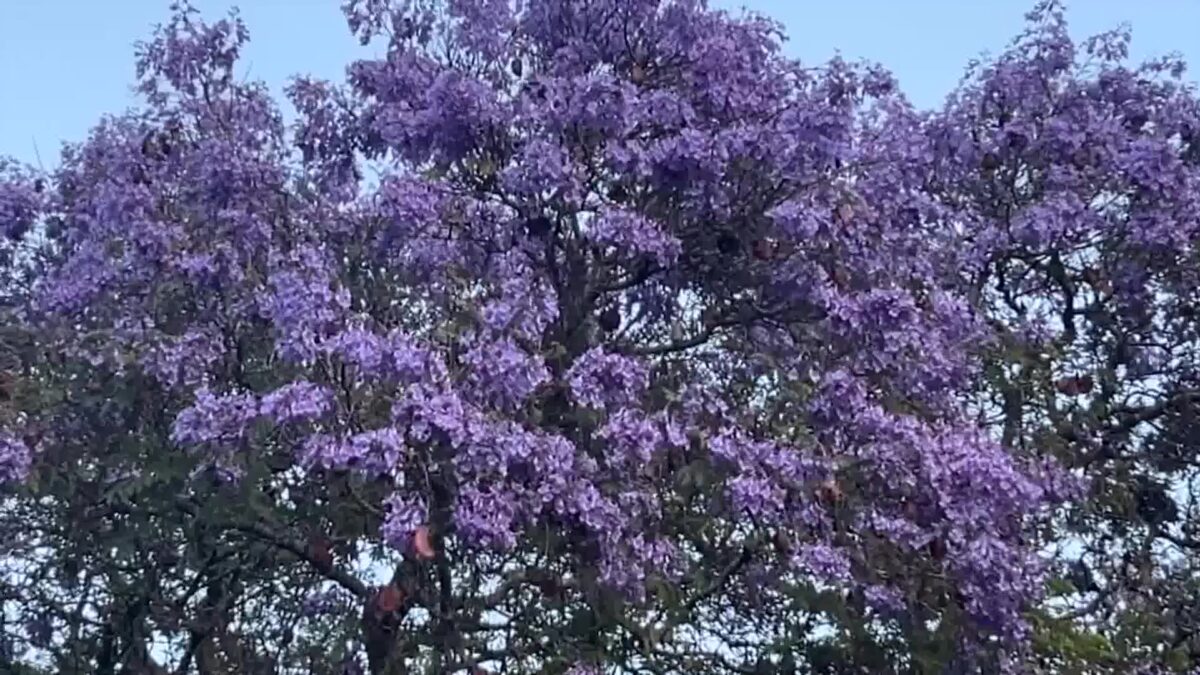
SANTA BARBARA, Calif. (KEYT) Jacaranda trees are in bloom.

The purple flowers line many streets in Santa Barbara, including Carrillo.

It looks like purple rain when the flower petals start to fall.

The petals cover sidewalks and cars.

One tree near Santa Barbara City Hall is shedding flowers in the parking lot.

Love them or hate them, the blooms only last a couple of weeks.

Click here to follow the original article.

California Islamic calligraphy artist preserves ancient tradition during Arab American Heritage Month

By Irene Gonzalez

Click here for updates on this story

    California (KMAX, KOVR) — As Arab American Heritage Month is celebrated, one Northern California artist is keeping the centuries-old tradition of Islamic calligraphy alive, one carefully measured stroke at a time.

Sehar Shahzad is a student calligrapher. Before starting any project, Shahzad said “one of the first things that calligraphers learn is how to cut their pens.”

Her tools must be in pristine condition.

“Your instruments are just as important as anything else in this art,” she said.

Shahzad said that as a young girl growing up in Toronto, she took up Islamic calligraphy while reflecting on her religion.

“It’s not like I’d never seen it before, but it was my first time kind of trying it,” she said. “And there’s no other way to say it except that I just fell in love with it.”

Now married with three children, Islamic calligraphy is very much part of her life.

“I remember thinking that this isn’t something that I just want to learn for fun,” she said. “I really want to be able to master it.”

Shahzad said that every angle and curve follows strict geometric rules and is measured with dots.

“For example, this letter here was just a little bit too long, so we use these nuqtas to help us guide and understand how long that letter should be,” she said.

Like the Arabic language, Islamic calligraphy is read from right to left. Its bold simplicity requires precision and a deep understanding of proportion.

“When you’re creating a composition, it’s not only about the letter itself,” Shahzad said. “It’s about composition as a whole and making sure that everything balances together.”

Even though she’s still mastering her form, Shahzad’s work is featured in the prayer room of a Muslim cemetery in Napa and in the domes of mosques in San Jose, Hayward, and San Francisco.

Still, she considers her work on paper the most special.

“A form of meditation, a form of worship, requires focus, requires discipline, really brings me to a different space,” Shahzad said. “And I think that’s what I love most.”

Proving that in this fast-paced world, this millennia-long tradition is far from disappearing.

Shahzad’s work will be featured at the upcoming Light Upon Light art exhibit at the Tarbiya Institute in Roseville from April 24-26.

Please note: This story was provided to CNN Wire by an affiliate and does not contain original CNN reporting. This content carries a strict local market embargo. If you share the same market as the contributor of this article, you may not use it on any platform.
Santa Barbara City Council Approves Resolution in Wake of ICE activity

Tracy Lehr

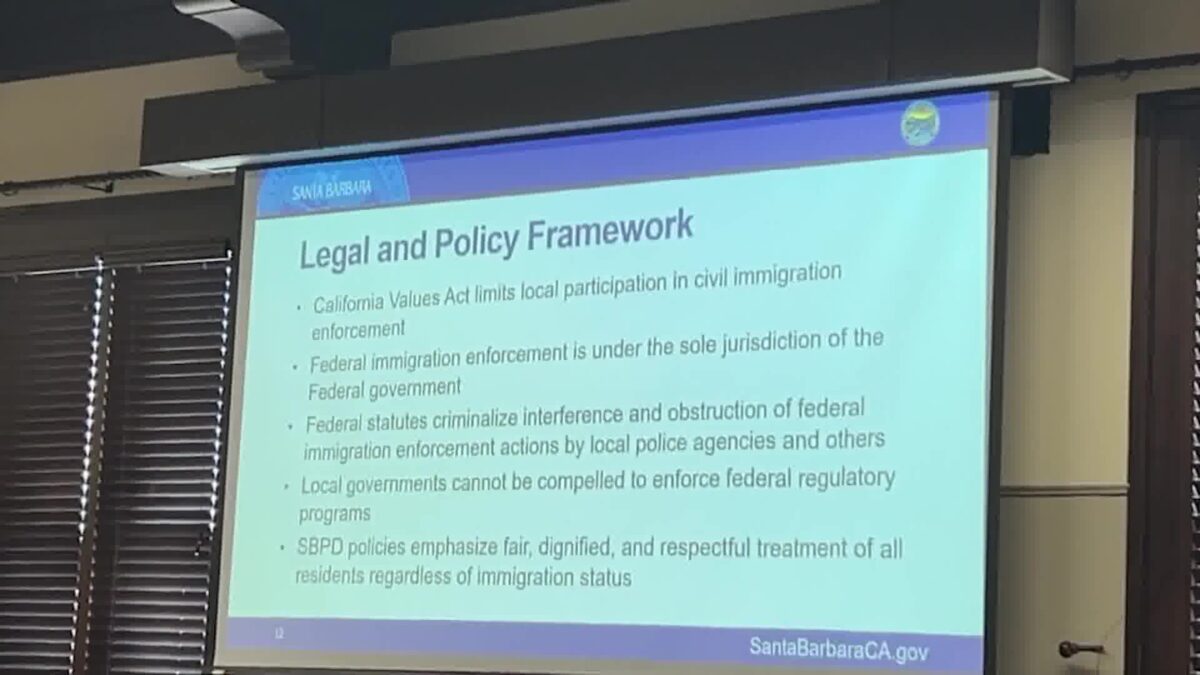
SANTA BARBARA, Calif. (KEYT) – The Santa Barbara City Council voted in favor of an updated resolution to re-affirm the city’s response to ICE.

The 6-1 vote followed a couple of hours of discussion.

The resolution promotes community safety, diversity and public trust in response to Federal Immigration Enforcement.

Mayor Randy Rowse voted against the plan due to signage that will mark public and private spaces in city facilities.

Rowse said he thought it would be confusing.

The resolution dropped a portion regarding Flock cameras.

The third party vendor’s cameras will be discussed in August following a July break.

“We want to be able to do more against ice so they don’t kidnap our neighbors who we really love um so I am happy this is a step forward but more steps need to be taken and getting rid of the Flock cameras I think is super important,” said Beckett Stabus-Friedmann.

Friedmann, who said he is with the Democratic Socialists of America, spoke during public comments.

Larry Behrendt of Indivisible Santa Barbara spoke, too.

He favors the signs and anything the city can do to help.

“It was a positive step forward by our city to express their values that all are welcome here and that we want to do everything a city can for everyone to be safe here,” said Behrendt.

During the discussion, one city council member said ICE has taken 97 people within city limits and 387 in the Tri-County area to date.

The Latest Breaking News, Weather Alerts, Sports and More Anytime On Our Mobile Apps. Keep Up With the Latest Articles by Signing Up for the News Channel 3-12 Newsletter.

Click here to follow the original article.

Shreveport Police Department timeline of mass shooting response

By KTBS News Staff

Click here for updates on this story

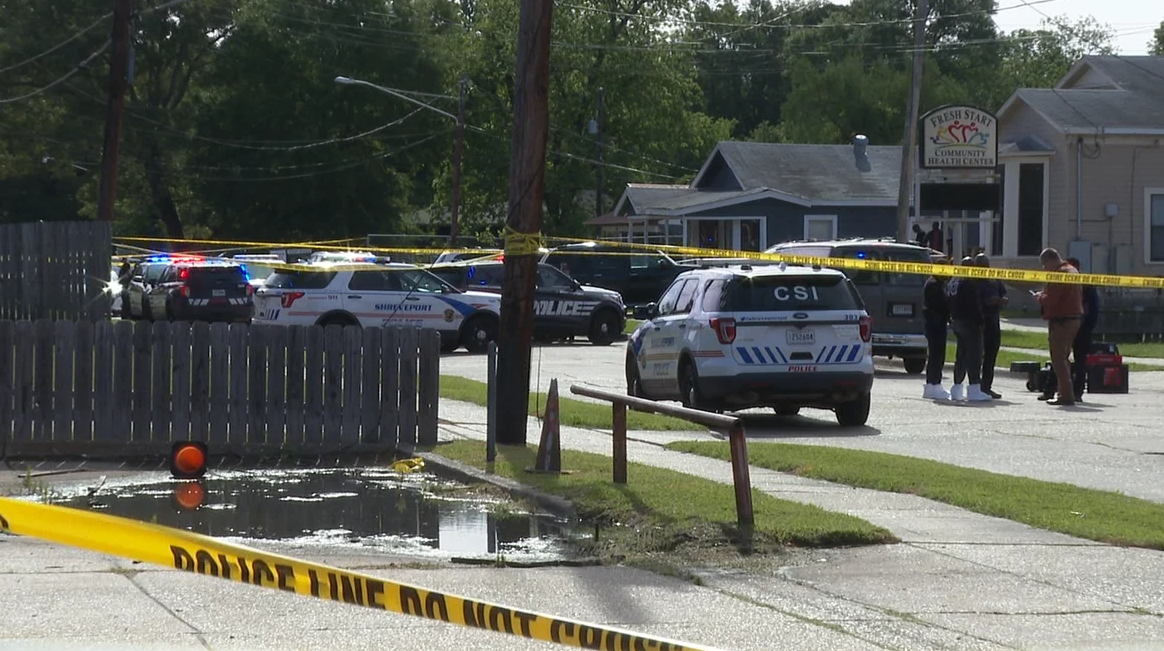
    SHREVEPORT, Louisiana (KTBS) — A mass shooting Sunday morning that left eight children dead is probably one of the most challenging incidents the Shreveport Police Department has ever faced, Police Chief Wayne Smith said during a news conference Monday.

“Will go down in history, be written in the pages of history; it was one of the worst days that could have ever happened,” Smith said.

He provided a detailed timeline of the events from the minute Shreveport police received the first call to just over an hour later when Shamar Elkins, 31, the man police say was responsible for the massacre, was pronounced dead.

Elkins is accused in the deaths of seven siblings and a cousin: Jayla Elkins, 3; Shayla Elkins, 5; Kayla Pugh, 6; Layla Pugh, 7; Markaydon Pugh, 10; Sariahh Snow, 11; Khedarrion Snow, 6; and Braylon Snow, 5.

“Within the immediate short period, after the first call came into SPD, our resources were deployed. At the same time, we were working five different crime scenes,” Smith said.

Here’s a look:

5:55 a.m. – First call to SPD from West 79th Street

Just before 6 a.m., around 5:56, officers received the first call about a disturbance in the 300 block of West 79th Street. The caller told dispatch she was on top of the house, said the suspect was inside, and reported that a man had been shot.

5:59 a.m. – More calls

Only three minutes later, another call came in — this time revealing that the suspect was a relative of the caller. As the information continued, dispatch learned that about nine people lived in the home. The caller said the suspect, later identified as Shamar Elkins, had shot everyone inside around 6 a.m. Moments after that, she told dispatch that she and her children had climbed down from the roof and were now hiding in the backyard.

6:01 a.m. – Police arrive at West 79th Street scene

Police arrived on scene at 6:01 a.m. Within minutes, officers made contact with the caller and asked the Shreveport Fire Department to stage nearby, close to Linwood Avenue.

6:07 a.m. – Harrison Street shooting reported

Then, just after 6:07 a.m., dispatch received another alarming call — this one from the 500 block of Harrison Street. The caller said her boyfriend had shot her, taken her three children, and fled the scene.

Investigators later confirmed the Harrison Street shooting and the West 79th Street shooting were connected and that everyone involved was related.

6:15 a.m. – Red Kia stolen

At 6:15 a.m., officers were told the suspect had carjacked a red Kia Sportage near West 79th Street, close to Linwood. Two minutes later, traffic units on routine patrol spotted that vehicle heading south on Interstate 49.

6:18 a.m. – Police chase into Bossier City

By 6:18 a.m., officers said the vehicle had crossed the Red River Bridge into Bossier City. Around that same time, police were warned that the children taken from Harrison Street might be inside the car.

6:23 a.m. – Elkins enters subdivision

The vehicle exited the interstate near the Swan Lake area around 6:23 a.m. shortly after, officers located the injured victims from the Harrison Street shooting at approximately 6:25 a.m.

6:29 a.m. – Gunfire exchanged

At 6:29 a.m., officers made contact with the suspect, and an exchange of gunfire followed. By 6:30 a.m., police confirmed they were engaged with the suspect in the 400 block of Brompton Lane.

About 10 minutes later, officers reported the suspect’s vehicle was empty, and no children were found inside.

6:43 a.m. – Multiple victims found at West 79th scene

Back in Shreveport, officers cleared the home on West 79th Street at 6:43 a.m., where they found multiple dead victims.

7:03 a.m. – Elkins pronounced dead

Just after 7 a.m., at 7:03, Shamar Elkins was pronounced dead at the scene on Brompton Lane.

Please note: This story was provided to CNN Wire by an affiliate and does not contain original CNN reporting. This content carries a strict local market embargo. If you share the same market as the contributor of this article, you may not use it on any platform.
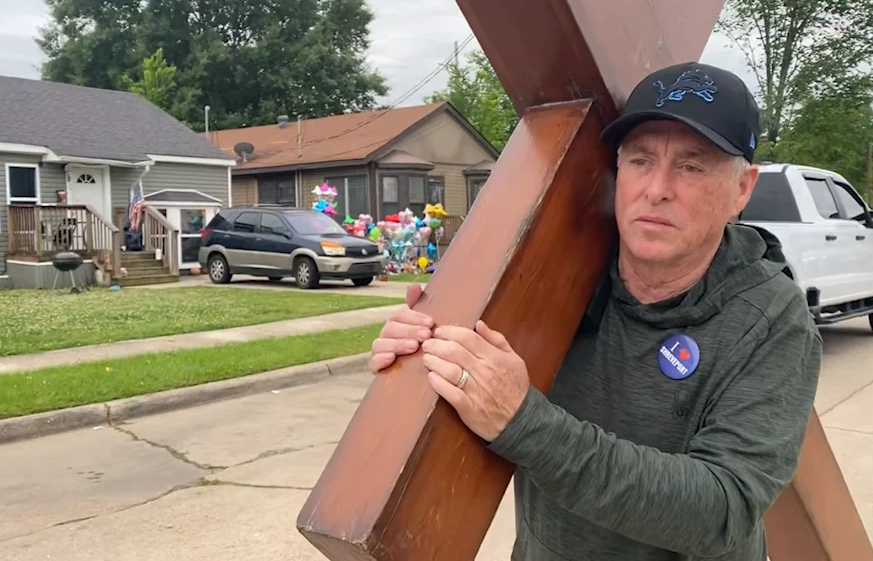
Michigan man brings cross to Shreveport in response to tragic killings

By Shannon Brinias

Click here for updates on this story

    SHREVEPORT, Louisiana (KTBS) — The devastating news that broke early Sunday about the murders of eight children has reverberated across the nation, prompting grief, reflection, and calls for healing.

For one Michigan man, the tragedy sparked action. Dan Beazley, who lives near Detroit, set out on a multi-state journey to Shreveport, carrying what he sees as a universal symbol of hope: a large wooden cross.

Beazley says his mission began several years ago in his home state, when he delivered the cross to the site of a school shooting. What started as a single act of compassion soon grew into a broader calling.

Now, whenever he feels compelled, Beazley travels to communities affected by violence or natural disasters, placing the cross where people can gather, pray and seek comfort.

“Jesus himself traveled days across the seas just to take a demon out of one man,” Beazley said. “So for me to travel from Michigan to Shreveport — if it can bring peace and calm and healing to just one person in this community — then it was well worth it.”

Over time, Beazley has logged hundreds of miles responding to tragedies across multiple states. He says the emotional weight of these journeys has never discouraged him from what he believes is his purpose: Doing God’s work and offering solace in moments of profound loss.

Please note: This story was provided to CNN Wire by an affiliate and does not contain original CNN reporting. This content carries a strict local market embargo. If you share the same market as the contributor of this article, you may not use it on any platform.