Couple hopes to donate embryos to help others grow their families

By Mallory Anderson
Click here for updates on this story
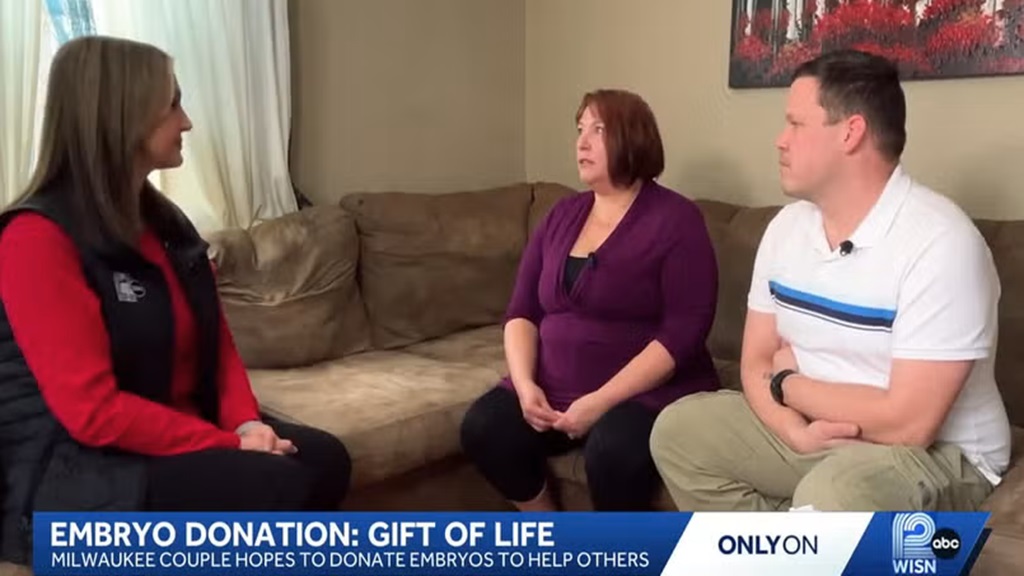
MILWAUKEE (WISN) — Rachel and Douglas Copher, a Milwaukee couple who grew their family through in vitro fertilization, are now hoping to donate their unused embryos to help another family experience parenthood.
The Copher home on Milwaukee’s south side is filled with the sound of little feet and laughter, a reality Rachel and Douglas once thought might never happen.
“We tried for about three years, probably, with all of the ovulation tests, all the crazy things, and we just couldn’t do it,” Rachel Copher said.
After one failed egg harvest and a few other bumps in the road, the couple eventually got pregnant through IVF, welcoming their son Dexter in August 2021 and their daughter Saya in May 2023.
“I can’t tell you how lucky we are that we were successful that easily with IVF, as so many people have trouble,” Rachel said.
Knowing the pain of dealing with infertility, the Cophers now want to help others experience parenthood.
“They are my everything,” Rachel said, tearing up. “And I want to help somebody else have that, too.”
With two leftover embryos, the Cophers faced a decision: keep the embryos frozen indefinitely, donate them to science for IVF research, destroy them, or donate them to another family. When they learned about that final option, they decided to give these potential daughters a chance at life and reached out to the agency Embryo Connections.
“What I discovered was that so many people wanted to donate embryos, but didn’t know how to do it,” said Deb Roberts, president of Embryo Connections.
Roberts founded Embryo Connections in 2018 after having her own two children through donated embryos. Her agency is now helping the Cophers find compatible potential parents through comprehensive questionnaires.
“We really want you to feel the fit, because my hope is that those two families are connecting in some way throughout their lives, because they have children who are genetic siblings,” Roberts said.
“You go through those thoughts of ‘What if?’ and it keeps you up a little bit at night, but it’s all about finding the right people you feel comfortable with,” Douglas Copher said.
“We’re trying to find somebody that has at least similar values to us, to raise our embryos, to give them a good life, and to know that they’re going to be treated well,” Rachel Copher said.
It’s not just Embryo Connections helping families on this journey. Dr. Jayme Bosler, a reproductive endocrinology and infertility specialist at Froedtert Hospital, said her clinic sees about 20 embryo donations a year, and there are various ways donor parents and recipient families connect.
“I’ve had couples that found each other on Facebook, and they knew each other in high school. So that, that was an option. Some just find each other anonymously through coworkers, and some go through these third-party companies,” Bosler said.
Donor parents do not receive payment for their embryos, but also do not bear any costs associated with the donation. Recipient parents take on costs for legal support and health screenings, which can be around $10,000.
“We also have processes where they meet with our clinical psychologist, both the couples that are donating and the couples that are receiving. So they kind of know what they’re getting into and have thought about all the extra emotional things that go along with this process,” Bosler said.
Embryo donation is not without controversy. Ethical concerns have been raised, and some religions, such as Roman Catholicism, condemn IVF entirely because it separates procreation from the marital act.
Roberts believes her agency is providing a solution for surplus embryos.
“The ability to give those embryos to somebody else is passing that gift forward and solving the problem of surplus embryos,” Roberts said.
“I think some people have the misconception that if they’re getting this embryo from someone else, that it’s not going to be their baby,” Bosler said. “But you are putting this embryo in the uterus. It’s growing entirely within you. You’re going to deliver it. You’re going to raise this child. So, honestly, it’s all perspective. I think it is definitely their child, whether it shares the genetics or not.”
The Cophers feel embryo donation opens the door to more choices for parents looking to grow their families.
“I feel like this is a great chance for whoever receives these embryos to go through the whole process. You know, the woman to go through process of growing that baby inside her, because that brings another connection,” Douglas Copher said.
Rachel reflected on the love she has for her children, emphasizing she hopes to bring that joy to another family through this journey.
“As they say, you never know true love until you have your kids,: Rachel said, holding back tears.
The Cophers are still searching for the perfect parental fit for their embryos and are open to hearing from local families who may be interested.
To learn more about the donation process, visit EmbryoConnections.org.
Please note: This story was provided to CNN Wire by an affiliate and does not contain original CNN reporting. This content carries a strict local market embargo. If you share the same market as the contributor of this article, you may not use it on any platform.