Colorado’s wildlife crossings can reduce animal-vehicle crashes by 90% — would you pay $5 to build more?

By Stephanie Butzer
Click here for updates on this story
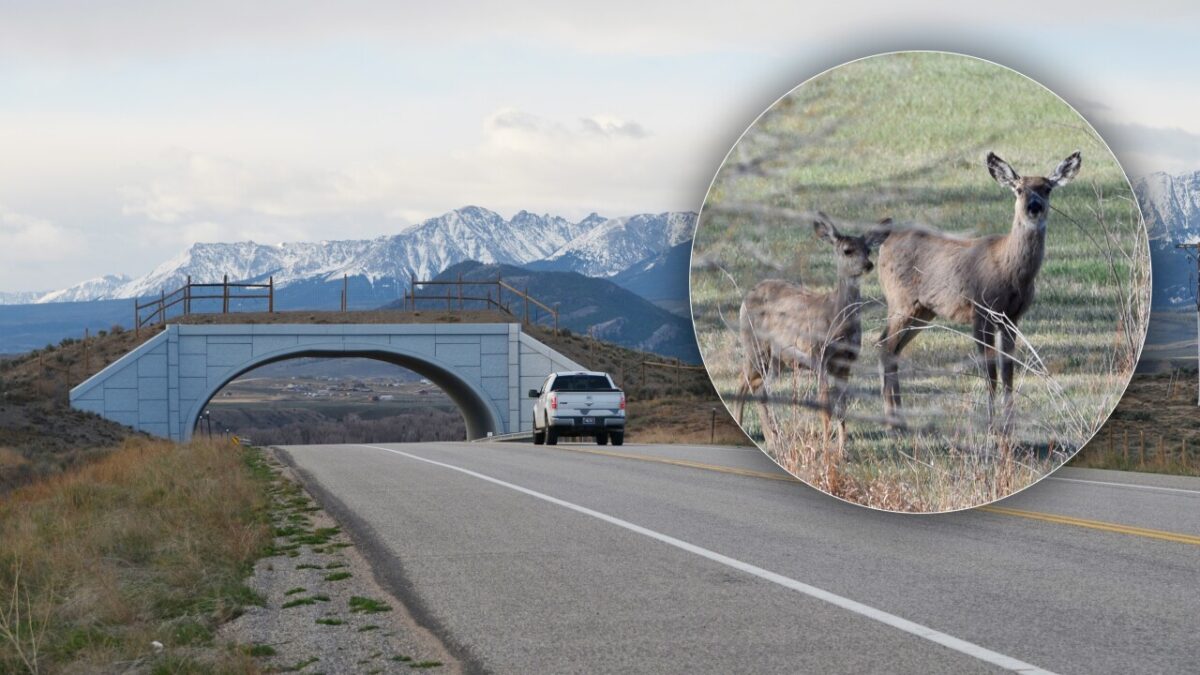
GRAND COUNTY, Colorado (KMGH) — In the pre-dawn darkness south of Kremmling, a lone deer followed a long fence along Highway 9 as it led her up to one of the first wildlife overpasses ever built in Colorado. She would cross safely, quietly, quickly. Drivers would never even know she was above them.
Lawmakers now have a bill before them that would help build more of these wildlife crossings by asking Coloradans if they would give an extra $5 to the cause when they register their vehicle. The state’s data shows its success: Wildlife crossings, paired with long stretches of wildlife fencing to funnel the animals to the safe passageway, work. Reductions in wildlife-involved crashes hover around 90% in most cases.
For Grand County residents like Mike Ritschard, a fourth-generation rancher who leaves his home in Kremmling to travel on Highway 9 on a near daily basis, improving safety on the stretch of road is an obvious win.
And not just for him, but for his entire Grand County community, the whole state, and all its visitors, he said.
He understands just how dangerous it can be.
Ritschard’s parents, Gene and Miriam, taught him the value of community early on, and the importance of doing what is right. Giving back was part of life. He had to rely on that after tragedy struck on a snowy, windy day on Dec. 3, 1985.
His parents were driving back home from Colorado Farm Bureau meetings in Colorado Springs on slick and snow-covered roads. Headlights appeared through the windshield, and they were hit head-on by another driver, Ritschard said. It’s not clear if, or how, wildlife was involved in that crash — nobody knows for sure, he said.
Gene and Miriam never made it home.
Ritschard, who was 23 at the time and playing basketball with friends, had gone to a local pub, where the chief of police found him and broke the news. His parents were gone. Brokenhearted, he called his three sisters to tell them what had happened.
In the days afterward, the community that the Ritschard family had supported for so long turned their attention to the four young siblings to help them navigate their new, painful reality.
Now, that’s the same community Ritschard hopes to protect with infrastructure keeping wildlife and drivers separated.
“I think that’s why you give back: You give back because they gave back,” he explained. “It was ingrained into us (by my parents) that no matter where you were, no matter what you were doing, you became involved, and that was the biggest thing. We learned to grow up and be part of it, as opposed to sticking our head in the sand and leaving.”
The Colorado Department of Transportation (CDOT) reports about 4,000 wildlife-involved crashes every year on average, but these incidents are immensely underreported. Estimates have found the actual number may be closer to 14,100.
In September 2024, Denver7 published an in-depth report on how Colorado was quickly becoming a leader in constructing wildlife crossings. As of then, the state had built more than 40 wildlife underpasses and three overpasses — the first two of which were constructed along Highway 9. Since that story, Colorado has also completed the largest wildlife overpass in North America, which spans over Interstate 25 in Douglas County. As Denver7 reported earlier this month, more crossings are planned by the end of the year across Interstate 70 at Vail Pass.
Under Senate Bill 26-141, Coloradans would pay an additional $5 when they register their vehicle to support the construction of future wildlife crossings, similar to the way Coloradans can already pay for a discounted state park pass through that registration. The $5 would go to the Collision Prevention Fund, which helps the CDOT and Colorado Parks and Wildlife build the projects. An opt-out option will be available.
“We’ve seen the places on the highway where you put in this infrastructure — it reduces collisions by over 90% almost overnight,” said Sen. Dylan Roberts, a Democrat who sponsors the bill. “So, they are incredibly successful… They prevent animal vehicle collisions, which prevents human death, human injury, as well as animal deaths, and they help save drivers money, because fewer wrecks mean fewer insurance claims, which brings down insurance costs for everybody.”
These crashes come with a cost — anything from a bill for vehicle repairs to the serious injury or loss of a loved one. CDOT and the Colorado Wildlife & Transportation Alliance report that Coloradans who crash into large wildlife pay about $80 million in property damage and $66.3 million in medical expenses each year.
The bill has received support from across the state and both political parties, Roberts said.
“People are realizing, from some of the testimony we’ve heard and some of the data that’s presented, that this is a statewide issue,” he continued. “We have animal-vehicle interactions in every part of the state — in cities, in suburbs, and, of course, in the rural areas. And this is a way to collectively solve a problem that our state has.”
That is why Ritschard jumped at the chance to learn more about the Colorado Highway 9 Wildlife Crossing Project — right in his backyard — more than a decade ago.
“In the back of your mind, you’re always like, ‘What can we do to help be part of this process, to maybe help alleviate those types of crashes and concerns?'” he said.
For that project, CDOT needed $45 million within a tight window. Towns, cities and county commissioners stepped up with large dollar figures, but Ritschard said a different kind of donation made a bigger impact on him.
“The ones that were probably the best and we were most appreciative of (were)… $5 donations from young kids,” he said. “Because they traveled the road, and they said, ‘Well, we want to protect the wildlife.'”
Completed in 2016, the project encompassed two overpasses — the first two in the state — five underpasses, more than 60 wildlife escape ramps, 29 wildlife guards and nine pedestrian walk-throughs over 10 or so miles between Green Mountain Reservoir and Kremmling. The effects were immediate: A 90% reduction in wildlife-vehicle collisions and more than 112,000 instances of mule deer using the seven structures to cross the highway, CDOT previously told Denver7.
“Deer use them. Elk use them. Pronghorns use them. They’ve got bear using them. Coyotes using them,” Ritschard said. “I mean, all species have used them… It was the best thing that could have happened. It truly was.”
Now, he hopes Senate Bill 26-141 will become law to provide funding for more crossings to be built in other wildlife-heavy areas. As of publishing time, there is no organized registered opposition to it. Ritschard, a Republican, said that is because all drivers benefit from the crossings.
“I truly believe in the projects. I believe in the wildlife fencing and the corridors for everyone’s safety,” he said.
So, would he pay the extra $5 on his vehicle registration if the bill passes?
“There’s no doubt about it, we would — we will — do that,” Ritschard said.
It’s just the price of a cup of coffee, he smiled, and he’d willingly give up one morning brew.
“Make it better for everyone as well as the wildlife that would be crossing, but truly for the people that are driving those roads,” he said. “I know that that animal is safe because it’s behind the fence. I know I’m safe because I’m on the road.”
Denver7’s Colette Bordelon contributed to this report.
Please note: This story was provided to CNN Wire by an affiliate and does not contain original CNN reporting. This content carries a strict local market embargo. If you share the same market as the contributor of this article, you may not use it on any platform.