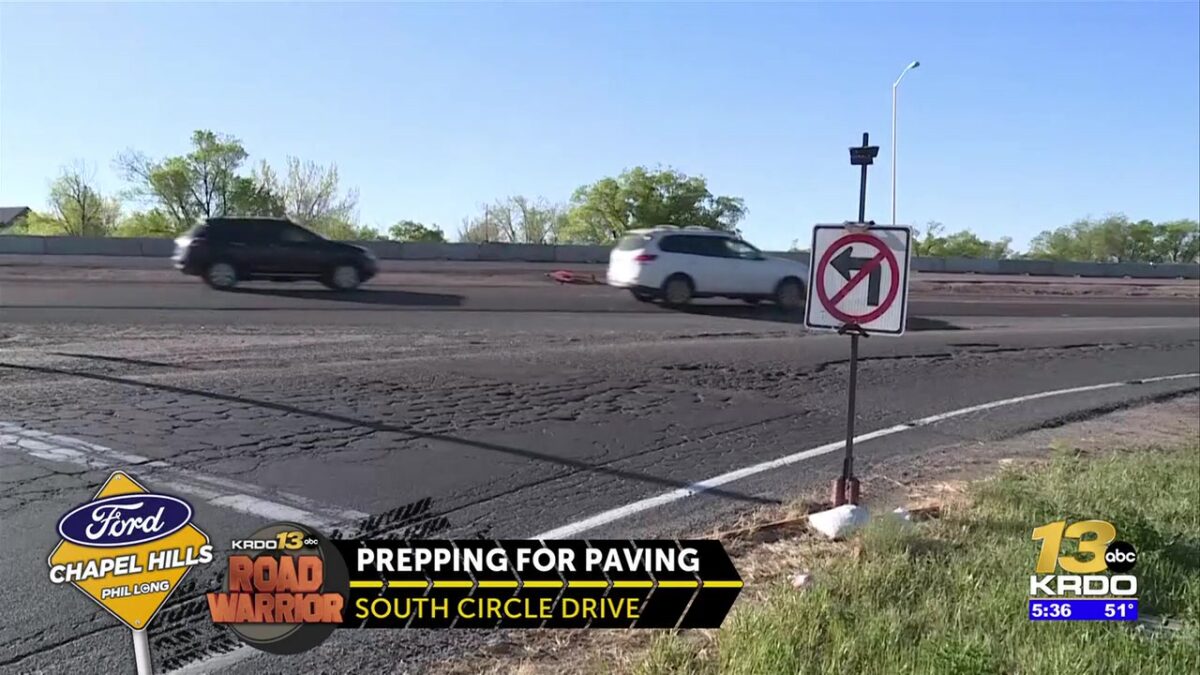
What took so long for crumbling Circle Drive in Colorado Springs to be repaved? City leaders explain process

Scott Harrison
COLORADO SPRINGS, Colo. (KRDO) — At a media briefing on Tuesday, an official said that it’s been at least 15 years since Circle Drive, the top priority for this year’s street paving season, was last repaved.

Yet many viewers have told KRDO 13’s The Road Warrior that the busy street through the center of town has been in bad condition for several years, and wonder why it wasn’t repaved sooner.
City officials explained that three factors determine how soon crews can repave a street: Weather, the availability of paving contractors, and the need for utility work or other projects there.

The weather hasn’t been an issue lately because conditions have been unusually warm and dry since the middle of last summer, but that followed a wet spring and early summer.
There’s been no problem with finding enough contractors this year, either; officials said that three contractors are involved in 2C paving work.

Completing other projects, such as the construction of concrete curbs, gutters, ramps, and sidewalks along the street, is the biggest challenge, said Corey Farkas, the city’s operations and maintenance manager.
“If it were as simple as just jumping on a roadway and being on the pavement, I’ve got ten years of paving that we’ve already identified,” Farkas said. “And we’ve got more beyond that.”
Farkas also said that having all three factors in harmony can allow crews to finish a paving season early and get a head start on the next year’s list.

For example, crews recently finished the weeklong repaving of Glen Avenue, a several-block street between Uintah Street and the north entrance to Monumet Valley Park; that project was scheduled for next year, but became a higher priority because of its condition and citizen feedback.

Another example is the city’s decision to accelerate its timetable for repaving Kern Street, a two-block street near the intersection of Galley and Wooten roads on the city’s east side; the city now plans to repave it next year because it is deteriorating sooner than expected.
This paving season marks the 11th year of 2C, the expanded paving program funded by a voter-approved sales tax increase.

Mayor Yemi Mobolade said that to date, a third of the city’s streets have been repaved, and the next ten years will generate $820 million to repave most remaining streets.
“We’re still catching up on 30 years of deferred maintenance,” Farkas said. “It took us a while to get into this and understand where we’re at. Now, we’re making steady progress.

The mayor added that 2C will continue its recent focus on neighborhood streets.
“You’re going to see more of this work happening in neighborhoods across our city,” Mobolade said. “Because taking care of our city means you show up close to where people live and not just in major corridors, but also on neighborhood streets.”

The mayor also mentioned that the first decade of 2C resulted in replacing or repairing 14,000 corner ramps that meet federal standards for the disabled, and a 30% decrease in pothole complaints.
“We can improve on that if more people report potholes when they see them,” he said. “Don’t assume that our crews know where every pothole is.”

Meanwhile, after removing old pavement from the south end of Circle this week, a paving machine arrived early Wednesday morning — raising hopes that the first new asphalt could be applied.
The city is repaving the northern six miles and the southern six miles of Circle; the mile-long segment between Platte Avenue and Airport Road is in good condition and doesn’t need repaving.