VAC gives glimpse inside new Opportunity Campus

Mitchell Kaminski
COLUMBIA, Mo. (KMIZ)
As construction continues on Columbia’s Opportunity Campus, community leaders are working to prepare both staff and the public ahead of the shelter’s opening this summer.
The Voluntary Action Center is hosting a series of training sessions aimed at educating the community about homelessness. Thursday marked the third of six sessions and the first held at the organization’s new offices on the Opportunity Campus.
Jessica McNear, shelter director for the Opportunity Campus, said the sessions are designed to address common questions and concerns.
“There are so many people that are invested and working already to support the unhoused population,” McNear said. “I thought it would be great to do the six part series where we take each night and kind of emphasize the different areas. People have had a lot of questions or concerns or interest in.”
The sessions are also helping prepare the public for the opening of the Opportunity Campus, a $18.6 million development that will include a resource center and shelter, with the facility expected to open in early July.
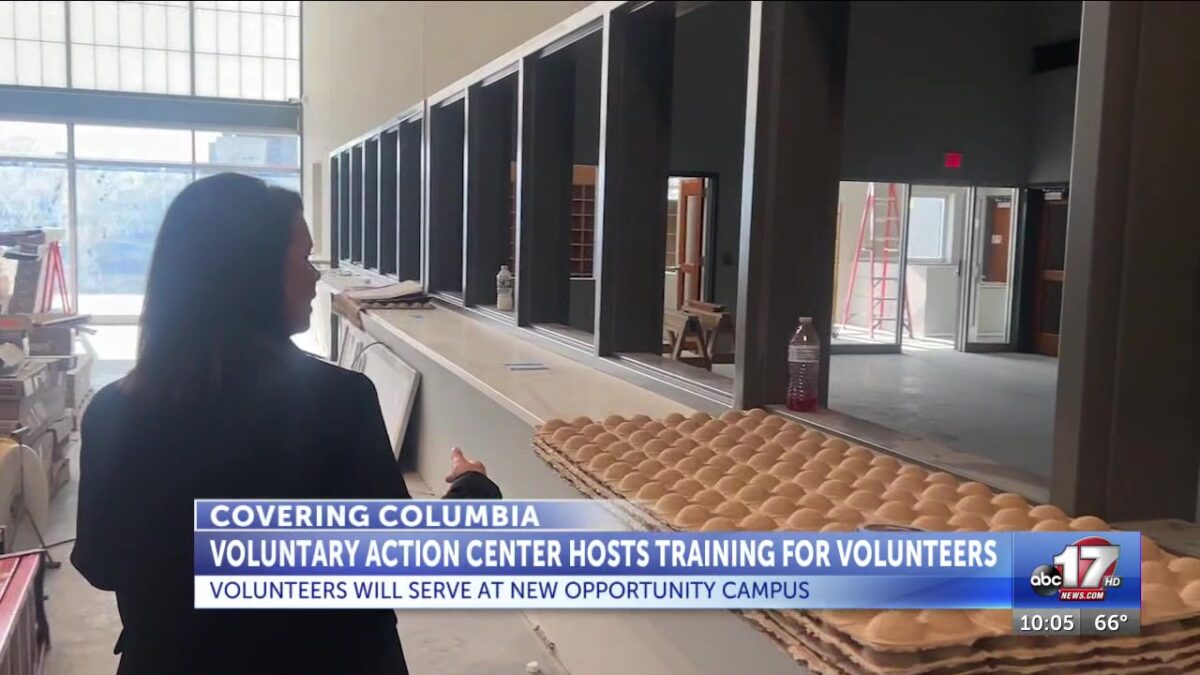
This week, the VAC opened its offices next to the shelter, known as “The Hub,” where services such as mail delivery, laundry, secure storage and computer access will continue.
ABC 17 News toured the nearly 30,000-square-foot facility, which is designed to better meet the needs of people experiencing homelessness. Currently, the overnight shelter operates out of a VFW building, a space McNear said is not suited for long-term use.
“The facility that we’re operating the overnight shelter in right now is a VFW. So it was not constructed to be a sleeping space for an overnight shelter. So people are sleeping in very close quarters,” McNear said. “The most we’ve squeezed into that building is 125, and that’s with some people just in a carpeted room. There’s no cots. They’re just kind of hunkering down and waiting out that cold weather.”
McNear said those cramped conditions can increase stress and anxiety.
“So it tends to get a little tense. People get a little irritated because they just have no personal space and nowhere that they can kind of go and decompress in solitude,” she explained.
The new shelter is designed to address those challenges. It will include space for up to 150 people, divided into separate areas to create a more comfortable and trauma-informed environment.
“With the new shelter, we’re going to have 150 beds divided into six areas that has been very deliberately designed to be as trauma-informed and relaxing as possible so people can really get good rest,” McNear said.
Those areas will include designated sections for men, women, people with pets and individuals with sensory sensitivities, as well as a dedicated space for veterans.
“We have our kind of louder section for our loud snores or people who talk a little bit louder, our men section, our women section, our animal owners have a section where they can actually use a trundle bed to utilize with their pets,” McNear said. “We have a sensory modulated area that’s going to be a little dimmer lighting. There’s air purifiers so that we can assist our folks who might have autism or really severe sensory disorders, not feel like they’re in a room with 149 other people and then an area specifically for our veterans, because they require a certain level of situational awareness to feel safe and really get a good night’s rest so that we can set them up for their best morning the next day as they can have to go out and be productive or get done whatever they need to get done.”
The facility will also partner with the University of Missouri Veterinary School to provide services for pets staying at the shelter.
In addition to sleeping areas, the building is divided into three main spaces: a sleeping area, a quiet workspace with showers, laundry and mail services, and a dining and kitchen area.
“The initial thought behind this building was one space that was multi-functional that would have been really hard to pull off on a daily basis,” McNear said. “Turning Point and Loaves and Fishes were a big part of the input process. I believe it was Turning Point that said, ‘Hey, we’re going to need more than just one space that transitions so that’s where the three separate spaces came about.”
The campus will also offer six showers, a computer lab and daytime programming, including volunteer-led classes like knitting and guitar lessons.
As the shelter prepares to open, staffing has grown significantly. The Voluntary Action Center now has 35 employees, up from about 15 last fall, with plans to hire more.
“When we open in July, we’re anticipating hiring about at least 15 more staff members,” McNear said. “We are going to have a safety and security team. Its relational for safety and security. So they are folks that know the population, they have great rapport with the population.There are best crisis intervention analysts and escalators, so they’re the ones if you are having a really bad day, who would you want to see,”
That team will also serve the surrounding neighborhoods and businesses.
“The team is also going to be providing safety and security to not just campus, but our residential and business neighborhood around us from about Range Line — East. So 24/7 anyone that’s in that residential neighborhood or businesses or nonprofits that are close, if someone’s on their property, they don’t recognize or loitering in their yard or the street, our team will go down,” McNear said.
As the VAC continues to prep for the shelter’s opening, McNear said the training session has been a good way to help address misconceptions about homelessness.
“They are morally corrupt in some way or they’re lazy. A lot of our folks work more than one job,” she said. “They are ten times more likely to be the victim of a crime versus the perpetrator.”
She added that financial barriers are often the biggest challenge.
“If you don’t have about $3,000, if you think you’re getting into a rental somewhere, it is nearly impossible,” McNear said. “There are a lot of great people who just don’t have a home right now.”
McNear also addressed concerns about people “flooding to the area,” saying past research does not support the idea that people will come to Columbia to take advantage of the shelter. She added the facility will be limited to people who live in the Columbia area, and staff will require proof of residency from those seeking services.