Foes of Bend’s planned natural gas appliance fee send out mailing, urge residents to oppose move

Barney Lerten
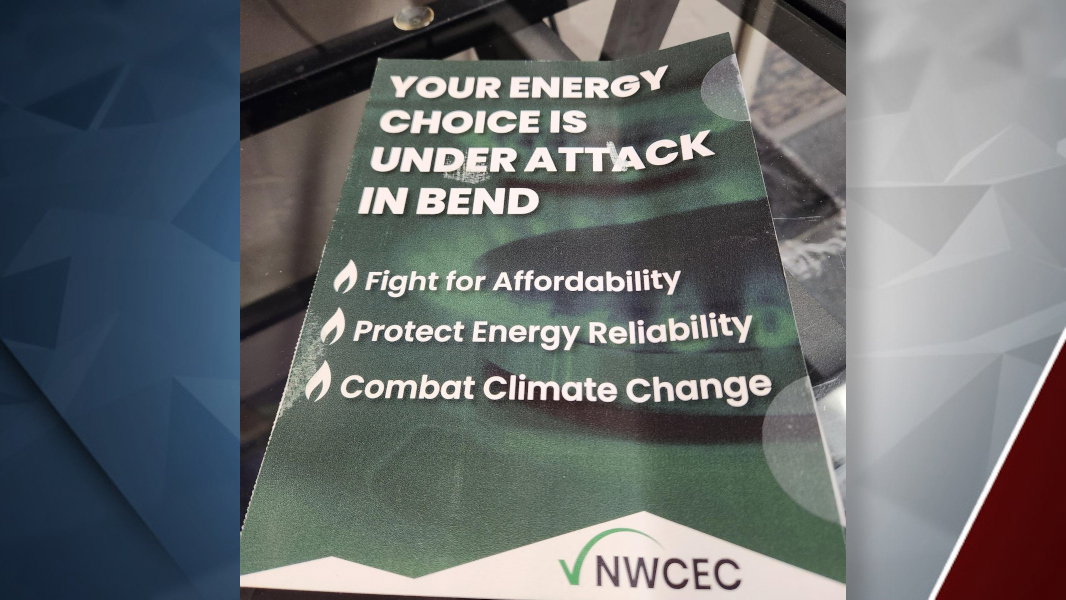
BEND, Ore. (KTVZ) — A brochure now landing in Bend mailboxes strongly urges residents to speak out against the city’s plans to impose a “climate pollution fee” of up to $2,300 on natural gas appliances in new homes, part of an effort to combat climate change and reduce greenhouse gas emissions.
“YOUR ENERGY CHOICE IS UNDER ATTACK IN BEND,” states the front of the mailing from the Northwest Coalition for Energy Choice, a group supported and apparently funded by the region’s natural gas industry.
The mailing urges residents to “make your voice heard” and to “stand up for energy choice and sound science.” It claims the new fee would “deprive Bend residents of their freedom to choose and threaten energy reliability for local families.”
The coalition asks residents to attend an April 22 city council meeting and to return an included postcard to Mayor Pro Tem Megan Perkins – who cast the lone no vote against the proposed fee in February’s 5-1 decision to move forward with its development.
The postcard says the fee will worsen the city’s housing affordability crisis and “will not achieve carbon reductions in Bend; electrification does not equate to zero emissions.”
The campaign also comes as Bend city councilors prepare to hold an electrification roundtable Wednesday at 4 p.m. Discussion topics include whether there should be exemptions from the fee on deed-restricted affordable housing, and whether to hold to a proposed effective date of Jan. 1, 2028.

Wednesday’s council roundtable agenda, along with the staff presentation viewable below, includes presentations by Cascade Natural Gas, Pacific Power and Central Electric Cooperative.
Bend’s electrification policy web page says the city has been “investigating options to reduce community use and reliance on natural gas in homes and buildings as a way to achieve our climate action goals.”
City Councilor Steve Platt told KTVZ News on Monday he’s led the council effort to enact an electrification fee. He pointed out that councilors did not set a much higher fee that would represent 100% of the total “Social Cost of Carbon,” a value set for each metric ton of carbon produced. That fee, he said, could have been added up to $12,000 feet on an average Bend home.
“Heck, that would be close to a prohibition – so we chose not to do that,” Platt said.
City of Bend Electrification PresentationDownload
The Bend fee, which the council set at 20% of the total “social cost,” comes amid a nationwide debate over the future of natural gas, as local environmental goals and state mandates on electrification lead industry groups to push back, raising concerns over energy affordability, the impact on housing costs and supply, among other issues.
Berkeley, California was the first U.S. city to ban gas hookups on new buildings, while in Oregon, Ashland last year imposed a fee that was estimated to add over $4,000 to the cost of a typical gas furnace.
In Bend, Platt noted, the city not only set the fee at only 20% of the social cost of carbon, but it created three tiers that scale the fee, based on the size of a new home. It’s also setting fees at various levels, depending on the appliance and how much carbon they emit.
The highest fee would be for a gas forced air furnace, which would have a $2,358 fee for new homes over 3,000 square feet. Add a gas water heater, stove, dryer and fireplace, and that Tier 3 fee would total $3,265. The Tier 1 total would be $1,415 for a home under 1,600 square feet, and $2,177 for an all-gas home in the middle Tier 2.
The opposing coalition has teamed up with some unions sounding the alarm over the fee and its potential impact on business and industry.
Platt, a physics teacher at Summit High, says he is a union member and has “spent a lot of time talking to the unions” about the planned fee.
“I would say Bend is on the leading edge,” Platt said, noting that Ashland’s fee is “a little more one-size-fits-all.”
In Bend, he said, “If you decide to do a high-efficiency (electric) HVAC, there goes $1,400 off the top of that fee. … If you want a (gas-fired) fireplace or gas stovetop, it’s a couple hundred bucks.”
Platt also noted “a state-level effort to clean up the electrical grid. The law says the state’s electrical grid has to be 80% clean by 2030 and 100% by 2040.”
“You can debate whether or not we’re going to get there, but that’s what the law says,” he said. “As a civic leader and a planner, you make assumptions. Like when I was leading military campaigns, you have to make assumptions.”
Based on current projections, Bend is going to need to add 80% more housing stock in the next 20 years, the city councilor noted.
Platt acknowledged, ”Is there some additional up-front cost for a high-efficiency electric home? Our consultant says yes, perhaps $7,000 – all up front,” depending on the size of the home or builder.
But he also pointed to a current Cascade Natural Gas rate hike request of 17% for the average residential customer, and noted projections of more rate hikes down the road. The utility says on its “Energy Choice” page, “Bans and limits to the use of natural gas may negatively impact energy reliability and affordability,” and has links that include the coalition.
Coincidentally, the city issued a news release Monday promoting its “Go Electric!” community workshops:
City of Bend Launches Go Electric! Community Workshop Series
The City of Bend is launching Go Electric!, a free community workshop series designed to help residents learn practical ways to reduce energy emissions, save money and create more comfortable homes.
Energy use, from heating and cooling homes to cooking food and powering transportation, is one of the largest sources of local climate pollution. Transitioning to efficient, electric solutions is a key strategy in Bend’s Community Climate Action Plan, and Go Electric! is designed to help community members understand how and why electrification matters.
Through interactive, in‑person and virtual workshops led by trusted local and statewide partners, Go Electric! breaks down electrification in clear, approachable terms. Participants will learn how electrification works, explore common misconceptions, and get connected to real‑world resources, incentives, and next steps.
“Go Electric! is about making the energy transition accessible and practical for everyone,” said City of Bend Management Analyst for Environment & Climate Megan Lee. “We want people to feel informed and supported as they explore options that can improve comfort in their homes while also benefiting our community and climate.”
All Go Electric! workshops are open to all community members. The series will launch with three workshops over the coming months:
Electrification 101
Learn what electrification really means, how it benefits individuals and the community, and what resources are available to help get started.
Wednesday, April 29, 5:30–7:30 p.m.
City of Bend Council Chambers (or join online via Zoom)
Speakers:
Brennan Breen, Energize Bend
Dan Cartmell, Electrify Oregon
Weatherization for income-Qualified Households
Learn about no‑ and low‑cost options like insulation, sealing and energy‑saving upgrades. Local experts will share information on available programs, eligibility and resources.
Wednesday, June 24, 5:30–7:30 p.m.
Bend City Hall, Awbrey Butte Conference Room (or join online via Zoom)
Panelists:
Satya Austin-Opper, The Environmental Center
Thomas Elzinga, Central Electric Cooperative
Jessica Taylor, NeighborImpact
Efficiency and Comfort for Renters
Homeownership is not a requirement to achieve a more comfortable, affordable and energy-efficient living space. This session dives into real‑world electrification solutions for renters.
Thursday, July 23, 5:30–7:30 p.m.
City of Bend Council Chambers (or join online via Zoom)
Speakers:
Tim Davis, Elevate NP
Jessica Taylor, NeighborImpact
To learn more and register for the events, visit the Go Electric! workshop webpage.
More workshop topics will be rolled out in the coming months. Future topics will include federal and state energy incentives, whole home planning, EV basics and charging, and more.