By Logan Dubel
Click here for updates on this story
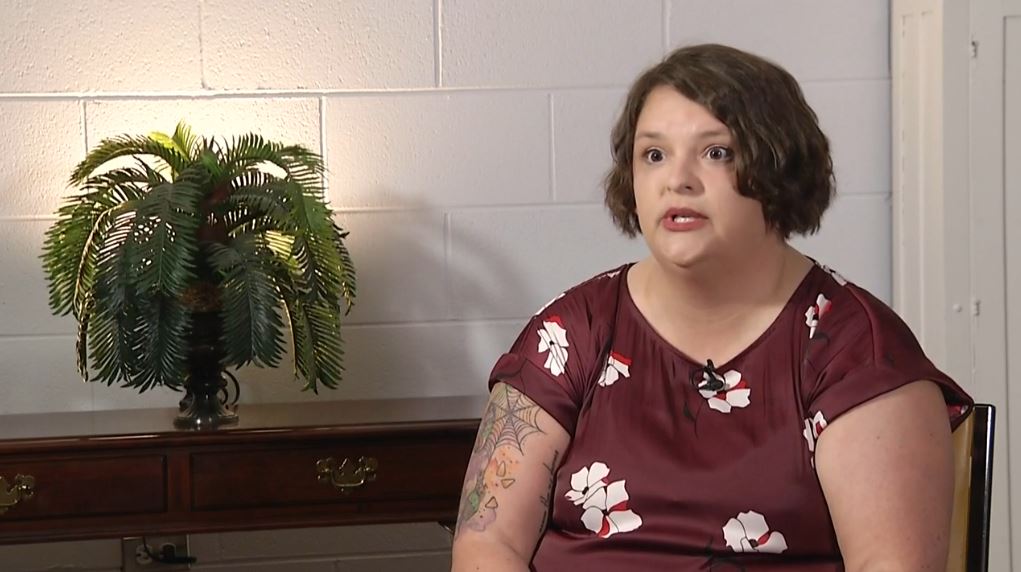
BRADLEY COUNTY, Tennessee (WRCB) — When Jennifer Carothers resigned from her role as a case manager at Tennessee’s Department of Children’s Services (DCS) last month, she tried to escape what she called a “moral dilemma” after spending 50+ nights in Bradley and McMinn offices with children. She says the children did not have access to showers, and some offices had mice issues.
“I felt ashamed for the first time in my career to be working for the department,” she said. “I felt like I was participating in helping to harm children instead of help children, and it was weighing very heavily on my conscience.”
Carothers talked with Local 3 just weeks after leaving DCS for the second time. She worked for the department from 2019-2020, before returning in April 2022. Local 3 reviewed a letter to Carothers from DCS as well as a tax form verifying her employment.
Local 3 learned she worked on a drug team and investigated cases of babies born positive for illegal substances.
“I was really passionate about what I did, and I’m sad to have left doing that, because I feel like I’ve lost my access to help children,” she said. “I’ve just really been trying to figure out what the best way is for me to speak out and to still continue to help children from the outside.”
Carothers spent more than 50 nights staying with children in Bradley and McMinn County offices. Children staying in offices often have higher levels of need and would not be placed in traditional foster homes.
In a 911 call obtained by Local 3 and aired as part of our previous investigation, a DCS employee called for help after an 11-year-old boy tried to “self-harm” himself in the Bradley County office.
Carothers said she spent time with the child, who is heard yelling in the background.
“He was very unhappy, very vocal about being unhappy,” she said. “He was telling workers during the shifts that he didn’t want to be there. In particular, he said to me, he just wanted to live somewhere where there were windows.”
No children have stayed in DCS offices since late January, DCS spokesperson Ashley Zarach said.
An email obtained by Local 3, sent by a regional secretary for the Tennessee Valley region at the end of February, said there would be “no more offices shifts going forward.” This would mean there is not the expectation staff would be needed to watch any children in offices.
But for Carothers, it’s too late.
She provided an affidavit as part of an emergency preliminary injunction, in an ongoing class action complaint, filed in May 2025 by A Better Childhood, a nonprofit litigation firm.
Carothers writes, “I cannot continue to participate in a system where the harm occurring in my presence outweighs the good I am attempting to do.”
She alleges children slept on four-inch-thick camping mattresses, and rooms in Bradley County had mice. She sometimes took children to First United Methodist Church in Cleveland before sunrise to take showers, so they could get the hygiene they needed.
“It sent workers who have good hearts and good souls and who are trying their best, and it’s put them in a place of crisis,” Carothers said. “It’s not uncommon to have workers crying in the office… The situation that is most heavy on my heart, honestly, is a young child who had some learning disabilities and was sleeping in offices for several months. [She] couldn’t keep her belongings together, would suddenly not have a coat, not have her toothbrush and she’s so young.”
Carothers said a 2025 reorganization of DCS regions, cutting the number of coverage areas in half to six, led to greater instability and burden for employees. She said she’d often have days where she needed to be in court for one case but quickly respond to another in a county far away.
Zarach said the restructuring helped standardize practices across the state.
Many comments on Local 3’s previous story praised the work of Isaiah 117 Houses, which provide a bed for children awaiting placement, typically for about 72 hours. Viewers suggested greater support for the nonprofit.
However, Zarach explained many of the children who were awaiting placement in offices had high levels of need and could not be safely placed in an Isaiah House. Additionally, the children in Isaiah Houses are often younger, and those 12 or 13 and above would not be placed there.
Rather, some of these children who were in offices may instead go to transitional homes, sometimes located on donated properties, and managed by private, licensed providers.
Additionally, a $421 million DCS real estate plan includes six welcome places, three wellness places and two youth development campuses.
However, Carothers said that isn’t the answer, at least right now.
“As a worker on the front line, coming to talk to me about a real estate plan when the building is on fire, is a little bit like bringing a fire prevention kit when the building’s already completely engulfed in flame,” she said.
Carothers doesn’t deny that some of the children in DCS custody can become aggressive and even violent. However, she disagreed earlier this month with a now-amended bill, SB 1868, which some advocates said would allow youth without criminal charges to be placed in juvenile detention centers.
“I don’t think that’s a solution, and it’s very concerning to me, the vague language of that bill,” she said.
An amended version removes language about children “in need of heightened supervision” and “authorizes a court to order a child to remain in custody of the Department of Child’s Services (DCS) for up to an additional six months if the court finds after a hearing or stipulation that the child has committed an assault against a staff member at the child’s residential placement.”
The legislation would also require DCS to establish a task force examining issues for children in custody.
As of early March, there were nearly 7,800 children in DCS custody, compared to around 4,800 in foster homes.
In search of solutions, Carothers said blame isn’t all on DCS. She’d also like to see reforms within the juvenile courts system and more resources for families.
“I heard a lot of the time when we were sitting in offices, ‘Well, we’re just doing the best that we can,’” she said. “But to me, that sounds like the same language that the parents are using. They’re also saying they’re just trying their best. So, if they’re just trying their best, and we’re just trying our best, at the end of the day, of the day, who’s helping the children?”
Please note: This story was provided to CNN Wire by an affiliate and does not contain original CNN reporting. This content carries a strict local market embargo. If you share the same market as the contributor of this article, you may not use it on any platform.