Idaho Falls Police now hiring entry-level officers

Maile Sipraseuth

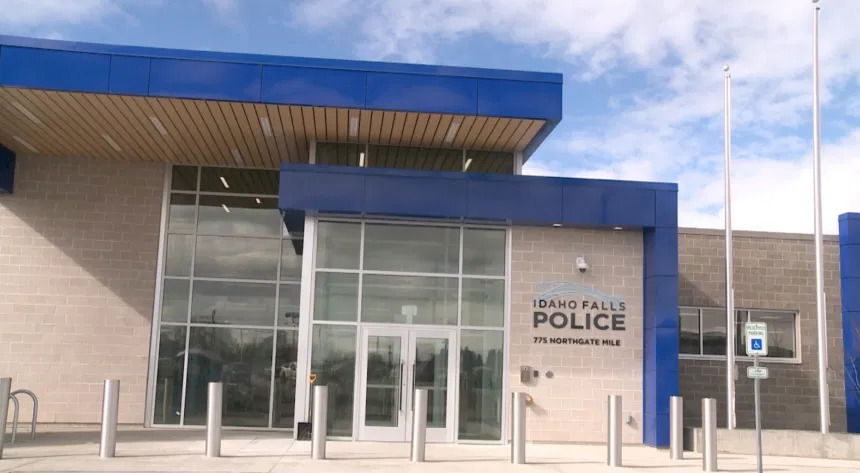
IDAHO FALLS, Idaho (KIFI) – The hiring cycle for the Idaho Falls Police Department has officially started. IFPD is encouraging individuals who have never served as police officers to apply for its entry-level Police Officer positions.

The department says these positions are continuously open and applications are reviewed on an ongoing basis.

New officer test prep will be on April 11, at 8 a.m. at the Idaho Falls Police Complex, and new officer testing will be on April 25.

Those interested in serving the Idaho Falls community are encouraged to begin the application process early to ensure they meet all requirements ahead of testing dates.

To be eligible, candidates must present the following requirements:

1.  United States citizenship (this is a POST Certification requirement).2.  21 years of age by date of hire.3.  High School Diploma or GED equivalent (copy of transcripts required).4.  A valid driver’s license.5.  The ability to successfully complete all testing requirements.6.  Good written and oral communication skills.7.  The ability to function on a day-to-day basis with limited supervision.8.  Certified by the Idaho Peace Officer Standards Training (POST) Council within one year of employment.9.  Successful candidates must pass a thorough background investigation.10.  Successful candidates must pass medical, polygraph and psychological examinations (after a contingent offer of employment).

Click HERE for more information.

Click here to follow the original article.

Week-long culvert replacement project begins on Grizzly Avenue

Seth Ratliff

IDAHO FALLS, Idaho (KIFI) — If your daily commute includes Grizzly Avenue, you may want to adjust your travel plans for the next week. Starting today, March 2nd, Idaho Falls Public Works crews are beginning a culvert replacement project at the Battle Creek Canal, which is set to affect traffic throughout the week.

From Monday through Wednesday, drivers can expect only minor lane closures with limited impact on travel times.

However, on Thursday at 6:30 a.m. Grizzly Avenue will be completely closed to all through traffic between Claredot Drive and the Skyline High School parking lot entrance. The closure will allow teams to excavate the roadway and install a new culvert pipe, designed to channel water beneath the asphalt.

Idaho Falls Public Works expects the road to remain closed until Friday afternoon. During this time, motorists will be detoured around the area using Skyline Drive and West 17th Street. While detour signage will be posted throughout the area, Pancheri Drive will remain fully open, and residents will be able to access their homes via Claredot Drive.

Public Works urges drivers to plan ahead, allow for extra travel time, and exercise caution when navigating near construction equipment. For more information about the project, contact the City of Idaho Falls Street Division at (208) 612-8490.

Click here to follow the original article.

New bill requires unexcused absence for student protests

Kevin Richert

Originally Published 2/27/2026 by IdahoEdNews

By Ryan Suppe and Kevin Richert

BOISE, Idaho — Public schools would not be allowed to grant excused absences for students attending political protests, under a new bill introduced Friday. 

Rep. Steve Tanner’s bill targets recent student walkouts over federal immigration enforcement. Leaving school for such protests would count as an all-day, unexcused absence. 

“While we recognize the First Amendment right to protest and to use political speech for all students, it’s a waste of taxpayer money for students to leave their classrooms in order to do so,” said Tanner, R-Nampa. “Students are free to protest at any other time.”

The bill would also require public schools to report annually to the state superintendent their total number of unexcused absences for political protests. The superintendent would then have to report the number to the Legislature. 

Idaho students from Boise to McCall to Idaho Falls have staged school walkouts in recent weeks to protest federal Immigration and Customs Enforcement. ICE agents shot and killed two people last month in Minnesota during an enforcement operation.

The House Education Committee voted to introduce the bill, setting the stage for a public hearing. 

But there were some questions. Rep. Jack Nelsen worried that restricting “political protests” would cast too wide of a net. The Jerome Republican wondered whether it would apply to students who testify at the Legislature, for instance, and whether it might discourage “political involvement from kids to get involved in things.”

The committee also voted to send two bills to the House floor, including: 

Senate Bill 1244, a DOGE Task Force bill that eliminates sections of state code that reference a regional library system that no longer exists.

Senate Bill 1227, which would direct the Idaho Department of Education to create a framework for the “responsible use of AI in K-12 education.”

The Senate has already passed both bills.

Click here to follow the original article.

ISP investigating weekend rollover crash on I-15 near Fort Hall

News Team

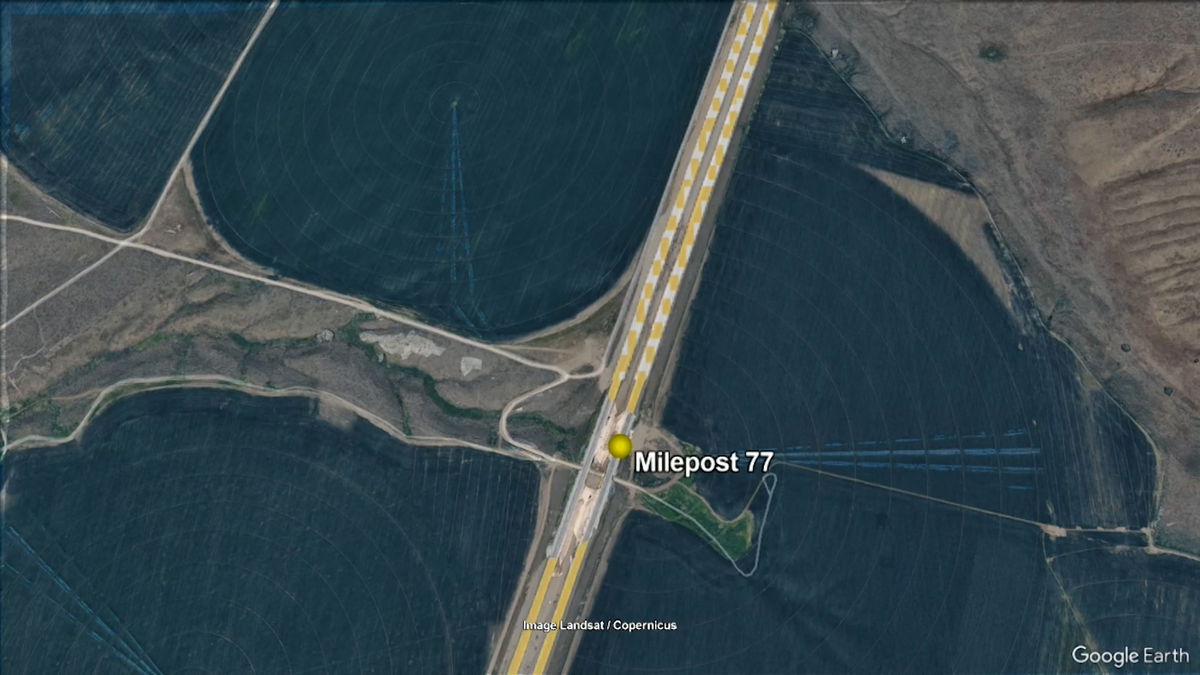
FORT HALL, Idaho (KIFI) — Idaho State Police is investigating a rollover crash on I-15 near milepost 77 in Bingham County, close to Fort Hall.

The crash took place on Sunday, March 1, 2026, at approximately 1:28 p.m. Troopers say a 74-year-old man from Idaho Falls was driving a Ford F-150 northbound in the left lane when a 39-year-old man from Stevensville, Montana, tried to pass him on the right in a Toyota FJ. As the Toyota moved back into the left lane before fully clearing the truck, the two vehicles collided.

The impact caused the Ford to spin out and roll over. The Toyota remained upright and came to a stop in the right lane.

Both drivers were wearing seat belts and were not injured. The right lane was blocked for about 25 minutes while crews cleared the scene. Two additional crashes were reported in the area as traffic backed up.

The crash is still under investigation.

Click here to follow the original article.

Twin Falls immigrants and refugees share their stories at ‘Becoming Idaho’ event

KIVI Staff

Originally Published: 27 FEB 26 13:14 ET

By Lorien Nettleton

Click here for updates on this story

    TWIN FALLS, Idaho (KIVI) — Two Magic Valley residents — a refugee-turned-advocate and a child of immigrants — are sharing their personal stories as part of a community storytelling event called “Becoming Idaho.”

Chandra Upreti, director of the Twin Falls office of the United States Committee for Refugees and Immigrants, is a refugee himself. He said his parents fled their home country of Bhutan when he was only 6 months old. After leaving Bhutan and before arriving in the United States, Upreti and his family lived in a refugee camp in Nepal for nearly 17 years.

“My parents fled when I was only six months old. I did not choose to become a refugee,” Upreti said. “Today I’m a very proud U.S. citizen, a parent, and also in a place where I’m able to help fellow refugees. It means a lot to me, and I’m looking forward to sharing my own personal story.”

Upreti is one of the guest speakers at the Feb 26 “Becoming Idaho” event, part of Idaho Solutions ‘The More You Know’ lecture series.

The event is an opportunity to highlight the diversity that has long defined Twin Falls.

“It’s really nice to see folks coming from different parts of the world,” added Upreti. “And live in a community that we all share.”

Twin Falls has welcomed refugees since the 1980s, resettling people from 47 countries over the past 46 years. Prior to the Trump administration’s restrictions on refugees, the office resettled about 200 individuals each year. Today, the center is on track to resettle fewer than half that number.

A pediatrician in Twin Falls and the child of immigrants from Honduras and Costa Rica, Dr. José Peña said he grew up in a bilingual household. He said those language skills allow him to connect with patients and community members who do not speak English.

“America has always been known as a land of opportunity, a land that’s welcoming to immigrants or to people that are from outside, and one of the ideals that I hope that a lot of people really cherish is that [we are] kind of a melting pot,” Peña said.

Peña said he hopes the event changes minds about immigration and diversity.

“I think it’s good to hear a different accent or hear someone speaking a different language,” Peña said. “My hope would be the people who can go to this experience and come away thinking ‘OK, this is actually a really good thing.'”

This story was reported on-air by a journalist and has been converted to this platform with the assistance of AI. KIVI verifies all reporting on all platforms for fairness and accuracy.

Please note: This story was provided to CNN Wire by an affiliate and does not contain original CNN reporting. This content carries a strict local market embargo. If you share the same market as the contributor of this article, you may not use it on any platform.

The-CNN-Wire™ & © 2026 Cable News Network, Inc., a Warner Bros. Discovery Company. All rights reserved.

Click here to follow the original article.

Idaho has $1.3 billion in rainy-day funds. Should that money help public schools?

Ryan Suppe

Originally posted on IdahoEdNews.org on March 2, 2026

By Ryan Suppe, Idaho Ed News:

BOISE, Idaho — Faced with a revenue shortfall heading into the legislative session, state leaders had three options to balance the budget: Reduce spending, tap reserves or restore tax revenue. 

The third option is unlikely in the GOP-dominated Legislature, which has overwhelmingly supported fast and furious tax cuts in recent years. But Democratic and Republican lawmakers this session have pushed for the second option, particularly as the impact of cuts comes into focus. 

Tapping the stockpile of state reserves could prevent budget cuts in the short term — including for public schools. Since the Great Recession, Idaho lawmakers and governors have socked away $1.3 billion in rainy-day funds, about 23% of state general fund spending. 

In a Feb. 12 press conference, Democratic leaders proposed spending $533 million in rainy-day funds to avoid cuts. Some Republicans, including Rep. Ben Fuhriman of Shelley, have also said they support using some of the reserves to bridge the revenue gap. 

But Republican Gov. Brad Little and the GOP chairmen of the Legislature’s powerful budget-setting committee want to preserve this money for a possible economic downturn in the future. Idaho’s economy continues to grow, and spending rainy-day funds could harm the state government’s stellar credit rating, they said. 

“When the economy is one of the top economies in the nation, that is not the time to be digging into our reserves,” said Sen. C. Scott Grow, R-Eagle, co-chair of the Joint Finance-Appropriations Committee.
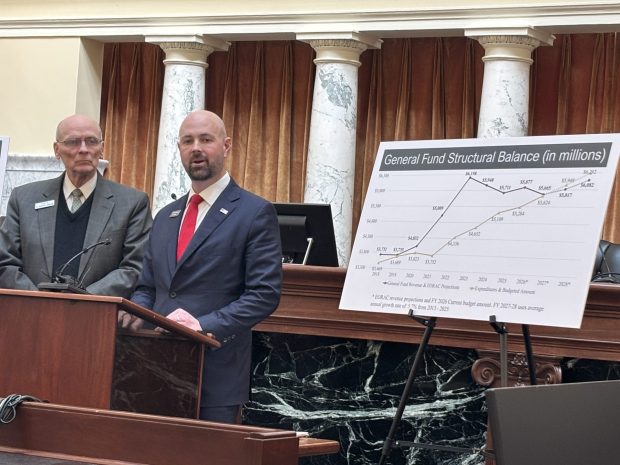
Budget committee co-chairs, Sen. C. Scott Grow (left) and Rep. Josh Tanner (right) discuss their budget cut plans with reporters on Feb. 19, 2026, at the Statehouse. (Kevin Richert/EdNews)

Lawmakers to vote on option one — reducing spending

Last year, the Legislature and governor enacted a suite of tax cuts and credits that reduced the state’s revenue by $453 million annually. At the same time, taxes that were still expected to come in started to miss projections.

By late summer, the governor’s office sounded an alarm. Little ordered most state agencies — excluding K-12 public schools — to cut their spending by 3% and to cancel any requests for budget increases during the 2026 legislative session.

Even after the governor’s cuts, the state faced a $40 million deficit for the current fiscal year, which ends June 30, and a $555 million shortfall next fiscal year, which starts July 1. This didn’t include the projected $155 million hit from conforming to federal tax changes in the One Big Beautiful Bill.

During his State of the State address Jan. 12, Little proposed more than $850 million budget cuts, reversions and transfers across both fiscal years — most of which would be one-time and aimed at bridging the shortfall until revenue rebounds.

Revenue has since improved. Tax collections are now tracking $112.6 million higher than projections for the fiscal year, according to the Legislative Services Office (LSO).
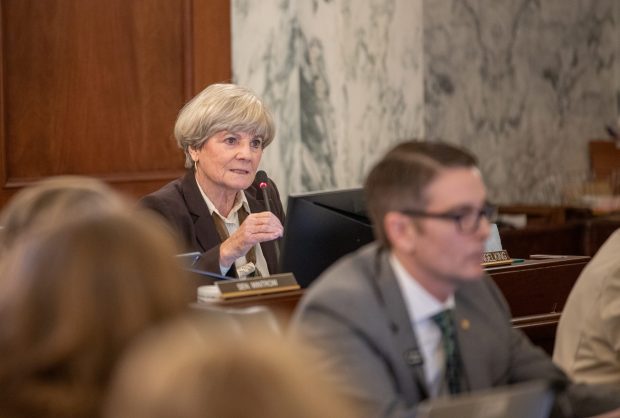
Sen. Janie Ward-Engelking at a JFAC meeting on Wednesday, Jan. 21, 2026. (Sean Dolan/EdNews)

But JFAC’s co-chairs are moving forward with deeper, ongoing spending cuts. They argue the cuts would ensure the state’s budget is “structurally balanced” and expenses line up with revenue. The House and Senate in the coming days and weeks will vote on additional 1% cuts this fiscal year and 2% next fiscal year. 

Colleges and universities would bear the brunt of the cuts, and layoffs and program reductions are already under way. Public school leaders are also preparing to cut their budgets or ask for new supplemental levies, even though K-12 is mostly exempt from both the governor’s and JFAC’s cuts. State funding hasn’t kept pace with rising costs to operate schools. 

“This is very disturbing, and this doesn’t need to be,” Sen. Janie Ward-Engelking, a Boise Democrat and JFAC’s longest-serving member, said during a recent committee debate on the cuts. “We have reserve funds. We have money. We could fix this.”

Idaho saves more than most other states

Idaho last year ranked in the top 10 nationally for rainy-day funds, according to a study by Pew Charitable Trust. The study, published in October, calculated how many days a state could operate on just its rainy-day funds. Idaho ranked eighth with 87.2 days. Washington was 49th with 12.8 days.

Rep. Josh Tanner, JFAC’s House co-chair, points to Idaho’s westerly neighbor as a cautionary tale. Washington lawmakers just passed the state’s first income tax after “borrowing from any stabilization fund they had,” Tanner, R-Eagle, told reporters during a Feb. 19 news conference. “They were unwilling to make hard choices, hard decisions to actually reel in their budget.”  

Amid a deficit, the Washington State Legislature is considering a 9.9% income tax on households that earn more than $1 million, among other budget proposals. But the tax hasn’t passed the full Legislature, only the Senate, and it would take effect in 2029. 

Idaho, on the other hand, has cut income taxes five times since 2021. Altogether, the cuts cost the state $4 billion in revenue over four years, according to the Idaho Fiscal Policy Center, a nonpartisan research group that’s been critical of state tax cuts, arguing they will cripple funding for services.

For Tanner, reducing revenue and giving money back to taxpayers is the goal. “We were growing in revenue at a massive rate,” he said. “We were trying to bring that revenue back down.”
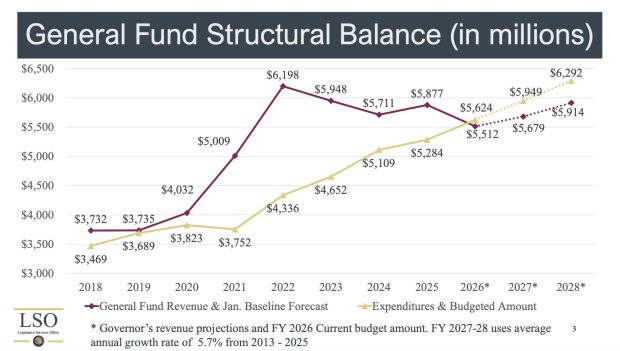
study by LSO

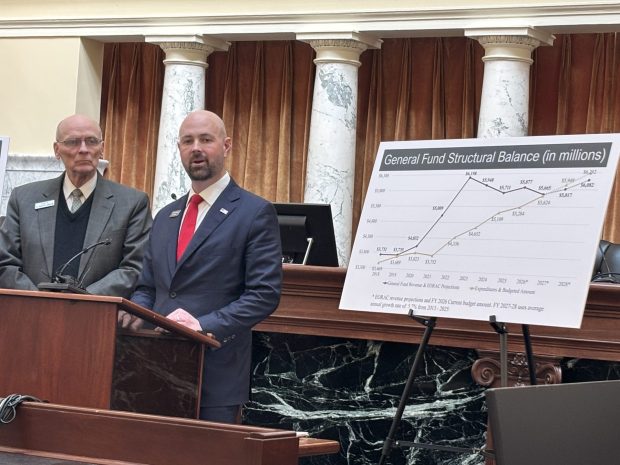
State revenue went from $3.7 billion in FY 2018 to a record $6.2 billion in FY 2022 amid population growth and a surge during the COVID-19 pandemic. In January, JFAC set a FY 2027 revenue target at $5.8 billion, which was 2.4% higher than a projection from the governor’s office.

Amid increasing revenue since the Great Recession, state spending has remained conservative, however. And state leaders bolstered rainy-day funds.

State general fund spending increased 0.4% per year, on average, since FY 2005 when adjusting for inflation and population growth, according to a study by LSO, a nonpartisan agency that supports the Legislature. But inflation-adjusted spending hasn’t returned to its two-decade high point in FY 2008, before the Great Recession.
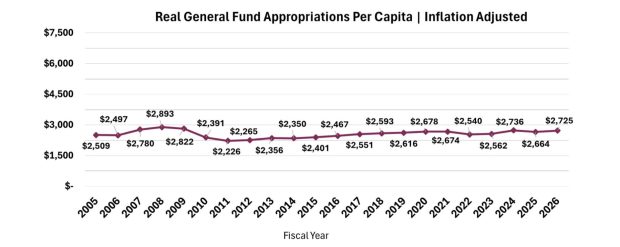
After the state exhausted its reserves during the recession, GOP leaders have since put away $1.3 billion in rainy-day funds. If you include the fund balance — what’s left over on the bottom line after budgeted appropriations — total reserves were $1.72 billion, or about 31% of general fund spending, when lawmakers adjourned last year’s session.

But using rainy-day funds now would only be a temporary fix to keep services fully funded after the string of tax cuts. Grow compared it to the way Congress operates — spending money that’s not backed by ongoing revenue.

“Let’s right-size the budget, and then when we do have a recession or a challenge, then we can deal with it appropriately,” Grow said. “That’s what those funds are reserved for.”

AAA credit rating benefits ‘whole state’

While the governor’s office is fighting JFAC’s plan for additional budget cuts, Little agrees with the budget co-chairs that rainy-day funds should be preserved for economic recession. 

The second-term governor also said that spending rainy-day funds could harm the state’s credit rating. Idaho is one of more than a dozen states with the highest grade, AAA, from the three major rating agencies. 

Credit ratings assess state governments’ ability to repay debt. Higher ratings indicate lower risk to investors, leading to more favorable interest rates on borrowing. 

Idaho takes on less debt than most other states. It has the second-lowest total debt, and it’s 47th in debt per capita, according to national rankings from the Reason Foundation, a libertarian think tank. But on Feb. 17, Little told reporters that Idaho’s strong rating benefits “the whole state.” It helps local governments more easily borrow money as well, he said. 

This is true for public schools that issue bonds to finance major building projects. While school districts can be rated separately when they issue bonds, they typically use the state’s credit enhancement program. It allows districts to issue bonds backed by the state’s AAA rating, lowering interest costs. 

“It took us a long time to get a AAA credit rating, and we don’t want to give that up,” Little said.
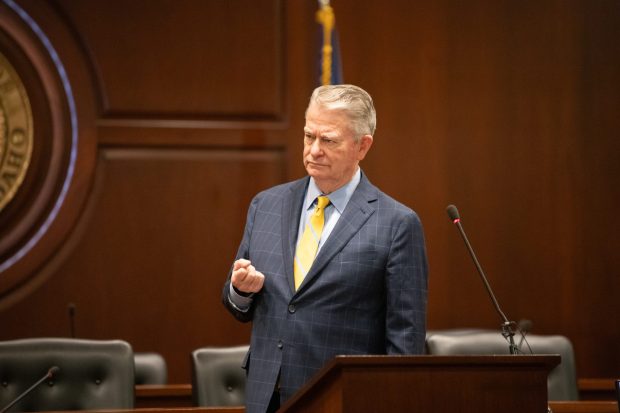
Gov. Brad Little listens to a question on Thursday, Jan. 8, 2026, at the Idaho Press Club’s Legislative Preview at the Lincoln Auditorium in Boise. (Sean Dolan/EdNews)

But this benefit is useful to public school districts so long as they can pass bonds, and that’s becoming increasingly difficult. Idaho is one of two states that requires supermajority voter approval for bonds. In 2023 and 2024, the Legislature and Little have cut in half — from four to two — the number of times per year that districts can hold elections. 

From 2001 to 2012, school bonds passed at a 58.4% rate, according to an EdNews analysis. From 2013 to 2023, the success rate fell to 42%. In the two years since the number of election dates were cut, just one of 12 bond measures have passed. 

“A concern and a worry that I have is any bonds being passed from here on out,” state superintendent Debbie Critchfield, a Republican, told EdNews in a recent interview. “With the threshold that they have anyway, (bonds are) going to be among the most challenging efforts that our districts make in the coming years.”

What about the third option — restoring taxes?

When state leaders forgo tax revenue and protect their savings it means less money is available for public schools. And unlike the state, public schools don’t have many levers they can pull to move revenue up or down.

Nearly 87% of public school funding comes from the state, while 10.5% comes from voter-approved bonds and levies and 2.7% comes from the federal government.

Some public school advocates, meanwhile, haven’t given up on the third option to balance the state’s budget — restoring taxes — which could also spare public education from cuts. 

And they’re invoking Shakespeare to plead their case. 

“To thine own self be true,” wrote TOADS, a nonprofit composed of current and former public school educators and administrators, in a recent news release.

The TOADS (Totally Optimistic Advocates Dedicated to Students) point to 89 state special interest tax exemptions, which write off about $2.8 billion a year that could help public schools and other agencies. 

The maxim from “Hamlet” urges state leaders — and the media — to look inward. “Are we ready to publicly admit Idaho’s agencies cannot be properly financed until we restore some of the tax base?”

Senate Assistant Minority Leader James Ruchti of Pocatello speaks during a news conference proposing alternatives to budget cuts on Feb. 12, 2026, at the Statehouse in Boise. (Ryan Suppe/EdNews)

Rep. Steve Berch, D-Boise, has called for a review of tax exemptions for years. House Minority Leader Ilana Rubel, D-Boise, is sponsoring a bill this session that would direct the Legislative Services Office to annually review exemptions and recommend whether they should continue. The House Revenue and Taxation Committee introduced the bill last week.

The legislation is among an assembly of Democratic budget proposals, which also call for restoring or pausing some of last year’s tax cuts.

After the state voluntarily reduced revenue for five years, people who rely on services will “pay the price,” said Senate Assistant Minority Leader James Ruchti, D-Pocatello.

“The Idaho Legislature blew it,” he said.

Click here to follow the original article.

KAWC general manager earns Lifetime Service Award

Dillon Fuhrman

PHOENIX (KYMA) – Arizona Western College (AWC) says KAWC and Border Radio General Manager Dave Riek has earned the Lifetime Service Award from the Arizona Media Association.

According to a press release, the award is to recognize Riek’s more than “40 years of dedication to public radio and service to communities across Arizona.”

AWC says Riek began his public radio career in 1985 as a student volunteer at KNAU-FM in Flagstaff, where he worked as a reporter, news director, producer, recording engineer, and operations manager.

AWC also says this year marks Riek’s 20th year as General Manager of KAWC and Border Radio.

Courtesy: Arizona Western College

“Working with Dave for more than 20 years, I’ve watched him embody what public service leadership truly means: quiet, consistent, and always focused on the work rather than the credit,” shared KAWC Development Director Alice Ferris. “When a station serving tribal communities went dark, Dave showed up with solutions. When the pandemic hit, and we worked remotely, Dave kept KAWC on the air. He has always put community service first in his work. He’s an unsung hero who will never get radio out of his blood, and this recognition is richly deserved.”

During his 40-year career, AWC says Reik helped develop Native American radio stations, worked alongside up-and-coming journalists, and got to interview a variety of Arizona govenors, from Evan Mecham to Katie Hobbs.

“One of my favorite things about working in radio is that every day is something new,” he shared. “While news (like history) sometimes repeats, it is always a little different every day.”

Riek will receive the Lifetime Service Award at the Arizona Media Icon Lunch on April 2 in Phoenix. To learn more about Riek, read the press release below.

KAWC’s Dave Riek earns Lifetime Service AwardDownload

Click here to follow the original article.
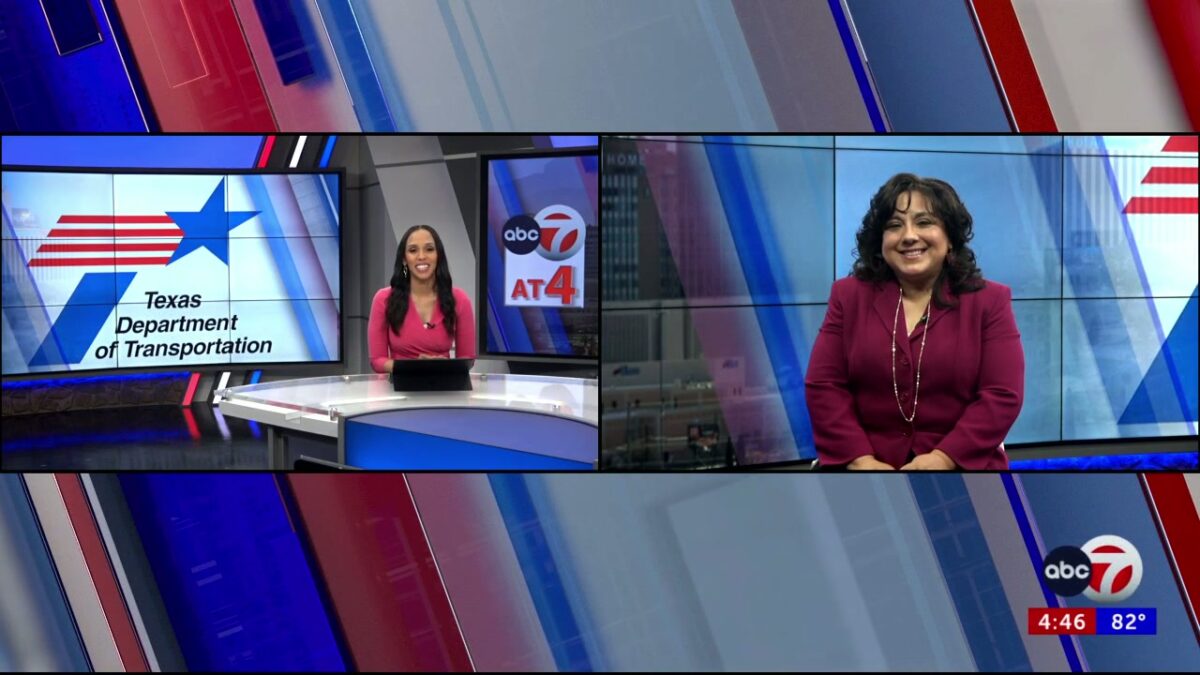
ABC-7 at 4: TX Dot’s launches “saved by the belt” campaign

Nichole Gomez

El Paso, TX (KVIA-TV)- TXDot’s “saved by the belt” campaign this month is reminding teens and young adults that seat belts save lives, but only if you wear them—for every seat, every ride. Lauren Macias-Cervantes explains that by instilling these habits now, we can help the next generation of drivers make safe driving decisions for the rest of their lives. 

Click here to follow the original article.
Aging Disputes: Lava Terrace Cellars submits revised winery plan amid mixed testimony

Matthew Draxton

BEND, Ore. (KTVZ) — Three year neighborhood debate over proposed tasting room and winery continues with the Deschutes Board of County Commissioners reviewing a modified application last week. The proposed winery on Bowery Lane is about five miles north of Bend.

Commissioner Adair and Commissioner Debone voted to close public testimony for the project, known as Lava Terrace Cellars, with formal deliberations scheduled for a later date. Commissioner Chair Phil Chang recused himself from the hearing due to potential conflict of interest having received $7,000 in campaign contributions from the Bayard’s, who are head of the Rock O’ Ranch Homeowners Association which is leading the charge in opposing the winery.

Property owners Duane and Dina Barker are seeking county approval for the small-scale winery and tasting room. The project has been under review for more than two years and has faced ongoing challenges from neighbors regarding zoning, wastewater and traffic.

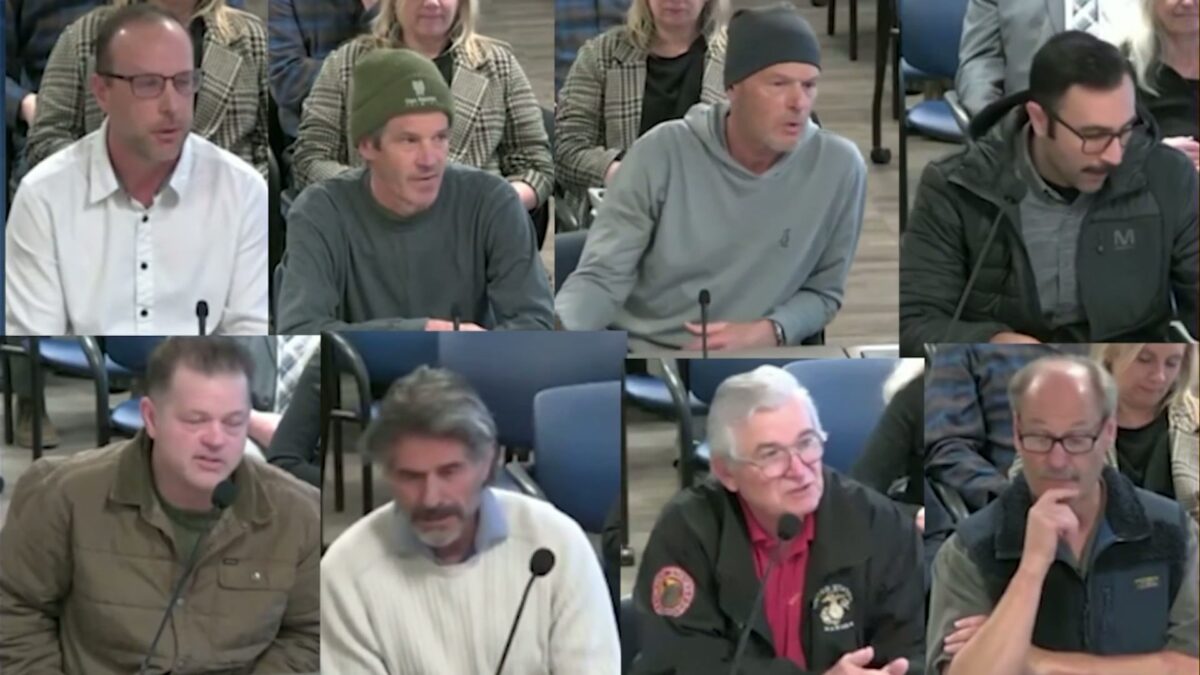
Carol Dollhousen, a neighbor to the Barker’s and Bayard’s who’s in favor of the winery spoke to commissioners, highlighting the small neighborhood community’s fragmented relations. She said, “The neighborhood is very divided. However, I do not think it is true that the winery divided the neighborhood.” Dollhousen added, “it was the tactics that were used and the way the HOA was done that was destructive to the unity and friendships and the community.”

Although a hearings officer initially approved the plan in early 2024, the current modifications were submitted to bring the project into full code compliance.

The Barkers presented several revisions to the application during the meeting, including a reduction in annual wine production from 2,000 cases to 1,500 cases. Other modifications include fewer parking spaces, updated fire access information, building compliance details and the removal of property from the public right of way. Barker told commissioners the changes were intended to satisfy regulatory requirements. “Since this has already been approved, we’re really just asking for the approval of the modifications that were being presented that bring everything into code compliance,” Barker said.

Michele Bayard, a neighbor and head of the Rock O’ Ranch Homeowners Association, argued that Oregon law prevents commercial activity on the property. While the land is currently designated as a multiple-use agricultural zone, Bayard contended that state statutes regarding wineries require larger plots of land. “Oregon law or as 215 452 explicitly states that an Oregon winery shall be cited on lands on exclusive farm use and must have a minimum parcel size of 15 acres,” Bayard said.

Wastewater management emerged as a primary concern for opposing neighbors. Toby Bayard, a resident in the area, warned that the winery’s operations could impact the local aquifer. “This amount of wastewater is definitely going to percolate down to the aquifer, particularly because of the porous soil,” Bayard said. “And it’s going to be a big lawsuit. And actually, State of Oregon can be held liable. Perhaps the county, if you approve it and certainly the Barkers.”

A legal representative for the Barkers stated that the applicants sought Department of Environmental Quality approval for their management plan. The lawyer explained that the proposal was adjusted to use holding tanks rather than ponds to manage the water used to clean and rinse equipment. “The wastewater management plan that DCPs reviewed and approved addresses is like the process by which that the potable water is used to clean equipment, rinse equipment and then it goes into holding tanks,” the lawyer said. The plan includes the use of several 275-gallon tanks.

Traffic safety on the dirt and gravel road was also debated. Neighbor William McVicker testified that residents frequently use the road for walking, biking and horseback riding and expressed concern that visitors would not see pedestrians around blind corners. Additionally, county transportation officials identified fencing, trellising and vines that are currently obstructing the public right of way. Officials stated these items must be removed as a safety requirement.

The hearing drew a packed house of supporters, including 14 individuals who spoke in favor of Lava Terrace Cellars. Proponents noted that the Barkers do not use herbicides or pesticides in their vineyard and argued that the appointment-only tasting room would have a minimal impact on traffic. Barker said the winery fits into the region’s long-term agricultural goals. “This will be something that actually supports the growth, the agritourism, the farm to table aspect of what the High Desert Food Alliance is doing and other organizations,” Barker said. “We want to support the agritourism that has been proposed in the 2040 plan.”

The legal authority of the Rock O’ Ranch Homeowners Association remains a point of contention between the parties. A lawyer, offering legal perspective to the record, cited a recent Deschutes County court case which he claimed invalidated the association and its restrictions on commercial activity. However, Bayard argued that the original 1966 declarations remain in effect and have been enforced. “The judgment is not final,” Bayard said. “So let’s not say we don’t have an HOA. We do have that HOA Does not allow commercial activity.”

County commissioners have closed the public record for the application. Deliberations regarding the proposal will take place at a later date.

Click here to follow the original article.
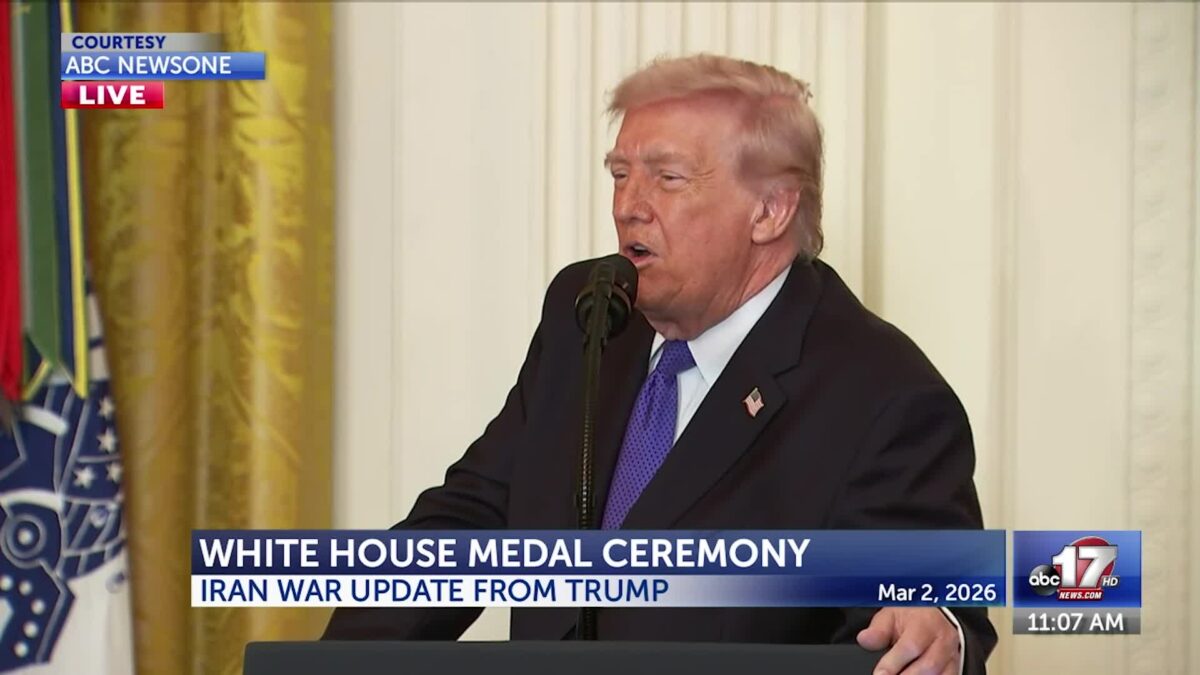
WATCH: President Trump gives update on Iran strikes from White House

Matthew Sanders

President Donald Trump gave a statement Monday morning from the White House about the American attacks on Iran during a military medal ceremony being held there.

Click here to follow the original article.