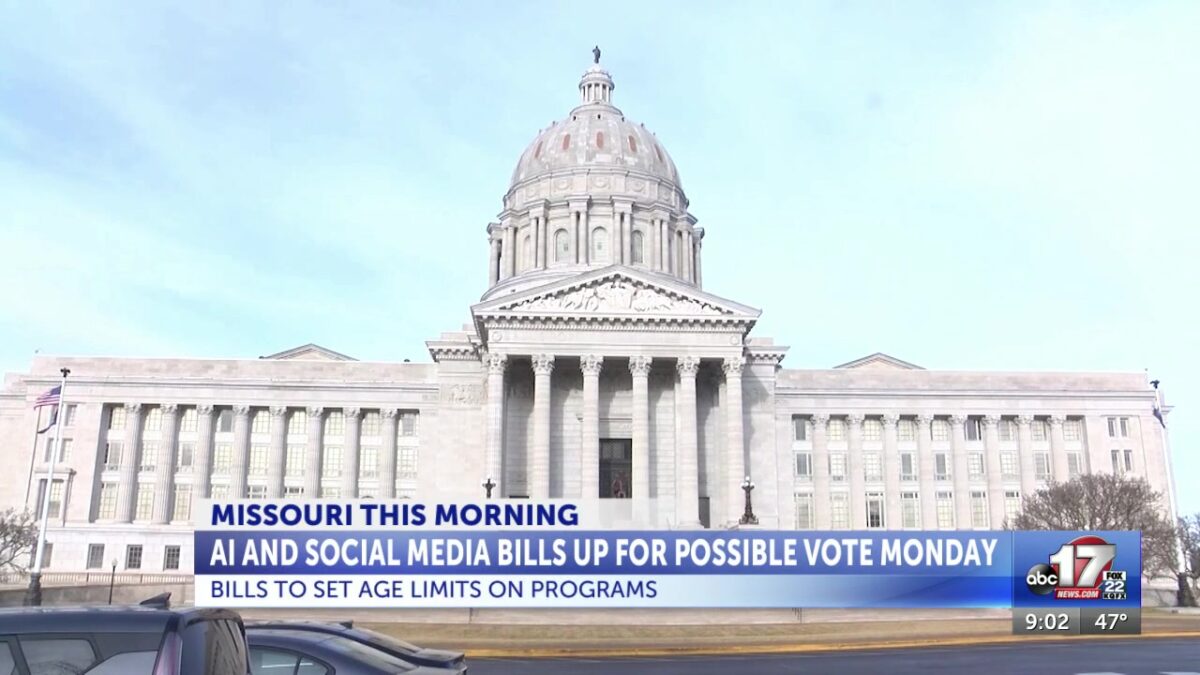
Social media and AI age verification bills up for potential vote in House Committee Monday

Marie Moyer
COLUMBIA, Mo. (KMIZ)
Three bills that add age verification to social media and AI programs are up for executive action Monday by the Missouri House’s Emerging Issues Committee.
House Bill 3393 and 2392, sponsored by Representatives Don Mayhew (R-Crocker) and Marty Murray (D-St. Louis), respectively, would establish the “Missouri Social Media Safety for Minors Act.”
The act would make it illegal for any minors under 13 to create a social media account. 14 and 15-year-olds would be allowed to make an account with a parent’s permission. Parents would also be given access to review, limit and delete the account.
The bill would make it illegal for social media platforms to let adults directly message minors or to design ads and algorithms that target minors. Fines can result in a penalty of up to $50,000 per violation.
House Bill 2032, sponsored by Melissa Schmidt (R-Eldridge), creates the “Guidelines for User Age-Verification and Responsible Dialogue Act of 2026,” also known as the “GUARD Act.”
The bill would require developers of AI chatbots to establish an ID-based age verification system by requiring users to make an account. If a user is found to be a minor, they will not be given access to the program.
The bill defines an AI chatbot as “An artificial intelligence chatbot that: Provides adaptive, human-like responses to user inputs; and is designed to encourage or facilitate the simulation of interpersonal or emotional interaction, friendship, companionship, or therapeutic communication.”
It also makes it illegal for developers to create a chatbot that “encourages, promotes, or coerces suicide, self-injury, or imminent physical or sexual violence.” Programs will also be required to disclose that the chatbot is AI and not a real human. Violations can result in up to a $100,000 fine.
According to the Age Verification Providers Association, at least 17 states have enacted laws addressing minors’ access to social media. However, several have been stalled due to court proceedings.
Public hearings were completed earlier on March 23.
According to House documents of testimonies, all three bills were supported by the Missouri Chapter of the American Academy of Pediatrics, the Missouri Psychological Association and the Missouri Network Against Child Abuse.
Opponents of the bills pushed back against the risks of data being collected through setting up an account to be age-verified.
“Age verification programs introduce a greater risk of sensitive data being used or even compromised, even though you might have a platform follow safety guidelines,” witness Riley McEvoy said.
Michael Dreyer voiced concern about user privacy, especially for LGBTQ+ youth who may use social media to find supportive communities.
“Parental consent requirements can expose vulnerable young people to family rejection or even conversion practices, requiring verified parental permission for accounts creates an insurmountable barrier,” Dreyer said.
Witness Sarah Berry also opposed both bills, adding in the AI bill that companies may be hesitant at developing technology in the state due to the restrictions.
“These systems produce probabilistic outputs, not prewritten scripts. Imposing $100,000 penalties per violation based on subjective interpretations of conversational outputs will create massive legal uncertainty and will discourage responsible companies from operating in Missouri at all,” Berry said. “The likely result is that Missouri residents lose access to emerging technology while the rest of the country moves forward.”
Libertarian think tank The Reason Foundation gave an informational testimony on both bills, pushing instead for safety protocols and limits instead of outright bans. They similarly pointed out risks of data management and account creation requirements for ID verification.
“It forces adults to give up anonymity just to use a general-purpose technology tool, where sensitive conversations can be had,” Reason Foundation Technology Policy Analyst Nicole Shekhovtsova said.
The committee will begin at 4:30 p.m. in House Hearing Room 7.