WBZ journalist who received co-worker’s kidney returns after open-heart surgery: “Humbling to think that someone could be that nice”

By Lisa Hughes
Click here for updates on this story
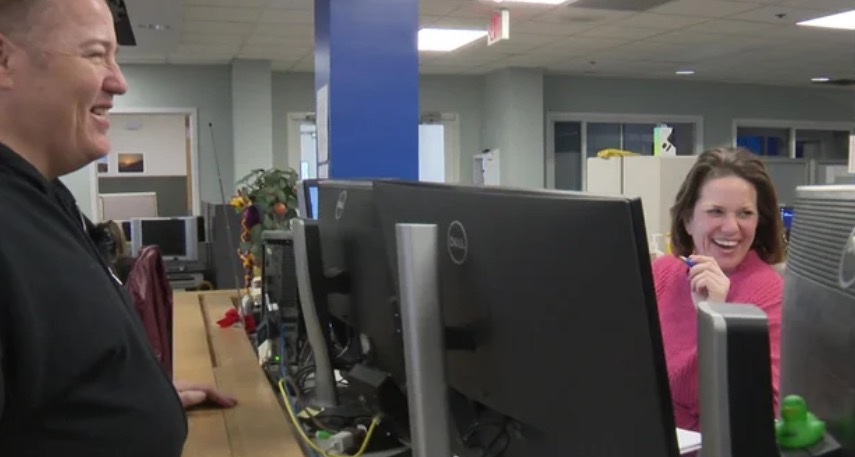
BOSTON (WBZ) — March 16, 2026, was worthy of celebration in the WBZ-TV newsroom. Four months and five days after assignment editor Andrea Courtois donated her kidney to photojournalist Jared Higginbotham, Jared returned to work. Hugs and applause marked his first day back in the office.
He felt healthy and energetic in a way he hadn’t for a very long time.
“I’d forgotten that I could be this person,” he explained. Jared suffered from chronic kidney disease for a decade and spent five years waiting for a transplant.
“I spent so much time … finding shortcuts and Band-Aids to feel like I had a normal life when it really wasn’t,” Jared said. “Now I’m like, I can do this again.” Asked how much of his good health he accredits to Andrea, he didn’t hesitate. “In my mind, she’s 100% why I feel that way,” he said.
Andrea is as humble and kind as she is generous. Jared’s return to work, she hoped, marked a return to normal for her friend and colleague.
“Just knowing that he can live his life again and not have to worry about dialysis,” Andrea said. “His coloring’s great.”
Life-changing transplant
It was Andrea’s decision, almost two years ago, that set in motion the life-changing transplant. After watching a story on WBZ about a living kidney donor with Type O blood, she filled out the Massachusetts General Hospital application online to become Jared’s donor. She went through months of testing (twice) without a word to Jared. She kept it to herself out of fear there would be a setback that stopped the transplant.
He was also keeping a secret. A member of Jared’s medical team had accidentally “let it slip” that Andrea was his match. In September of 2025—when Jared was cleared for the transplant surgery—he revealed to Andrea, with immense gratitude, that he knew that she was his match. With resolve and relief, they made plans for the operation.
Surgeons at Mass General performed the kidney transplant on November 11, 2025.
Andrea’s surgery took less time than Jared’s. When she awoke in the recovery room, she immediately asked about Jared. Confident in the surgeons and the outcome, she wasn’t worried, but she was eager to know that the kidney was working. Once he was out of surgery, a nurse wheeled her to the ICU where she found Jared eating pancakes. She laughed at the memory.
“I couldn’t believe it,” Andrea said. “I was nauseous. They were trying to give me food. And I was like, no.”
More importantly, it was clear from the beginning that Andrea’s kidney was functioning in Jared’s body. “It was weird to have so many conversations with a co-worker around pee,” she laughed.
Andrea’s medical team had warned her that she would likely be in pain immediately after the surgery. “They were like, ‘You’re gonna feel like you got hit by a truck.’ I felt like I got hit by a coach bus,” she said. But that discomfort didn’t last long.
Andrea was released from the hospital and back home a little more than 24 hours after donating her kidney. For that, she credits her medical team. “It’s really remarkable. Going to MGH and seeing a city within a city—what a well-oiled machine it was. From the check-in to the valet guy to the surgeons. I can’t even say enough about how wonderful they were. I was blown away. I have more gratitude for them, that they’ve figured out how to do this and make it so easy for the donors,” she said.
Andrea, who lives with her parents, was able to recover at home and, within days, start walking around her neighborhood. The ease with which she bounced back was a pleasant surprise. Before the transplant, she had never been hospitalized or even had stitches. “And to this day,” she explains, “I still haven’t had stitches. They glued me.” She has no scars from the surgery.
Jared suffers setback, open-heart surgery Andrea hoped Jared’s health health would also quickly improve. But 48 hours after the surgery, he suffered a major setback. The kidney function started to slow down. He couldn’t breathe. He felt a heavy weight on his chest. “Like it was a car or an elephant or something,” he recalled.
Rushed back to the ICU, he started receiving medication. “I’m asking them why they’re giving me the meds they’re giving me. And they say, ‘It’s the best solution when you’re having a heart attack.”
Suddenly, he was staring down a new crisis that would require open-heart surgery.
When Andrea found out, she was devastated. “I didn’t prepare for the emotional rollercoaster,” she said.
She and Jared stayed in touch. Doctors sent him home with medication to stabilize his heart and strict instructions to limit any exertion. His parents and brother moved in to care for him. The time at home (Jared joked that his dogs saw a lot of him this winter) also allowed the kidney to heal and get stronger.
On December 29 he returned to MGH for quintuple bypass surgery—a six-hour operation to create new paths for blood to flow around Jared’s blocked arteries. Andrea was one of his first visitors after the surgery. “Not only did she donate a kidney, but she’s been in constant contact with me the whole time,” Jared said.
Her dedication to a friend in need is not surprising. At their home in Attleboro, Andrea’s mom admits that she was nervous for Andrea and Jared before the transplant surgery but couldn’t be prouder of her daughter. “It’s kind of a miracle they both work in the same building, and he’d gone that long before finding a kidney,” Anne Marie Courtois said. “I’m very happy for him. She gave him a life. That’s what it’s all about.”
How to become an organ donor
Andrea’s living donor coordinator at MGH, registered nurse Alison Bomm, praised Andrea’s selflessness. “I really respect and admire her for coming forward,” she said. The two talked for months about Andrea’s testing, her overall health, and what to expect post-surgery. Bomm says that by talking about her experience, Andrea may encourage people to become living kidney donors.
The first step is to apply through the hospital’s website: mghlivingdonors.org. Prospective donors can identify an intended recipient (as Andrea did) or simply offer to donate a kidney to someone in need. Applicants receive a packet of information from the program and sign a medical release form so that doctors can review their records. Donors then talk with an MGH donor advocate—a social worker who provides support throughout the process.
As Andrea can attest, there’s quite a bit of testing to ensure that a donor is healthy enough to undergo the surgery and that the organ is suitable for the recipient.
“Red carpet treatment” for donors
Donors receive more education at each step of the process. Bomm said the team is in tune with their needs.
“They are giving an organ which is an extraordinary act of kindness,” Bomm said. “So, in return, we want to treat these patients with all the respect and the information that they deserve. We call it the red carpet treatment for these patients because they don’t need to have the surgery. It’s not something that’s going to help them or that they need to move forward. It’s just truly out of having a good heart to help another person.”
For Bomm, who was a dialysis nurse helping critically ill patients for more than 30 years, working with living donors like Andrea is particularly fulfilling. “It’s very encouraging,” she said smiling. “It’s very heartwarming that people want to help.”
Bomm also points to the National Kidney Registry as a resource for donors who may not be compatible with their intended recipient. A partnership between MGH and the National Kidney Registry allows for a “swap.” Someone else gets the donor’s kidney and the intended recipient moves up the transplant list to receive a kidney from someone else. Bomm says that about 25% of the kidney transplant surgeries are through the swap program.
“Ultimate way to help someone”
Andrea wants people to know that donating a kidney is “easy.” She said she feels great. “I’m completely myself,” she said.
“Maybe it’s the ultimate way to help someone if you can’t do it monetarily or if you can’t donate your time and volunteer—because of the hours we work.” She’s been listed as an organ donor with the Registry of Motor Vehicles from the time she got her first driver’s license. “So why not be a living donor if you can?”
Jared hopes that potential donors watch their story and consider following Andrea’s example. According to several organ donation networks, more than 90,000 Americans are waiting for a kidney transplant. The American Kidney Fund reports that fewer than 6,500 living donor kidney transplants were performed in 2024. Transplants from living donors are, statistically, more successful than those from deceased donors.
Jared’s message to patients waiting for a transplant is to stay as strong as possible—physically and emotionally—and remain hopeful that a donor will come forward. “Don’t stop fighting to find one. They are out there,” he said.
Jared is still healing. He will have more cardiac rehabilitation over the coming year and regular check-ups with his doctor. But for the first time in years, he can imagine going to concerts and taking vacations without worry. Standing just a few feet from Andrea in the newsroom, his gratitude was palpable.
“It’s just humbling to think that someone could be that nice,” Jared said.
Please note: This story was provided to CNN Wire by an affiliate and does not contain original CNN reporting. This content carries a strict local market embargo. If you share the same market as the contributor of this article, you may not use it on any platform.