‘The genie’s out of the bottle:’ Little signs artificial intelligence education bill

Kaeden Lincoln
By: Kaeden Lincoln
Originally posted on IdahoEdNews.org on March 26, 2026
Idaho Gov. Brad Little signed a bill instructing the Idaho Department of Education to develop a statewide framework for integrating generative artificial intelligence (AI) into classrooms.
The framework will serve teachers just as much, if not more, than students, said State Superintendent Debbie Critchfield.
Critchfield once asked a classroom of fourth graders if they use AI every day. All of them raised their hands, she told reporters after the bill signing ceremony.
“The surprised group in the room were the adults,” Critchfield said. The framework the Idaho Department of Education develops, she said, should “force adults to catch up with kids.”
Before Little signed Senate Bill 1227, the state had no guidelines for AI use in schools. The law is open-ended so it can adapt over time.
“We didn’t tie down the bill,” said Sen. Kevin Cook, R-Idaho Falls. Cook, a software engineer, sponsored the bill in the Senate.
The law requires the framework to be “human-centered,” transparent and safe.
By “generative AI,” the bill means chiefly text, image and video generation, according to the bill’s own definition.
It excludes AI models that “have the primary goal of classifying data, such as those in automated vehicles.”
“You can make the argument that the AI genie is out of the bottle,” Little said. “Nobody’s putting that genie back in the bottle.”
Little referred to Moore’s Law, an observation made by former Intel leader Gordon Moore in 1965, which essentially proposed that semiconductors, the computer component that enables AI to “think,” would shrink to half their size every two years.
“Everybody thought it wasn’t going to happen,” Little said of Moore’s Law, “and it just continued to happen.”
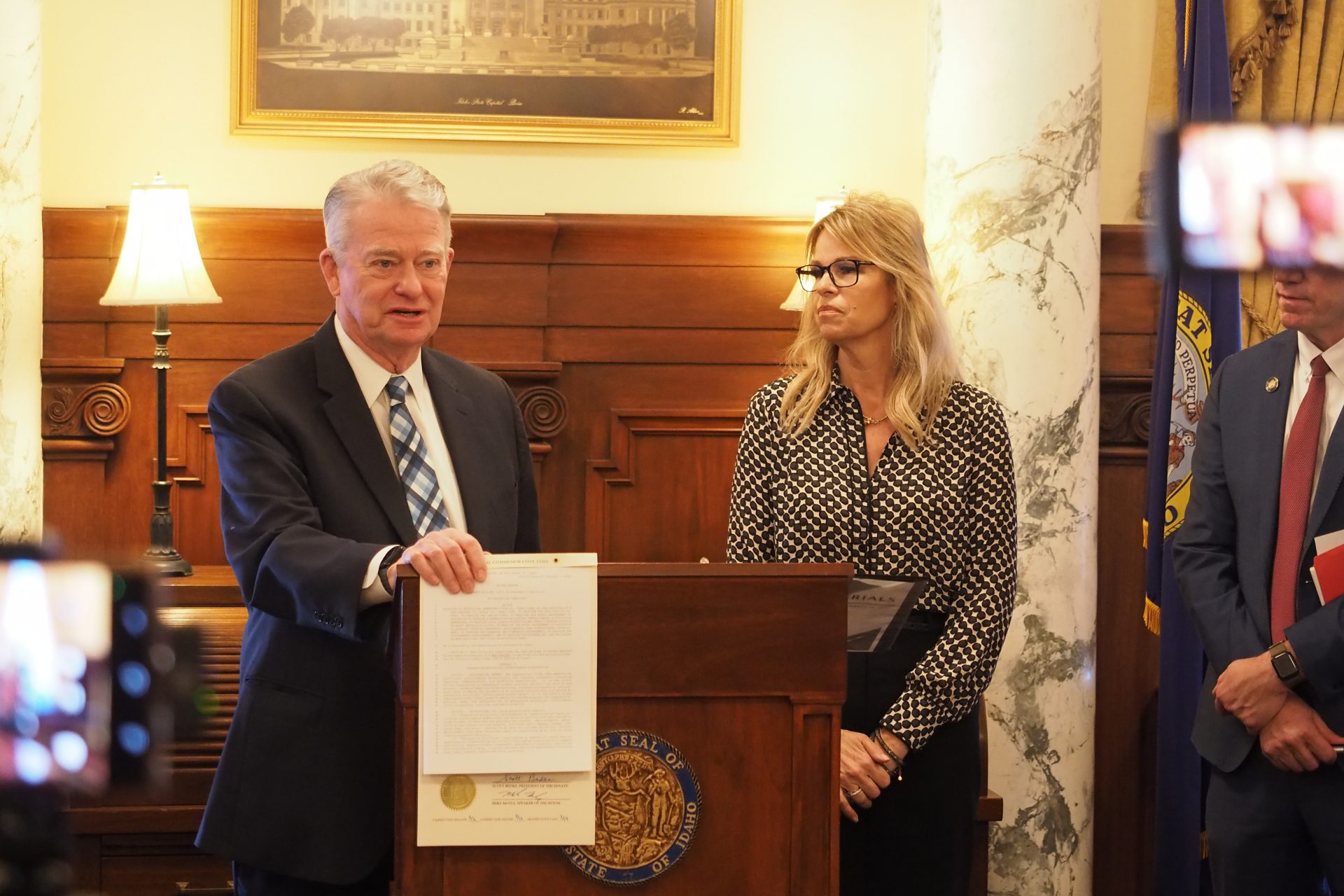 Idaho Governor Brad Little after signing an AI education bill on March 26, 2026 at the Idaho Capitol. (Kaeden Lincoln/IdahoEdNews)