Deschutes County’s population has grown the most in Oregon this decade; Crook County’s growth rate tops state

Barney Lerten
BEND, Ore. (KTVZ) — Halfway through the 2020s – a decade in which Americans’ lives were greatly impacted by the COVID pandemic – Deschutes County has added more residents than any other Oregon county, while Crook County’s growth rate tops the state.
Those are two Central Oregon highlights from the U.S. Census Bureau’s county population estimates for July 1, 2025, released Thursday, which shows a definite slowing growth trend – or even declines – around the country.
The new figures show Deschutes County had a July 2025 estimated population of 213,072 people. That’s an increase of 1,870 residents from 2024, up nearly a full percent in a year. The county also has added 14,811 more people since July 2020 – a 7.5% increase, which is No. 1 in the state.
City of Bend Senior Planner Damian Syrnyk tells KTVZ News the breakdown of those numbers is even more telling – as the growth is based far more on newcomers than on growing families.
“Deschutes County has seen, over the last five years, our population growth from natural increase – births exceeding deaths – is becoming a much smaller component” of the total, Syrnyk told us. “Most of it has been from net migration – more people moving in than moving out.”
In fact, he said, a whopping 97% of Deschutes County’s growth this decade is attributed to more newcomers’ arrivals than those who have left.
Crook County’s population estimate for last July 1 was 27,564, an increase of 244 people in a year, almost a percent. But the county has grown by 2,825 people over the past five years – a growth rate of 11.4% that is the fastest in the state, according to the new estimates.
Jefferson County, meanwhile, added 55 people in the year ended last July, or .2%. It’s grown by 1,225 people, or 5% since 2020.
While .2% sounds small, that’s twice the growth rate seen in Oregon’s most populous county, Multnomah, which added just over 900 residents last year, a .1% increase. The latest population for that county is down 2.6% this decade.
Smaller counties can lead the way, when you look at county rankings. Sherman County, for example, added 36 residents last year, for a total population of 2,051 – but that 1.8% annual growth rate is No. 1 in the state.
KTVZ News reported last fall on a different set of Oregon population estimates, compiled from similar but different data by Portland State University’s Population Research Center.
It showed, for example, Deschutes County adding 2,764 residents in the year ended last July – nearly 1,000 more than the Census Bureau – but a lower total population of 213,886 people.
The Census Bureau is expected to release its city population estimates for July 1, 2025 in May.
Here’s the national picture, as the Census Bureau reported on Thursday:
Slow Growth Impacts Nation’s Largest Counties HardestDiminishing Population Gains in Metro Areas Highlight Nationwide Trend
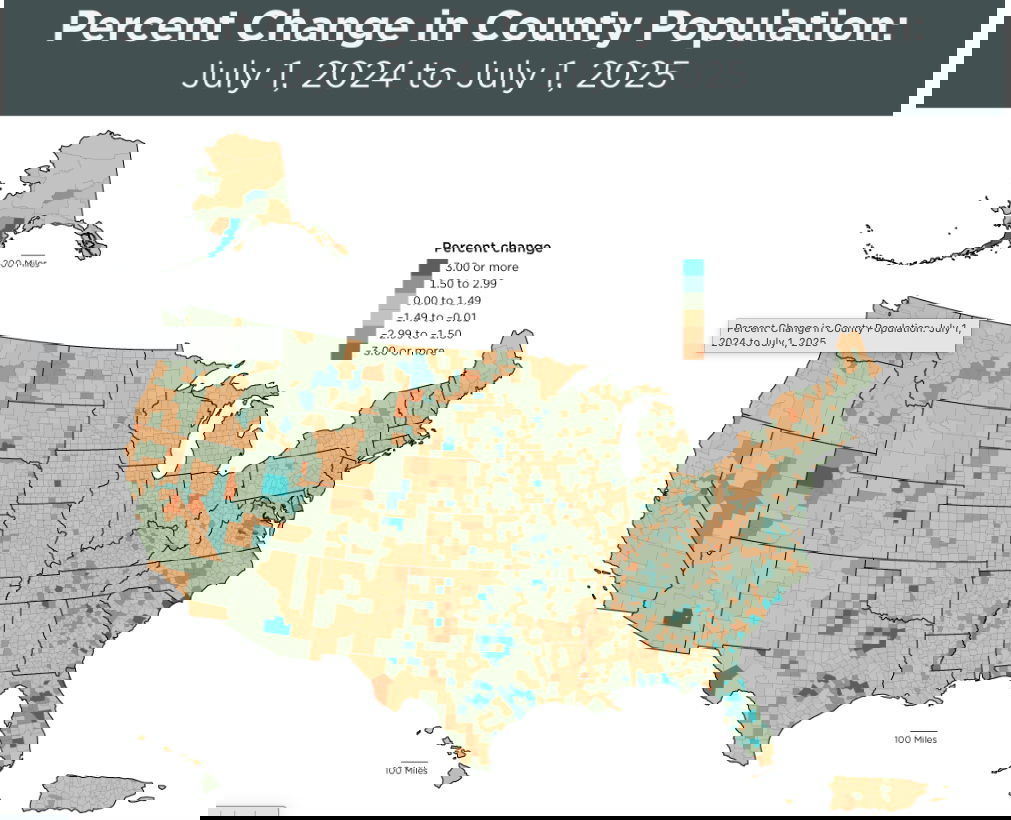
MARCH 26, 2026 – Population growth slowed in a majority of the nation’s 3,143 counties and the District of Columbia between July 1, 2024, and July 1, 2025, according to the Vintage 2025 population estimates released today by the U.S. Census Bureau.
Among the 2,066 counties that grew between 2023 and 2024, nearly 8 in 10 saw their growth slow or reverse direction in 2025. In many cases, counties already in decline saw losses accelerate.
Meanwhile, 310 of the 387 U.S. metropolitan statistical areas (metro areas) had slower growth between 2024 and 2025 than during the prior year. The three metro areas with the steepest percentage point declines in population growth rates were along the U.S.-Mexico border: Laredo, TX (from 3.2% in 2023-2024 to 0.2% from 2024 to 2025); Yuma, AZ (3.3% to 1.4%); and El Centro, CA (1.2% to -0.7%).
These shifts were largely due to lower levels of net international migration (NIM), which declined nationwide. Nine out of 10 U.S. counties experienced lower NIM levels between July 1, 2024, and June 30, 2025, compared to the year prior. The one in 10 counties that did not see a drop in international migration did not see an increase either.
Some of the country’s most populous counties experienced the greatest impacts from lower NIM. These counties typically had more births than deaths (natural increase) as well as negative net domestic migration — more people moving out than moving in from other areas of the country. Coupled with reduced NIM, the result was slower growth or, in some cases, population decline.
“The nation’s largest counties like those in the New York metro area are often international migration hubs, gaining large numbers of international migrants and losing people that move to other parts of the country via domestic migration,” explained George M. Hayward, a Census Bureau demographer. “With fewer gains from international migration, these types of counties saw their population growth diminish or even turn into loss.”
The Population Estimates Program uses current data on births, deaths and migration to calculate population change since the most recent decennial census (2020 Census) and produce an annual time series of population estimates. Today’s release includes population totals and components of change for U.S. counties and metro areas and micropolitan statistical areas (micro areas), and total population for Puerto Rico municipios and metro/micro areas. Tables are available on census.gov/popest.
Key Takeaways
Geographically, many of the fastest-growing counties were in states along the southeast coast of the United States in Florida, Georgia, South Carolina, North Carolina and Virginia.
Among some of the largest metro areas, the fastest-growing counties tended to be on the outer edges, a pattern especially pronounced in Texas.
Among counties with populations of 20,000 or more, nine of the top 10 fastest-growing counties were in the South, as were 45 out of the top 50.
Growth declined dramatically in metro areas — on average from 1.1% between 2023 and 2024 to 0.6% between 2024 and 2025.
This shift was largely due to NIM reductions, especially since net domestic migration losses waned and natural increase had no noticeable change.
County Highlights
The number of counties in 2025 with natural decrease (more deaths than births) was 2,055 or 65% — roughly the same level as the prior two years, but still lower than between 2021 and 2022 when around 75% of counties had natural decrease.
Domestic migration patterns continue to redistribute the population from the largest counties to less populous ones. Collectively, the 50 counties with 1 million or more people in 2025 had a net domestic migration loss of 637,634. In contrast, large counties (50,000-999,999 in population) had a combined net domestic migration gain of 533,766, and medium-sized counties (15,000-49,999) had a net domestic migration gain of 95,095. Even small counties (less than 15,000) had a slight net domestic migration gain of 8,773.
NIM dropped by 20,000 or more in 10 counties. These counties (0.3% of all counties) made up 25.5% of the nation’s total NIM reduction between 2024 and 2025.
Refer to the bottom of the release for tables on Population Change by County Size, Components of Population Change by County Size, Top 10 Most Populous Counties, Top 10 Counties by Numeric Growth: 2024 to 2025, Top 10 Counties by Percent Growth: 2024 to 2025, Top 10 Counties by Numeric Decline: 2024 to 2025, and Top 10 Counties by Percent Decline: 2024 to 2025.
Metro and Micro Areas
Between 2024 and 2025, metro areas grew faster (0.6%) than micro areas (0.2%) or the territory outside of metro/micro areas (0.1%). However, all three saw their growth reduced to about half of what it had been between 2023 and 2024 (1.1%, 0.5%, and 0.2%, respectively).
In their entirety, metro areas lost population between 2024 and 2025 through net domestic migration (-119,205). But those losses were offset by gains in both NIM (1,209,432) and natural increase (613,743), resulting in overall population increase (1,704,826; 0.6%).
Between 2024 and 2025, micro areas and the territory outside of metro/micro areas both lost population from natural decrease (-39,119 and -55,766, respectively) — losses that were balanced by gains from domestic migration (67,419 and 51,786) and NIM (36,655 and 16,155). As a result, micro areas grew by 64,867 (0.2%), and the territory outside of metro/micro areas grew by 11,367 (0.1%).
Refer to the bottom of the release for tables on Population Change by Metro/Micro Area Status, Components of Population Change by Metro/Micro Area Status, Top 10 U.S. Metro Areas by Numeric Growth: 2024 to 2025, Top 10 U.S. Metro Areas by Percent Growth: 2024 to 2025, Top 10 U.S. Micro Areas by Numeric Growth: 2024 to 2025, and Top 10 U.S. Micro Areas by Percent Growth: 2024 to 2025.
Technical Notes
The most recent net international migration estimates reflect methodological improvements, including the incorporation of additional administrative data at the subnational level. Details are available in the Random Samplings blog, “New Population Estimates Show Historic Decline in Net International Migration.”
The Census Bureau in June is scheduled to release July 1, 2025, population estimates by age, sex, race and Hispanic origin for the nation, states metro and micro areas and counties, and population by age and sex for the Commonwealth of Puerto Rico and its municipios. Vintage 2025 incorporates the 2020 Census by full demographic detail (age, sex, race and Hispanic origin) into the April 1, 2020, estimates base for the first time. These data will be embargoed.
With each new release of annual estimates, the entire time series of estimates is revised for all years back to the date of the last census. All previously published estimates (i.e., old vintages) are superseded and archived on the FTP2 site. Due to periodic methodological updates, year-to-year comparisons in the estimates should only be done within the same vintage.
Tables
Population and Population Change by County Size in 2025: 2023-24 vs. 2024-25
Components of Population Change (Rates per 1,000) by County Size in 2025: 2023-24 vs. 2024-25
Population and Population Change by Metro/Micro Area Status: 2023-24 vs. 2024-25
Components of Population Change (Rates per 1,000) by Metro/Micro Area Status: 2023-24 vs. 2024-25
Top 10 Most Populous Counties: July 1, 2025
Top 10 Counties by Numeric Growth: July 1, 2024, to July 1, 2025
Top 10 Counties by Percent Growth: July 1, 2024, to July 1, 2025
Top 10 Counties by Numeric Decline: July 1, 2024, to July 1, 2025
Top 10 Counties by Percent Decline: July 1, 2024, to July 1, 2025
Top 10 U.S. Metro Areas by Numeric Growth: July 1, 2024, to July 1, 2025
Top 10 U.S. Metro Areas by Percent Growth: July 1, 2024, to July 1, 2025
Top 10 U.S. Micro Areas by Numeric Growth: July 1, 2024, to July 1, 2025
Top 10 U.S. Micro Areas by Percent Growth: July 1, 2024, to July 1, 2025