Missouri referendum on congressional map clears key signature hurdle

Mitchell Kaminski
COLUMBIA, Mo (KMIZ)
Missouri election officials have verified enough signatures for a proposed referendum that would give voters the final say on the state’s newly redrawn congressional map.
The redrawn congressional map, backed by President Donald Trump, is designed to shift political control in Missouri’s 5th Congressional District, currently represented by Democratic U.S. Rep. Emanuel Cleaver, potentially giving Republicans an additional seat in the U.S. House.
In October, a referendum petition seeking to repeal the redistricting legislation was submitted to the office of Secretary of State Denny Hoskins. Hoskins approved the referendum on Oct. 15, allowing the sponsoring group, People Not Politicians, to begin collecting signatures from registered Missouri voters.
According to the Secretary of State’s verification report, People Not Politicians submitted more than 305,000 signatures, nearly three times the roughly 110,000 valid signatures required under Missouri law.
“We sort of knew that this day was going to come when we turned in over 305,000 signatures back in December,” said Richard von Glahn, who is the director of People Not Politicians Missouri. “We know that there’s going to be tens of thousands of more signatures that are still waiting to be validated.”
To qualify for the ballot, supporters also had to meet minimum thresholds in at least six of the state’s eight congressional districts.
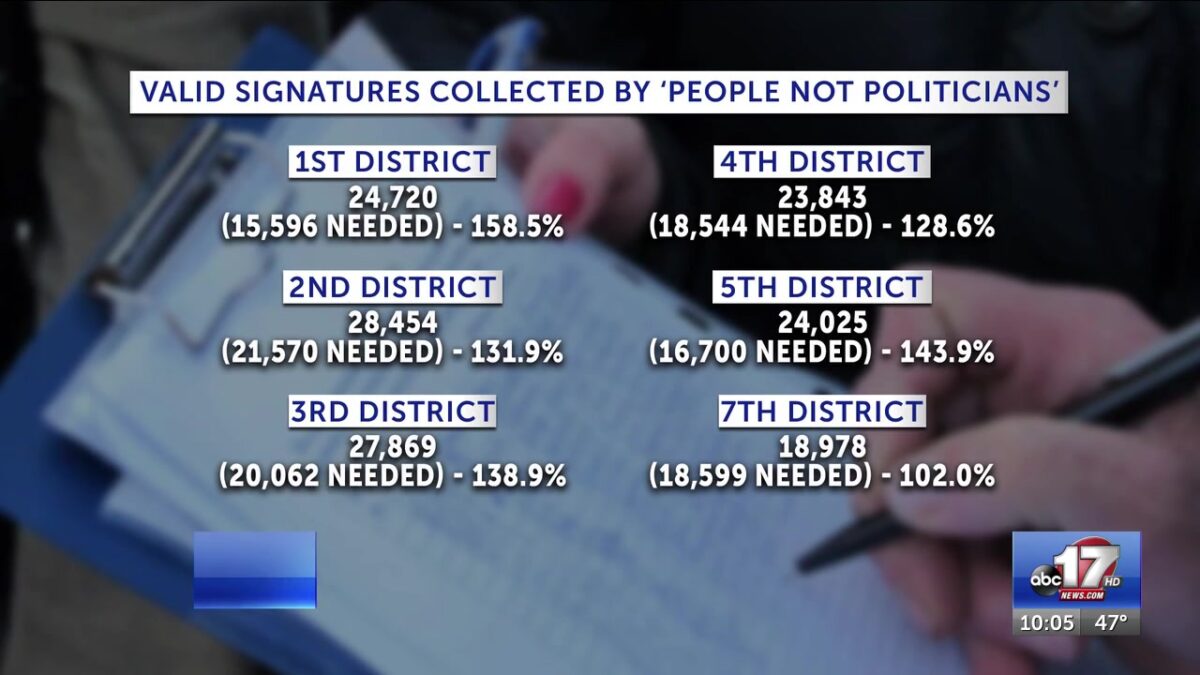
According to the Secretary of State’s verification report, that requirement has been met:
1st District: 24,720 valid signatures (15,596 needed) — 158.5%
2nd District: 28,454 valid signatures (21,570 needed) — 131.9%
3rd District: 27,869 valid signatures (20,062 needed) — 138.9%
4th District: 23,843 valid signatures (18,544 needed) — 128.6%
5th District: 24,025 valid signatures (16,700 needed) — 143.9%
7th District: 18,978 valid signatures (18,599 needed) — 102.0%
If ultimately certified by the secretary of state, the referendum would place the map approved by Republican lawmakers last year on the November ballot. Under Missouri’s Constitution, qualifying a referendum suspends the law until voters decide whether to uphold or repeal it.
“This isn’t a Republican issue or Democratic issue,” von Glahn said. “Voters around this state want a democracy that focuses on them and our needs. And so we want to make sure that politicians are accountable to us. And that means that we get to pick them through elections every two years. This was a process in which politicians were trying to pick voters instead of voters picking politicians and no matter what your politics are, you know that’s wrong.”
Despite the signature milestone, the referendum still faces several hurdles before appearing on the ballot.
The secretary of state must formally certify the results, a process that could continue for months as county clerks review signatures to confirm voter registration and accuracy. The office has until early August to determine whether the petition meets all constitutional requirements.
At the same time, multiple lawsuits could impact whether the measure ultimately goes before voters. One case before the Missouri Supreme Court challenges the legality of the redistricting plan itself, arguing the mid-decade map changes may violate the state Constitution. Another legal dispute has already resulted in a judge ordering changes to the ballot summary language after finding it could unfairly influence voters.
“There’s still some court cases that need to get worked out,” von Glahn said. “We shouldn’t have to be in lawsuits against our officeholders whose job is to simply uphold the Constitution and the process that’s outlined there. Unfortunately, we’ve had to do, and I expect we might continue to do to force them to to do their jobs. But if that’s what’s required, that’s what we’ll do.”
Von Glahn said the effort drew widespread public participation, with thousands of volunteers helping collect signatures across the state.
“We had over 2,000 people sign up to volunteer within the first two weeks after the legislature passed this map. So we ran trainings all across the state multiple times a week,” von Glahn said. “Ultimately, thousands of Missourians went out and did this. Some this was their first time and they might have gathered ten signatures. Others might have been veterans of multiple campaigns and gathered hundreds of signatures.”
Even with the remaining legal and administrative steps, von Glahn beleives the effort reflects strong public interest in the issue and a desire to let voters decide.
“The important thing about a referendum is it’s just about allowing people to decide,” von Glahn said. “I think it’s very telling that politicians are so afraid of people having the final say.”