Missouri schools still seeing no sports betting revenue as March Madness approaches

Mitchell Kaminski
COLUMBIA, Mo. (KMIZ)
Missouri saw a drop in sports betting activity in its second month of legalization, and once again, no tax revenue went toward education.
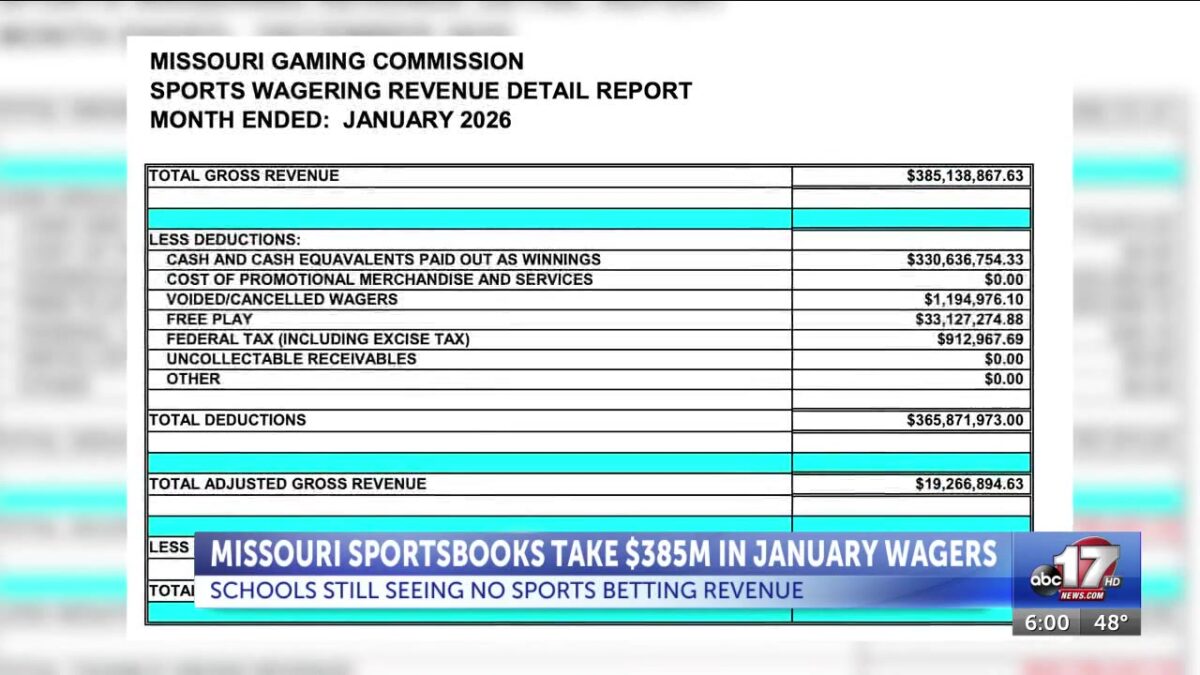
After bringing in more than $543 million in wagers in December, sportsbooks handled just over $385 million in January.
However, after accounting for payouts, voided wagers, and promotional credits, the state once again finished in the red. Missouri books reported a net loss of $6.7 million for the month, an improvement from the $20.8 million loss recorded in December.
And no profit means no tax revenue.
“As for the January numbers, they were not too surprising,” Mike Leara, executive director of the Missouri Gaming Commission, told ABC 17 News in a statement. “We do expect an increase this month from March Madness, and we also look for sports wagering to see a spike for the upcoming World Cup.”
Many of the losses were once again driven by promotional bets, a common strategy sportsbooks use to lure in new customers.
Sam Pack, a sophomore at the University of Missouri, said he has been gambling since he was 18, when it became legal for him in Illinois. Pack said that once sports betting became legal in Missouri, he was quick to take advantage of the promotional offers.
“I like it when you sign up for apps, you get the bonus bets,” Pack said. “Be smart with your picks. If you can do a protected play, do that, and then if you lose that, you can use bonus bets to win more money.”
However, with many Missourians already creating accounts during the first month, those numbers were expected to gradually decline.
“It’s one of the larger concerns where you look at it, where when you have such operator-friendly numbers early on, where they’re allowed to get rid of these free bets so heavily, it does cause a tax thing,” said Ryan Butler, a senior news analyst at Covers.com. “This isn’t terribly uncommon. And in states where they are, if they’re allowed to do this and they’re taking full advantage of it, so still stand by it. Once we get a little further in, this is going to level out.”
GeoComply’s geolocation services recorded more than 18.5 million login attempts from over 520,000 accounts during the first week of legalized sports betting alone.
After writing off $125.1 million in free-play wagers in December, sportsbooks wrote off $33 million in February. FanDuel wrote off $33 million in February, a $20 million drop from the first month, while DraftKings wrote off $9.2 million, down from $39.3 million in December.
According to the Missouri Gaming Commission, sportsbooks were able to apply negative adjusted gross receipts carried forward from promotional costs in the previous month, which also affect those totals.
Impact on local schools
When Amendment 2, which legalized sports betting in Missouri, appeared on the ballot, one of its most vocal supporters was the group Winning for Missouri Education. The group estimated the measure would generate about $100 million in tax revenue over five years.
Under the amendment, a 10% tax is applied to sports betting revenue and directed toward education. However, operators are allowed to deduct certain expenses and must also contribute to the compulsive gambling prevention fund before any tax revenue is calculated. The ballot language also allows for the possibility that no money would go to schools if taxable revenue is too low.
According to Butler, the amount of money sports betting will actually send to schools is often overstated.
“The impact is going to be really unnoticeable to even people in education,” Butler said. “It’s always part of the campaign, and I think sportsbooks overall got a little bit better at it going, ‘Guys, this is just an opportunity. It’s a little bit of money. It’s something, this isn’t going to make or break Missouri schools.’”
Any money from sports betting generated for public schools goes into a general pot and is distributed through the Missouri school funding formula known as the foundation formula. However, Heather McArthur, chief financial officer at Columbia Public Schools, says those funds are not materializing to meet the funding target that was set by the state legislature last spring
“We were conservative in budgeting for the foundation formula funding last spring because the decisions were made very late in the budgeting process, and we had doubts that the funds would actually be distributed as appropriated,” McArthur told ABC 17 News in a statement.
But with Gov. Mike Kehoe recommending the foundation formula remain flat in this year’s fiscal budget and transportation funding expected to decline, CPS says any additional revenue from the state could help offset shortfalls in other funding sources.
“Fortunately, the district is highly locally funded and has built up reserves in recent years, but the outlook does not look great,” McArthur said. “We will have to continue to look for internal efficiencies and additional revenue sources in future years to make up for the deficit spending.”
University of Missouri issues warning as March Madness approaches
While March Madness could boost the state’s tax revenue, the University of Missouri is raising concerns about its potential impact on student-athletes.
On Thursday, UM System President Mun Choi issued a statement reminding students, faculty, and staff about expectations surrounding sports wagering and the protection of student-athletes.
Since sports betting became legal in Missouri on Dec. 1, 2025, NCAA and SEC schools like MU have faced new challenges in ensuring the integrity of competition and the welfare of student-athletes.
In Thursday’s statement, Choi outlined prohibited behavior for students and employees, including attempting to influence or compromise the outcome of athletic events, sharing confidential information about MU athletes and harassing players.
Violations may breach federal or state law as well as university policies.
According to the University of Missouri, students found to harass athletes or engage in betting-related misconduct are subject to discipline under the university’s Standard of Conduct, which can include warnings, probation, suspension or expulsion.
“Maybe people joke about it in comment sections of Instagram posts, but I’ve never seen anyone seriously threaten a player,” Pack said.
Faculty and staff who violate the Standards of Faculty Conduct or MU’s Code of Conduct may face reprimands, suspension or termination. Student-athletes are encouraged to report any harassment so the university can monitor and address potential threats.
According to Butler, March typically ranks as the sixth-most active betting month, with September, October, November and December usually seeing the highest betting activity, due to being in the heart of football season.
Nationally, concerns about harassment and manipulation have grown as betting on individual college athletes, including prop bets, has expanded. Surveys indicate 36% of Division I men’s basketball players reported harassment linked to betting, and NCAA investigations have found cases of athletes wagering on their own performances or sharing insider information.
Butler noted that while sportsbooks are pushing to keep these bets legal, losing player props would not be a major blow.
“These individual college player props are less than 1% of their handle. It’s just not a huge deal for them,” he said. “They’re still fighting to keep them.”
Missouri officials are closely monitoring the issue. MU Athletics Director Laid Veatch warned that when student-athletes are paid, and sports betting is legal, player prop bets make it easier for athletes to become involved. Choi also said in January that the university tracks social media to watch for harassment and continues to evaluate policies in line with other institutions.
While only four states currently ban individual college athlete prop bets, Missouri officials say they may revisit the issue as more data becomes available.