Satellite-driven research helps oyster farmers choose sites with more confidence

By Renata Schmidt
Click here for updates on this story
SOUTH BRISTOL, Maine (WMTW) — University of Maine researchers are using satellite data to help oyster farmers pick their site locations with greater confidence and even predict an oyster’s time to market.
Professor Damian Brady and his post-doctoral student, Tom Kiffney, spend a lot of time out on the Damariscotta River. It’s where they have a research farm, full of oysters, scallops and kelp.
They are working on a variety of research projects with the Darling Marine Center and recently published their proof-of-concept study for a computer model they hope will help farmers choose their sites.
“Site selection is everything,” Brady said. “It takes a long time to get a lease. And then once you have a lease, that’s your lease. You can’t move it elsewhere.”
Choosing the right site is critical.
“Unlike terrestrial agriculture, there are no inputs to shellfish aquaculture. So once you choose a site, you rely on that site to provide both the food and good temperatures to grow your oyster or other shellfish,” Kiffney said.
Water temperature and chlorophyll levels, or oyster food, are key components in oyster farming, so understanding these measurements at potential oyster sites is valuable in understanding if a site would be successful.
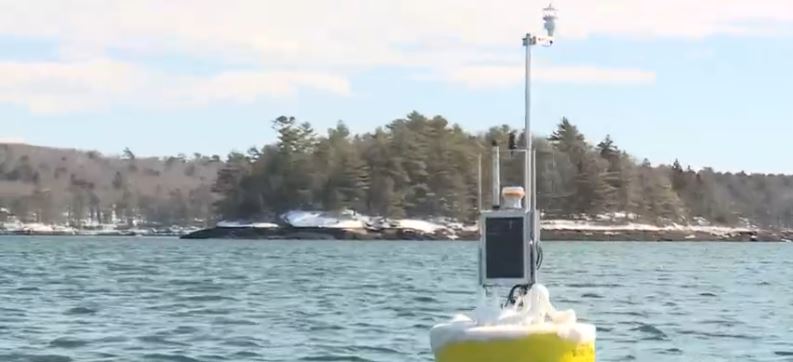
The research team has eight sensors in the Gulf of Maine and more in other waterways along the coast. However, they cannot put a sensor in every corner of the coast, so that is where satellite data comes in.
Satellites are constantly circling over Earth and transmitting images back. Brady and Kiffney can access these images and pool them together to get a strong idea of water temperature and chlorophyll levels of the coast of Maine over time.
However, the satellites are far away and there may be a lot of cloud or pollution between the water and the satellite, so Brady and Kiffney need to “ground truth” the data — verify that the satellite data matches the data from their own sensors.
With that accomplished, they now have a tool that can provide the temperature or chlorophyll levels within a 300-square-foot area of the Maine coast within the past couple of weeks.
But they want to push it further and to do that, Kiffney spends a lot of time measuring oysters.
“Working with Maine farmers is one of the biggest highlights of my job,” he said. “In aquaculture, you don’t want to just know what is happening at one site. You want to look across multiple sites. The Maine farming community is very generous. They often allow us to track animals on their farm.”
Together with the oyster measurements and chlorophyll and temperature measurements, Kiffney and Brady have been building a growth model, something to predict when an oyster will be ready for market.
“This idea of building end-to-end products now can’t be understated,” Brady said. “When I first came here to the University of Maine, and I’ve been here 16 years, these tools were not available.”
Between scouting locations, obtaining leases and then growing oysters, there is a lot of time between starting a farm and making a profit. Knowing what the time horizon looks like before investing in a farm could be instrumental in helping potential farmers be better prepared.
“It’s a pretty risky proposition,” said Luke Saindon, the farm director for The World is Your Oyster. “Anything you can do ahead of time really helps.”
Saindon used an early version of the computer model to choose his farm’s location near Wiscasset.
“The actual interaction was really straightforward. It was just a GIS map that was available online, which made it pretty smooth to use and interact with,” Saindon said.
Now, the work is perfecting the computer model and getting it into the hands of farmers.
“Our biggest challenge now is getting this into the hands of growers,” Brady said. “The actual technology is there.”
Brady also said that the team wants to work closely with growers to understand what data would be helpful or what additional questions they can begin to answer.
There are other resources for shellfish farmers to use while this tool is being rolled out. Kiffney helps teach a course with the Aquaculture and Shared Waters program to help farmers take advantage of tools already available to the public. Brady and Kiffney also encouraged growers to reach out to them via email if they are considering a site for a farm and need some help sorting through the data.
Please note: This story was provided to CNN Wire by an affiliate and does not contain original CNN reporting. This content carries a strict local market embargo. If you share the same market as the contributor of this article, you may not use it on any platform.