Missouri advocates weigh in as Supreme Court reviews gun law tied to marijuana

Mitchell Kaminski
COLUMBIA, Mo. (KMIZ)
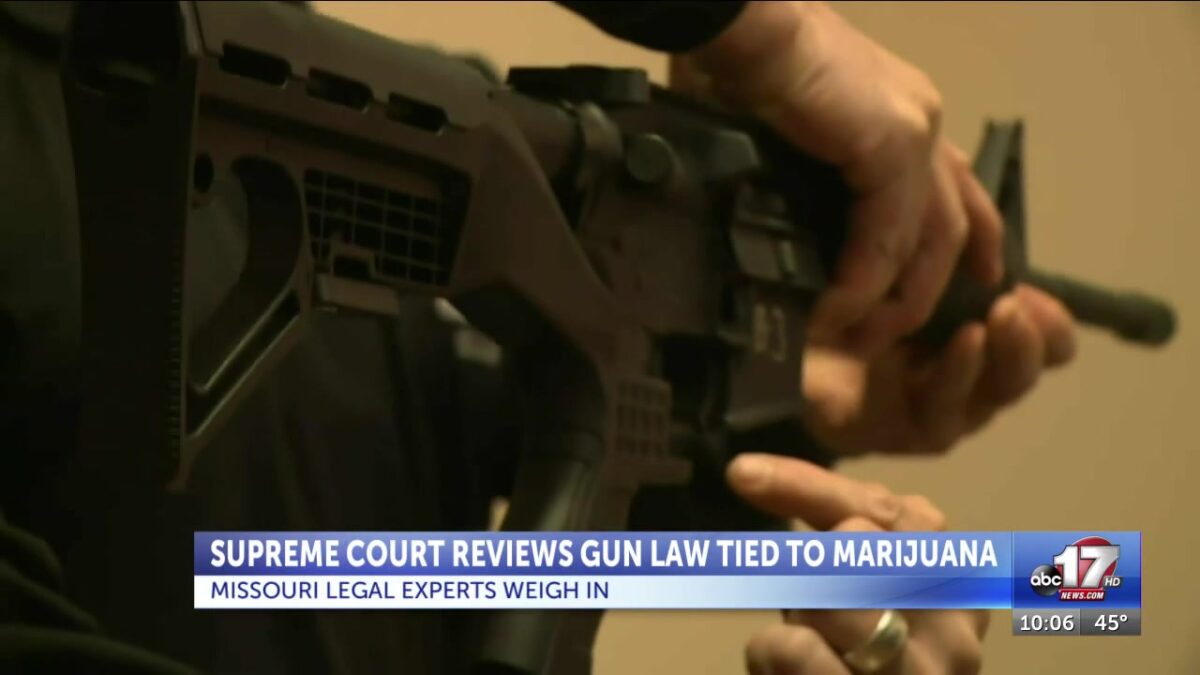
A pending U.S. Supreme Court case could determine whether millions of Americans who use marijuana can legally own firearms.
The high court is reviewing the 1968 federal Gun Control Act, which makes it a crime for anyone considered an “unlawful user” of a controlled substance to possess a gun. While marijuana has been legalized in many states, including Missouri, it remains illegal under federal law.
Dan Viets, an attorney for Missouri NORML who wrote a brief in the case, said the central legal question revolves around history, specifically whether there is a longstanding tradition of restricting gun rights for cannabis users.
“Historically, there was no restriction. There was no regulation related to being a cannabis consumer and restricting Second Amendment rights,” Viets told ABC 17 News. “So our argument to the court is that there should not be any right now.”
Viets said the distinction between active impairment and habitual use is critical. He noted laws already prohibit possessing or using guns while impaired by alcohol and argued a similar standard for marijuana would make sense.
“We have laws which say that it’s illegal to possess or use firearms while you’re impaired by alcohol,” Viets said. “And a law that says the same thing about marijuana would make perfect sense, but not a blanket prohibition that says if you ever use marijuana, you can never possess a firearm.”
Dave Roland, senior legal adviser with the Freedom Center of Missouri, said the case carries sweeping implications because of the widening gap between state legalization and federal prohibition.
“This is a big issue because one of the most commonly used drugs in the country right now is marijuana,” Roland said. “The implications are pretty massive and could affect tens of millions of Americans.”
In states like Missouri, where marijuana is legal under state law, Roland said users “are running the risk of being dispossessed of their Second Amendment rights.”
The case has also created unlikely political alliances.
“Groups like the NRA and the ACLU were working together on this case because they all recognized that the civil liberties implications really are pretty gigantic,” Roland said.
Kevin Jamison, president of the Missouri Sport Shooting Association, a state affiliate of the NRA, said he personally opposed marijuana legalization. While his organization has not taken an official position on the case, Jamison said he also believes a blanket federal ban may go too far.
“I had a client who acted in self-defense while under the influence of marijuana — this was when it was illegal. I believe that some of our members indulge. I do not ask. It seems excessive to make these people felons,” Jamison told ABC 17 News in an email.
Supporters of the challenge have also pointed to the long history of hemp cultivation in the United States, including in Missouri, where hemp was once a major crop. Viets argued that history undercuts the idea that cannabis use has traditionally been tied to firearm disqualification.
Viets emphasized the case is not about promoting gun ownership, but about equal treatment under the law.
“We’re not promoting gun use. We’re not promoting gun ownership, but we are promoting fairness and equal treatment for cannabis consumers along with everyone else,” he said.
Roland said the historical debate also touches on how early American laws treated intoxication.
“The men who wrote the Second Amendment drank alcohol all the time and in large quantities. And so it is very interesting to contemplate what did they mean by a habitual drunkard,” Roland said. “These are people who I guarantee you would not have looked kindly on it if you told them ‘Oh, hey, you’re on your fourth cocktail of the day, maybe you shouldn’t be allowed to have firearms anymore.’ I think they would have taken great offense at that. And so, it’s it’s really interesting to contemplate whether there is any real parallel at all between this historical analog of habitual drunkenness being a disqualifying factor for the possession or use of firearms and the current statute that is at issue in this case.”
If the Supreme Court upholds the federal ban, both Viets and Roland said the real-world impact may be uneven.
“I don’t think it would have much impact on the hemp industry. I think people will go on buying and consuming cannabis as they have for decades, whether it’s legal or not,” Viets said. “It will have some impact on the firearms industry because there’s a big chunk of the population who are cannabis consumers.”
Roland said a ruling in favor of the federal government could instead push certain conduct further out of view.
“What it might do is push the possession of weapons or the use of drugs even more underground,” Roland said, adding that it “probably wouldn’t make it go away entirely.”
Roland also pointed to past Missouri efforts such as the Second Amendment Preservation Act, which sought to limit state and local cooperation with federal gun enforcement. Even if revived, he said, such a measure would not prevent federal authorities from enforcing the law.
While President Donald Trump has supported the federal government’s position in the case, Roland said he does not expect dramatic state-level shifts regardless of the outcome.
“President Trump has not been a full-throated supporter of the Second Amendment. He has, in fact, introduced regulations on guns that have really rubbed many within the right to keep and bear arms community the wrong way over the years,” Roland said. “It is an interesting and tenuous dance between the gun enthusiast community and the Trump administration. But I do also want to emphasize that even if the president supports the position that’s been taken by the federal government here and he does, that doesn’t necessarily mean he’s going to make it a priority.”
The court is expected to issue its decision by the end of June.