Gene editing and new tree varieties offer hope for Florida’s citrus industry

By Alex Howard
Click here for updates on this story
LABELLE, Florida (WBBH) — It’s the fruit synonymous with the Sunshine State, stamped onto license plates and woven into Florida’s identity. But the citrus industry has endured decades of hardship, with production falling by roughly 73 percent due to hurricanes, freezes, invasive pests, and disease.
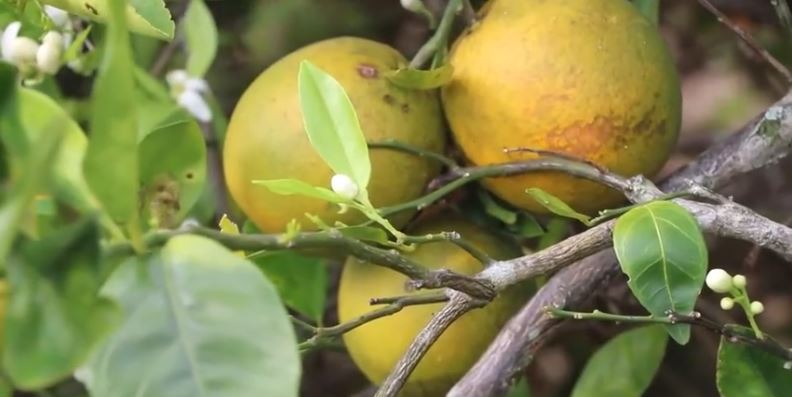
Among the most devastating threats is citrus greening, a bacterial disease that has crippled groves across the state. Now, growers and researchers say emerging technologies — including gene editing — could help bring Florida oranges back from the brink.
From his groves outside LaBelle, Wayne Simmons, owner of LaBelle Fruit Company, has witnessed the industry’s struggles firsthand.
“My goal in life and my lot in life is growing oranges, and I want to continue to do that,” Simmons said.
A fifth-generation Floridian, Simmons says citrus is more than a livelihood — it’s a legacy.
“I am committed. I want to be a steward of the land and carry on the tradition,” he said.
For decades, growers have battled storms, cold snaps, invasive pests, and blight. But citrus greening remains the most destructive.
“There is no known cure for greening, so we are certainly at a disadvantage,” Simmons said.
Over the years, growers have tried protective coverings, antibiotic treatments, and other mitigation strategies. One method, however, has remained essential: selective breeding.
“You know, we have always felt like, as a grower community, the silver bullet to greening is going to be a resistant tree,” said Matt Joyner of Florida Citrus Mutual. “We are seeing some go into the ground that are showing tolerance, if not total resistance.”
Many groves are already planting conventionally bred trees designed to withstand the disease.
“All of these trees here have just been conventionally bred to resist greening,” Joyner said.
Meanwhile, researchers from the University of Florida, along with federal agencies including the USDA and FDA, are testing a more advanced solution: CRISPR gene editing.
“CRISPR allows the breeder to locate those genes in the tree that are less desirable … and eliminate them instantly,” Joyner explained.
The technology functions like accelerated selective breeding, allowing scientists to target traits linked to disease susceptibility.
While CRISPR-developed trees remain in field trials, industry leaders say greening-resistant oranges produced using the technology could reach grocery stores as soon as next year.
“I think the important thing is how we are harnessing current technologies used in medical science and agriculture around the world,” Joyner said. “We are finally able to harness some of these technologies here in Florida in an expedited manner that is going to move this industry forward.”
For growers like Simmons, that progress represents more than innovation — it offers a path to preserving a way of life rooted deep in Florida soil.
Please note: This story was provided to CNN Wire by an affiliate and does not contain original CNN reporting. This content carries a strict local market embargo. If you share the same market as the contributor of this article, you may not use it on any platform.